Direct Method For Teaching
English
Sukhbir Kaur Brar
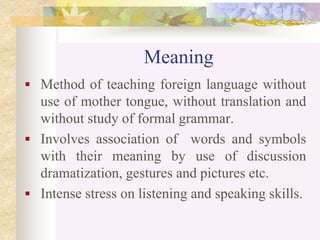
Meaning
 Method of teaching foreign language without
use of mother tongue, without translation and
without study of formal grammar.
 Involves association of words and symbols
with their meaning by use of discussion
dramatization, gestures and pictures etc.
 Intense stress on listening and speaking skills.
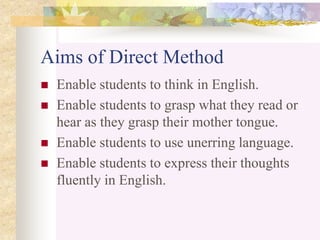
Aims of Direct Method
 Enable students to think in English.
 Enable students to grasp what they read or
hear as they grasp their mother tongue.
 Enable students to use unerring language.
 Enable students to express their thoughts
fluently in English.
Principles of Direct Method
 Use of one language i.e. English.
 Use of limited vocabulary.
 Teaching grammar inductively.
 Stress on oral work.
 Emphasis on correct pronunciation.
 Sentence as unit of speech.
 Direct association of word and thought.
Techniques
 Learners are motivated to think in English.
 Learners are encouraged to ask questions
and give answers n English.
 Proper exercise for listening and speaking.
 Use of various teaching aids i.e. charts,
pictures and audio –video devices.
Advantages
 Direct method helps learners to acquire
correct pronunciation .
 It provides better understanding.
 Time Saving.
 Helpful in teaching idioms.
 It provides better fluency of language.
 Based on psychological principles.
 No gap between active and passive
vocabularies.
Disadvantages
 Direct method is difficult as there is no use of
mother tongue.
 It is not economical as it requires various
teaching aids.
 May not be suitable for average and weaker
students.
 It needs competent teachers.
 It gives overemphasis on listening and speaking
skills.
 It is not effective in early stages of learning.

Direct method for teaching english

  • 1.
    Direct Method ForTeaching English Sukhbir Kaur Brar
  • 2.
    Meaning  Method ofteaching foreign language without use of mother tongue, without translation and without study of formal grammar.  Involves association of words and symbols with their meaning by use of discussion dramatization, gestures and pictures etc.  Intense stress on listening and speaking skills.
  • 3.
    Aims of DirectMethod  Enable students to think in English.  Enable students to grasp what they read or hear as they grasp their mother tongue.  Enable students to use unerring language.  Enable students to express their thoughts fluently in English.
  • 4.
    Principles of DirectMethod  Use of one language i.e. English.  Use of limited vocabulary.  Teaching grammar inductively.  Stress on oral work.  Emphasis on correct pronunciation.  Sentence as unit of speech.  Direct association of word and thought.
  • 5.
    Techniques  Learners aremotivated to think in English.  Learners are encouraged to ask questions and give answers n English.  Proper exercise for listening and speaking.  Use of various teaching aids i.e. charts, pictures and audio –video devices.
  • 6.
    Advantages  Direct methodhelps learners to acquire correct pronunciation .  It provides better understanding.  Time Saving.  Helpful in teaching idioms.  It provides better fluency of language.  Based on psychological principles.  No gap between active and passive vocabularies.
  • 7.
    Disadvantages  Direct methodis difficult as there is no use of mother tongue.  It is not economical as it requires various teaching aids.  May not be suitable for average and weaker students.  It needs competent teachers.  It gives overemphasis on listening and speaking skills.  It is not effective in early stages of learning.