GRAMMAR
TRANSLATI
ON
METHOD
• GTM was first introduced in Germany
especially in Prussia. Hence, it was
also called Prussian Method. This
method is the oldest method of
teaching foreign language teaching,
having existed for more than 2000
years which dominated European
and foreign language teaching from
the 1840s to the 1940s and is being
modifies and used in different
countries of the world today.
GRAMMAR
TRANSLATION
METHOD
a language teaching method and method
of learning any foreign language by the
practice of translating or converting the
sentences of the native language into the
target language of vise versa.
• The principle aim of the GTM
was to make language
learning easier and the central
feature was the replacement
of traditional texts by
exemplary sentences. (Kumar
Mondal, Nitish)
GRAMMAR
TRANSLATION
METHOD
In GTM classes; students learn grammar
rules of the foreign language and try to
apply those rules to the native language to
convert it into the foreign one.
Example:
• Sentence in English: The
children are playing in the
park.
• Translation to Filipino: Ang
mga bata ay naglalaro sa
parke.
English and Cebuano
Example:
• Sentence in English: The
children are playing in the
park.
• Translation to Cebuano:
Ang mga bata nagdula sa
parke.
• Advanced classes of GTM enable students to
convert the whole paragraph even word to word,
and to advance their intellectual development.
Example :
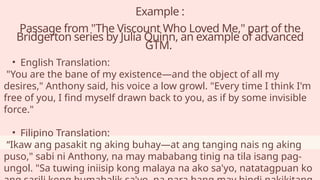
Passage from "The Viscount Who Loved Me," part of the
Bridgerton series by Julia Quinn, an example of advanced
GTM.
• English Translation:
"You are the bane of my existence—and the object of all my
desires," Anthony said, his voice a low growl. "Every time I think I'm
free of you, I find myself drawn back to you, as if by some invisible
force."
• Filipino Translation:
“Ikaw ang pasakit ng aking buhay—at ang tanging nais ng aking
puso," sabi ni Anthony, na may mababang tinig na tila isang pag-
ungol. "Sa tuwing iniisip kong malaya na ako sa'yo, natatagpuan ko
TECHNIQU
ES OF
GRAMMAR
TRANSLATI
ON
1. TRANSLATION OF A LITERACY
PASSAGE
- Translating target language to native
language.
Example:
English: The book is on the table.
Tagalog: Ang libro ay nasa lamesa.
Bisaya: Ang libro kay naa salamesa
2. READING COMPREHENSION
QUESTIONS
- Finding information in a passage, making
inferences and relating to personal
experience.
Example: The curious cat silently crept
through the garden, chasing a butterfly
fluttering above the vibrant flowers.
ANTONYMS/SYNONYMS
- Finding antonyms and synonyms for
words or sets of words.
Examples:
Antonyms: big - small
White- black
Synonyms: begin - start
fast - quick
4. COGNATES
- Learning spelling or sound pattern that
corresponds between
L1 and the target language.
Examples:
English: Computer English: Radio
Tagalog: Kompyuter Tagalog: Radyo
Bisaya: Kompyuter Bisaya: Radyo
5. DEDUCTIVE APPLICATION OF
RULE
- Understanding grammar rules and their
exception, then applying them to new examples.
Example:
Rule: To form the past tense of the regular
verb, add
-ed to the base form of the verb.
Jump- jumped
Clean- cleaned
Dance- danced
6. FILL-IN-THE-
BLANKS
-Filling in gaps in sentences with new words
or items of a particular grammar type.
Examples:
The soup is to ______ to eat.
She wore a _____ dress to the party.
7. MEMORIZATION
–Memorizing vocabulary lists, grammatical
rules and grammatical paradigms.
8. USE WORDS IN
SENTENCES
- Students creates sentences to illustrate
they know the meaning and use of new
vocabulary words.
9. COMPOSITION
- Students write about a topic using the
target languages.
Examples using the GTM would typically involve
translating a passage from the target language to the
native language or vice versa focusing on grammar
rules and vocabulary.
Example 1.
Dhinel is a very diligent and dedicated student
who always strives to do his best.Everyday, he wakes
up early to study. He has a deep love for reading a
wide variety of books and takes great pleasure in
solving math problems. His teacher often praises him
for his consistent hard work and determination to
succeed.
CHARACTERISTIC
S OF GRAMMAR
TRANSLATION
METHOD
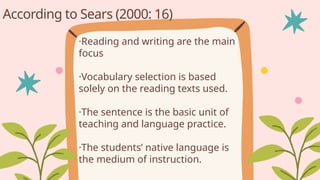
·Reading and writing are the main
focus
·Vocabulary selection is based
solely on the reading texts used.
·The sentence is the basic unit of
teaching and language practice.
·The students’ native language is
the medium of instruction.
According to Sears (2000: 16)
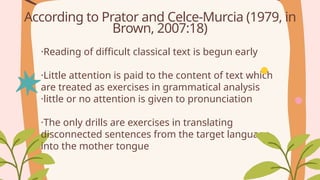
·Reading of difficult classical text is begun early
·Little attention is paid to the content of text which
are treated as exercises in grammatical analysis
·little or no attention is given to pronunciation
·The only drills are exercises in translating
disconnected sentences from the target language
into the mother tongue
According to Prator and Celce-Murcia (1979, in
Brown, 2007:18)
According to Gorski
(2019),
The Advantages and
Disadvantages of the
GTM are:
ADVANTAGES
1.It reduces the teacher’s stress, so the teacher
involvement is rarely necessary, and teacher who is not
fluent in target language.
2.It focuses on grammar, sentence structure and word
meaning, it can help students to learn how to read and
write in the target language.
DISADVANTAGES
1.Less learner or students’ motivation and participation,
because GTM is not an interactive method, the students will
not be motivated, and there is less learners’ participation
and teacher- learner relationship because they just learn
from a textbook.
2. Unnatural and inaccurate pronunciation, the students
only learn about the grammar and word meaning from a
textbook, it makes them do not know how to pronounce
the words naturally and accurately.
CRITICI
SM
Richards and Rodgers (2001, p. 4) describe the
grammar-translation method as
• “a tedious experience of memorizing endless lists of
unusable grammar rules and vocabulary and
attempting to produce perfect translations of stilted
or literary prose,”
• “it is a method for which there is no theory. There
is no literature that offers a rationale or
justification for it or that attempts to relate it to
issues in linguistics, psychology, or educational
theory.”
According to Dr. Roma (2021) that many authors and literary
heads have condemned this approach as they believed that, this
method just facilitates reading and writing skills but does not
focus on conversational skills.
It also makes the students dull and boring as they get habitual of
translating each line word by word and do not get quick in
translation. This method also takes much time to translate.
Moreover, despite learning the vocabulary of a new language, they
will not be much able to communicate with others as they only
know how to write and take time for it. That’s why, I hear many of
the students saying, “mam, can we write instead of speaking?”
Thank You!

Grammar Translation Method ( Language Arts).pptx

  • 1.
  • 2.
    • GTM wasfirst introduced in Germany especially in Prussia. Hence, it was also called Prussian Method. This method is the oldest method of teaching foreign language teaching, having existed for more than 2000 years which dominated European and foreign language teaching from the 1840s to the 1940s and is being modifies and used in different countries of the world today.
  • 3.
    GRAMMAR TRANSLATION METHOD a language teachingmethod and method of learning any foreign language by the practice of translating or converting the sentences of the native language into the target language of vise versa.
  • 4.
    • The principleaim of the GTM was to make language learning easier and the central feature was the replacement of traditional texts by exemplary sentences. (Kumar Mondal, Nitish)
  • 5.
    GRAMMAR TRANSLATION METHOD In GTM classes;students learn grammar rules of the foreign language and try to apply those rules to the native language to convert it into the foreign one.
  • 6.
    Example: • Sentence inEnglish: The children are playing in the park. • Translation to Filipino: Ang mga bata ay naglalaro sa parke.
  • 7.
    English and Cebuano Example: •Sentence in English: The children are playing in the park. • Translation to Cebuano: Ang mga bata nagdula sa parke.
  • 8.
    • Advanced classesof GTM enable students to convert the whole paragraph even word to word, and to advance their intellectual development.
  • 9.
    Example : Passage from"The Viscount Who Loved Me," part of the Bridgerton series by Julia Quinn, an example of advanced GTM. • English Translation: "You are the bane of my existence—and the object of all my desires," Anthony said, his voice a low growl. "Every time I think I'm free of you, I find myself drawn back to you, as if by some invisible force." • Filipino Translation: “Ikaw ang pasakit ng aking buhay—at ang tanging nais ng aking puso," sabi ni Anthony, na may mababang tinig na tila isang pag- ungol. "Sa tuwing iniisip kong malaya na ako sa'yo, natatagpuan ko
  • 10.
  • 11.
    1. TRANSLATION OFA LITERACY PASSAGE - Translating target language to native language. Example: English: The book is on the table. Tagalog: Ang libro ay nasa lamesa. Bisaya: Ang libro kay naa salamesa
  • 12.
    2. READING COMPREHENSION QUESTIONS -Finding information in a passage, making inferences and relating to personal experience. Example: The curious cat silently crept through the garden, chasing a butterfly fluttering above the vibrant flowers.
  • 13.
    ANTONYMS/SYNONYMS - Finding antonymsand synonyms for words or sets of words. Examples: Antonyms: big - small White- black Synonyms: begin - start fast - quick
  • 14.
    4. COGNATES - Learningspelling or sound pattern that corresponds between L1 and the target language. Examples: English: Computer English: Radio Tagalog: Kompyuter Tagalog: Radyo Bisaya: Kompyuter Bisaya: Radyo
  • 15.
    5. DEDUCTIVE APPLICATIONOF RULE - Understanding grammar rules and their exception, then applying them to new examples. Example: Rule: To form the past tense of the regular verb, add -ed to the base form of the verb. Jump- jumped Clean- cleaned Dance- danced
  • 16.
    6. FILL-IN-THE- BLANKS -Filling ingaps in sentences with new words or items of a particular grammar type. Examples: The soup is to ______ to eat. She wore a _____ dress to the party.
  • 17.
    7. MEMORIZATION –Memorizing vocabularylists, grammatical rules and grammatical paradigms.
  • 18.
    8. USE WORDSIN SENTENCES - Students creates sentences to illustrate they know the meaning and use of new vocabulary words.
  • 19.
    9. COMPOSITION - Studentswrite about a topic using the target languages.
  • 20.
    Examples using theGTM would typically involve translating a passage from the target language to the native language or vice versa focusing on grammar rules and vocabulary.
  • 21.
    Example 1. Dhinel isa very diligent and dedicated student who always strives to do his best.Everyday, he wakes up early to study. He has a deep love for reading a wide variety of books and takes great pleasure in solving math problems. His teacher often praises him for his consistent hard work and determination to succeed.
  • 22.
  • 23.
    ·Reading and writingare the main focus ·Vocabulary selection is based solely on the reading texts used. ·The sentence is the basic unit of teaching and language practice. ·The students’ native language is the medium of instruction. According to Sears (2000: 16)
  • 24.
    ·Reading of difficultclassical text is begun early ·Little attention is paid to the content of text which are treated as exercises in grammatical analysis ·little or no attention is given to pronunciation ·The only drills are exercises in translating disconnected sentences from the target language into the mother tongue According to Prator and Celce-Murcia (1979, in Brown, 2007:18)
  • 25.
    According to Gorski (2019), TheAdvantages and Disadvantages of the GTM are:
  • 26.
    ADVANTAGES 1.It reduces theteacher’s stress, so the teacher involvement is rarely necessary, and teacher who is not fluent in target language. 2.It focuses on grammar, sentence structure and word meaning, it can help students to learn how to read and write in the target language.
  • 27.
    DISADVANTAGES 1.Less learner orstudents’ motivation and participation, because GTM is not an interactive method, the students will not be motivated, and there is less learners’ participation and teacher- learner relationship because they just learn from a textbook. 2. Unnatural and inaccurate pronunciation, the students only learn about the grammar and word meaning from a textbook, it makes them do not know how to pronounce the words naturally and accurately.
  • 28.
  • 29.
    Richards and Rodgers(2001, p. 4) describe the grammar-translation method as • “a tedious experience of memorizing endless lists of unusable grammar rules and vocabulary and attempting to produce perfect translations of stilted or literary prose,” • “it is a method for which there is no theory. There is no literature that offers a rationale or justification for it or that attempts to relate it to issues in linguistics, psychology, or educational theory.”
  • 30.
    According to Dr.Roma (2021) that many authors and literary heads have condemned this approach as they believed that, this method just facilitates reading and writing skills but does not focus on conversational skills. It also makes the students dull and boring as they get habitual of translating each line word by word and do not get quick in translation. This method also takes much time to translate. Moreover, despite learning the vocabulary of a new language, they will not be much able to communicate with others as they only know how to write and take time for it. That’s why, I hear many of the students saying, “mam, can we write instead of speaking?”
  • 31.

Editor's Notes

  • #2 Understand and appreciate Latin and Greek or the ancient text Foundation to western culture and tradition. Expand their about origins.
  • #4 Before GTm,complicated. it just translates words. How will the students understand. U only get the word not how you say it in the sentence
  • #5 Prepositional provides additional information about relationships between different elements in a sentence
  • #9 Emotion, frustration,desire, conflict. Metaphors. Strong, unctrollable, pull towards kate. Don’t forget to capture the essence of the original text. Even after translating.
  • #23 The goal is to understand and produce written language correctly. Speaking and listening is not the main focus This means that the selection is highly contextualized within the literature This means that lessons focus on understanding and translating sentencs of which sentences is the basic part of teaching and practicing This means that the explanation and instructions are given in the students first language
  • #24 This means that from the beginning stages of learning students are introduced to complex and often classical literature It servr as a basis for grammar exercises. Fovus on analyzing and underdstanding grammatical rules and structures Pronunciation is not priority Learning exercises in this method mainly involve translating sentences from the target language, often isolated examples and may not form a coherent narrative
  • #28 One common criticism of the Grammar Translation Method (GTM) is that it places too much emphasis on learning about the language rather than actually using it for communication. Critics argue that this method focuses heavily on rote memorization of grammatical rules and vocabulary, often through translation exercises, rather than fostering students' speaking and listening skills, which are crucial for real-life communication.
  • #29 There are no books or studies that explain why it works or connect it to ideas from linguistics, psychology, or education. The Grammar-Translation method lacks a solid foundation. No theory or research is explaining why it's effective or how it connects to language, psychology, or education.