Introduction
Introduction
TheGrammar-Translation Method is not new. It has had different names, but it has
been used by language teachers for many years. At one time it was called the
Classical Method since it was first used in the teaching of the classical
languages,
Latin and Greek. Earlier in the 20th century,this method was used for the purposeof
helpingstudentsto read and appreciate foreign language literature. It was also hoped
that through the study of the grammar of the target language1 studentswould become
more familiar with the grammar of their native language and that this familiarity
would help them speak and write their native language better. Finally, it was thought
that foreign language learningwould help studentsgrow intellectually; it was
recognized that studentswould probably never use the target language, but the mental
exercise of learningit would be beneficial anyway.
3.
PRINCIPLES OF GTM
A fundamental purposeof learninga language is to be able to
read literature written in it. Literary language is superior to spoken
language. Students’ study of the target culture is limited to its literature
and fine arts.
An important goal is for studentsto be able to translate each
language into the other. If studentscan translate from one language
into another, they are considered successful language learners.
The ability to communicate in the target languageis not a goal
of language instruction.
The primary skills to be developed are reading and writing. Little
attention is given to speaking and listening , and almost none to pronunciation.
The teacheris the authority in the classroom. It is very
important that students get the correct answer.
It is possible to find native language equivalents for all target
language words.
4.
PRINCIPLES OF GTM
Learning is facilitated through attention to similarities
between the target language and the native
language.
It is important for studentsto learn about the
grammar or form of the target language.
Deductive application of an explicit grammar rule
is a useful pedagogical technique.
Language learning provides good mental exercise.
Students should be conscious of the grammatical rules
of the target language. Wherever possible, verb
conjugations and other grammatical paradigms should be
committed to memory.
5.
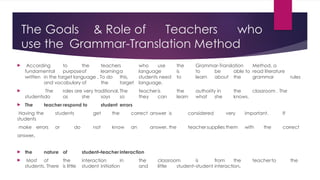
The Goals &Role of Teachers who
use the Grammar-Translation Method
According to the teachers who use the Grammar-Translation Method, a
fundamental purposeof learninga language is to be able to read literature
written in the target language . To do this, students need to learn about the grammar rules
and vocabulary of the target language.
The roles are very traditional. The teacheris the authority in the classroom . The
studentsdo as she says so they can learn what she knows.
The teacher respond to student errors
Having the students get the correct answer is considered very important. If
students
make errors or do not know an answer, the teachersupplies them with the correct
answer.
the nature of student–teacher interaction
Most of the interaction in the classroom is from the teacherto the
students. There is little student initiation and little student–student interaction.
6.
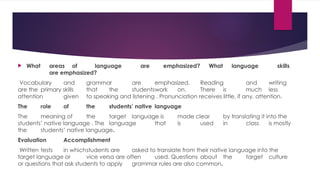
What areasof language are emphasized? What language skills
are emphasized?
Vocabulary and grammar are emphasized. Reading and writing
are the primary skills that the studentswork on. There is much less
attention given to speaking and listening . Pronunciation receives little, if any, attention.
The role of the students’ native language
The meaning of the target language is made clear by translating it into the
students’ native language . The language that is used in class is mostly
the students’ native language.
Evaluation Accomplishment
Written tests in whichstudents are asked to translate from their native language into the
target language or vice versa are often used. Questions about the target culture
or questions that ask students to apply grammar rules are also common.
7.
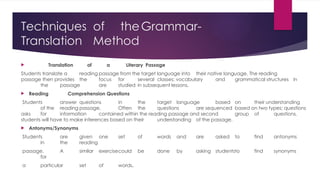
Techniques of theGrammar-
TranslationMethod
Translation of a Literary Passage
Students translate a reading passage from the target language into their native language. The reading
passage then provides the focus for several classes: vocabulary and grammatical structures in
the passage are studied in subsequent lessons.
Reading Comprehension Questions
Students answer questions in the target language based on their understanding
of the reading passage. Often the questions are sequenced based on two types; questions
asks for information contained within the reading passage and second group of questions,
students will have to make inferences based on their understanding of the passage.
Antonyms/Synonyms
Students are given one set of words and are asked to find antonyms
in the reading
passage. A similar exercisecould be done by asking studentsto find synonyms
for
a particular set of words.
8.
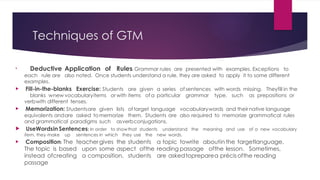
Techniques of GTM
DeductiveApplication of Rules: Grammar rules are presented with examples. Exceptions to
each rule are also noted. Once students understand a rule, they are asked to apply it to some different
examples.
Fill-in-the-blanks Exercise: Students are given a series of sentences with words missing. Theyfill in the
blanks wnew vocabularyitems or with items of a particular grammar type, such as prepositions or
verbwith different tenses.
Memorization: Studentsare given lists of target language vocabularywords and their native language
equivalents andare asked tomemorize them. Students are also required to memorize grammatical rules
and grammatical paradigms such asverbconjugations.
UseWordsin Sentences: In order to showthat students understand the meaning and use of a new vocabulary
item, they make up sentences in which they use the new words.
Composition: The teachergives the students a topic towrite aboutin the targetlanguage.
The topic is based upon some aspect ofthe reading passage ofthe lesson. Sometimes,
instead ofcreating a composition, students are askedtopreparea précisofthe reading
passage
9.
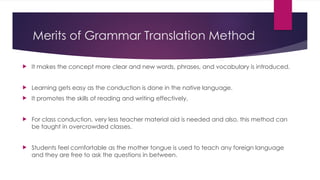
Merits of GrammarTranslation Method
It makes the concept more clear and new words, phrases, and vocabulary is introduced.
Learning gets easy as the conduction is done in the native language.
It promotes the skills of reading and writing effectively.
For class conduction, very less teacher material aid is needed and also, this method can
be taught in overcrowded classes.
Students feel comfortable as the mother tongue is used to teach any foreign language
and they are free to ask the questions in between.
10.
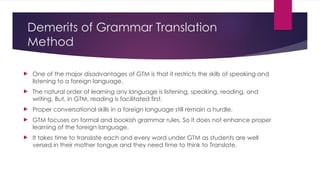
Demerits of GrammarTranslation
Method
One of the major disadvantages of GTM is that it restricts the skills of speaking and
listening to a foreign language.
The natural order of learning any language is listening, speaking, reading, and
writing. But, in GTM, reading is facilitated first.
Proper conversational skills in a foreign language still remain a hurdle.
GTM focuses on formal and bookish grammar rules. So it does not enhance proper
learning of the foreign language.
It takes time to translate each and every word under GTM as students are well
versed in their mother tongue and they need time to think to Translate.