Task-Based
Language
Teaching

Page 1
CONTENT
•
•
•
•
•
•

DEFINITION OF TBLT
DEFINITION OF TASKS
TYPES OF TASKS
CHARACTERISTICS OF TBLT
METHODOLOGY
ADVANTAGES AND
DISADVANTAGES OF TBLT
• DEMONSTRATION
• REFERENCES

Page 2
WHAT DOES TASK-BASED LANGUAGE
TEACHING (TBLT) MEAN?
• Is related to Communicative
Language Teaching (CLT).
• Some researchers (Kumaravadivelu,
2006) argue that TBLT is significantly
different than CLT but some (Ellis,
2003) thinks that TBLT is at the very
core of CLT.
This pedagogy puts the use of TASKS
at the core of language teaching.
Page 3
(Brown, 2007)
WHAT TASKS?
Task is defined by Skehan (1998) as an
activity in which:
• meaning is of the utmost importance;
there is some communicative problem
to solve;
• there is relationship to real-world
activities;
• task completion has some priority;
and
the assessment of task is in terms of
outcome.
Page 4
OR SIMPLY PUT…
“A TASK IS AN ACTIVITY WHICH REQUIRES
LEARNERS TO USE LANGUAGE
(PEDAGOGICAL TASKS), WITH EMPHASIS ON
MEANING, TO ATTAIN AN OBJECTIVE
(TARGET TASKS)”
(BYGATE, SKEHAN, & SWAIN, 2011)

Page 5
TYPES OF TASKS IN TBLT
1. Target tasks
• Which students must achieve
beyond the classroom.
• Much more specific and more
explicitly related to classroom
instruction.
• Specifies a context.
Page 6
TYPES OF TASKS IN TBLT
2. Pedagogical tasks
• Form the nucleus of the classroom
activity
• Include series of techniques to ultimately
teach students to perform the target
task.
• Involve students in some form of
simulation of the target task.
• Distinguished by their specific goals that
point beyond the language classroom to
the target task.
Page 7
CHARACTERISTICS OF TBLT
• Tasks ultimately points learners to the application
of language in real-life situations.
• Tasks are not heavily guided by the need for
correct grammatical and structural aspects of the
language.
• Tasks specifically contribute to communicative
goals.
• Their objectives are well specified so that you can
at some later point accurately determine the
success of a task over another.
• Tasks engage learners, at some level, in genuine
problem-solving activity.
Page 8
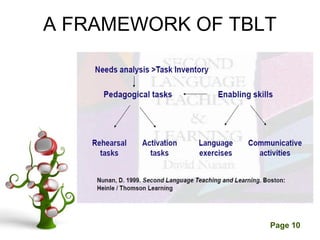
HOW DO WE PERFORM IT?
1. Perform needs analysis.
 “I want to be able to talk to foreign
visitors in English.”
2. Specify learning goals and objectives.
 Goal type: Communicative.
3. Create tasks.
 Simulations in classroom.
4. Develop and enable integrating skills.
 Language exercises, communicative
activities.
Page 9
A FRAMEWORK OF TBLT

Page 10
ADVANTAGES OF TBLT
• useful for moving the focus of the learning
process from the teacher to the student.
• gives the student a different way of
understanding language as a tool instead of as a
specific goal.
• can bring teaching from abstract knowledge to
real world application.
• A Task is helpful in meeting the immediate
needs of the learners and provides a framework
for creating classes, interesting and able to
address to the students needs.
Page 11
DISADVANTAGES OF TBLT
• There is no acquisition of new grammar or
vocabulary features
• Everything is left to the teacher
• Not all students are or will be motivated by TBLT
• Some students need more guidance and will not
or cannot `notice´ language forms (grammar) or
other elements of accuracy
• Students typically translate and use a lot of their
L1 rather than the target language in completing
the tasks.
(Broady, 2006)
Page 12
SIMPLE IN-CLASS
DEMONSTRATION
•
•
•
•

EXAMPLES OF REAL-WORLD TASKS
Visiting the doctor
Making a telephone call
Asking for street directions

Page 13
SIMPLE IN-CLASS
DEMONSTRATION
•
•
•
•
•

Om came at 2.
He wants to break up with you.
No discussion. Made up his mind.
He gave his promise ring.
Don’t contact him ever again.

Page 14
WHAT DO WE THINK ABOUT
THE IMPLEMENTATION OF
TBLT FOR LANGUAGE
LEARNING METHODOLOGY?

Page 15
REFERENCES
• Teaching by Principles, An Interactive
Approach to Language Pedagogy [Book] /
auth. Brown H. Douglas. - New York : Pearson
Education, 2007. - Vol. III.
• Nunan, D. 1999. Second Language Teaching
and Learning. Boston: Heinle / Thomson
Learning

Page 16

Task based language teaching

  • 1.
  • 2.
    CONTENT • • • • • • DEFINITION OF TBLT DEFINITIONOF TASKS TYPES OF TASKS CHARACTERISTICS OF TBLT METHODOLOGY ADVANTAGES AND DISADVANTAGES OF TBLT • DEMONSTRATION • REFERENCES Page 2
  • 3.
    WHAT DOES TASK-BASEDLANGUAGE TEACHING (TBLT) MEAN? • Is related to Communicative Language Teaching (CLT). • Some researchers (Kumaravadivelu, 2006) argue that TBLT is significantly different than CLT but some (Ellis, 2003) thinks that TBLT is at the very core of CLT. This pedagogy puts the use of TASKS at the core of language teaching. Page 3 (Brown, 2007)
  • 4.
    WHAT TASKS? Task isdefined by Skehan (1998) as an activity in which: • meaning is of the utmost importance; there is some communicative problem to solve; • there is relationship to real-world activities; • task completion has some priority; and the assessment of task is in terms of outcome. Page 4
  • 5.
    OR SIMPLY PUT… “ATASK IS AN ACTIVITY WHICH REQUIRES LEARNERS TO USE LANGUAGE (PEDAGOGICAL TASKS), WITH EMPHASIS ON MEANING, TO ATTAIN AN OBJECTIVE (TARGET TASKS)” (BYGATE, SKEHAN, & SWAIN, 2011) Page 5
  • 6.
    TYPES OF TASKSIN TBLT 1. Target tasks • Which students must achieve beyond the classroom. • Much more specific and more explicitly related to classroom instruction. • Specifies a context. Page 6
  • 7.
    TYPES OF TASKSIN TBLT 2. Pedagogical tasks • Form the nucleus of the classroom activity • Include series of techniques to ultimately teach students to perform the target task. • Involve students in some form of simulation of the target task. • Distinguished by their specific goals that point beyond the language classroom to the target task. Page 7
  • 8.
    CHARACTERISTICS OF TBLT •Tasks ultimately points learners to the application of language in real-life situations. • Tasks are not heavily guided by the need for correct grammatical and structural aspects of the language. • Tasks specifically contribute to communicative goals. • Their objectives are well specified so that you can at some later point accurately determine the success of a task over another. • Tasks engage learners, at some level, in genuine problem-solving activity. Page 8
  • 9.
    HOW DO WEPERFORM IT? 1. Perform needs analysis.  “I want to be able to talk to foreign visitors in English.” 2. Specify learning goals and objectives.  Goal type: Communicative. 3. Create tasks.  Simulations in classroom. 4. Develop and enable integrating skills.  Language exercises, communicative activities. Page 9
  • 10.
    A FRAMEWORK OFTBLT Page 10
  • 11.
    ADVANTAGES OF TBLT •useful for moving the focus of the learning process from the teacher to the student. • gives the student a different way of understanding language as a tool instead of as a specific goal. • can bring teaching from abstract knowledge to real world application. • A Task is helpful in meeting the immediate needs of the learners and provides a framework for creating classes, interesting and able to address to the students needs. Page 11
  • 12.
    DISADVANTAGES OF TBLT •There is no acquisition of new grammar or vocabulary features • Everything is left to the teacher • Not all students are or will be motivated by TBLT • Some students need more guidance and will not or cannot `notice´ language forms (grammar) or other elements of accuracy • Students typically translate and use a lot of their L1 rather than the target language in completing the tasks. (Broady, 2006) Page 12
  • 13.
    SIMPLE IN-CLASS DEMONSTRATION • • • • EXAMPLES OFREAL-WORLD TASKS Visiting the doctor Making a telephone call Asking for street directions Page 13
  • 14.
    SIMPLE IN-CLASS DEMONSTRATION • • • • • Om cameat 2. He wants to break up with you. No discussion. Made up his mind. He gave his promise ring. Don’t contact him ever again. Page 14
  • 15.
    WHAT DO WETHINK ABOUT THE IMPLEMENTATION OF TBLT FOR LANGUAGE LEARNING METHODOLOGY? Page 15
  • 16.
    REFERENCES • Teaching byPrinciples, An Interactive Approach to Language Pedagogy [Book] / auth. Brown H. Douglas. - New York : Pearson Education, 2007. - Vol. III. • Nunan, D. 1999. Second Language Teaching and Learning. Boston: Heinle / Thomson Learning Page 16

Editor's Notes

  • #4 As we have become more sensitive to the importance of teaching foreign languages for communicative purposes (not just for the purposes of fulfilling a requirement or of ‘passing a test’).
  • #5 Task-based learning focuses on the use of authentic language through meaningful tasks such as visiting the doctor or a telephone call.  This method encourages meaningful communication and is student-centred.
  • #6 A task is an activity in which a person engages in order to attain an objective, and which necessitates the use of language….
  • #10 Goal: to exchange information, ideas, opinions, attitudes, and feelings and to get things done. “I want to be able to talk to foreign visitors in English.”