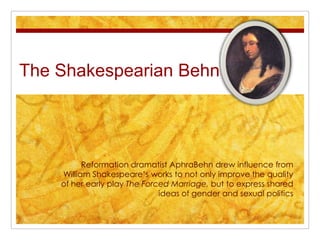
The Shakespearian BehnReformation dramatist AphraBehn drew influence from William Shakespeare’s works to not only improve the quality of her early play The Forced Marriage, but to express shared ideas of gender and sexual politics
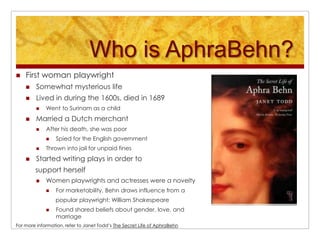
Who is AphraBehn?First woman playwrightSomewhat mysterious lifeLived in during the 1600s, died in 1689Went to Surinam as a childMarried a Dutch merchantAfter his death, she was poorSpied for the English governmentThrown into jail for unpaid finesStarted writing plays in order to      support herselfWomen playwrights and actresses were a noveltyFor marketability, Behn draws influence from a      popular playwright: William Shakespeare Found shared beliefs about gender, love, and marriageFor more information, refer to Janet Todd’s The Secret Life of AphraBehn
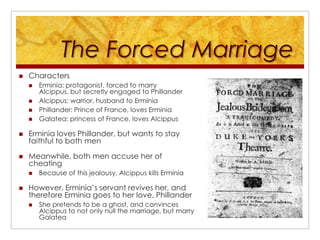
The Forced MarriageCharactersErminia: protagonist, forced to marry Alcippus, but secretly engaged to PhillanderAlcippus: warrior, husband to ErminiaPhillander: Prince of France, loves ErminiaGalatea: princess of France, loves AlcippusErminia loves Phillander, but wants to stay faithful to both menMeanwhile, both men accuse her of cheatingBecause of this jealousy, Alcippus kills ErminiaHowever, Erminia’s servant revives her, and therefore Erminia goes to her love, PhillanderShe pretends to be a ghost, and convinces Alcippus to not only null the marriage, but marry Galatea
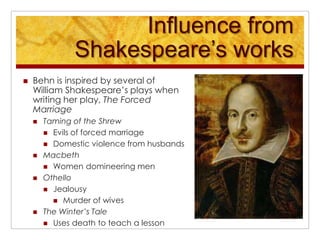
Influence from Shakespeare’s worksBehn is inspired by several of William Shakespeare’s plays when writing her play, The Forced MarriageTaming of the ShrewEvils of forced marriageDomestic violence from husbandsMacbethWomen domineering men OthelloJealousyMurder of wivesThe Winter’s TaleUses death to teach a lesson
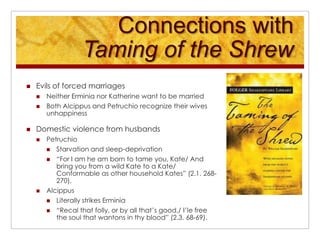
Connections with Taming of the ShrewEvils of forced marriagesNeither Erminia nor Katherine want to be marriedBoth Alcippus and Petruchio recognize their wives unhappinessDomestic violence from husbandsPetruchioStarvation and sleep-deprivation“For I am he am born to tame you, Kate/ And bring you from a wild Kate to a Kate/ Conformable as other household Kates” (2.1. 268-270). AlcippusLiterally strikes Erminia“Recal that folly, or by all that’s good,/ I’le free the soul that wantons in thy blood” (2.3. 68-69).
Connections with MacbethWomen domineering over menErminia over PhillanderPhillander to Erminia: “Life of my soul, retire, I cannot hear that voice and disobey” (2.7. 64-65)Lady Macbeth over Macbeth“Hie thee hither [Macbeth], That I may pour my spirits in thine ear/ and chastise with the valour of my tongue” (1.5 23-25) Both women use this dominance to gain political power for themselvesErminia can manipulate a princeLady Macbeth can become queen
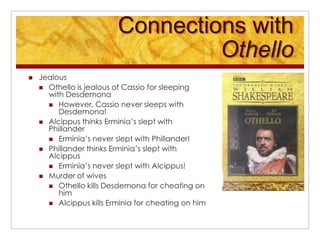
Connections with OthelloJealousOthello is jealous of Cassio for sleeping with DesdemonaHowever, Cassio never sleeps with Desdemona!Alcippus thinks Erminia’s slept with PhillanderErminia’s never slept with Phillander!Phillander thinks Erminia’s slept with AlcippusErminia’s never slept with Alcippus!Murder of wivesOthello kills Desdemona for cheating on himAlcippus kills Erminia for cheating on him
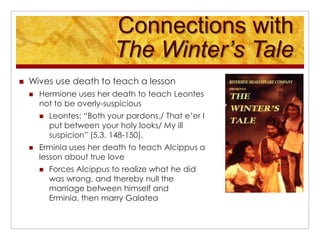
Connections withThe Winter’s TaleWives use death to teach a lessonHermione uses her death to teach Leontes not to be overly-suspiciousLeontes: “Both your pardons,/ That e’er I put between your holy looks/ My ill suspicion” (5.3. 148-150).Erminia uses her death to teach Alcippus a lesson about true loveForces Alcippus to realize what he did was wrong, and thereby null the marriage between himself and Erminia, then marry Galatea
So What?Shows the influence of William Shakespeare throughout the yearsStill popular during the ReformationEven great dramatists like AphraBehn needed to draw influence from other great dramatists to master their craftLater on, she would write great works, including the play The Rover and the novel OronookoWriters today should not be embarrassed to borrow ideas and themes from works of writing/art/ect. that they love, as that’s how we learnPablo Picasso: “Good artists borrow, great artists steal”
Works CitedBehn, Aphra. The Forced Marriage. The Works of AphraBehn. Ed. Janet Todd.Vol. 5. London: Pickering & Chatto, 1996. 1-82.Duffy, Maureen. Introduction. Five Plays. By AphraBehn. New York: Phaeton Press, 1990. ix-xiii.Ferguson, Frances. “Envy Rising.” ELH 69.4 (2002) 889-905.Gill, Pat. “AphraBehn: Desiring Women II.” Interpreting Ladies: Women, Wit, and Morality in the Restoration Comedy of Manners. Athens, GA: University of Georgia Press, 1994. 137-157.Green, André. The Tragic Effect: The Oedipus Complex in Tragedy, trans. Alan Sheridan. Cambridge: Cambridge UP, 1979.Lim, Walter S. H. “Knowledge and Belief in The Winter’s Tale.” SEL Studies in English Literature 1500-1900. (2001): 317-334.Malcolmson, Cristina. Rev. of Fantasies of Female Evil: The Dynamics of Gender and Power in Shakespearean Tragedy, By Cristina León Alfar. Shakespeare Quarterly, 56.1 (2005): 110-112.Shakespeare, William. Macbeth.The Norton Shakespeare. New York: W.W. Norton & Company, Inc., 2008. 2579-2632.---. Othello.The Norton Shakespeare. New York: W.W. Norton & Company, Inc., 2008. 2119-2191.---. Taming of the Shrew. The Norton Shakespeare. New York: W.W. Norton & Company, Inc., 2008. 169-228.---. The Winter’s Tale. The Norton Shakespeare. New York: W.W. Norton & Company, Inc., 2008. 2892-2961.Todd, Janet, and Derek Hughes. “Tragedy and tragicomedy.” The Cambridge Companion to AphraBehn. ed. Derek Hughs and Janet Todd. Cambridge: Cambridge University Press, 2004. 83-97.

Aphra Behn

  • 1.
    The Shakespearian BehnReformationdramatist AphraBehn drew influence from William Shakespeare’s works to not only improve the quality of her early play The Forced Marriage, but to express shared ideas of gender and sexual politics
  • 2.
    Who is AphraBehn?Firstwoman playwrightSomewhat mysterious lifeLived in during the 1600s, died in 1689Went to Surinam as a childMarried a Dutch merchantAfter his death, she was poorSpied for the English governmentThrown into jail for unpaid finesStarted writing plays in order to support herselfWomen playwrights and actresses were a noveltyFor marketability, Behn draws influence from a popular playwright: William Shakespeare Found shared beliefs about gender, love, and marriageFor more information, refer to Janet Todd’s The Secret Life of AphraBehn
  • 3.
    The Forced MarriageCharactersErminia:protagonist, forced to marry Alcippus, but secretly engaged to PhillanderAlcippus: warrior, husband to ErminiaPhillander: Prince of France, loves ErminiaGalatea: princess of France, loves AlcippusErminia loves Phillander, but wants to stay faithful to both menMeanwhile, both men accuse her of cheatingBecause of this jealousy, Alcippus kills ErminiaHowever, Erminia’s servant revives her, and therefore Erminia goes to her love, PhillanderShe pretends to be a ghost, and convinces Alcippus to not only null the marriage, but marry Galatea
  • 4.
    Influence from Shakespeare’sworksBehn is inspired by several of William Shakespeare’s plays when writing her play, The Forced MarriageTaming of the ShrewEvils of forced marriageDomestic violence from husbandsMacbethWomen domineering men OthelloJealousyMurder of wivesThe Winter’s TaleUses death to teach a lesson
  • 5.
    Connections with Tamingof the ShrewEvils of forced marriagesNeither Erminia nor Katherine want to be marriedBoth Alcippus and Petruchio recognize their wives unhappinessDomestic violence from husbandsPetruchioStarvation and sleep-deprivation“For I am he am born to tame you, Kate/ And bring you from a wild Kate to a Kate/ Conformable as other household Kates” (2.1. 268-270). AlcippusLiterally strikes Erminia“Recal that folly, or by all that’s good,/ I’le free the soul that wantons in thy blood” (2.3. 68-69).
  • 6.
    Connections with MacbethWomendomineering over menErminia over PhillanderPhillander to Erminia: “Life of my soul, retire, I cannot hear that voice and disobey” (2.7. 64-65)Lady Macbeth over Macbeth“Hie thee hither [Macbeth], That I may pour my spirits in thine ear/ and chastise with the valour of my tongue” (1.5 23-25) Both women use this dominance to gain political power for themselvesErminia can manipulate a princeLady Macbeth can become queen
  • 7.
    Connections with OthelloJealousOthellois jealous of Cassio for sleeping with DesdemonaHowever, Cassio never sleeps with Desdemona!Alcippus thinks Erminia’s slept with PhillanderErminia’s never slept with Phillander!Phillander thinks Erminia’s slept with AlcippusErminia’s never slept with Alcippus!Murder of wivesOthello kills Desdemona for cheating on himAlcippus kills Erminia for cheating on him
  • 8.
    Connections withThe Winter’sTaleWives use death to teach a lessonHermione uses her death to teach Leontes not to be overly-suspiciousLeontes: “Both your pardons,/ That e’er I put between your holy looks/ My ill suspicion” (5.3. 148-150).Erminia uses her death to teach Alcippus a lesson about true loveForces Alcippus to realize what he did was wrong, and thereby null the marriage between himself and Erminia, then marry Galatea
  • 9.
    So What?Shows theinfluence of William Shakespeare throughout the yearsStill popular during the ReformationEven great dramatists like AphraBehn needed to draw influence from other great dramatists to master their craftLater on, she would write great works, including the play The Rover and the novel OronookoWriters today should not be embarrassed to borrow ideas and themes from works of writing/art/ect. that they love, as that’s how we learnPablo Picasso: “Good artists borrow, great artists steal”
  • 10.
    Works CitedBehn, Aphra.The Forced Marriage. The Works of AphraBehn. Ed. Janet Todd.Vol. 5. London: Pickering & Chatto, 1996. 1-82.Duffy, Maureen. Introduction. Five Plays. By AphraBehn. New York: Phaeton Press, 1990. ix-xiii.Ferguson, Frances. “Envy Rising.” ELH 69.4 (2002) 889-905.Gill, Pat. “AphraBehn: Desiring Women II.” Interpreting Ladies: Women, Wit, and Morality in the Restoration Comedy of Manners. Athens, GA: University of Georgia Press, 1994. 137-157.Green, André. The Tragic Effect: The Oedipus Complex in Tragedy, trans. Alan Sheridan. Cambridge: Cambridge UP, 1979.Lim, Walter S. H. “Knowledge and Belief in The Winter’s Tale.” SEL Studies in English Literature 1500-1900. (2001): 317-334.Malcolmson, Cristina. Rev. of Fantasies of Female Evil: The Dynamics of Gender and Power in Shakespearean Tragedy, By Cristina León Alfar. Shakespeare Quarterly, 56.1 (2005): 110-112.Shakespeare, William. Macbeth.The Norton Shakespeare. New York: W.W. Norton & Company, Inc., 2008. 2579-2632.---. Othello.The Norton Shakespeare. New York: W.W. Norton & Company, Inc., 2008. 2119-2191.---. Taming of the Shrew. The Norton Shakespeare. New York: W.W. Norton & Company, Inc., 2008. 169-228.---. The Winter’s Tale. The Norton Shakespeare. New York: W.W. Norton & Company, Inc., 2008. 2892-2961.Todd, Janet, and Derek Hughes. “Tragedy and tragicomedy.” The Cambridge Companion to AphraBehn. ed. Derek Hughs and Janet Todd. Cambridge: Cambridge University Press, 2004. 83-97.