By :- Chandani Kumari
Yogesh Vishwakarma
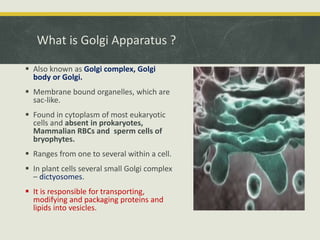
GOLGI APPARATUS
What is Golgi Apparatus ?
 Also known as Golgi complex, Golgi
body or Golgi.
 Membrane bound organelles, which are
sac-like.
 Found in cytoplasm of most eukaryotic
cells and absent in prokaryotes,
Mammalian RBCs and sperm cells of
bryophytes.
 Ranges from one to several within a cell.
 In plant cells several small Golgi complex
– dictyosomes.
 It is responsible for transporting,
modifying and packaging proteins and
lipids into vesicles.
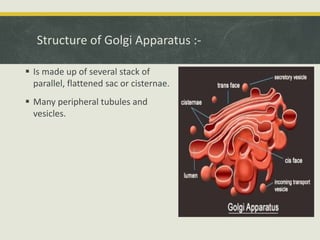
Structure of Golgi Apparatus :-
 Is made up of several stack of
parallel, flattened sac or cisternae.
 Many peripheral tubules and
vesicles.
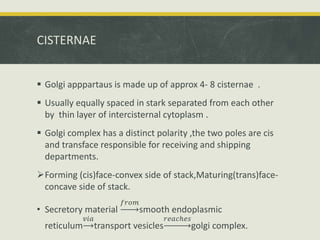
CISTERNAE
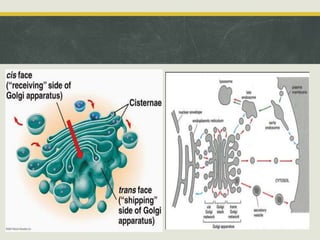
 Golgi apppartaus is made up of approx 4- 8 cisternae .
 Usually equally spaced in stark separated from each other
by thin layer of intercisternal cytoplasm .
 Golgi complex has a distinct polarity ,the two poles are cis
and transface responsible for receiving and shipping
departments.
Forming (cis)face-convex side of stack,Maturing(trans)face-
concave side of stack.
• Secretory material
𝑓𝑟𝑜𝑚
smooth endoplasmic
reticulum
𝑣𝑖𝑎
transport vesicles
𝑟𝑒𝑎𝑐ℎ𝑒𝑠
golgi complex.
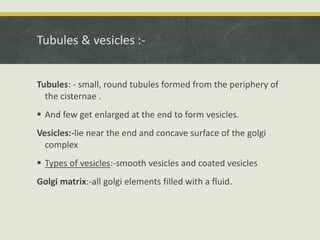
Tubules & vesicles :-
Tubules: - small, round tubules formed from the periphery of
the cisternae .
 And few get enlarged at the end to form vesicles.
Vesicles:-lie near the end and concave surface of the golgi
complex
 Types of vesicles:-smooth vesicles and coated vesicles
Golgi matrix:-all golgi elements filled with a fluid.
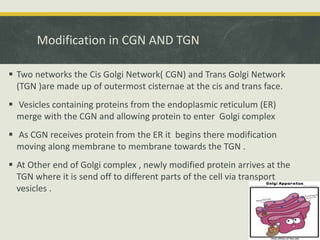
Modification in CGN AND TGN
 Two networks the Cis Golgi Network( CGN) and Trans Golgi Network
(TGN )are made up of outermost cisternae at the cis and trans face.
 Vesicles containing proteins from the endoplasmic reticulum (ER)
merge with the CGN and allowing protein to enter Golgi complex
 As CGN receives protein from the ER it begins there modification
moving along membrane to membrane towards the TGN .
 At Other end of Golgi complex , newly modified protein arrives at the
TGN where it is send off to different parts of the cell via transport
vesicles .
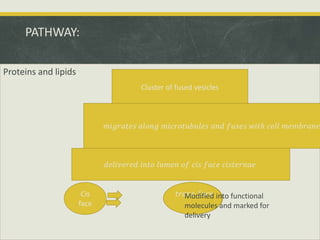
PATHWAY:
Proteins and lipids
Cluster of fused vesicles
𝑚𝑖𝑔𝑟𝑎𝑡𝑒𝑠 𝑎𝑙𝑜𝑛𝑔 𝑚𝑖𝑐𝑟𝑜𝑡𝑢𝑏𝑢𝑙𝑒𝑠 𝑎𝑛𝑑 𝑓𝑢𝑠𝑒𝑠 𝑤𝑖𝑡ℎ 𝑐𝑒𝑙𝑙 𝑚𝑒𝑚𝑏𝑟𝑎𝑛𝑒
𝑑𝑒𝑙𝑖𝑣𝑒𝑟𝑒𝑑 𝑖𝑛𝑡𝑜 𝑙𝑢𝑚𝑒𝑛 𝑜𝑓 𝑐𝑖𝑠 𝑓𝑎𝑐𝑒 𝑐𝑖𝑠𝑡𝑒𝑟𝑛𝑎𝑒
𝑡𝑟𝑎𝑛𝑠 𝑓𝑎𝑐𝑒
Cis
face
𝑡𝑟𝑎𝑛𝑠 𝑓𝑎𝑐𝑒
𝑡𝑟𝑎𝑛𝑠 𝑓𝑎𝑐𝑒
Modified into functional
molecules and marked for
delivery
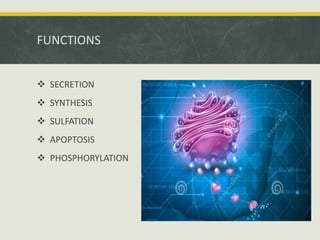
FUNCTIONS
 SECRETION
 SYNTHESIS
 SULFATION
 APOPTOSIS
 PHOSPHORYLATION
SECRETION
 Golgi complex plays an important role in secretion.
 Production of proteoglycans
SYNTHESIS
It is also major site of carbohydrate synthesis .
Includes synthesis of glycoasaminoglycans (GAGs)
Golgi attaches to polysaccharides and protein
to form proteoglycans
SULFHATION
 Golgi involves in the sulfation of ceratain molecules passing
through lumen via sulphotransferases that gain sulphur
molecule from a donor called PAPS .
 Sulfation is generally performed in trans – Golgi network
 Sulfation occurs in GAGs of proteoglycans as well as core
protein
 Level of sulfation is very important to proteoglycans.
APOPTOSIS
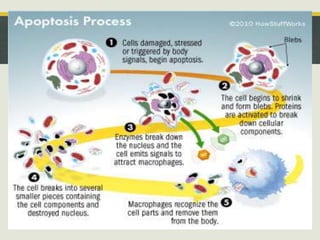
 Golgi has a putative role in apoptosis
 A newly characterized protein (Golgi anti-apoptotic
protein) almost exclusively resides the Golgi and protects
cells from apoptosis
 As yet it is an undefined mechanism
PHOSPHORYLATION
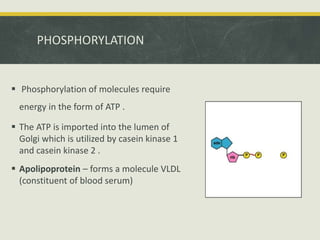
 Phosphorylation of molecules require
energy in the form of ATP .
 The ATP is imported into the lumen of
Golgi which is utilized by casein kinase 1
and casein kinase 2 .
 Apolipoprotein – forms a molecule VLDL
(constituent of blood serum)
Protein glycosylation within Golgi
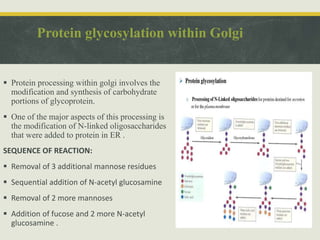
 Protein processing within golgi involves the
modification and synthesis of carbohydrate
portions of glycoprotein.
 One of the major aspects of this processing is
the modification of N-linked oligosaccharides
that were added to protein in ER .
SEQUENCE OF REACTION:
 Removal of 3 additional mannose residues
 Sequential addition of N-acetyl glucosamine
 Removal of 2 more mannoses
 Addition of fucose and 2 more N-acetyl
glucosamine .
LIPID AND POLYSACCHARIDE
METABOLISM
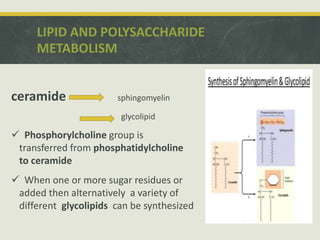
ceramide sphingomyelin
glycolipid
 Phosphorylcholine group is
transferred from phosphatidylcholine
to ceramide
 When one or more sugar residues or
added then alternatively a variety of
different glycolipids can be synthesized
Vesicular transport from ER
to Golgi bodies
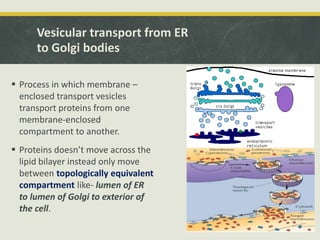
 Process in which membrane –
enclosed transport vesicles
transport proteins from one
membrane-enclosed
compartment to another.
 Proteins doesn’t move across the
lipid bilayer instead only move
between topologically equivalent
compartment like- lumen of ER
to lumen of Golgi to exterior of
the cell.
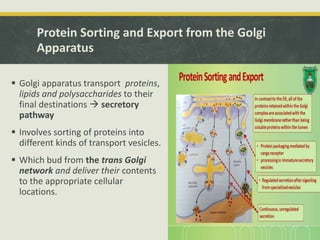
Protein Sorting and Export from the Golgi
Apparatus
 Golgi apparatus transport proteins,
lipids and polysaccharides to their
final destinations  secretory
pathway
 Involves sorting of proteins into
different kinds of transport vesicles.
 Which bud from the trans Golgi
network and deliver their contents
to the appropriate cellular
locations.
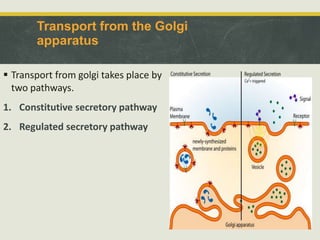
Transport from the Golgi
apparatus
 Transport from golgi takes place by
two pathways.
1. Constitutive secretory pathway
2. Regulated secretory pathway
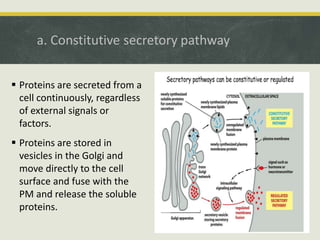
a. Constitutive secretory pathway
 Proteins are secreted from a
cell continuously, regardless
of external signals or
factors.
 Proteins are stored in
vesicles in the Golgi and
move directly to the cell
surface and fuse with the
PM and release the soluble
proteins.
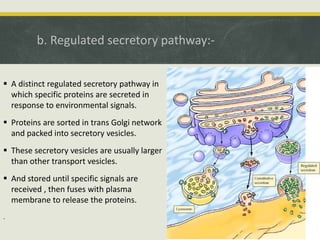
b. Regulated secretory pathway:-
 A distinct regulated secretory pathway in
which specific proteins are secreted in
response to environmental signals.
 Proteins are sorted in trans Golgi network
and packed into secretory vesicles.
 These secretory vesicles are usually larger
than other transport vesicles.
 And stored until specific signals are
received , then fuses with plasma
membrane to release the proteins.
.
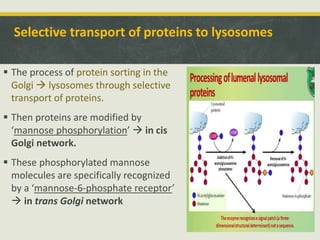
Selective transport of proteins to lysosomes
 The process of protein sorting in the
Golgi  lysosomes through selective
transport of proteins.
 Then proteins are modified by
‘mannose phosphorylation’  in cis
Golgi network.
 These phosphorylated mannose
molecules are specifically recognized
by a ‘mannose-6-phosphate receptor’
 in trans Golgi network
Questions ???
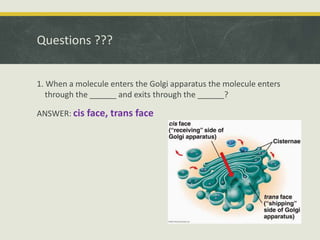
1. When a molecule enters the Golgi apparatus the molecule enters
through the ______ and exits through the ______?
ANSWER: cis face, trans face
golgiapparatus-180728213127.pdf

golgiapparatus-180728213127.pdf

  • 1.
    By :- ChandaniKumari Yogesh Vishwakarma
  • 2.
  • 3.
    What is GolgiApparatus ?  Also known as Golgi complex, Golgi body or Golgi.  Membrane bound organelles, which are sac-like.  Found in cytoplasm of most eukaryotic cells and absent in prokaryotes, Mammalian RBCs and sperm cells of bryophytes.  Ranges from one to several within a cell.  In plant cells several small Golgi complex – dictyosomes.  It is responsible for transporting, modifying and packaging proteins and lipids into vesicles.
  • 4.
    Structure of GolgiApparatus :-  Is made up of several stack of parallel, flattened sac or cisternae.  Many peripheral tubules and vesicles.
  • 5.
    CISTERNAE  Golgi apppartausis made up of approx 4- 8 cisternae .  Usually equally spaced in stark separated from each other by thin layer of intercisternal cytoplasm .  Golgi complex has a distinct polarity ,the two poles are cis and transface responsible for receiving and shipping departments. Forming (cis)face-convex side of stack,Maturing(trans)face- concave side of stack. • Secretory material 𝑓𝑟𝑜𝑚 smooth endoplasmic reticulum 𝑣𝑖𝑎 transport vesicles 𝑟𝑒𝑎𝑐ℎ𝑒𝑠 golgi complex.
  • 7.
    Tubules & vesicles:- Tubules: - small, round tubules formed from the periphery of the cisternae .  And few get enlarged at the end to form vesicles. Vesicles:-lie near the end and concave surface of the golgi complex  Types of vesicles:-smooth vesicles and coated vesicles Golgi matrix:-all golgi elements filled with a fluid.
  • 8.
    Modification in CGNAND TGN  Two networks the Cis Golgi Network( CGN) and Trans Golgi Network (TGN )are made up of outermost cisternae at the cis and trans face.  Vesicles containing proteins from the endoplasmic reticulum (ER) merge with the CGN and allowing protein to enter Golgi complex  As CGN receives protein from the ER it begins there modification moving along membrane to membrane towards the TGN .  At Other end of Golgi complex , newly modified protein arrives at the TGN where it is send off to different parts of the cell via transport vesicles .
  • 9.
    PATHWAY: Proteins and lipids Clusterof fused vesicles 𝑚𝑖𝑔𝑟𝑎𝑡𝑒𝑠 𝑎𝑙𝑜𝑛𝑔 𝑚𝑖𝑐𝑟𝑜𝑡𝑢𝑏𝑢𝑙𝑒𝑠 𝑎𝑛𝑑 𝑓𝑢𝑠𝑒𝑠 𝑤𝑖𝑡ℎ 𝑐𝑒𝑙𝑙 𝑚𝑒𝑚𝑏𝑟𝑎𝑛𝑒 𝑑𝑒𝑙𝑖𝑣𝑒𝑟𝑒𝑑 𝑖𝑛𝑡𝑜 𝑙𝑢𝑚𝑒𝑛 𝑜𝑓 𝑐𝑖𝑠 𝑓𝑎𝑐𝑒 𝑐𝑖𝑠𝑡𝑒𝑟𝑛𝑎𝑒 𝑡𝑟𝑎𝑛𝑠 𝑓𝑎𝑐𝑒 Cis face 𝑡𝑟𝑎𝑛𝑠 𝑓𝑎𝑐𝑒 𝑡𝑟𝑎𝑛𝑠 𝑓𝑎𝑐𝑒 Modified into functional molecules and marked for delivery
  • 10.
    FUNCTIONS  SECRETION  SYNTHESIS SULFATION  APOPTOSIS  PHOSPHORYLATION
  • 12.
    SECRETION  Golgi complexplays an important role in secretion.  Production of proteoglycans
  • 14.
    SYNTHESIS It is alsomajor site of carbohydrate synthesis . Includes synthesis of glycoasaminoglycans (GAGs) Golgi attaches to polysaccharides and protein to form proteoglycans
  • 15.
    SULFHATION  Golgi involvesin the sulfation of ceratain molecules passing through lumen via sulphotransferases that gain sulphur molecule from a donor called PAPS .  Sulfation is generally performed in trans – Golgi network  Sulfation occurs in GAGs of proteoglycans as well as core protein  Level of sulfation is very important to proteoglycans.
  • 16.
    APOPTOSIS  Golgi hasa putative role in apoptosis  A newly characterized protein (Golgi anti-apoptotic protein) almost exclusively resides the Golgi and protects cells from apoptosis  As yet it is an undefined mechanism
  • 18.
    PHOSPHORYLATION  Phosphorylation ofmolecules require energy in the form of ATP .  The ATP is imported into the lumen of Golgi which is utilized by casein kinase 1 and casein kinase 2 .  Apolipoprotein – forms a molecule VLDL (constituent of blood serum)
  • 19.
    Protein glycosylation withinGolgi  Protein processing within golgi involves the modification and synthesis of carbohydrate portions of glycoprotein.  One of the major aspects of this processing is the modification of N-linked oligosaccharides that were added to protein in ER . SEQUENCE OF REACTION:  Removal of 3 additional mannose residues  Sequential addition of N-acetyl glucosamine  Removal of 2 more mannoses  Addition of fucose and 2 more N-acetyl glucosamine .
  • 20.
    LIPID AND POLYSACCHARIDE METABOLISM ceramidesphingomyelin glycolipid  Phosphorylcholine group is transferred from phosphatidylcholine to ceramide  When one or more sugar residues or added then alternatively a variety of different glycolipids can be synthesized
  • 21.
    Vesicular transport fromER to Golgi bodies  Process in which membrane – enclosed transport vesicles transport proteins from one membrane-enclosed compartment to another.  Proteins doesn’t move across the lipid bilayer instead only move between topologically equivalent compartment like- lumen of ER to lumen of Golgi to exterior of the cell.
  • 22.
    Protein Sorting andExport from the Golgi Apparatus  Golgi apparatus transport proteins, lipids and polysaccharides to their final destinations  secretory pathway  Involves sorting of proteins into different kinds of transport vesicles.  Which bud from the trans Golgi network and deliver their contents to the appropriate cellular locations.
  • 23.
    Transport from theGolgi apparatus  Transport from golgi takes place by two pathways. 1. Constitutive secretory pathway 2. Regulated secretory pathway
  • 24.
    a. Constitutive secretorypathway  Proteins are secreted from a cell continuously, regardless of external signals or factors.  Proteins are stored in vesicles in the Golgi and move directly to the cell surface and fuse with the PM and release the soluble proteins.
  • 25.
    b. Regulated secretorypathway:-  A distinct regulated secretory pathway in which specific proteins are secreted in response to environmental signals.  Proteins are sorted in trans Golgi network and packed into secretory vesicles.  These secretory vesicles are usually larger than other transport vesicles.  And stored until specific signals are received , then fuses with plasma membrane to release the proteins. .
  • 26.
    Selective transport ofproteins to lysosomes  The process of protein sorting in the Golgi  lysosomes through selective transport of proteins.  Then proteins are modified by ‘mannose phosphorylation’  in cis Golgi network.  These phosphorylated mannose molecules are specifically recognized by a ‘mannose-6-phosphate receptor’  in trans Golgi network
  • 27.
    Questions ??? 1. Whena molecule enters the Golgi apparatus the molecule enters through the ______ and exits through the ______? ANSWER: cis face, trans face