functionof Golgi complex
By
KAUSHAL KUMAR SAHU
Assistant Professor (Ad Hoc)
Department of Biotechnology
Govt. Digvijay Autonomous P. G. College
Raj-Nandgaon ( C. G. )
Synopsis
• Introduction
• Discovery
• Evolution
• Structure
• Function
• Types of secretion are controlled by the
Golgi complex
• How do proteins move to the Golgi complex
• Conclusion
• Reference
• The Golgi apparatus (also Golgi body or the Golgi complex)
is an organelle found in most eukaryotic cells.
• It was discovered by the Italian physicianCamillo Golgi, in
1897 after whom the Golgi apparatus is named.
• Golgi apparatus forms a part of the cellular endomembrane
system
• It provides connection between ER and perinuclear space
on the one hand and between transport vesicles and
plasma lemma on the other.
• It also performs an important function for transport of
material from nucleus to the cytoplasm.
• It processes and packages macromolecules, such
as proteins and lipids
• Due to its fairly large size, the Golgi apparatus was one of the first
organelles to be discovered and observed in detail. The apparatus was
discovered in 1897 by Italian physician Camillo Golgi during an
investigation of the nervous system
• After first observing it under his microscope, he termed the structure
the internal reticular apparatus.
• The structure was then renamed after Golgi not long after the
announcement of his discovery in 1898.
• However, some doubted the discovery at first, arguing that the appearance
of the structure was merely an optical illusion created by the observation
technique used by Golgi.
• With the development of modern microscopes in the 20th century, the
discovery was confirm.
• The Golgi apparatus appears to have existed
even in the "ancestral eukaryote" from which
all modern eukaryotes evolved, even though
some do not have it in the stacked form.
• Found in both plant and animal cells
• The Golgi is composed of stacks of membrane-
bound structures known
as cisternae (singular: cisterna).
• An individual stack is sometimes called a
dictyosome (from Greek dictyon: net + soma:
body),[4] especially in plant cell
• A mammalian cell typically contains 40 to 100
stacks.
• Between four and eight cisternae are usually
present in a stack; however, in some protists as
many as sixty have been observed
• Each cisterna comprises a flat, membrane
enclosed disc that includes special Golgi enzymes.
• The cisternae stack has four functional regions:
the cis- Golgi network, medial-Golgi, endo -Golgi,
and trans-Golgi network. Each region contains
different enzymes .
This electron micrograph illustrates
a Golgi Complex
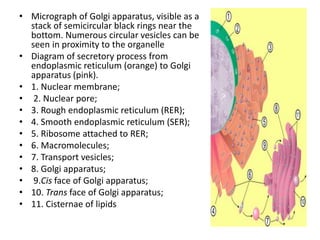
• Micrograph of Golgi apparatus, visible as a
stack of semicircular black rings near the
bottom. Numerous circular vesicles can be
seen in proximity to the organelle
• Diagram of secretory process from
endoplasmic reticulum (orange) to Golgi
apparatus (pink).
• 1. Nuclear membrane;
• 2. Nuclear pore;
• 3. Rough endoplasmic reticulum (RER);
• 4. Smooth endoplasmic reticulum (SER);
• 5. Ribosome attached to RER;
• 6. Macromolecules;
• 7. Transport vesicles;
• 8. Golgi apparatus;
• 9.Cis face of Golgi apparatus;
• 10. Trans face of Golgi apparatus;
• 11. Cisternae of lipids
• This includes the production of glycosaminoglycans (GAGs), long unbranched polysaccharides .
• Enzymes in the Golgi polymerize several of these GAGs via a xylose link onto the core protein
• Another task of the Golgi involves the sulfation of certain molecules passing through its lumen via
sulphotranferases that gain their sulphur molecule from a donor called PAPs.
• This process occurs on the GAGs of proteoglycans as well as on the core protein.
• The level of sulfation is very important to the proteoglycans' signalling abilities as well as giving the
proteoglycan its overall negative charge.[13]
• The phosphorylation of molecules requires that ATP is imported into the lumen of the Golgi[15] and
then utilised
• by resident kinases such as casein kinase 1 and casein kinase 2
• One molecule that is phosphorylated in the Golgi is Apolipoprotein, which forms a molecule known
as VLDL that is a constituent of blood serum. It is thought that the phosphorylation of these
molecules is important to help aid in their sorting for secretion into the blood serum.
• A newly characterized protein, GAAP (Golgi anti-apoptotic protein), almost exclusively resides in the
Golgi and protects cells from apoptosis
• The bcl2 genes present in the Golgi are used for this purpose.
• The Golgi complex controls trafficking of different
types of proteins.
• Some are destined for secretion. Others are
destined for the extracellular matrix.
• other proteins, such as lysosomal enzymes, may
need to be sorted and sequestered from the
remaining constituents because of their potential
destructive effects.
• Finally, this cartoon also shows the packaging
of lysosomes .
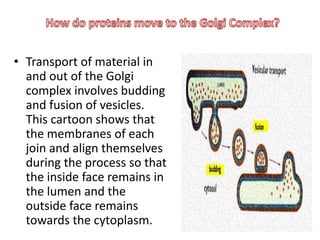
• Transport of material in
and out of the Golgi
complex involves budding
and fusion of vesicles.
This cartoon shows that
the membranes of each
join and align themselves
during the process so that
the inside face remains in
the lumen and the
outside face remains
towards the cytoplasm.
Conclusion
• The golgi apparatus is an important organelle
of eukaryotic cells . directing the
carbohydrates and protein required by the
body to their correct destination is the
primary job of golgi body. In this process of
directing molecules to appropriate
destinations, they are tagged with
destination information and structural
modifications.
Reference
• 1.Lodish et al.-molecular cell biology
• 2.P.K. Gupta, cell and molecular biology
• 3.C.B. Powar , cell biology
• 4.Internet.

Function of golgi complex By KK Sahu Sir

  • 1.
    functionof Golgi complex By KAUSHALKUMAR SAHU Assistant Professor (Ad Hoc) Department of Biotechnology Govt. Digvijay Autonomous P. G. College Raj-Nandgaon ( C. G. )
  • 2.
    Synopsis • Introduction • Discovery •Evolution • Structure • Function • Types of secretion are controlled by the Golgi complex • How do proteins move to the Golgi complex • Conclusion • Reference
  • 3.
    • The Golgiapparatus (also Golgi body or the Golgi complex) is an organelle found in most eukaryotic cells. • It was discovered by the Italian physicianCamillo Golgi, in 1897 after whom the Golgi apparatus is named. • Golgi apparatus forms a part of the cellular endomembrane system • It provides connection between ER and perinuclear space on the one hand and between transport vesicles and plasma lemma on the other. • It also performs an important function for transport of material from nucleus to the cytoplasm. • It processes and packages macromolecules, such as proteins and lipids
  • 4.
    • Due toits fairly large size, the Golgi apparatus was one of the first organelles to be discovered and observed in detail. The apparatus was discovered in 1897 by Italian physician Camillo Golgi during an investigation of the nervous system • After first observing it under his microscope, he termed the structure the internal reticular apparatus. • The structure was then renamed after Golgi not long after the announcement of his discovery in 1898. • However, some doubted the discovery at first, arguing that the appearance of the structure was merely an optical illusion created by the observation technique used by Golgi. • With the development of modern microscopes in the 20th century, the discovery was confirm.
  • 5.
    • The Golgiapparatus appears to have existed even in the "ancestral eukaryote" from which all modern eukaryotes evolved, even though some do not have it in the stacked form.
  • 6.
    • Found inboth plant and animal cells • The Golgi is composed of stacks of membrane- bound structures known as cisternae (singular: cisterna). • An individual stack is sometimes called a dictyosome (from Greek dictyon: net + soma: body),[4] especially in plant cell • A mammalian cell typically contains 40 to 100 stacks. • Between four and eight cisternae are usually present in a stack; however, in some protists as many as sixty have been observed • Each cisterna comprises a flat, membrane enclosed disc that includes special Golgi enzymes. • The cisternae stack has four functional regions: the cis- Golgi network, medial-Golgi, endo -Golgi, and trans-Golgi network. Each region contains different enzymes . This electron micrograph illustrates a Golgi Complex
  • 7.
    • Micrograph ofGolgi apparatus, visible as a stack of semicircular black rings near the bottom. Numerous circular vesicles can be seen in proximity to the organelle • Diagram of secretory process from endoplasmic reticulum (orange) to Golgi apparatus (pink). • 1. Nuclear membrane; • 2. Nuclear pore; • 3. Rough endoplasmic reticulum (RER); • 4. Smooth endoplasmic reticulum (SER); • 5. Ribosome attached to RER; • 6. Macromolecules; • 7. Transport vesicles; • 8. Golgi apparatus; • 9.Cis face of Golgi apparatus; • 10. Trans face of Golgi apparatus; • 11. Cisternae of lipids
  • 8.
    • This includesthe production of glycosaminoglycans (GAGs), long unbranched polysaccharides . • Enzymes in the Golgi polymerize several of these GAGs via a xylose link onto the core protein • Another task of the Golgi involves the sulfation of certain molecules passing through its lumen via sulphotranferases that gain their sulphur molecule from a donor called PAPs. • This process occurs on the GAGs of proteoglycans as well as on the core protein. • The level of sulfation is very important to the proteoglycans' signalling abilities as well as giving the proteoglycan its overall negative charge.[13] • The phosphorylation of molecules requires that ATP is imported into the lumen of the Golgi[15] and then utilised • by resident kinases such as casein kinase 1 and casein kinase 2 • One molecule that is phosphorylated in the Golgi is Apolipoprotein, which forms a molecule known as VLDL that is a constituent of blood serum. It is thought that the phosphorylation of these molecules is important to help aid in their sorting for secretion into the blood serum. • A newly characterized protein, GAAP (Golgi anti-apoptotic protein), almost exclusively resides in the Golgi and protects cells from apoptosis • The bcl2 genes present in the Golgi are used for this purpose.
  • 9.
    • The Golgicomplex controls trafficking of different types of proteins. • Some are destined for secretion. Others are destined for the extracellular matrix. • other proteins, such as lysosomal enzymes, may need to be sorted and sequestered from the remaining constituents because of their potential destructive effects.
  • 10.
    • Finally, thiscartoon also shows the packaging of lysosomes .
  • 11.
    • Transport ofmaterial in and out of the Golgi complex involves budding and fusion of vesicles. This cartoon shows that the membranes of each join and align themselves during the process so that the inside face remains in the lumen and the outside face remains towards the cytoplasm.
  • 12.
    Conclusion • The golgiapparatus is an important organelle of eukaryotic cells . directing the carbohydrates and protein required by the body to their correct destination is the primary job of golgi body. In this process of directing molecules to appropriate destinations, they are tagged with destination information and structural modifications.
  • 13.
    Reference • 1.Lodish etal.-molecular cell biology • 2.P.K. Gupta, cell and molecular biology • 3.C.B. Powar , cell biology • 4.Internet.