Shahid Hussain Raja
Independent Consultant-Public Policy
www.shahidhussainraja.com
May 10, 2015
 Introduction
 What is food security
 Evolution of concept
 Global profile
 Major challenges
 Global response
 Conclusion
 Food is the first basic human need and fundamental right of every
human being, having constitutional guarantees in almost all countries.
That's why the UNO recognized the Right to food in the Declaration of
Human Rights in 1948,vital for the enjoyment of all other rights.
 Although food security has always been a crucial issue, there is
increasing global concern in it after 2007/8 food crises which is
reinforced whenever food prices start rising.
 This presentation explains the concept of food security, its evolution,
challenges at country level as well as at global level and ends with a set
of recommendations.
 Its detailed article version is available at my website
www.shahidhussainraja.com
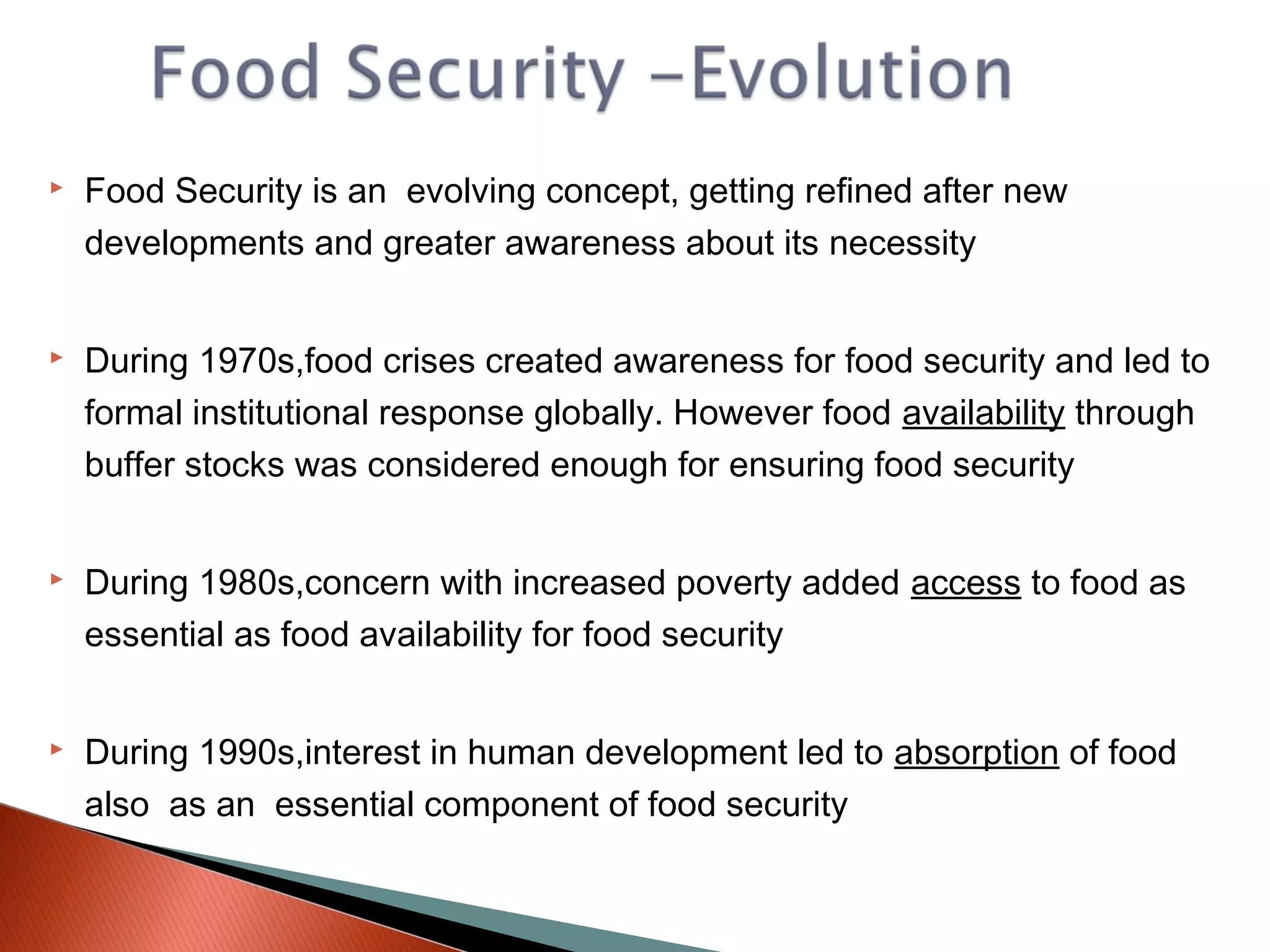
 Food Security is an evolving concept, getting refined after new
developments and greater awareness about its necessity
 During 1970s,food crises created awareness for food security and led to
formal institutional response globally. However food availability through
buffer stocks was considered enough for ensuring food security
 During 1980s,concern with increased poverty added access to food as
essential as food availability for food security
 During 1990s,interest in human development led to absorption of food
also as an essential component of food security
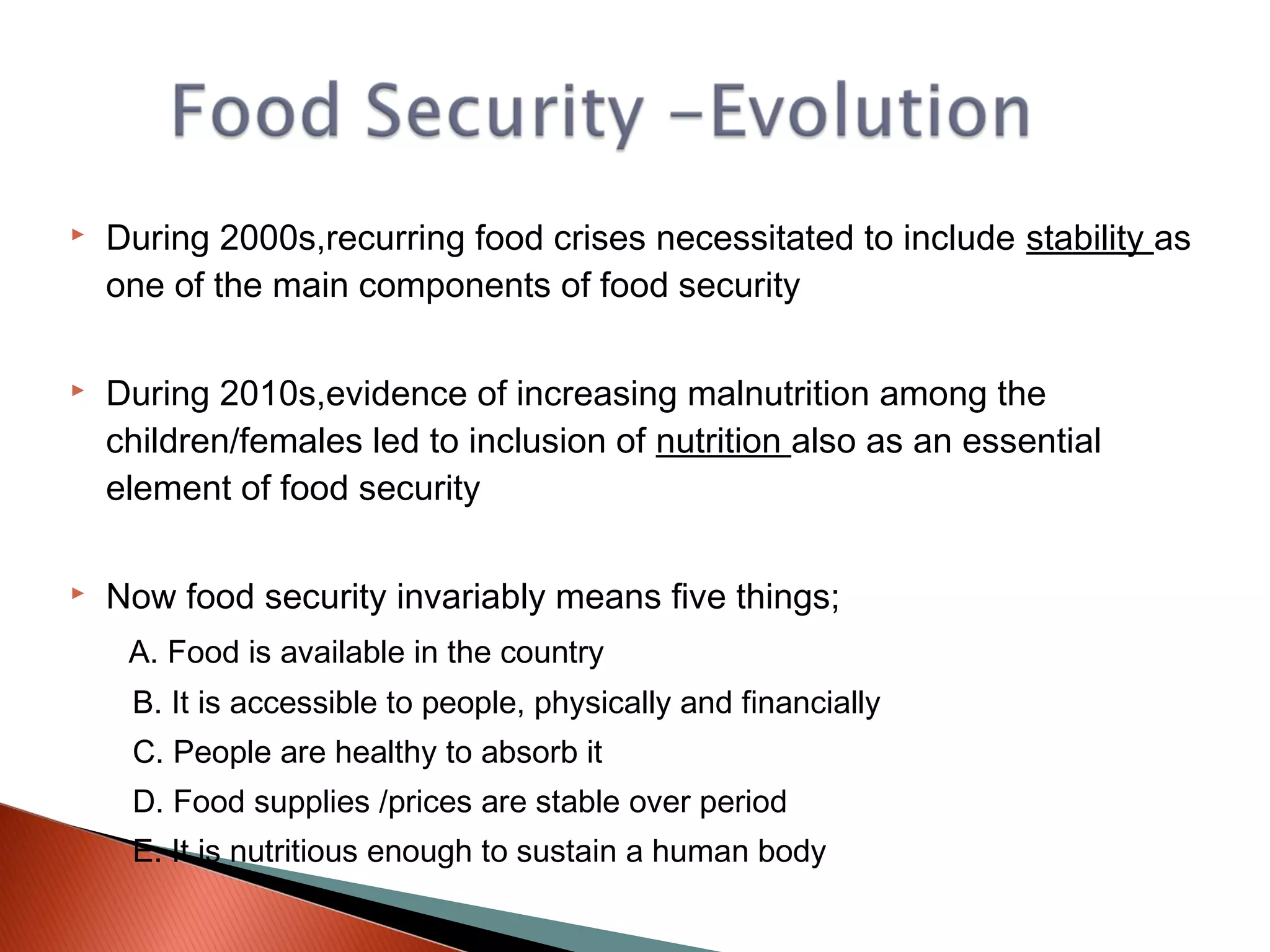
 During 2000s,recurring food crises necessitated to include stability as
one of the main components of food security
 During 2010s,evidence of increasing malnutrition among the
children/females led to inclusion of nutrition also as an essential
element of food security
 Now food security invariably means five things;
A. Food is available in the country
B. It is accessible to people, physically and financially
C. People are healthy to absorb it
D. Food supplies /prices are stable over period
E. It is nutritious enough to sustain a human body
“when all people at all times have access to sufficient, safe,
nutritious food to maintain a healthy and active life”.
Food and Agriculture Organisation,UN
Food insecurity is a situation of limited or uncertain availability
of nutritionally adequate and safe foods or limited or uncertain
ability to acquire acceptable foods in socially acceptable ways“
United States Department of Agriculture (USDA).[
1990–92 2000–02 2005–07 2008–10 2011–13*
World 1 015.3 957.3 906.6 878.2 842.3
Developed
Regions
19.8 18.4 13.6 15.2 15.7
Developing
Regions
995.5 938.9 892.9 863.0 826.6
Africa 177.6 214.3 217.6 226.0 226.4
Asia 751.3 662.3 619.6 585.5 552.0
Latina America &
Caribbean
65.7 61.0 54.6 50.3 47.0
Oceania 0.8 1.2 1.1 1.1 1.2
Undernourished Population
Source: State of Food Insecurity 2013 (FAO)
Millions
 Despite substantial progress made since the MDGs were
launched in 2000, the number of people chronically
undernourished are more than 870 million, bulk of whom are
in Africa and Asia; almost 15 percent of their population is
undernourished
 Most of the progress made was before 2007/8 food crises. It
means any food crises wipes out a significant proportion of
progress made
 Even the methodology used by FAO needs to be improved to
truly capture the incidence of mal/undernourishment
 failed agriculture market regulations
 lack of anti-dumping mechanisms
 export restrictions and panic buying,
 US Dollar Depreciation
 increased farming for use in biofuels
 world oil prices at more than $100 a barrel
 global population growth
 climate change
 loss of agricultural land to residential and industrial
development
 growing consumer demand in China and India
 Wikipedia
 Growth is essential for poverty alleviation which is a crucial
condition for food and nutrition security
 Yet this growth must be inclusive, ensuring the participation
of poor in growth effort process for substantial improvement in
food security
 Within this framework, contents of growth must target the food
and nutrition aspects to ensure food security---safe drinking
water, health services, targeted food fortification
 In the broader perspective, it is the agricultural development
which makes the biggest dent in poverty reduction and hence
food and nutrition security
 Despite the highest growth rates which can be achieved,
there will always remain a significant section of society
which could not reap the benefits of growth for any
reason.
 State must create an effective, efficient and transparent
system of Social Safety Nets for these people who are
left in this growth process
 Growth must ultimately accompanied by social and
political structural changes such as people
empowerment, gender balance, good governance,
private sector participation etc
Global Food Security-Major Challenges
 Production-slow rate of growth of food production is adversely
affecting the supply of food grains
 Consumption-increasing consumption and wastages are
putting pressures on food grains stocks
 Distribution -bottlenecks pose threats to its availability even in
normal times
 Politics-political Issues also affecting food chains
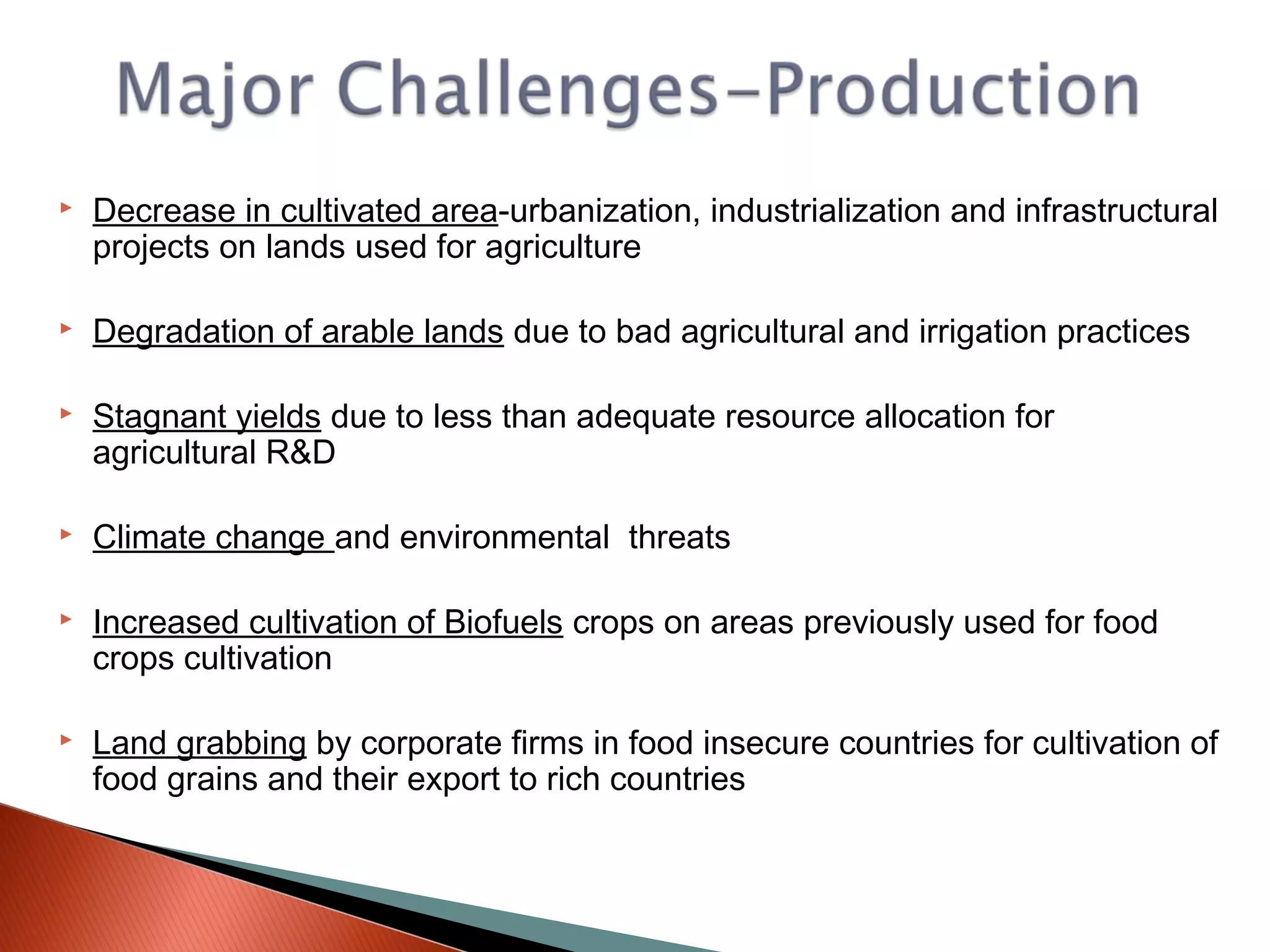
 Decrease in cultivated area-urbanization, industrialization and infrastructural
projects on lands used for agriculture
 Degradation of arable lands due to bad agricultural and irrigation practices
 Stagnant yields due to less than adequate resource allocation for
agricultural R&D
 Climate change and environmental threats
 Increased cultivation of Biofuels crops on areas previously used for food
crops cultivation
 Land grabbing by corporate firms in food insecure countries for cultivation of
food grains and their export to rich countries
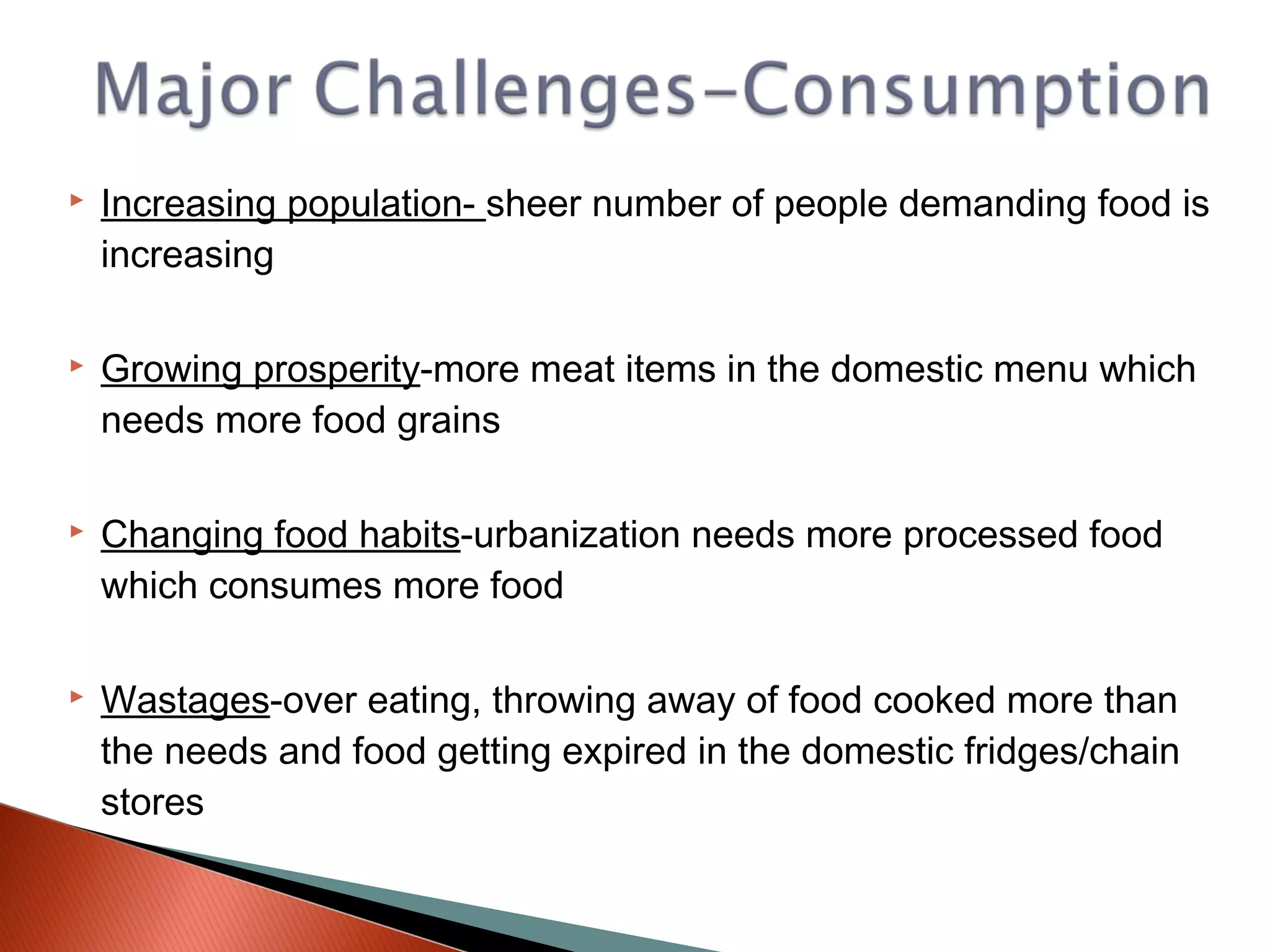
 Increasing population- sheer number of people demanding food is
increasing
 Growing prosperity-more meat items in the domestic menu which
needs more food grains
 Changing food habits-urbanization needs more processed food
which consumes more food
 Wastages-over eating, throwing away of food cooked more than
the needs and food getting expired in the domestic fridges/chain
stores
 Access to food-financial constraints due to persistent
poverty, inequality and lack of sufficient job
opportunities
 Access to food-physical constraints, due to bad
governance, infrastructural inadequacies or wrong
policy framework
 Food Denial to people and communities due to
militancy, civil war or proxy wars
 Poor commitment of the ruling elite to ensure this
fundamental right through proper legislation
 Not providing good governance whereby people have
freedom to get food grains without any hassle
 Not improving overall law and order and security situation
in the country for peaceful movement of the food grains
and its convenient availability
 Not making special arrangements for the provision of food
grains in conflict/disaster prone areas
Food Security–Country Responses
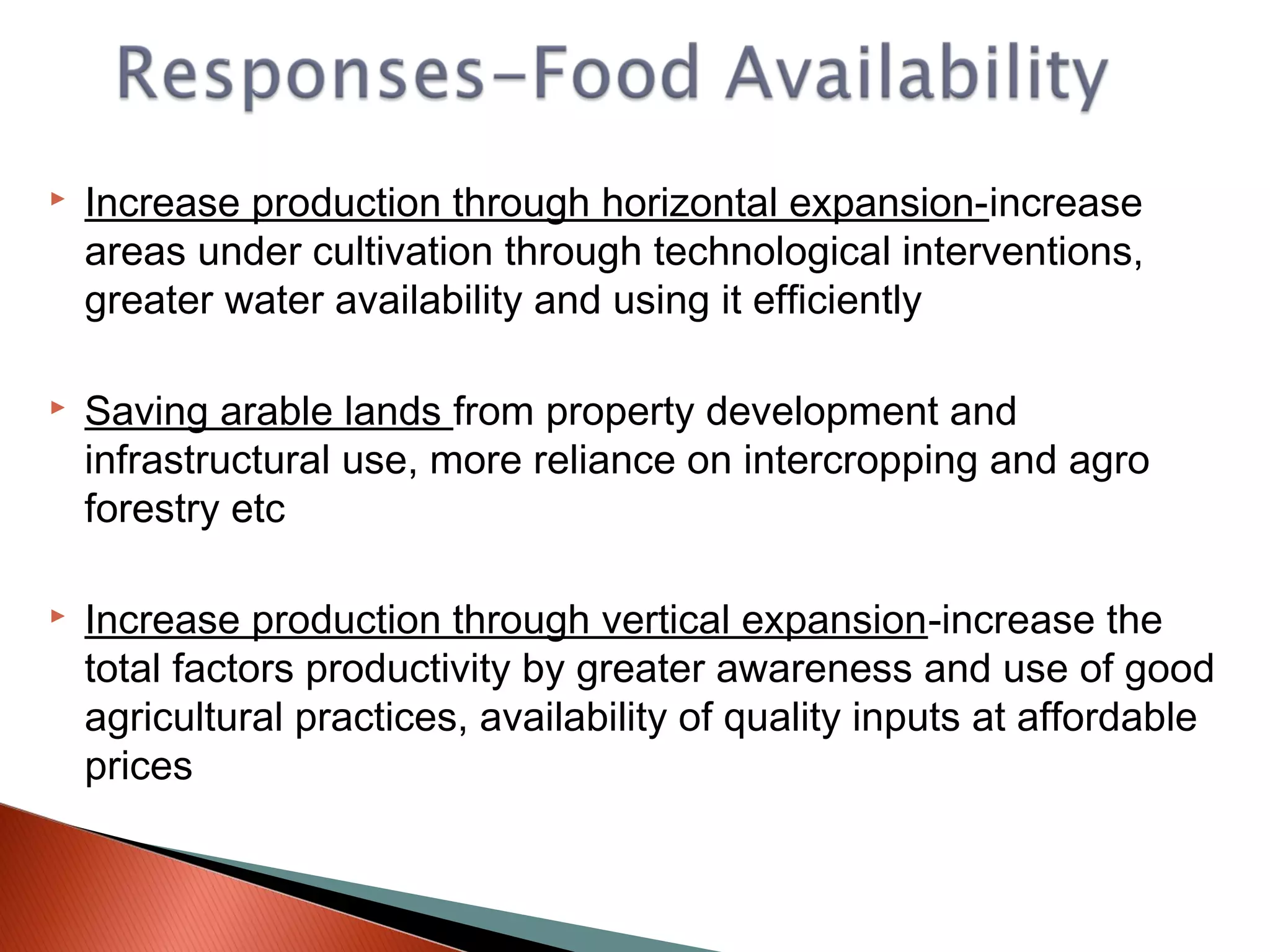
 Increase production through horizontal expansion-increase
areas under cultivation through technological interventions,
greater water availability and using it efficiently
 Saving arable lands from property development and
infrastructural use, more reliance on intercropping and agro
forestry etc
 Increase production through vertical expansion-increase the
total factors productivity by greater awareness and use of good
agricultural practices, availability of quality inputs at affordable
prices
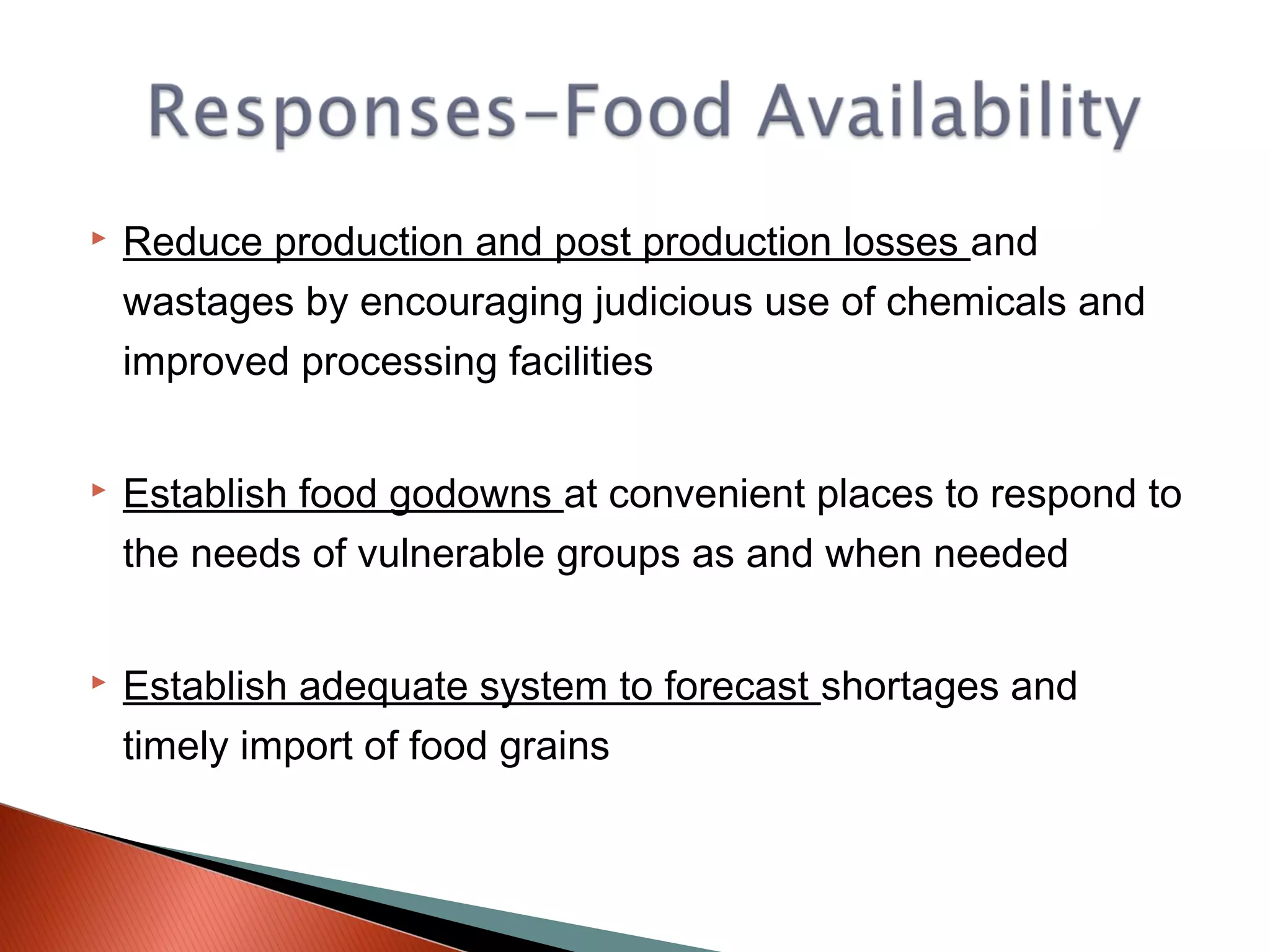
 Reduce production and post production losses and
wastages by encouraging judicious use of chemicals and
improved processing facilities
 Establish food godowns at convenient places to respond to
the needs of vulnerable groups as and when needed
 Establish adequate system to forecast shortages and
timely import of food grains
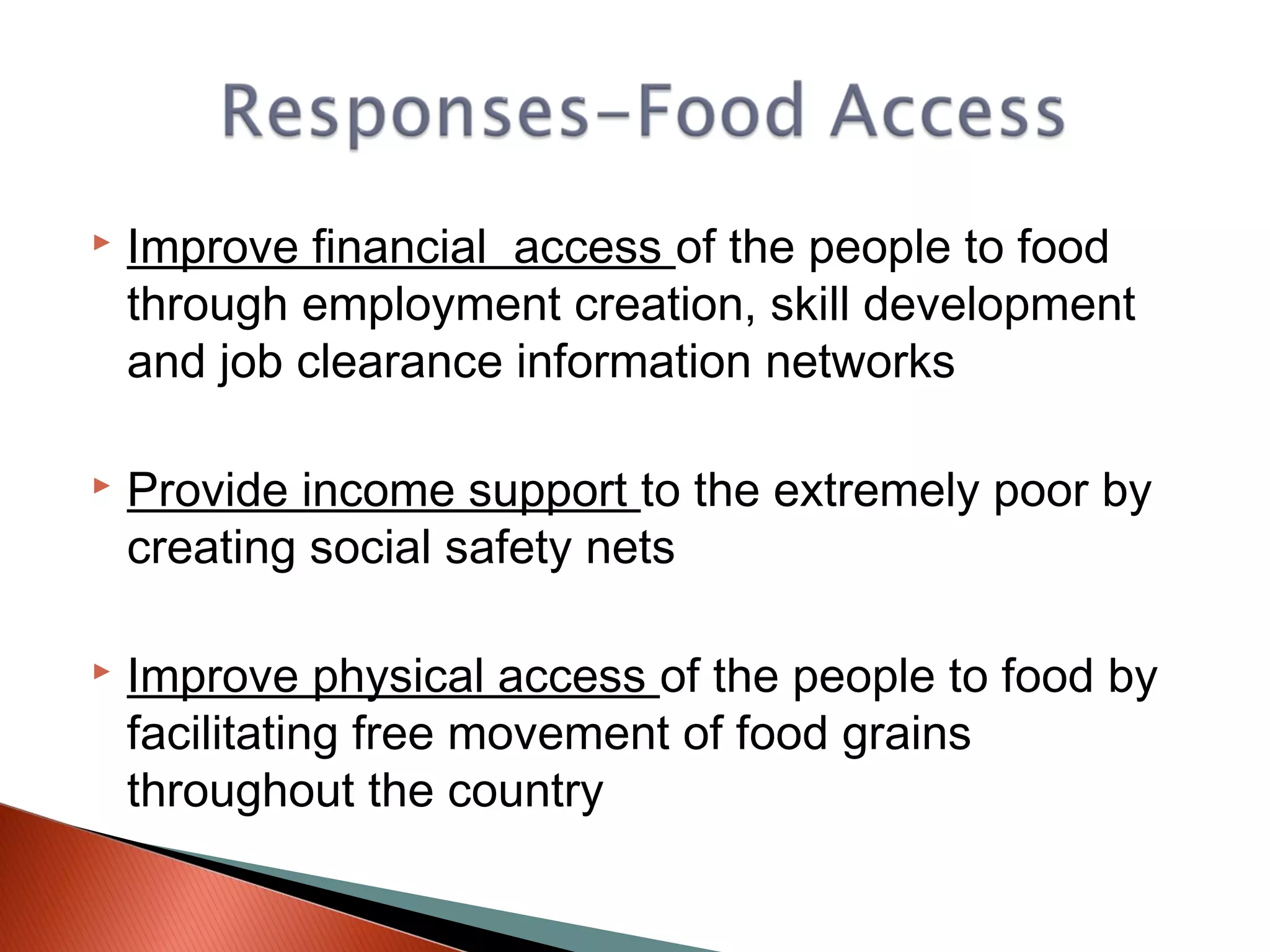
 Improve financial access of the people to food
through employment creation, skill development
and job clearance information networks
 Provide income support to the extremely poor by
creating social safety nets
 Improve physical access of the people to food by
facilitating free movement of food grains
throughout the country
 Improve general health care by allocating more resources to
promotive and preventive healthcare which is more cost effective
and helpful in the developing countries than the curative
 Population planning for arresting its rapid growth with particular
attention to mother and child healthcare
 Pay special attention to water borne diseases which are
widespread but can be controlled with dedicated efforts
 Food fortification to make it healthy and absorption friendly
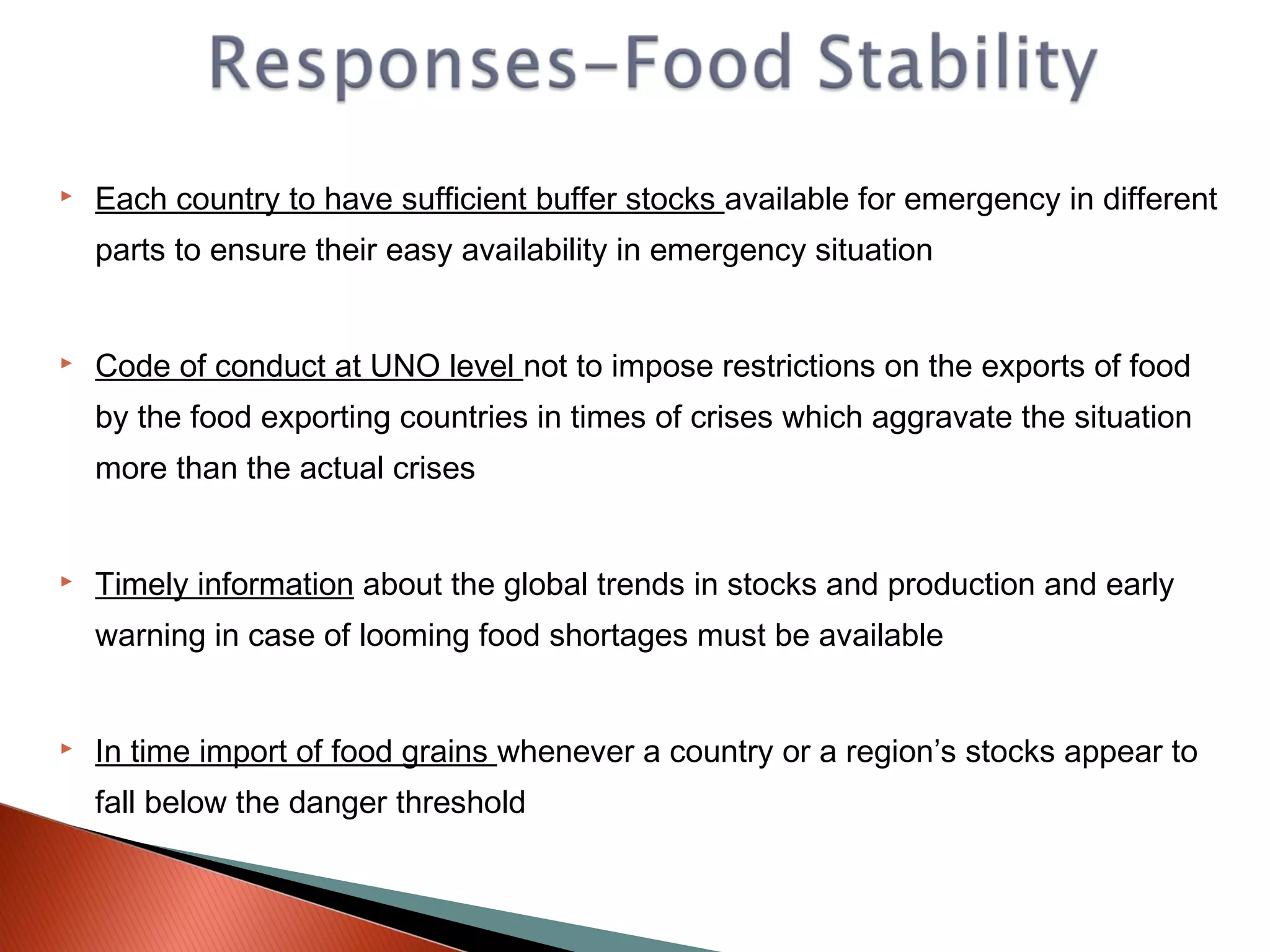
 Each country to have sufficient buffer stocks available for emergency in different
parts to ensure their easy availability in emergency situation
 Code of conduct at UNO level not to impose restrictions on the exports of food
by the food exporting countries in times of crises which aggravate the situation
more than the actual crises
 Timely information about the global trends in stocks and production and early
warning in case of looming food shortages must be available
 In time import of food grains whenever a country or a region’s stocks appear to
fall below the danger threshold
Food Security-Global Response
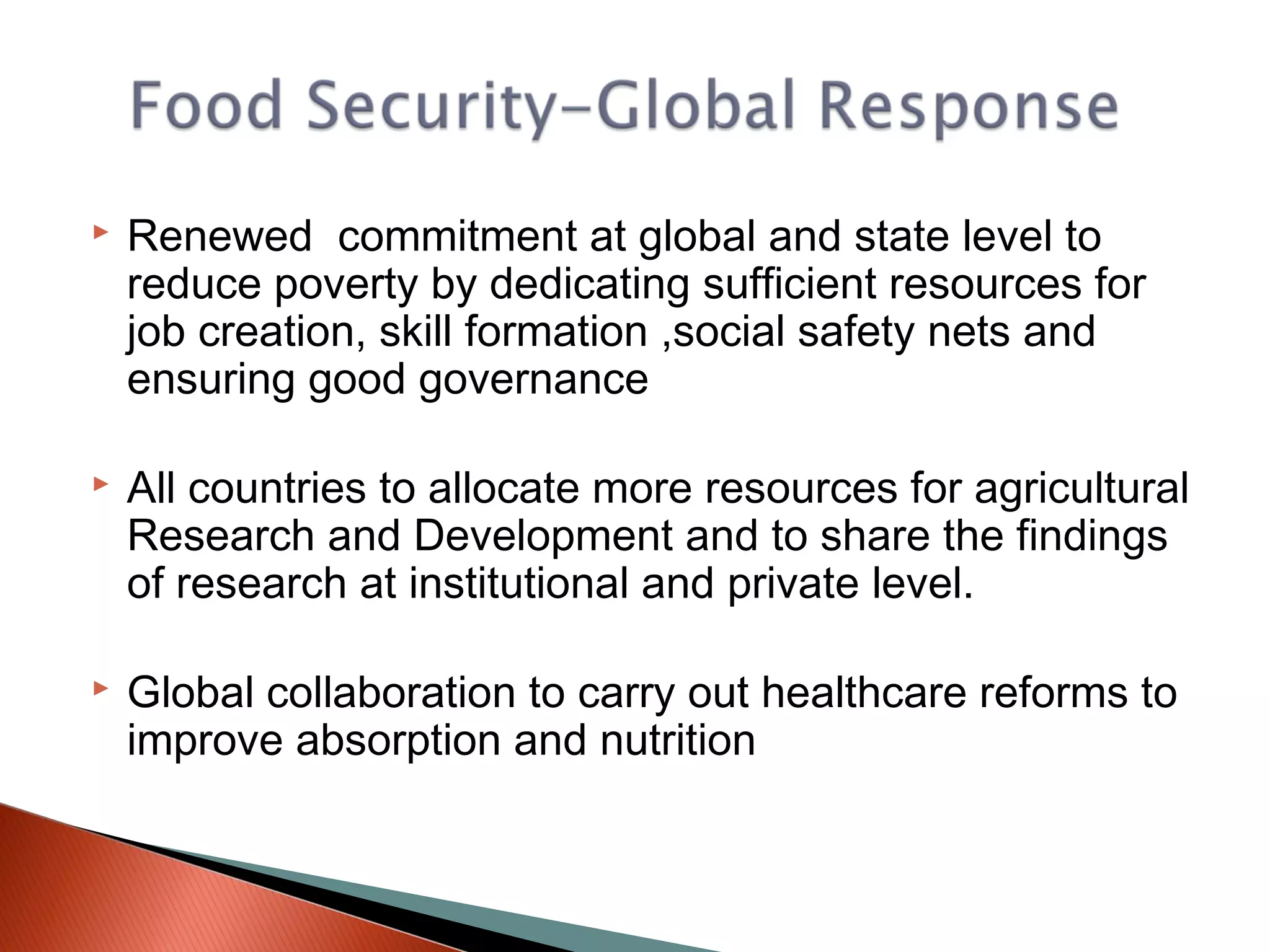
 Renewed commitment at global and state level to
reduce poverty by dedicating sufficient resources for
job creation, skill formation ,social safety nets and
ensuring good governance
 All countries to allocate more resources for agricultural
Research and Development and to share the findings
of research at institutional and private level.
 Global collaboration to carry out healthcare reforms to
improve absorption and nutrition
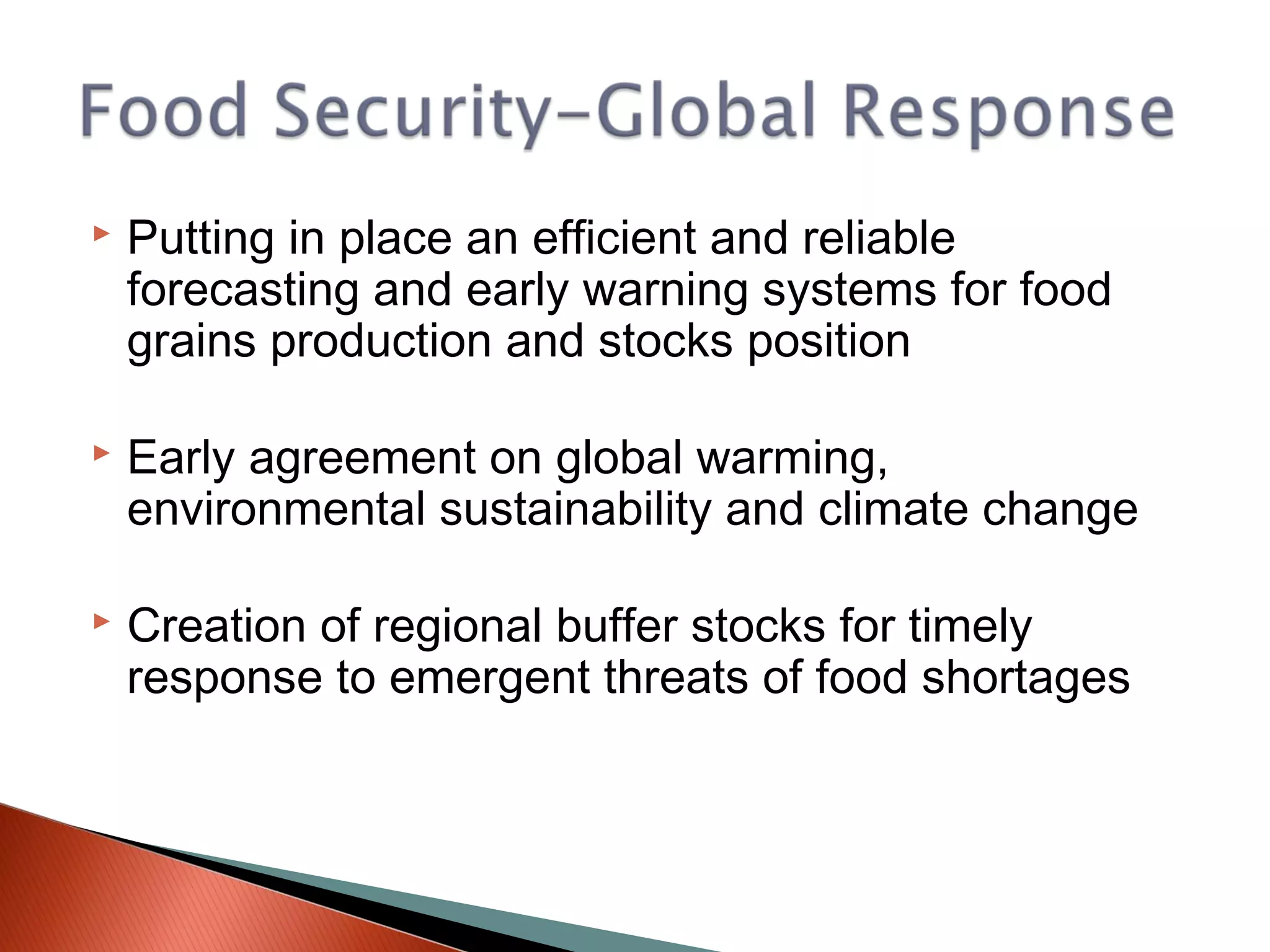
 Putting in place an efficient and reliable
forecasting and early warning systems for food
grains production and stocks position
 Early agreement on global warming,
environmental sustainability and climate change
 Creation of regional buffer stocks for timely
response to emergent threats of food shortages
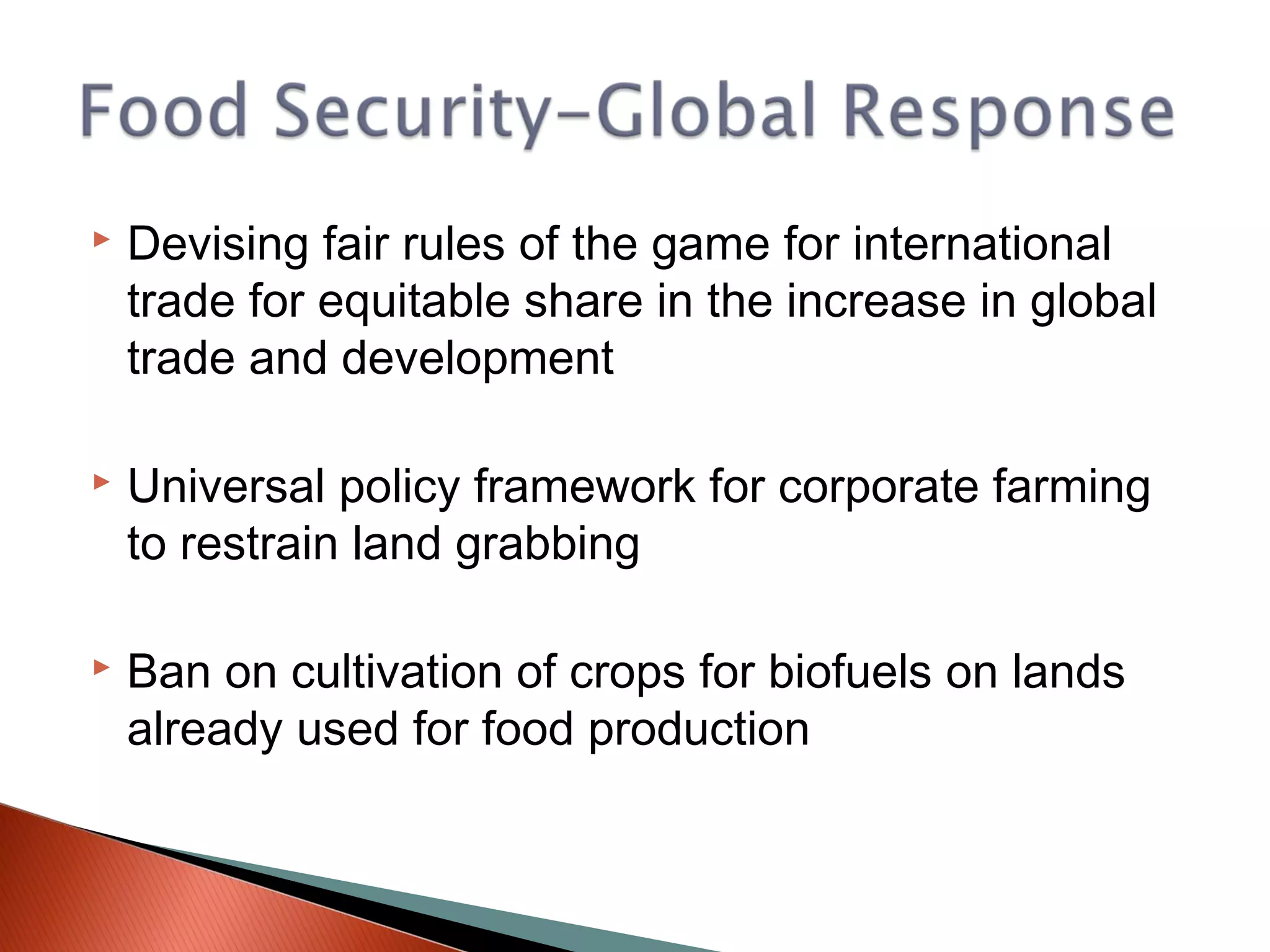
 Devising fair rules of the game for international
trade for equitable share in the increase in global
trade and development
 Universal policy framework for corporate farming
to restrain land grabbing
 Ban on cultivation of crops for biofuels on lands
already used for food production
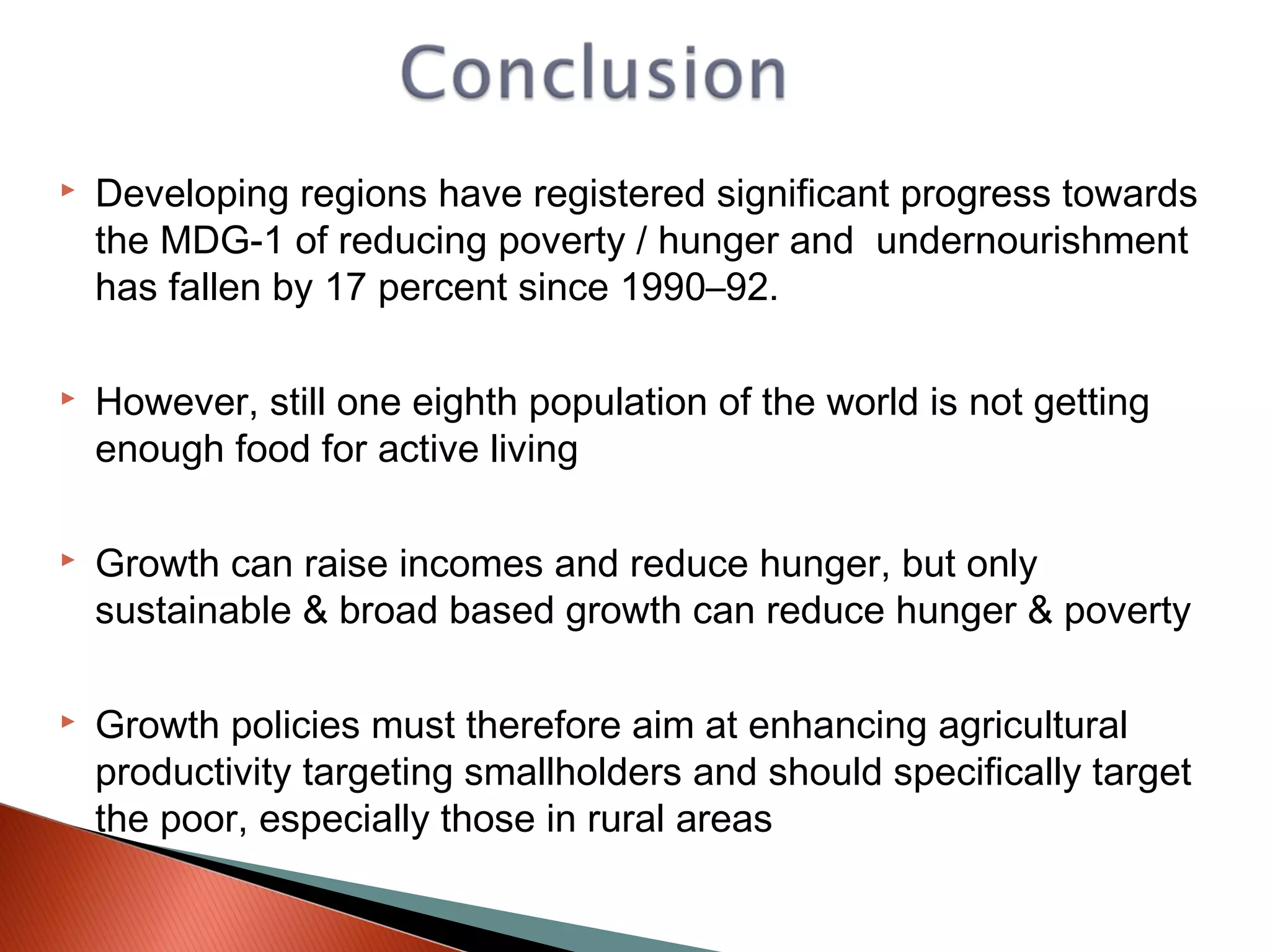
 Developing regions have registered significant progress towards
the MDG-1 of reducing poverty / hunger and undernourishment
has fallen by 17 percent since 1990–92.
 However, still one eighth population of the world is not getting
enough food for active living
 Growth can raise incomes and reduce hunger, but only
sustainable & broad based growth can reduce hunger & poverty
 Growth policies must therefore aim at enhancing agricultural
productivity targeting smallholders and should specifically target
the poor, especially those in rural areas
 Thank you for viewing the presentation. If you liked it,
kindly express it by clicking the like button below.
 Please feel free to express your opinion in the
comments section below.
 Its long article version is available at my website
www.shahidhussainraja.com
 Kindly visit the website and do record your views
Global Food Security: Challenges and Response

Global Food Security: Challenges and Response

  • 1.
    Shahid Hussain Raja IndependentConsultant-Public Policy www.shahidhussainraja.com May 10, 2015
  • 2.
     Introduction  Whatis food security  Evolution of concept  Global profile  Major challenges  Global response  Conclusion
  • 3.
     Food isthe first basic human need and fundamental right of every human being, having constitutional guarantees in almost all countries. That's why the UNO recognized the Right to food in the Declaration of Human Rights in 1948,vital for the enjoyment of all other rights.  Although food security has always been a crucial issue, there is increasing global concern in it after 2007/8 food crises which is reinforced whenever food prices start rising.  This presentation explains the concept of food security, its evolution, challenges at country level as well as at global level and ends with a set of recommendations.  Its detailed article version is available at my website www.shahidhussainraja.com
  • 4.
     Food Securityis an evolving concept, getting refined after new developments and greater awareness about its necessity  During 1970s,food crises created awareness for food security and led to formal institutional response globally. However food availability through buffer stocks was considered enough for ensuring food security  During 1980s,concern with increased poverty added access to food as essential as food availability for food security  During 1990s,interest in human development led to absorption of food also as an essential component of food security
  • 5.
     During 2000s,recurringfood crises necessitated to include stability as one of the main components of food security  During 2010s,evidence of increasing malnutrition among the children/females led to inclusion of nutrition also as an essential element of food security  Now food security invariably means five things; A. Food is available in the country B. It is accessible to people, physically and financially C. People are healthy to absorb it D. Food supplies /prices are stable over period E. It is nutritious enough to sustain a human body
  • 6.
    “when all peopleat all times have access to sufficient, safe, nutritious food to maintain a healthy and active life”. Food and Agriculture Organisation,UN Food insecurity is a situation of limited or uncertain availability of nutritionally adequate and safe foods or limited or uncertain ability to acquire acceptable foods in socially acceptable ways“ United States Department of Agriculture (USDA).[
  • 7.
    1990–92 2000–02 2005–072008–10 2011–13* World 1 015.3 957.3 906.6 878.2 842.3 Developed Regions 19.8 18.4 13.6 15.2 15.7 Developing Regions 995.5 938.9 892.9 863.0 826.6 Africa 177.6 214.3 217.6 226.0 226.4 Asia 751.3 662.3 619.6 585.5 552.0 Latina America & Caribbean 65.7 61.0 54.6 50.3 47.0 Oceania 0.8 1.2 1.1 1.1 1.2 Undernourished Population Source: State of Food Insecurity 2013 (FAO) Millions
  • 8.
     Despite substantialprogress made since the MDGs were launched in 2000, the number of people chronically undernourished are more than 870 million, bulk of whom are in Africa and Asia; almost 15 percent of their population is undernourished  Most of the progress made was before 2007/8 food crises. It means any food crises wipes out a significant proportion of progress made  Even the methodology used by FAO needs to be improved to truly capture the incidence of mal/undernourishment
  • 9.
     failed agriculturemarket regulations  lack of anti-dumping mechanisms  export restrictions and panic buying,  US Dollar Depreciation  increased farming for use in biofuels  world oil prices at more than $100 a barrel  global population growth  climate change  loss of agricultural land to residential and industrial development  growing consumer demand in China and India  Wikipedia
  • 10.
     Growth isessential for poverty alleviation which is a crucial condition for food and nutrition security  Yet this growth must be inclusive, ensuring the participation of poor in growth effort process for substantial improvement in food security  Within this framework, contents of growth must target the food and nutrition aspects to ensure food security---safe drinking water, health services, targeted food fortification  In the broader perspective, it is the agricultural development which makes the biggest dent in poverty reduction and hence food and nutrition security
  • 11.
     Despite thehighest growth rates which can be achieved, there will always remain a significant section of society which could not reap the benefits of growth for any reason.  State must create an effective, efficient and transparent system of Social Safety Nets for these people who are left in this growth process  Growth must ultimately accompanied by social and political structural changes such as people empowerment, gender balance, good governance, private sector participation etc
  • 12.
  • 13.
     Production-slow rateof growth of food production is adversely affecting the supply of food grains  Consumption-increasing consumption and wastages are putting pressures on food grains stocks  Distribution -bottlenecks pose threats to its availability even in normal times  Politics-political Issues also affecting food chains
  • 14.
     Decrease incultivated area-urbanization, industrialization and infrastructural projects on lands used for agriculture  Degradation of arable lands due to bad agricultural and irrigation practices  Stagnant yields due to less than adequate resource allocation for agricultural R&D  Climate change and environmental threats  Increased cultivation of Biofuels crops on areas previously used for food crops cultivation  Land grabbing by corporate firms in food insecure countries for cultivation of food grains and their export to rich countries
  • 15.
     Increasing population-sheer number of people demanding food is increasing  Growing prosperity-more meat items in the domestic menu which needs more food grains  Changing food habits-urbanization needs more processed food which consumes more food  Wastages-over eating, throwing away of food cooked more than the needs and food getting expired in the domestic fridges/chain stores
  • 16.
     Access tofood-financial constraints due to persistent poverty, inequality and lack of sufficient job opportunities  Access to food-physical constraints, due to bad governance, infrastructural inadequacies or wrong policy framework  Food Denial to people and communities due to militancy, civil war or proxy wars
  • 17.
     Poor commitmentof the ruling elite to ensure this fundamental right through proper legislation  Not providing good governance whereby people have freedom to get food grains without any hassle  Not improving overall law and order and security situation in the country for peaceful movement of the food grains and its convenient availability  Not making special arrangements for the provision of food grains in conflict/disaster prone areas
  • 18.
  • 19.
     Increase productionthrough horizontal expansion-increase areas under cultivation through technological interventions, greater water availability and using it efficiently  Saving arable lands from property development and infrastructural use, more reliance on intercropping and agro forestry etc  Increase production through vertical expansion-increase the total factors productivity by greater awareness and use of good agricultural practices, availability of quality inputs at affordable prices
  • 20.
     Reduce productionand post production losses and wastages by encouraging judicious use of chemicals and improved processing facilities  Establish food godowns at convenient places to respond to the needs of vulnerable groups as and when needed  Establish adequate system to forecast shortages and timely import of food grains
  • 21.
     Improve financialaccess of the people to food through employment creation, skill development and job clearance information networks  Provide income support to the extremely poor by creating social safety nets  Improve physical access of the people to food by facilitating free movement of food grains throughout the country
  • 22.
     Improve generalhealth care by allocating more resources to promotive and preventive healthcare which is more cost effective and helpful in the developing countries than the curative  Population planning for arresting its rapid growth with particular attention to mother and child healthcare  Pay special attention to water borne diseases which are widespread but can be controlled with dedicated efforts  Food fortification to make it healthy and absorption friendly
  • 23.
     Each countryto have sufficient buffer stocks available for emergency in different parts to ensure their easy availability in emergency situation  Code of conduct at UNO level not to impose restrictions on the exports of food by the food exporting countries in times of crises which aggravate the situation more than the actual crises  Timely information about the global trends in stocks and production and early warning in case of looming food shortages must be available  In time import of food grains whenever a country or a region’s stocks appear to fall below the danger threshold
  • 24.
  • 25.
     Renewed commitmentat global and state level to reduce poverty by dedicating sufficient resources for job creation, skill formation ,social safety nets and ensuring good governance  All countries to allocate more resources for agricultural Research and Development and to share the findings of research at institutional and private level.  Global collaboration to carry out healthcare reforms to improve absorption and nutrition
  • 26.
     Putting inplace an efficient and reliable forecasting and early warning systems for food grains production and stocks position  Early agreement on global warming, environmental sustainability and climate change  Creation of regional buffer stocks for timely response to emergent threats of food shortages
  • 27.
     Devising fairrules of the game for international trade for equitable share in the increase in global trade and development  Universal policy framework for corporate farming to restrain land grabbing  Ban on cultivation of crops for biofuels on lands already used for food production
  • 28.
     Developing regionshave registered significant progress towards the MDG-1 of reducing poverty / hunger and undernourishment has fallen by 17 percent since 1990–92.  However, still one eighth population of the world is not getting enough food for active living  Growth can raise incomes and reduce hunger, but only sustainable & broad based growth can reduce hunger & poverty  Growth policies must therefore aim at enhancing agricultural productivity targeting smallholders and should specifically target the poor, especially those in rural areas
  • 29.
     Thank youfor viewing the presentation. If you liked it, kindly express it by clicking the like button below.  Please feel free to express your opinion in the comments section below.  Its long article version is available at my website www.shahidhussainraja.com  Kindly visit the website and do record your views