
Shahid Hussain Raja
Author/Consultant/Trainer
Cambridge. UK
www.shahidhussainraja.com
 Introduction
 What is a Nation-state
 Origins of the Nation-State
 Essential Elements of Nation-State
 Challenges to Modern Nation-State
 Prospects of Nation-state system
 Conclusion
 Peace of Westphalia (1648) not only created the modern nation-state
system in Europe but also stipulated the basic rules of statecraft.
 Despite all the criticisms, the concept of state and nation took firm
roots in most parts of the world, thanks to colonialism.
 However, it is now facing existential challenges from different
sources
 This presentation is all about modern nation-state system, its origin,
essential elements, challenges it is facing, & its future prospects.
 The concept of a nation-state is difficult to define.The key distinction
is the identification of people with a polity in the nation-state.
 Declarative Theory of Statehood: “a nation-state is a type of state that
conjoins the political entity of a state to the cultural entity of a nation,
from which it aims to derive its political legitimacy to rule and
potentially its status as a sovereign state”
 The concept of a nation-state can be compared and contrasted with
that of the multinational state, city-state, empire, confederation, and
other state formations with which it may overlap.
 Origins of nation-states disputed. One theory, nation existed first,
then nationalist movements arose for sovereignty, and nation-state
was created to meet that demand
 To them, nation-state was an inadvertent by-product of few
developments
◦ 15th-century intellectual discoveries in political science, economics
◦ Rise of capitalism, mercantilism needing efficient state and greater
space
◦ Political geography, cartography and advances in map-making
accelerated it
 Some "modernization theories" of nationalism see it as a product of
government policies to unify and modernize an already existing state.
 Most theories see the nation-state as a modern European phenomenon
called the "Westphalian system" about the Treaty of Westphalia (1648)
 The balance of power that characterized that system depended on its
effectiveness upon clearly defined, centrally controlled, independent
entities, whether empires or nation-states, that recognized each
other's sovereignty and territory.
 Facilitated by developments such as state-mandated education, mass
literacy, and mass media (including print).
 Whether Peace of Westphalia(1648) created the modern nation-state
system or it just endorsed a trend is immaterial
 European colonial powers introduced it all over the world.
 Nation-state got identified with its four essential elements namely
◦ Territorial Integrity
◦ Sovereignty
◦ Nationalism
◦ Equality.
 Territorial integrity: A geographical entity whereby the protection of
the people living within its boundaries became its chief responsibility.
 Sovereignty: Internally, state’s right to order behaviour of its citizens,
and externally, its right to protect its national interest by any means
 Nationalism: which advocates identification of the individual with the
state in return for obedience to its laws.
 Equality: Finally, international law recognized all states as equal
sovereign entities with equal legal status and rights.
 Peace of Westphalia not only created the institution of the nation-state
but also stipulated the basic rules of the statecraft
 Rule of law, respect for human rights, and democratic governance are
now universal standards acknowledged in most of the constitutions
 Also separated state from religion in statecraft and made religion the
private affair of the people. Secularism is now its cornerstone
 Despite all the criticisms about its Western origins, the concept of state
and nation has taken firm roots in most parts of the world

 Despite all the criticisms about its Western origins, the concept of
state and nation took firm roots in most parts of the world – not
without conflicts and bloodshed.
 However, it is now facing an existential challenge from four different
trends namely
 Globalisation
 Decentralisation
 Sub-nationalism
 Regional groupings.
 Peace of Westphalia abolished the feudal system of Europe, divided it
into sovereign secular states with thick borderlines
 Within those borders, each respective government was the absolute
authority, gave sanctity to borders howsoever arbitrary they may be.
 Despite all ups and downs, wars, economic turmoil, and political
chaos, nation-state system has remained relatively stable.
 Globalisation is making state redundant player through integration of
commerce, finance, trade, technological developments
 No longer a conduit by which non-state/supra-state actors must filter
through to operate in and around its geographical sphere.
 Globalization has brought more FDI, built infrastructure, inspired
democratic movements and created emerging middle classes globally
 It is disrupting social fabrics of nation-state, causes unrest, financial
meltdown, poverty, hunger, dissension, ethnic crisis.
 Nation-state seems helpless due to inability of its current structure to
effectively harness its destructive elements.

 Rise of the demand for greater decentralisation by its federating units and
even by the mega-cities under its jurisdiction.
 Increasing population, rapid urbanisation, greater economic activity making
these provines/cities autonomous governance entities
 This process has accelerated from the 1970s onward, with the introduction
of various forms of regional autonomy in formerly centralized states.
 It is now common for provinces, states, and cities to deal directly with the
other nation-states, corporations, and other big cities
 Most modern nation-states are artificial creations, results of dissolution
of empires or end of colonialism; most are multi-ethnic, multi-lingual.
 Resultantly, in every state, there are efforts to convert these nationalities
into a single nation through a wset of state policies
 However, that is being challenged by emerging sub-nationalism in their
areas of jurisdiction particularly after separation of religion from state
 There is emerging a wide legitimacy gap for keeping the people
together; to create a solid foundation of unity that religion used to do.
 Peaceful conditions within a nation-state, led to the emergence of
capitalist- industrialist class as an extremely powerful stakeholder.
 They needed bigger areas of operation which was only possible within
bigger units of administration- EU type regional entities
 Emergence of capitalism as the dominant mode of production
globally is accelerating regional grouping, sidestepping the nation-
state
 It is added by outsourcing as a universally accepted form of business
organisation, technological developments,information technology
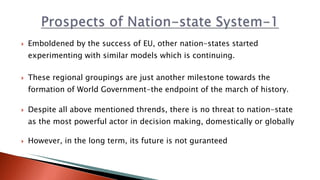
 Emboldened by the success of EU, other nation-states started
experimenting with similar models which is continuing.
 These regional groupings are just another milestone towards the
formation of World Government-the endpoint of the march of history.
 Despite all above mentioned thrends, there is no threat to nation-state
as the most powerful actor in decision making, domestically or globally
 However, in the long term, its future is not guranteed
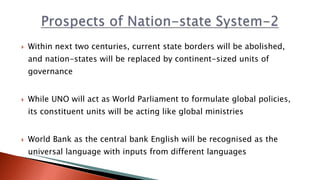
 Within next two centuries, current state borders will be abolished,
and nation-states will be replaced by continent-sized units of
governance
 While UNO will act as World Parliament to formulate global policies,
its constituent units will be acting like global ministries
 World Bank as the central bank English will be recognised as the
universal language with inputs from different languages
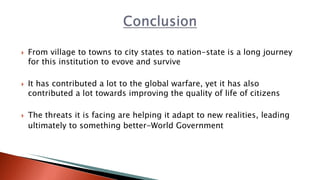
 From village to towns to city states to nation-state is a long journey
for this institution to evove and survive
 It has contributed a lot to the global warfare, yet it has also
contributed a lot towards improving the quality of life of citizens
 The threats it is facing are helping it adapt to new realities, leading
ultimately to something better-World Government
 If you like the presentation , kindly click the icon
 For any question, kindly email me at shahidraja@hotmail.com
 For downloading the presentation or its word version, please visit my
website
www.shahidhussainraja.com
This website contains large number of articles on diverse issues. Some
of these are presented in the next few slides
 Pakistan’s Difficulties at the Time of her Independence
http://www.shahidhussainraja.com/pakistans-difficulties-at-the-time-of-her-independence/
 Why Countries Break? Case of Bangladesh
http://www.shahidhussainraja.com/why-countries-break-case-of-bangladesh/
 Pakistan’s 13th IMF Programme: Prospects & Challenges
http://www.shahidhussainraja.com/pakistans-13th-imf-programme-prospects-challenges/
 Federalism in Pakistan: Challenges & Response
https://www.shahidhussainraja.com/federalism-in-pakistan-challengers-response/
 Water Issues in Pakistan
http://www.shahidhussainraja.com/water-issues-in-pakistan/
 Governance Reforms in Pakistan: Need and Content
http://www.shahidhussainraja.com/governance-reforms-in-pakistan-need-and-content/
 Pakistan’s Strategic Culture: Determinants & Dimensions
http://www.shahidhussainraja.com/pakistans-strategic-culture-determinants-dimensions/
 Pakistani Culture: Sources & Drivers
http://www.shahidhussainraja.com/pakistani-culture-sources-drivers/
 Improving Pakistan’s Global Image
http://www.shahidhussainraja.com/improving-pakistans-global-image/
 Two Nations Theory: Myths and Reality
http://www.shahidhussainraja.com/two-nations-theory-myths-and-reality/
 Why do Civil Service Reforms in Pakistan Fail?
http://www.shahidhussainraja.com/why-do-civil-service-reforms-in-pakistan-fail/
 Is Pakistan a Failed State?
http://www.shahidhussainraja.com/is-pakistan-a-failed-state/
 Pakistan Ideology: Sources & Features
http://www.shahidhussainraja.com/what-is-pakistan-ideology-myths-and-content/
 International Relations: Definition, Scope & Subject Matter
(http://www.shahidhussainraja.com/the-scope-of-international-relations/)
 Modern Nation-state System: Challenges & Prospects
(http://www.shahidhussainraja.com/modern-nation-state-system-challenges-prospects/)
 Foreign Policy: Features, Success Factors & Challenges
(http://www.shahidhussainraja.com/foreign-policy-features-success-factors-challenges/)
 Clash of Civilisations by Huntington
http://www.shahidhussainraja.com/clash-of-civilizations-a-critique/
 Globalization: Compressing Time and Space -Part 1& 2
http://www.shahidhussainraja.com/globalization-compressing-time-and-space-part-1/
/http://www.shahidhussainraja.com/globalization-compressing-time-and-space-part-2/
 Determinants of Foreign Policy
http://www.shahidhussainraja.com/determinants-of-foreign-policy/
 Foreign Policy: Tools & Implements
http://www.shahidhussainraja.com/foreign-policy-tools-instruments/
 National Interest: Meaning & Components
http://www.shahidhussainraja.com/national-interest-meaning-components/
 World Peace: A Norm or an Aberration?
http://www.shahidhussainraja.com/world-peace-a-norm-or-an-aberration/
 End of History by Francis Fukuyama
http://www.shahidhussainraja.com/end-of-history-by-francis-fukuyama-a-critique/
 Breakup of Soviet Union: Causes & Consequences
http://www.shahidhussainraja.com/breakup-of-the-soviet-union-causes-consequences/
 Global Terrorism: Challenges & Response – Part 1 & 2
http://www.shahidhussainraja.com/global-terrorism-challenges-response/
http://www.shahidhussainraja.com/global-terrorism-challenges-response-part-2/
 War on Terror: Causes, Course, Costs and Consequences Part 1 & 2
http://www.shahidhussainraja.com/war-on-terror-causes-course-costs-and-consequences-part-1/
http://www.shahidhussainraja.com/war-on-terror-causes-course-costs-and-consequences-part-2/
 Arab Spring: Genesis, Causes of Failure & Lessons Learnt
http://www.shahidhussainraja.com/arab-spring-genesis-causes-of-failure-lessons-learnt/
 Islamophobia: Genesis, Challenges & Response
http://www.shahidhussainraja.com/islamophobia-genesis-challenges-response/
 Vietnam War: Causes & Consequences
http://www.shahidhussainraja.com/vietnam-war-causes-course-and-consequences/
 Nine Drivers of Sino-American Cold War
http://www.shahidhussainraja.com/9-drivers-of-america-china-cold-war/
 IMF Programmes: Do they help Developing Countries?
http://www.shahidhussainraja.com/imf-programme-does-it-help-a-developing-country/
 American Interests in Afghanistan
http://www.shahidhussainraja.com/american-interests-in-afghanistan/
 Reasons for Soviet Invasion of Afghanistan in 1979
http://www.shahidhussainraja.com/why-did-soviet-union-enter-afghanistan-in-1979/
 The Middle East Crises: Genesis and Dimensions
http://www.shahidhussainraja.com/the-middle-east-crises-genesis-and-dimensions/
 China Iran Relations: Past, Present & Future
http://www.shahidhussainraja.com/china-iran-relations-past-present-future/
Modern Nation-state System: Challenhes & Prospects

Modern Nation-state System: Challenhes & Prospects

  • 1.
  • 2.
     Introduction  Whatis a Nation-state  Origins of the Nation-State  Essential Elements of Nation-State  Challenges to Modern Nation-State  Prospects of Nation-state system  Conclusion
  • 3.
     Peace ofWestphalia (1648) not only created the modern nation-state system in Europe but also stipulated the basic rules of statecraft.  Despite all the criticisms, the concept of state and nation took firm roots in most parts of the world, thanks to colonialism.  However, it is now facing existential challenges from different sources  This presentation is all about modern nation-state system, its origin, essential elements, challenges it is facing, & its future prospects.
  • 4.
     The conceptof a nation-state is difficult to define.The key distinction is the identification of people with a polity in the nation-state.  Declarative Theory of Statehood: “a nation-state is a type of state that conjoins the political entity of a state to the cultural entity of a nation, from which it aims to derive its political legitimacy to rule and potentially its status as a sovereign state”  The concept of a nation-state can be compared and contrasted with that of the multinational state, city-state, empire, confederation, and other state formations with which it may overlap.
  • 5.
     Origins ofnation-states disputed. One theory, nation existed first, then nationalist movements arose for sovereignty, and nation-state was created to meet that demand  To them, nation-state was an inadvertent by-product of few developments ◦ 15th-century intellectual discoveries in political science, economics ◦ Rise of capitalism, mercantilism needing efficient state and greater space ◦ Political geography, cartography and advances in map-making accelerated it
  • 6.
     Some "modernizationtheories" of nationalism see it as a product of government policies to unify and modernize an already existing state.  Most theories see the nation-state as a modern European phenomenon called the "Westphalian system" about the Treaty of Westphalia (1648)  The balance of power that characterized that system depended on its effectiveness upon clearly defined, centrally controlled, independent entities, whether empires or nation-states, that recognized each other's sovereignty and territory.  Facilitated by developments such as state-mandated education, mass literacy, and mass media (including print).
  • 7.
     Whether Peaceof Westphalia(1648) created the modern nation-state system or it just endorsed a trend is immaterial  European colonial powers introduced it all over the world.  Nation-state got identified with its four essential elements namely ◦ Territorial Integrity ◦ Sovereignty ◦ Nationalism ◦ Equality.
  • 8.
     Territorial integrity:A geographical entity whereby the protection of the people living within its boundaries became its chief responsibility.  Sovereignty: Internally, state’s right to order behaviour of its citizens, and externally, its right to protect its national interest by any means  Nationalism: which advocates identification of the individual with the state in return for obedience to its laws.  Equality: Finally, international law recognized all states as equal sovereign entities with equal legal status and rights.
  • 9.
     Peace ofWestphalia not only created the institution of the nation-state but also stipulated the basic rules of the statecraft  Rule of law, respect for human rights, and democratic governance are now universal standards acknowledged in most of the constitutions  Also separated state from religion in statecraft and made religion the private affair of the people. Secularism is now its cornerstone  Despite all the criticisms about its Western origins, the concept of state and nation has taken firm roots in most parts of the world 
  • 10.
     Despite allthe criticisms about its Western origins, the concept of state and nation took firm roots in most parts of the world – not without conflicts and bloodshed.  However, it is now facing an existential challenge from four different trends namely  Globalisation  Decentralisation  Sub-nationalism  Regional groupings.
  • 11.
     Peace ofWestphalia abolished the feudal system of Europe, divided it into sovereign secular states with thick borderlines  Within those borders, each respective government was the absolute authority, gave sanctity to borders howsoever arbitrary they may be.  Despite all ups and downs, wars, economic turmoil, and political chaos, nation-state system has remained relatively stable.  Globalisation is making state redundant player through integration of commerce, finance, trade, technological developments
  • 12.
     No longera conduit by which non-state/supra-state actors must filter through to operate in and around its geographical sphere.  Globalization has brought more FDI, built infrastructure, inspired democratic movements and created emerging middle classes globally  It is disrupting social fabrics of nation-state, causes unrest, financial meltdown, poverty, hunger, dissension, ethnic crisis.  Nation-state seems helpless due to inability of its current structure to effectively harness its destructive elements. 
  • 13.
     Rise ofthe demand for greater decentralisation by its federating units and even by the mega-cities under its jurisdiction.  Increasing population, rapid urbanisation, greater economic activity making these provines/cities autonomous governance entities  This process has accelerated from the 1970s onward, with the introduction of various forms of regional autonomy in formerly centralized states.  It is now common for provinces, states, and cities to deal directly with the other nation-states, corporations, and other big cities
  • 14.
     Most modernnation-states are artificial creations, results of dissolution of empires or end of colonialism; most are multi-ethnic, multi-lingual.  Resultantly, in every state, there are efforts to convert these nationalities into a single nation through a wset of state policies  However, that is being challenged by emerging sub-nationalism in their areas of jurisdiction particularly after separation of religion from state  There is emerging a wide legitimacy gap for keeping the people together; to create a solid foundation of unity that religion used to do.
  • 15.
     Peaceful conditionswithin a nation-state, led to the emergence of capitalist- industrialist class as an extremely powerful stakeholder.  They needed bigger areas of operation which was only possible within bigger units of administration- EU type regional entities  Emergence of capitalism as the dominant mode of production globally is accelerating regional grouping, sidestepping the nation- state  It is added by outsourcing as a universally accepted form of business organisation, technological developments,information technology
  • 16.
     Emboldened bythe success of EU, other nation-states started experimenting with similar models which is continuing.  These regional groupings are just another milestone towards the formation of World Government-the endpoint of the march of history.  Despite all above mentioned thrends, there is no threat to nation-state as the most powerful actor in decision making, domestically or globally  However, in the long term, its future is not guranteed
  • 17.
     Within nexttwo centuries, current state borders will be abolished, and nation-states will be replaced by continent-sized units of governance  While UNO will act as World Parliament to formulate global policies, its constituent units will be acting like global ministries  World Bank as the central bank English will be recognised as the universal language with inputs from different languages
  • 18.
     From villageto towns to city states to nation-state is a long journey for this institution to evove and survive  It has contributed a lot to the global warfare, yet it has also contributed a lot towards improving the quality of life of citizens  The threats it is facing are helping it adapt to new realities, leading ultimately to something better-World Government
  • 19.
     If youlike the presentation , kindly click the icon  For any question, kindly email me at shahidraja@hotmail.com  For downloading the presentation or its word version, please visit my website www.shahidhussainraja.com This website contains large number of articles on diverse issues. Some of these are presented in the next few slides
  • 20.
     Pakistan’s Difficultiesat the Time of her Independence http://www.shahidhussainraja.com/pakistans-difficulties-at-the-time-of-her-independence/  Why Countries Break? Case of Bangladesh http://www.shahidhussainraja.com/why-countries-break-case-of-bangladesh/  Pakistan’s 13th IMF Programme: Prospects & Challenges http://www.shahidhussainraja.com/pakistans-13th-imf-programme-prospects-challenges/  Federalism in Pakistan: Challenges & Response https://www.shahidhussainraja.com/federalism-in-pakistan-challengers-response/  Water Issues in Pakistan http://www.shahidhussainraja.com/water-issues-in-pakistan/  Governance Reforms in Pakistan: Need and Content http://www.shahidhussainraja.com/governance-reforms-in-pakistan-need-and-content/  Pakistan’s Strategic Culture: Determinants & Dimensions http://www.shahidhussainraja.com/pakistans-strategic-culture-determinants-dimensions/
  • 21.
     Pakistani Culture:Sources & Drivers http://www.shahidhussainraja.com/pakistani-culture-sources-drivers/  Improving Pakistan’s Global Image http://www.shahidhussainraja.com/improving-pakistans-global-image/  Two Nations Theory: Myths and Reality http://www.shahidhussainraja.com/two-nations-theory-myths-and-reality/  Why do Civil Service Reforms in Pakistan Fail? http://www.shahidhussainraja.com/why-do-civil-service-reforms-in-pakistan-fail/  Is Pakistan a Failed State? http://www.shahidhussainraja.com/is-pakistan-a-failed-state/  Pakistan Ideology: Sources & Features http://www.shahidhussainraja.com/what-is-pakistan-ideology-myths-and-content/
  • 22.
     International Relations:Definition, Scope & Subject Matter (http://www.shahidhussainraja.com/the-scope-of-international-relations/)  Modern Nation-state System: Challenges & Prospects (http://www.shahidhussainraja.com/modern-nation-state-system-challenges-prospects/)  Foreign Policy: Features, Success Factors & Challenges (http://www.shahidhussainraja.com/foreign-policy-features-success-factors-challenges/)  Clash of Civilisations by Huntington http://www.shahidhussainraja.com/clash-of-civilizations-a-critique/  Globalization: Compressing Time and Space -Part 1& 2 http://www.shahidhussainraja.com/globalization-compressing-time-and-space-part-1/ /http://www.shahidhussainraja.com/globalization-compressing-time-and-space-part-2/
  • 23.
     Determinants ofForeign Policy http://www.shahidhussainraja.com/determinants-of-foreign-policy/  Foreign Policy: Tools & Implements http://www.shahidhussainraja.com/foreign-policy-tools-instruments/  National Interest: Meaning & Components http://www.shahidhussainraja.com/national-interest-meaning-components/  World Peace: A Norm or an Aberration? http://www.shahidhussainraja.com/world-peace-a-norm-or-an-aberration/  End of History by Francis Fukuyama http://www.shahidhussainraja.com/end-of-history-by-francis-fukuyama-a-critique/  Breakup of Soviet Union: Causes & Consequences http://www.shahidhussainraja.com/breakup-of-the-soviet-union-causes-consequences/
  • 24.
     Global Terrorism:Challenges & Response – Part 1 & 2 http://www.shahidhussainraja.com/global-terrorism-challenges-response/ http://www.shahidhussainraja.com/global-terrorism-challenges-response-part-2/  War on Terror: Causes, Course, Costs and Consequences Part 1 & 2 http://www.shahidhussainraja.com/war-on-terror-causes-course-costs-and-consequences-part-1/ http://www.shahidhussainraja.com/war-on-terror-causes-course-costs-and-consequences-part-2/  Arab Spring: Genesis, Causes of Failure & Lessons Learnt http://www.shahidhussainraja.com/arab-spring-genesis-causes-of-failure-lessons-learnt/  Islamophobia: Genesis, Challenges & Response http://www.shahidhussainraja.com/islamophobia-genesis-challenges-response/  Vietnam War: Causes & Consequences http://www.shahidhussainraja.com/vietnam-war-causes-course-and-consequences/
  • 25.
     Nine Driversof Sino-American Cold War http://www.shahidhussainraja.com/9-drivers-of-america-china-cold-war/  IMF Programmes: Do they help Developing Countries? http://www.shahidhussainraja.com/imf-programme-does-it-help-a-developing-country/  American Interests in Afghanistan http://www.shahidhussainraja.com/american-interests-in-afghanistan/  Reasons for Soviet Invasion of Afghanistan in 1979 http://www.shahidhussainraja.com/why-did-soviet-union-enter-afghanistan-in-1979/  The Middle East Crises: Genesis and Dimensions http://www.shahidhussainraja.com/the-middle-east-crises-genesis-and-dimensions/  China Iran Relations: Past, Present & Future http://www.shahidhussainraja.com/china-iran-relations-past-present-future/