Global Food Security Challenges and OpportunitiesShenggen FanDirector GeneralInternational Food Policy Research InstituteUniversity of Nebraska-Lincoln’s Interdisciplinary Research Initiative in Food, Water, and Energy Resources Policy Event, Nebraska, April 13, 2011
Key messagesFood security challenges remain largeA development agenda with greater support for food security is neededThe role of policy research is crucial
Food security challenges remain large
The goal of halving hunger is off-trackNumber of hungry people, 1990-2015946584Source: Fan 2010
Challenges to global food securityFood price volatilityEnergy/BiofuelsPopulation growth and demographic changesLand and water constraintsClimate change
Food price hikes and volatilityGlobal hikes since June 2010Maize: 90%Wheat: 82%High domestic food inflationChina: 10% (Jan. 2011, y-o-y)India: 11% (Feb. 2011, y-o-y) Driven by non-staplesVolatility due toNatural disastersPanic purchasesTrade restrictions, etc.Source:  FAO 2011
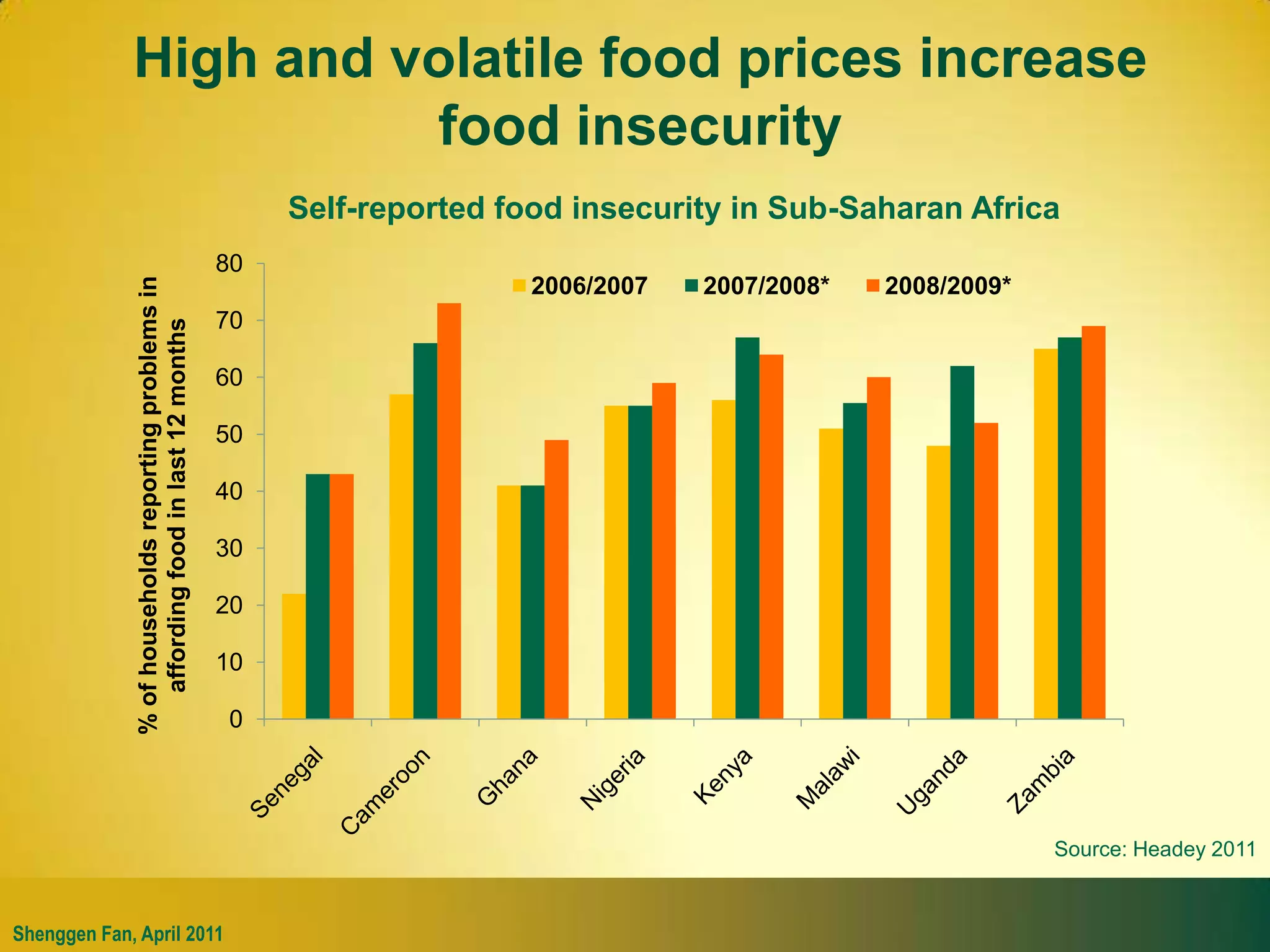
High and volatile food prices increase food insecuritySelf-reported food insecurity in Sub-Saharan AfricaSource: Headey 2011
Rapidly growing population and demographic changeWorld population reaches 9 billion by 2050All growth to come from urban areasMost growth to come from developing countriesSource: FAO 2009.Larger and more urban population will demand more and better food
Rising energy prices influence food securityRising energy prices cause food prices to increase, rather than the reverse (Heady and Fan 2010) Rising energy prices make biofuels more profitable, rather than agricultural production more expensive (Abbott, Hurt, and Tyner 2008)Source: Data from IMF 2011
Biofuel boomWorld ethanol and biodiesel productionBiofuel production to more than double from 2007-09 to 2019 (OECD-FAO 2010)Biofuel demand to grow four-fold between 2008 and 2035 (IEA 2010)Biofuels support to rise 2009: $20 bnFrom 2010 to 2020: $45 bnFrom 2011 to 2035: $65 bnSource: Data from Earth Policy Institute 2011
Food-fuel competition(e.g. U.S.maize)Source: Data from Earth Policy Institute 2011Source: Data from USDA 2011; Headey 2011
Biofuels will impact food security(2020, compared to baseline)Changes in calorie availability (%)Price changes (%)Source: Rosegrant  et al. 2008Changes in number of malnourished children (‘000s)
Growing land constraintsArable land per capita (ha in use per person)Source: Bruinsma 2009Global extent of soils with low nutrient capital reservesSource: Ahamed et al 2006
Severe water constraintsWith “business as usual,” high water stress by 2050 puts at risk:52% of global population
49% of global grain production
45% of global GDPSource: Veolia Water  and IFPRI 2011
Climate change will push up food prices World food price increases under various scenarios, 2010–2050(% change from 2010)Source: Nelson et al. 2010
A development agenda with greater support for food security is needed
Address food price volatilityPromote effective policies and technology investments to minimize food-fuel competitionSupport transparent, fair, and open global trade to enhance efficiency of global agricultural markets Create global, physical, shared grain reserve to address food price crisesEstablish an international working group to monitor world food situation and catalyze action
Invest in agriculture and smallholder productivitySource: Data from IFPRI SPEED databaseImprove access to quality seeds, fertilizer, financial and extension services, crop insurance, new technologies, rural infrastructure
Promote safety nets that increase productive capacity Ethiopia’s Productive Safety Nets Program (PSNP)Improved daily/capita caloric acquisition in last 7 days by 10%Enhanced food security in 2004-06 by 0.36 monthsRise in credit use by 12% pointsIncreased use of fertilizer by 11% pointsIncreased use of improved seeds by 5% pointsSource: Gilligan, Hoddinott, and Taffesse 2009
Promote land productivity improvementsCreate awareness of sustainable land management (SLM) practices Provide technical support for often knowledge-intensive SLM practicesSupport generation of innovative SLM practices (e.g. fertilizer micro dosing and packaging, biomass transfer, manure management)Invest in water storage or distribution to improve irrigation efficiencyIncrease finance of irrigation investments, esp. for small farmersSource: Nkonya et al. 2011, forthcoming
Sustainable land management (SLM) practices have win–win outcomes  SLM practices: (evidence from Kenya, Niger, Nigeria, and Uganda)control soil erosion increase soil carbon stockincrease crop yieldsreduce climate-induced production risks enhance agricultural productivity and incomesExamples of SLM practices: irrigation, agroforestry, fertilizers, mulching, crop residues, improved fallow, compostSource: Kato et al. 2010; Nkonya et al. 2011, forthcoming
Promote water productivity improvementsHigher levels of water reuse by all users of waterImprovements and evolution of water technologyWater and wastewater infrastructure improvementsExtension of services to rural and urban poor populations Greater energy efficiency with increased use of renewable energySource: Veolia Water  and IFPRI 2011
Sustainable water management has high pay-offsCompared to “business as usual,” it can de-risk:>1 bn people~$17 trillion of GDP>20% of children likely to suffer from malnutrition(with higher investments in rural water supply and sanitation and  female secondary education)Source: Veolia Water  and IFPRI 2011
Invest in climate change adaptation and mitigation esp. through agricultureAdaptation: e.g. improved land managementadjustment of planting dates introduction of new crop varietiesMitigation: e.g. improved energy efficiency and crop yieldsland management techniques to increase carbon storageAt least additional US$7 billion agricultural productivity investments are needed annually to offset adverse effects on human well-beingSource: IPCC 2007; Nelson et al. 2009
The role of policy research is crucial
Changing global policy landscapeEmerging issues and new actorsHigh and volatile prices, increasing natural resource stresses, climate change, demographic shifts etc.Emerging economies, private sector, philanthropic organizations etc. Emphasis on country-driven and -owned development strategiesIncreased demand for policy research
Role of policy researchPolicy research evolves beyond technology e.g. to macroeconomics, trade, energy, and social protectionContribution of policy research to poverty and hunger reductionDirect: Increases investment in food security, agriculture, and rural development and improves resource allocationIndirect: Creates enabling environment for agricultural technology innovation and adoption in developing countries
Impacts of policy researchVietnam rice marketing and policy researchInfluenced timing of changes in rice policiesGenerated benefits worth US$45-91 millionBangladesh food-for-education program researchImproved targeting and strengthened capacityGenerated benefits of about US$248 millionEvaluation of Mexico’s PROGRESAGuided program investments and implementationPublic investment researchContributed to public investment strategies in many Asian and African countries
Policy research insights for resource allocationSource: Fan, Mogues, and Benin 2009 Note: “n.e.” indicates not estimated

Global Food Security Challenges and Opportunities

  • 1.
    Global Food SecurityChallenges and OpportunitiesShenggen FanDirector GeneralInternational Food Policy Research InstituteUniversity of Nebraska-Lincoln’s Interdisciplinary Research Initiative in Food, Water, and Energy Resources Policy Event, Nebraska, April 13, 2011
  • 2.
    Key messagesFood securitychallenges remain largeA development agenda with greater support for food security is neededThe role of policy research is crucial
  • 3.
  • 4.
    The goal ofhalving hunger is off-trackNumber of hungry people, 1990-2015946584Source: Fan 2010
  • 5.
    Challenges to globalfood securityFood price volatilityEnergy/BiofuelsPopulation growth and demographic changesLand and water constraintsClimate change
  • 6.
    Food price hikesand volatilityGlobal hikes since June 2010Maize: 90%Wheat: 82%High domestic food inflationChina: 10% (Jan. 2011, y-o-y)India: 11% (Feb. 2011, y-o-y) Driven by non-staplesVolatility due toNatural disastersPanic purchasesTrade restrictions, etc.Source: FAO 2011
  • 7.
    High and volatilefood prices increase food insecuritySelf-reported food insecurity in Sub-Saharan AfricaSource: Headey 2011
  • 8.
    Rapidly growing populationand demographic changeWorld population reaches 9 billion by 2050All growth to come from urban areasMost growth to come from developing countriesSource: FAO 2009.Larger and more urban population will demand more and better food
  • 9.
    Rising energy pricesinfluence food securityRising energy prices cause food prices to increase, rather than the reverse (Heady and Fan 2010) Rising energy prices make biofuels more profitable, rather than agricultural production more expensive (Abbott, Hurt, and Tyner 2008)Source: Data from IMF 2011
  • 10.
    Biofuel boomWorld ethanoland biodiesel productionBiofuel production to more than double from 2007-09 to 2019 (OECD-FAO 2010)Biofuel demand to grow four-fold between 2008 and 2035 (IEA 2010)Biofuels support to rise 2009: $20 bnFrom 2010 to 2020: $45 bnFrom 2011 to 2035: $65 bnSource: Data from Earth Policy Institute 2011
  • 11.
    Food-fuel competition(e.g. U.S.maize)Source:Data from Earth Policy Institute 2011Source: Data from USDA 2011; Headey 2011
  • 12.
    Biofuels will impactfood security(2020, compared to baseline)Changes in calorie availability (%)Price changes (%)Source: Rosegrant et al. 2008Changes in number of malnourished children (‘000s)
  • 13.
    Growing land constraintsArableland per capita (ha in use per person)Source: Bruinsma 2009Global extent of soils with low nutrient capital reservesSource: Ahamed et al 2006
  • 14.
    Severe water constraintsWith“business as usual,” high water stress by 2050 puts at risk:52% of global population
  • 15.
    49% of globalgrain production
  • 16.
    45% of globalGDPSource: Veolia Water and IFPRI 2011
  • 17.
    Climate change willpush up food prices World food price increases under various scenarios, 2010–2050(% change from 2010)Source: Nelson et al. 2010
  • 18.
    A development agendawith greater support for food security is needed
  • 19.
    Address food pricevolatilityPromote effective policies and technology investments to minimize food-fuel competitionSupport transparent, fair, and open global trade to enhance efficiency of global agricultural markets Create global, physical, shared grain reserve to address food price crisesEstablish an international working group to monitor world food situation and catalyze action
  • 20.
    Invest in agricultureand smallholder productivitySource: Data from IFPRI SPEED databaseImprove access to quality seeds, fertilizer, financial and extension services, crop insurance, new technologies, rural infrastructure
  • 21.
    Promote safety netsthat increase productive capacity Ethiopia’s Productive Safety Nets Program (PSNP)Improved daily/capita caloric acquisition in last 7 days by 10%Enhanced food security in 2004-06 by 0.36 monthsRise in credit use by 12% pointsIncreased use of fertilizer by 11% pointsIncreased use of improved seeds by 5% pointsSource: Gilligan, Hoddinott, and Taffesse 2009
  • 22.
    Promote land productivityimprovementsCreate awareness of sustainable land management (SLM) practices Provide technical support for often knowledge-intensive SLM practicesSupport generation of innovative SLM practices (e.g. fertilizer micro dosing and packaging, biomass transfer, manure management)Invest in water storage or distribution to improve irrigation efficiencyIncrease finance of irrigation investments, esp. for small farmersSource: Nkonya et al. 2011, forthcoming
  • 23.
    Sustainable land management(SLM) practices have win–win outcomes SLM practices: (evidence from Kenya, Niger, Nigeria, and Uganda)control soil erosion increase soil carbon stockincrease crop yieldsreduce climate-induced production risks enhance agricultural productivity and incomesExamples of SLM practices: irrigation, agroforestry, fertilizers, mulching, crop residues, improved fallow, compostSource: Kato et al. 2010; Nkonya et al. 2011, forthcoming
  • 24.
    Promote water productivityimprovementsHigher levels of water reuse by all users of waterImprovements and evolution of water technologyWater and wastewater infrastructure improvementsExtension of services to rural and urban poor populations Greater energy efficiency with increased use of renewable energySource: Veolia Water and IFPRI 2011
  • 25.
    Sustainable water managementhas high pay-offsCompared to “business as usual,” it can de-risk:>1 bn people~$17 trillion of GDP>20% of children likely to suffer from malnutrition(with higher investments in rural water supply and sanitation and female secondary education)Source: Veolia Water and IFPRI 2011
  • 26.
    Invest in climatechange adaptation and mitigation esp. through agricultureAdaptation: e.g. improved land managementadjustment of planting dates introduction of new crop varietiesMitigation: e.g. improved energy efficiency and crop yieldsland management techniques to increase carbon storageAt least additional US$7 billion agricultural productivity investments are needed annually to offset adverse effects on human well-beingSource: IPCC 2007; Nelson et al. 2009
  • 27.
    The role ofpolicy research is crucial
  • 28.
    Changing global policylandscapeEmerging issues and new actorsHigh and volatile prices, increasing natural resource stresses, climate change, demographic shifts etc.Emerging economies, private sector, philanthropic organizations etc. Emphasis on country-driven and -owned development strategiesIncreased demand for policy research
  • 29.
    Role of policyresearchPolicy research evolves beyond technology e.g. to macroeconomics, trade, energy, and social protectionContribution of policy research to poverty and hunger reductionDirect: Increases investment in food security, agriculture, and rural development and improves resource allocationIndirect: Creates enabling environment for agricultural technology innovation and adoption in developing countries
  • 30.
    Impacts of policyresearchVietnam rice marketing and policy researchInfluenced timing of changes in rice policiesGenerated benefits worth US$45-91 millionBangladesh food-for-education program researchImproved targeting and strengthened capacityGenerated benefits of about US$248 millionEvaluation of Mexico’s PROGRESAGuided program investments and implementationPublic investment researchContributed to public investment strategies in many Asian and African countries
  • 31.
    Policy research insightsfor resource allocationSource: Fan, Mogues, and Benin 2009 Note: “n.e.” indicates not estimated
  • 32.
    Examples of policyresearch needs (1)Assessing the impacts of high and volatile food prices on poor people (use of household surveys)Identifying strategic investments in pro-poor agricultural technology development and adoptionUnderstanding the impacts of biofuels and climate change on agriculture and food securityIdentifying more effective strategies to promote sustainable land management for poverty reduction
  • 33.
    Examples of policyresearch needs (2)Understanding the impacts of global change drivers on current and future availability and accessibility of water resources Identifying research-based options to address growing water scarcity and water quality challengesIdentifying strategies to build the capacity of small farmers and the rural poor to adapt to climate changeUnderstanding the linkages between climate change and gender

Editor's Notes

  • #14 Agricultural production would need to increase by 70 percent (nearly 100 percent in developing countries) by 2050 to cope with a 40 percent increase in world population and to raise average food consumption to 3130 kcal per person per day by 2050 (Bruinsma 2009).