What is hunger and famine? 
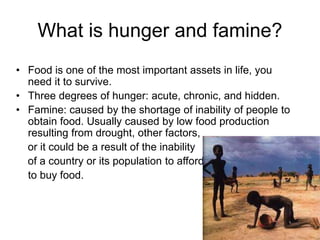
• Food is one of the most important assets in life, you 
need it to survive. 
• Three degrees of hunger: acute, chronic, and hidden. 
• Famine: caused by the shortage of inability of people to 
obtain food. Usually caused by low food production 
resulting from drought, other factors, 
or it could be a result of the inability 
of a country or its population to afford 
to buy food.
Alarming Facts About Hunger 
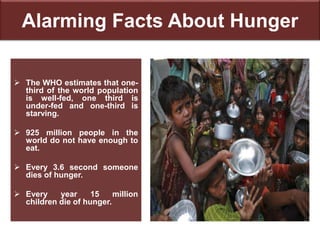
 The WHO estimates that one-third 
of the world population 
is well-fed, one third is 
under-fed and one-third is 
starving. 
 925 million people in the 
world do not have enough to 
eat. 
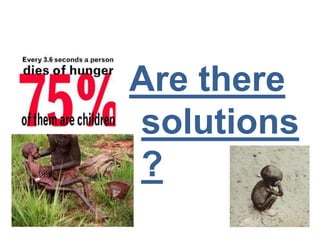
 Every 3.6 second someone 
dies of hunger. 
 Every year 15 million 
children die of hunger.
Alarming Facts About Hunger 
 65% of the world’s hungry 
populaces live in only seven 
countries: India, China, The 
Democratic, Republic of 
Congo, Bangladesh, 
Indonesia, Pakistan, and 
Ethiopia. 
 Undernourishment kills more 
people every year than 
malaria, tuberculosis and 
AIDS combined.
Causes For Lack Of Food In The World 
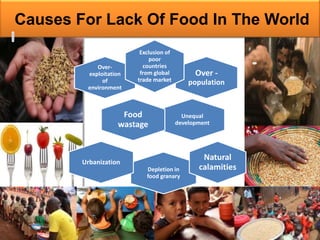
Over-exploitation 
of 
environment 
Over - 
population 
Exclusion of 
poor 
countries 
from global 
trade market 
Unequal 
development 
Food 
wastage 
Depletion in 
food granary 
Natural 
calamities 
Urbanization
Hunger And The Human Body 
BRAIN: 
A healthy brain needs 20 percent of your body’s energy 
which comes from food consumption. 
HEART: 
A healthy heart pumps a steady supply of blood throughout 
the body. An undernourished heart shrinks. 
VITAL ORGANS: 
The liver and kidneys filter out toxins and waste, while your 
immune system fends off. Dangerous toxins build up as the 
liver and kidneys fail. 
SKIN & BONES: 
Healthy skin shields the body from infection. Hungry skin 
cracks, becoming a gateway for infection. Bones stop growing 
also known as stunting.
The global food crisis 
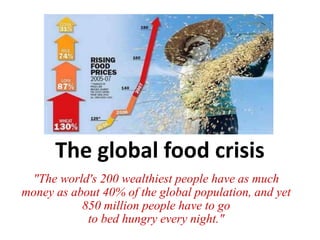
"The world's 200 wealthiest people have as much 
money as about 40% of the global population, and yet 
850 million people have to go 
to bed hungry every night."
Food as proportion of household budget 
• While Australian households spend only 17% 
of their budget on food, Nigerian families 
spend 73% of their budgets to eat, 
Vietnamese 65%, Indonesians half. 
- NY Times 
• In Bangladesh, food consumes more than half 
most people’s earnings and rent takes up 
almost all the rest. -UK Guardian
Food problems 
THE MOST EFECTED REGION
The problem? 
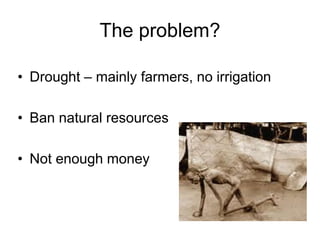
• Drought – mainly farmers, no irrigation 
• Ban natural resources 
• Not enough money
Political Causes and Effects 
• African farmers cultivate small plots of land that do not 
produce enough to meet the needs of their families. The 
problem is compounded by the farmers' lack of bargaining 
power and lack of access to land, finance and technology. 
• The government had no choice but to raise prices because 
there is nothing importing or exporting. The prices for tools, 
fertilizers, seeds, and other farming oriented needs are 
constantly rising, and the farmer’s don’t have a constant 
income. 
• Lastly, Africa’s technology isn’t most supreme, and their 
agriculture is terrible, and the government isn’t doing 
enough to help them meet their needs.
Social Causes and Effects 
• Given that Africa is rural, and dry, all they do is farm, in 
Africa farmers make up 80 percent of the population. 
• This becomes a social aspect as well because farming 
is their everything. That is how they get their food. 
Since the droughts and other causes of hunger and 
famine, people have to begin to migrate. 
• Africa’s population has been rising as well, therefore 
making it hard for people to migrate.
Economic Causes and Effects 
• Drought. It has ruined harvests and left people and livestock 
without food and water. Due to drought in Africa, this has led 
to a shocking amount of bad natural resources then leading to 
little to no crops being grown or harvested. 
• The main problem of famine and hunger is not only drought 
but most African countries are not self-sufficient in food and 
are relying on imports and income to pay for them. 
• The food prices have gone up around 57 percent, more than 
41 percent of people in Sub-Saharan Africa live on less than 
$1 per day, and 32 percent are undernourished. No money to 
buy food, and bad resources and drought lead to no food 
being grown. Leaving everyone starving.
Are there 
solutions 
?
Solution 1 
Microloans: 
small sum of money which an individual borrows from 
another individual, group or legal entity with the 
condition that it be returned or repaid at a later date 
(sometimes with interest). supporters are giving 
money to people in Africa to start small businesses to 
start making money to pay for food, and to possibly 
grow food. .
Positives 
• People will be able to start businesses 
• Be able to make money from their 
businesses 
• With the money you can grow crops
Negatives 
• Loans eventually have to be paid back 
• Can only receive a certain amount of money 
• Money may be wasted 
• Through the process, money could potentially 
get lost
Solution 2 
Tree planting: 
prevents deforestation which is also a 
problem in Africa. As well, farmers are 
struggling to feed their families while 
farmable land could diminish by up to two 
thirds the next 20 years.
Positives 
• Tree planting can prevent hunger. Many foreign 
companies in Africa are planting trees in areas that 
could have been used for food production. 
• These newly built forests will prevent erosion, 
desertification, and best, create a better local 
climate for poor farmers and help them increase 
their food production. 
• Positive effect on environment as well.
Negatives 
• Trees will take a while to grow 
• Only 1 tree is planted for every 28 cut
The Best Solution? 
SOLUTION 2! 
Tree planting will in future will offer quality wood from 
sustainable forestry without depleting natural resources. 
The harvesting of sustainable natural resources will 
create jobs, income opportunities and economical 
development as local supporting industries are created.
WORLD FOOD PROBLEMS 
Future prospective 
Expanded cultivation of food crops 
Adjustment in priorities 
Increase production in agriculture 
Improvement/expansion in irrigation system 
Population control? 
World food security
"SUSTAINABLE FOOD SYSTEMS FOR FOOD 
SECURITY AND NUTRITION" 
Food security: To feed an estimated 870 million hungry people on the planet, 
we need to increase production of basic staple foods by 60 percent. 
Nutrition: Two billion worldwide lack micronutrients vital for good health. 
Agriculture must become more nutrition-sensitive, with a stronger focus on 
fruits, vegetables, and other nutrient-dense foods. 
Food Systems: Since every aspect of our food systems has an effect on the final 
availability and accessibility of diverse, nutritious foods, we must constantly 
strive towards a healthier global food system. 
Sustainability: By using resources more efficiently at every stage along the food 
chain, we can increase the amount of healthy food available worldwide. Getting 
the most food from every drop of water, plot of land, and speck of fertilizer saves 
resources for the future.
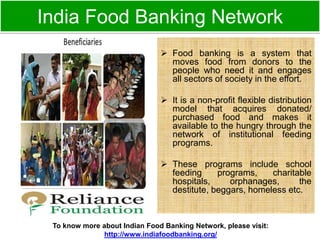
India Food Banking Network 
 Food banking is a system that 
moves food from donors to the 
people who need it and engages 
all sectors of society in the effort. 
 It is a non-profit flexible distribution 
model that acquires donated/ 
purchased food and makes it 
available to the hungry through the 
network of institutional feeding 
programs. 
 These programs include school 
feeding programs, charitable 
hospitals, orphanages, the 
destitute, beggars, homeless etc. 
To know more about Indian Food Banking Network, please visit: 
http://www.indiafoodbanking.org/
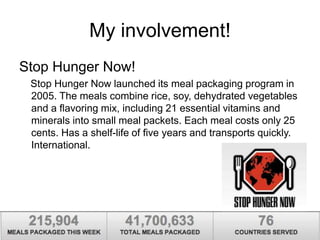
My involvement! 
Stop Hunger Now! 
Stop Hunger Now launched its meal packaging program in 
2005. The meals combine rice, soy, dehydrated vegetables 
and a flavoring mix, including 21 essential vitamins and 
minerals into small meal packets. Each meal costs only 25 
cents. Has a shelf-life of five years and transports quickly. 
International.
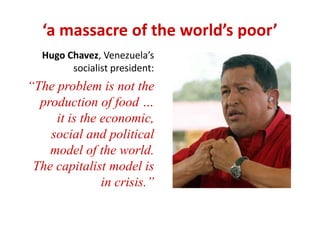
‘a massacre of the world’s poor’ 
Hugo Chavez, Venezuela’s 
socialist president: 
“The problem is not the 
production of food … 
it is the economic, 
social and political 
model of the world. 
The capitalist model is 
in crisis.”

Food problems around the world

  • 1.
    What is hungerand famine? • Food is one of the most important assets in life, you need it to survive. • Three degrees of hunger: acute, chronic, and hidden. • Famine: caused by the shortage of inability of people to obtain food. Usually caused by low food production resulting from drought, other factors, or it could be a result of the inability of a country or its population to afford to buy food.
  • 2.
    Alarming Facts AboutHunger  The WHO estimates that one-third of the world population is well-fed, one third is under-fed and one-third is starving.  925 million people in the world do not have enough to eat.  Every 3.6 second someone dies of hunger.  Every year 15 million children die of hunger.
  • 3.
    Alarming Facts AboutHunger  65% of the world’s hungry populaces live in only seven countries: India, China, The Democratic, Republic of Congo, Bangladesh, Indonesia, Pakistan, and Ethiopia.  Undernourishment kills more people every year than malaria, tuberculosis and AIDS combined.
  • 4.
    Causes For LackOf Food In The World Over-exploitation of environment Over - population Exclusion of poor countries from global trade market Unequal development Food wastage Depletion in food granary Natural calamities Urbanization
  • 5.
    Hunger And TheHuman Body BRAIN: A healthy brain needs 20 percent of your body’s energy which comes from food consumption. HEART: A healthy heart pumps a steady supply of blood throughout the body. An undernourished heart shrinks. VITAL ORGANS: The liver and kidneys filter out toxins and waste, while your immune system fends off. Dangerous toxins build up as the liver and kidneys fail. SKIN & BONES: Healthy skin shields the body from infection. Hungry skin cracks, becoming a gateway for infection. Bones stop growing also known as stunting.
  • 6.
    The global foodcrisis "The world's 200 wealthiest people have as much money as about 40% of the global population, and yet 850 million people have to go to bed hungry every night."
  • 7.
    Food as proportionof household budget • While Australian households spend only 17% of their budget on food, Nigerian families spend 73% of their budgets to eat, Vietnamese 65%, Indonesians half. - NY Times • In Bangladesh, food consumes more than half most people’s earnings and rent takes up almost all the rest. -UK Guardian
  • 8.
    Food problems THEMOST EFECTED REGION
  • 9.
    The problem? •Drought – mainly farmers, no irrigation • Ban natural resources • Not enough money
  • 10.
    Political Causes andEffects • African farmers cultivate small plots of land that do not produce enough to meet the needs of their families. The problem is compounded by the farmers' lack of bargaining power and lack of access to land, finance and technology. • The government had no choice but to raise prices because there is nothing importing or exporting. The prices for tools, fertilizers, seeds, and other farming oriented needs are constantly rising, and the farmer’s don’t have a constant income. • Lastly, Africa’s technology isn’t most supreme, and their agriculture is terrible, and the government isn’t doing enough to help them meet their needs.
  • 11.
    Social Causes andEffects • Given that Africa is rural, and dry, all they do is farm, in Africa farmers make up 80 percent of the population. • This becomes a social aspect as well because farming is their everything. That is how they get their food. Since the droughts and other causes of hunger and famine, people have to begin to migrate. • Africa’s population has been rising as well, therefore making it hard for people to migrate.
  • 12.
    Economic Causes andEffects • Drought. It has ruined harvests and left people and livestock without food and water. Due to drought in Africa, this has led to a shocking amount of bad natural resources then leading to little to no crops being grown or harvested. • The main problem of famine and hunger is not only drought but most African countries are not self-sufficient in food and are relying on imports and income to pay for them. • The food prices have gone up around 57 percent, more than 41 percent of people in Sub-Saharan Africa live on less than $1 per day, and 32 percent are undernourished. No money to buy food, and bad resources and drought lead to no food being grown. Leaving everyone starving.
  • 13.
  • 14.
    Solution 1 Microloans: small sum of money which an individual borrows from another individual, group or legal entity with the condition that it be returned or repaid at a later date (sometimes with interest). supporters are giving money to people in Africa to start small businesses to start making money to pay for food, and to possibly grow food. .
  • 15.
    Positives • Peoplewill be able to start businesses • Be able to make money from their businesses • With the money you can grow crops
  • 16.
    Negatives • Loanseventually have to be paid back • Can only receive a certain amount of money • Money may be wasted • Through the process, money could potentially get lost
  • 17.
    Solution 2 Treeplanting: prevents deforestation which is also a problem in Africa. As well, farmers are struggling to feed their families while farmable land could diminish by up to two thirds the next 20 years.
  • 18.
    Positives • Treeplanting can prevent hunger. Many foreign companies in Africa are planting trees in areas that could have been used for food production. • These newly built forests will prevent erosion, desertification, and best, create a better local climate for poor farmers and help them increase their food production. • Positive effect on environment as well.
  • 19.
    Negatives • Treeswill take a while to grow • Only 1 tree is planted for every 28 cut
  • 20.
    The Best Solution? SOLUTION 2! Tree planting will in future will offer quality wood from sustainable forestry without depleting natural resources. The harvesting of sustainable natural resources will create jobs, income opportunities and economical development as local supporting industries are created.
  • 21.
    WORLD FOOD PROBLEMS Future prospective Expanded cultivation of food crops Adjustment in priorities Increase production in agriculture Improvement/expansion in irrigation system Population control? World food security
  • 22.
    "SUSTAINABLE FOOD SYSTEMSFOR FOOD SECURITY AND NUTRITION" Food security: To feed an estimated 870 million hungry people on the planet, we need to increase production of basic staple foods by 60 percent. Nutrition: Two billion worldwide lack micronutrients vital for good health. Agriculture must become more nutrition-sensitive, with a stronger focus on fruits, vegetables, and other nutrient-dense foods. Food Systems: Since every aspect of our food systems has an effect on the final availability and accessibility of diverse, nutritious foods, we must constantly strive towards a healthier global food system. Sustainability: By using resources more efficiently at every stage along the food chain, we can increase the amount of healthy food available worldwide. Getting the most food from every drop of water, plot of land, and speck of fertilizer saves resources for the future.
  • 23.
    India Food BankingNetwork  Food banking is a system that moves food from donors to the people who need it and engages all sectors of society in the effort.  It is a non-profit flexible distribution model that acquires donated/ purchased food and makes it available to the hungry through the network of institutional feeding programs.  These programs include school feeding programs, charitable hospitals, orphanages, the destitute, beggars, homeless etc. To know more about Indian Food Banking Network, please visit: http://www.indiafoodbanking.org/
  • 24.
    My involvement! StopHunger Now! Stop Hunger Now launched its meal packaging program in 2005. The meals combine rice, soy, dehydrated vegetables and a flavoring mix, including 21 essential vitamins and minerals into small meal packets. Each meal costs only 25 cents. Has a shelf-life of five years and transports quickly. International.
  • 25.
    ‘a massacre ofthe world’s poor’ Hugo Chavez, Venezuela’s socialist president: “The problem is not the production of food … it is the economic, social and political model of the world. The capitalist model is in crisis.”