Food Security in Asia

 For the students of International
         School of Manila
            April 2011
2


1. What we hear about it


 2. Why it matters


   3. What we have been doing


     4. What needs to be done
Food security: what we hear about it                               3


Higher food prices


   February 2011
   “World food prices surged to a new historic peak in January,
   for the seventh consecutive month” (FAO)
   “Global food prices are rising to dangerous levels” (World
   Bank)
Food security: what we hear about it                         4


 What drives food price rise

 Cyclical factors              Structural factors
 (It just happens..)           (How the world is made)
 •   Crop failures             •   Increasing demand
 •   Natural disasters         •   Low grain stock
                               •   Stagnating yield growth
 •   High fuel prices          •   Less water and land
 •   Weak US$                  •   Bio-fuel competition
Food security: what we hear about it                                                           5


Increasing demand for food:
70% more food needed to feed
population - 6.7 billion now to 9
billion in 2050 (FAO)
Decreasing farm land


     Source: FAO, ftp://ftp.fao.org/docrep/fao/011/i0765e/i0765e08.pdf

                                                                         Source: IFPRI, 2001
Food security: what we hear about it                                                6

Emerging water crisis:
Asia has 50% of world’s population but only 30% of world’s

fresh water
Severe shortage in 40% of developing Asia by 2030

Climate change affects water availability (IWMI)


                                                 Source: UN Environment Program
                                                 http://www.unep.org/dewa/vitalwater/
Food security: what we hear about it                           7

Climate change: Decline in the global crop production by as
much as 15% of rain-fed maize, 20% of irrigated wheat, and
16% of irrigated rice (IFPRI)

Biofuel: 90% increase in demand for transport fuel,
2000-2050. Increasing demand for biofuel (IIASA).


                                         Irrigated rice
                                         production in 2050
                                               Source: IFPRI
Food security: what we hear about it                       8

 Disasters in Asia:
 Between    1975 and 2006, Asia had 89% of disaster-
 affected people, 57% of fatalities, and 44% of economic
 damages (Sanker, et al)
 Climate change increases frequency and intensity of
 disasters (IPCC)
Food Security: Why it matters                              9


                            Affects economic growth
  Food inflation            Hurts poor people and
                             increase poverty

                            Leads to panic and hording
  Market volatility         Food disappears from shops
                            Leads to social instability

             Photos fom
         “Hungry Planet”
  Vulnerable food
         by Peter Menzel    Leads to supply shortage
  supply systems            Increases food prices
Food Security: Why it matters                       10


Food security and poverty

  Despite continuing fight against poverty, Asia
   is still home to the largest number of poor
  Higher food prices hurt poor people most


Hungry people
in the world
(FAO, 2010)
Food Security: Why it matters                                       11


Volatility of food grains market

   Accurate information about food not available
   Free and open trade remains a goal, not a practice
   Lack of information causes hording and panic
   Speculation fans volatility, and is hard to regulate
   Abnormal spikes in food prices benefit nobody

                                                  Export price of Thai
                                                  white rice, 5%
                                                  broken
                                                  Source: IRRI
Food Security: Why it matters                           12


Problems with the existing food supply systems


  R&D: Not enough support to research and technology
   development
  Small farmers who dominate Asia’s agriculture lack
   access to finance, infrastructure, and technology
  More investment is needed in agriculture but funding
   is not enough
  Efficient value chain is a key to deliver more food to
   market, but many farmers remain left
  Risk management: Agriculture is a risky business, and
   we have not found the way to manage risks well
Food Security: What we have done to date                                13


                     Green Revolution
How it         Widespread hunger and poverty in Asia in mid
started         1960s.
               The Rockefeller and Ford foundations initiated.
               IRRI and CIMMYT to develop new rice and wheat
                variety
               Expanded use of fertilizer and Irrigation
What did it    More than double cereal production in Asia
do              (1970-95).
               No famine despite population increase by 60%.
               Poverty declined from 3 out of 5 to less than 1 in 5.
But some       Environmental degradation, and increased
criticize       inequality.
               Agriculture becomes more input-reliant, particularly
                to fertilizer and energy.
Food Security: What we have done to date                                         14

                   Food security challenges today
 What we did           Good news              Bad news
                         are more complex
 Safety net              New and more promising   Many poor people remain
                         approaches               vulnerable
 Promotion of trade inflationinterest and
            Food Stronger                         Politics prevails in the end
                         political will           of the day
 Agronomic               New and coordinated      Funding shortage
                         approach and funding     Weak link to small farmers
 innovation
 Irrigation         Expanded coverage of          High level of water
 development
            Market volatility production
                    irrigation with               inefficiency
                         growth                   Lack of O&M funding
 Value chain             Active private sector    Small and poor famers left
                         engagement               out
 development
             Vulnerable food supply systems
 Climate change     Increasing knowledge, tools More knowledge and tools
                    and funding support         needed
 adaptation
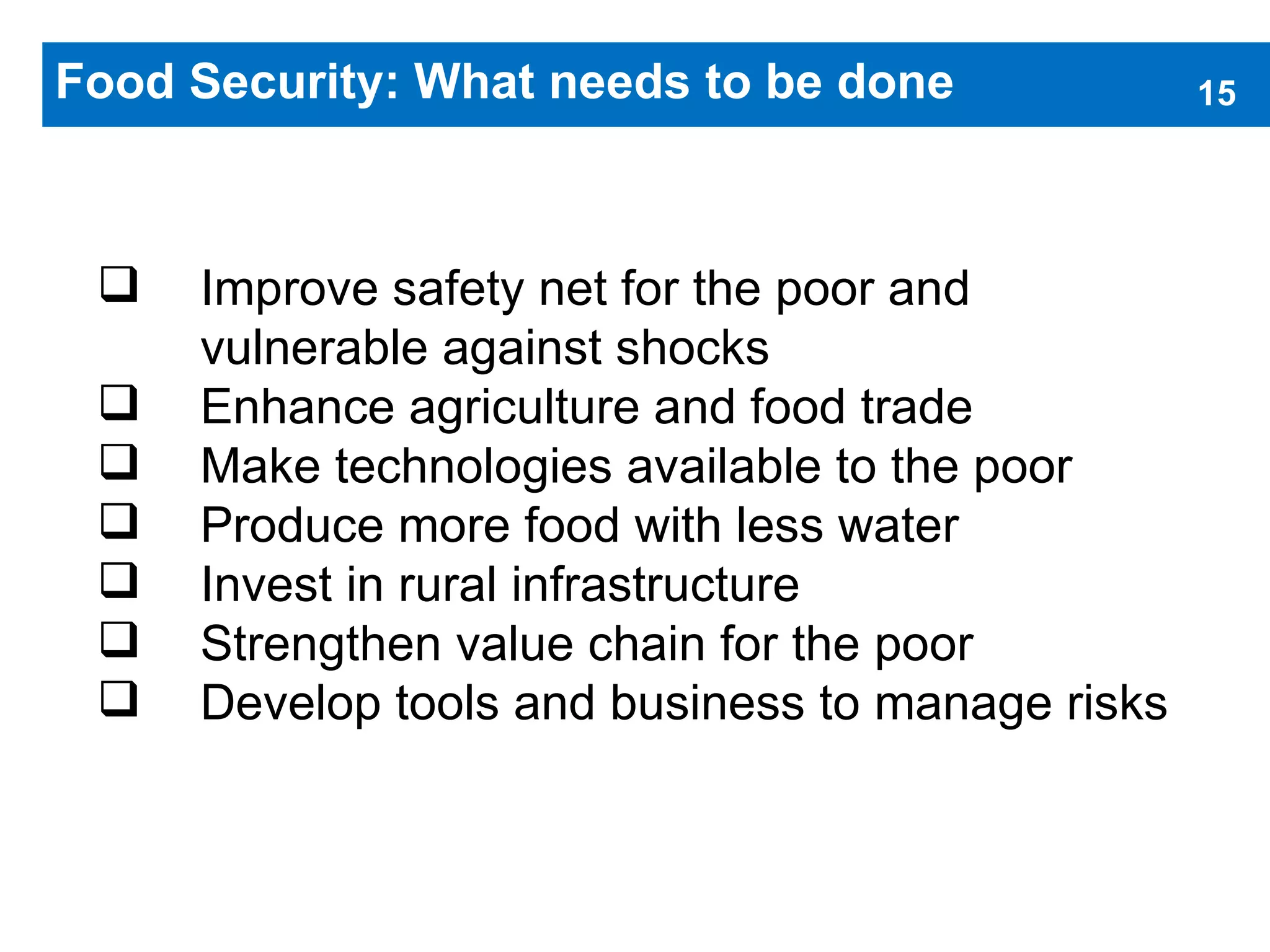
Food Security: What needs to be done              15


    Improve safety net for the poor and
     vulnerable against shocks
    Enhance agriculture and food trade
    Make technologies available to the poor
    Produce more food with less water
    Invest in rural infrastructure
    Strengthen value chain for the poor
    Develop tools and business to manage risks
Food Security: What needs to be done                       16


  More debate needed on:
  Does the world need the second Green Revolution or
  not?
  Do we support genetically modified crops or not?
  Food or biofuel?
  Should small farmers be protected or should more of
  them be sent to non agriculture?
  Food self-sufficiency or free trade?
  Increased partnership with private sector – can it be
  supportive of the poor?
Thank you for listening.


Katsuji Matsunami        Views expressed in this presentation do
                         not necessarily reflect the views of the
Asian Development Bank   Asian Development Bank.
kmatsunami@adb.org

Food Security

  • 1.
    Food Security inAsia For the students of International School of Manila April 2011
  • 2.
    2 1. What wehear about it 2. Why it matters 3. What we have been doing 4. What needs to be done
  • 3.
    Food security: whatwe hear about it 3 Higher food prices February 2011 “World food prices surged to a new historic peak in January, for the seventh consecutive month” (FAO) “Global food prices are rising to dangerous levels” (World Bank)
  • 4.
    Food security: whatwe hear about it 4 What drives food price rise Cyclical factors Structural factors (It just happens..) (How the world is made) • Crop failures • Increasing demand • Natural disasters • Low grain stock • Stagnating yield growth • High fuel prices • Less water and land • Weak US$ • Bio-fuel competition
  • 5.
    Food security: whatwe hear about it 5 Increasing demand for food: 70% more food needed to feed population - 6.7 billion now to 9 billion in 2050 (FAO) Decreasing farm land Source: FAO, ftp://ftp.fao.org/docrep/fao/011/i0765e/i0765e08.pdf Source: IFPRI, 2001
  • 6.
    Food security: whatwe hear about it 6 Emerging water crisis: Asia has 50% of world’s population but only 30% of world’s fresh water Severe shortage in 40% of developing Asia by 2030 Climate change affects water availability (IWMI) Source: UN Environment Program http://www.unep.org/dewa/vitalwater/
  • 7.
    Food security: whatwe hear about it 7 Climate change: Decline in the global crop production by as much as 15% of rain-fed maize, 20% of irrigated wheat, and 16% of irrigated rice (IFPRI) Biofuel: 90% increase in demand for transport fuel, 2000-2050. Increasing demand for biofuel (IIASA). Irrigated rice production in 2050 Source: IFPRI
  • 8.
    Food security: whatwe hear about it 8 Disasters in Asia: Between 1975 and 2006, Asia had 89% of disaster- affected people, 57% of fatalities, and 44% of economic damages (Sanker, et al) Climate change increases frequency and intensity of disasters (IPCC)
  • 9.
    Food Security: Whyit matters 9  Affects economic growth Food inflation  Hurts poor people and increase poverty  Leads to panic and hording Market volatility  Food disappears from shops  Leads to social instability Photos fom “Hungry Planet” Vulnerable food by Peter Menzel  Leads to supply shortage supply systems  Increases food prices
  • 10.
    Food Security: Whyit matters 10 Food security and poverty  Despite continuing fight against poverty, Asia is still home to the largest number of poor  Higher food prices hurt poor people most Hungry people in the world (FAO, 2010)
  • 11.
    Food Security: Whyit matters 11 Volatility of food grains market  Accurate information about food not available  Free and open trade remains a goal, not a practice  Lack of information causes hording and panic  Speculation fans volatility, and is hard to regulate  Abnormal spikes in food prices benefit nobody Export price of Thai white rice, 5% broken Source: IRRI
  • 12.
    Food Security: Whyit matters 12 Problems with the existing food supply systems  R&D: Not enough support to research and technology development  Small farmers who dominate Asia’s agriculture lack access to finance, infrastructure, and technology  More investment is needed in agriculture but funding is not enough  Efficient value chain is a key to deliver more food to market, but many farmers remain left  Risk management: Agriculture is a risky business, and we have not found the way to manage risks well
  • 13.
    Food Security: Whatwe have done to date 13 Green Revolution How it  Widespread hunger and poverty in Asia in mid started 1960s.  The Rockefeller and Ford foundations initiated.  IRRI and CIMMYT to develop new rice and wheat variety  Expanded use of fertilizer and Irrigation What did it  More than double cereal production in Asia do (1970-95).  No famine despite population increase by 60%.  Poverty declined from 3 out of 5 to less than 1 in 5. But some  Environmental degradation, and increased criticize inequality.  Agriculture becomes more input-reliant, particularly to fertilizer and energy.
  • 14.
    Food Security: Whatwe have done to date 14 Food security challenges today What we did Good news Bad news are more complex Safety net New and more promising Many poor people remain approaches vulnerable Promotion of trade inflationinterest and Food Stronger Politics prevails in the end political will of the day Agronomic New and coordinated Funding shortage approach and funding Weak link to small farmers innovation Irrigation Expanded coverage of High level of water development Market volatility production irrigation with inefficiency growth Lack of O&M funding Value chain Active private sector Small and poor famers left engagement out development Vulnerable food supply systems Climate change Increasing knowledge, tools More knowledge and tools and funding support needed adaptation
  • 15.
    Food Security: Whatneeds to be done 15  Improve safety net for the poor and vulnerable against shocks  Enhance agriculture and food trade  Make technologies available to the poor  Produce more food with less water  Invest in rural infrastructure  Strengthen value chain for the poor  Develop tools and business to manage risks
  • 16.
    Food Security: Whatneeds to be done 16 More debate needed on: Does the world need the second Green Revolution or not? Do we support genetically modified crops or not? Food or biofuel? Should small farmers be protected or should more of them be sent to non agriculture? Food self-sufficiency or free trade? Increased partnership with private sector – can it be supportive of the poor?
  • 17.
    Thank you forlistening. Katsuji Matsunami Views expressed in this presentation do not necessarily reflect the views of the Asian Development Bank Asian Development Bank. kmatsunami@adb.org