
Shahid Hussain Raja
Author/Consultant/Trainer
Cambridge.UK
www.shahidhussainraja.com
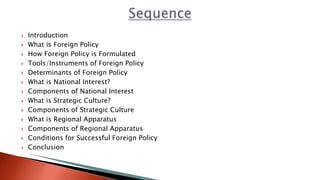
 Introduction
 What is Foreign Policy
 How Foreign Policy is Formulated
 Tools/Instruments of Foreign Policy
 Determinants of Foreign Policy
 What is National Interest?
 Components of National Interest
 What is Strategic Culture?
 Components of Strategic Culture
 What is Regional Apparatus
 Components of Regional Apparatus
 Conditions for Successful Foreign Policy
 Conclusion
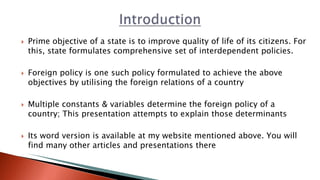
 Prime objective of a state is to improve quality of life of its citizens. For
this, state formulates comprehensive set of interdependent policies.
 Foreign policy is one such policy formulated to achieve the above
objectives by utilising the foreign relations of a country
 Multiple constants & variables determine the foreign policy of a
country; This presentation attempts to explain those determinants
 Its word version is available at my website mentioned above. You will
find many other articles and presentations there
 “Foreign policy is a systematic statement of deliberately selected
national interests."- Hartmann
 “Those actions (including words) of government officials to influence
human behaviour beyond the jurisdiction of their own state."-
Schleicher
 "Foreign policy is the key element in the process by which a state
translates its broadly conceived goals and interests into concrete
courses of action to attain those objectives and preserve its interests
within the limits of its strength and the realities of the external
environment."-Padelford and Lincoln
 Not a formal Document; public statements, actions, refusals to take
 State policy, rather than government policy; long term national interest
 Obverse of domestic policy; same objectives but different field
 Cross-cutting; affects several domestic policies, is affected by them
 Sanctity: not an act of parliament but still has its own santity
 Different from Strategy: Only broad guidelines, strategy by diplomats
 Proactive vs Reactionary Mode: Depends upon the situation which mode
 No country issues a formal documented version of its foreign policy
 It issues various statements, carries out different activities and
takes/refuses to take decisions on any matter requiring attention
 Job of analysts and academia to sift out patterns of relations and
behaviour from this and describe it as the foreign policy of country
 These statements, activities & decisions are result of countless
meetings & lot of paperwork by multiple stakeholders
 This provides us clues to the formulation of foreign policy process
 Any issue requiring action is first examined by the concerned ministry
which solicits the opinions of other stakeholders under its control
 Ministry recommends its preferred option with cogent reasons to
cabinet through foreign office for recording its observations en route.
 Elected representatives discuss these options and suggestion of the
foreign office in select committes/cabinet meeting
 Once an option is approved, the statement is issued as the response
of the state to that issue
 Diplomacy-establishing/terminating diplomatic relations, bilateral
visits, summit meetings, protest notes
 Trade-access/denial to market/rsources, MFN status, FTA, Trade war
 Economic aid-grants, concessional loans, multilateral assistance
 Military aid- arms/ammunition, bases, training, joint exercises
 Threat of uses of force-powerful states use it when diplomacy fails
 Use of force-terrorism, limited war, total war
 Post-WWII Reconstruction- best example of success of diplomatic
means-Marshall Plan
 Creation of World Institutions-World Bank, IMF etc
 Rise of the Nonaligned Movement,
 Nuclear Non-Proliferation Treaty,
 USA China Rapproachment
 USA-USSR Detente
 Creation of the European Union,
 Two World Wars- both, WW1 & WW2, were classic cases of failures of
the global diplomacy to avert bloodshed
 Dropping of Atomic Bombs-It could have been averted if diplonacy
has been effective in the last days of the war.
 Iran-IRAQ War-again the failure of the diplomats
 US Attack on Afghanistan- Taliban were willing to handover OBL
 American Attack on Iraq- Diplomacy not given chance to play its role
 Syrian Crises-Deliberate efforts to scuttle diplomatic solution
 Multiple factors-geograpy, history, social, economic,
internal/external
 All these can be grouped in three categories
◦ A. Dictates of National Interest
◦ B. Strategic Culture
◦ C. Regional Security Apparatus
 However, all these are inter-related and inter-dependent
 Not fixed, can change even in short term, change in one,affect others
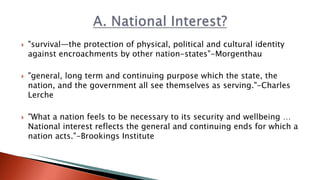
 "survival—the protection of physical, political and cultural identity
against encroachments by other nation-states"-Morgenthau
 "general, long term and continuing purpose which the state, the
nation, and the government all see themselves as serving."-Charles
Lerche
 "What a nation feels to be necessary to its security and wellbeing …
National interest reflects the general and continuing ends for which a
nation acts."-Brookings Institute
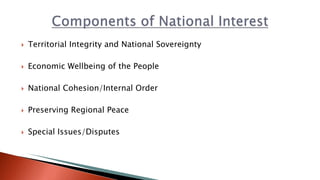
 Territorial Integrity and National Sovereignty
 Economic Wellbeing of the People
 National Cohesion/Internal Order
 Preserving Regional Peace
 Special Issues/Disputes
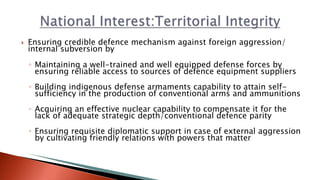
 Ensuring credible defence mechanism against foreign aggression/
internal subversion by
◦ Maintaining a well-trained and well equipped defense forces by
ensuring reliable access to sources of defence equipment suppliers
◦ Building indigenous defense armaments capability to attain self-
sufficiency in the production of conventional arms and ammunitions
◦ Acquiring an effective nuclear capability to compensate it for the
lack of adequate strategic depth/conventional defence parity
◦ Ensuring requisite diplomatic support in case of external aggression
by cultivating friendly relations with powers that matter
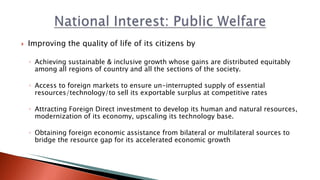
 Improving the quality of life of its citizens by
◦ Achieving sustainable & inclusive growth whose gains are distributed equitably
among all regions of country and all the sections of the society.
◦ Access to foreign markets to ensure un-interrupted supply of essential
resources/technology/to sell its exportable surplus at competitive rates
◦ Attracting Foreign Direct investment to develop its human and natural resources,
modernization of its economy, upscaling its technology base.
◦ Obtaining foreign economic assistance from bilateral or multilateral sources to
bridge the resource gap for its accelerated economic growth
 Promoting national cohesion & internal stability by
◦ Acting upon the policy of non-interference and mutual cooperation
◦ Formulating shared vision of just and prosperous country enshrined in duly-
formulated with consensus & formally-approved constitution
◦ Ensuring that this shared vision is implemented by well-functioning vibrant
institutions to create stakes for everyone to feel satisfied
◦ Mainstreaming marginalized/disgruntled elements of society by ensuring good
governance & taking affirmative action where needed
◦ Strengthening democracy by promoting tolerant political culture, strengthening
democratic structures, letting democratic processes work
 Ensuring regional peace & security by
◦ Maintaining good relations with regional countries/immediate neighbours
◦ Eliminating regional/global terrorism by denying safe havens to terrorists within
or allowing them in neighbouring countries.
◦ Promotion of regional trade and investment by creating business/ investment
friendly environment by providing incentives and facilities
◦ Adopting common regional approch to the challenges emanating from outside the
region- globalisation, environmetal issues, climate
 Amicable resolution of bilateral/regional disputes (border/
water) by
◦ Peaceful means utilising diplomatic avenues to the last
◦ Utilising all the multilateral avenues available to sort them out
◦ If not resolved amicably, then be in a position to resolve them through
non-diplomatic means
 Mindset of ruling elite which ultimately defines the national interest
 Set of shared beliefs, assumptions, and modes of behaviour
 Common experiences & accepted narratives shape collective identity
 It formulates the objectives to be achieved and how.
 Determines appropriate strategies to accomplish national objectives.
 Gerography
 History
 Economy
 Society
 Polity
 Size-size does matter a lot if other factors present
 Location-strategic location, an asset or liability?
 Shape-does it have enough space to withstand deep foreign
aggression without capitulation
 Resources-availability of natural/human resources determine
the response capability/morale of leaders
 Geography is said to be 80% of the foreign policy of a country
 Historical legacies-how it came into existence, travails/traumas
 Past war experiences-failures, and successes; lessons learnt
 If a specific policy had proved to be rewarding, policy-makers would
like to try the same policy for tackling similar situations in the future.
 If a particular policy had been a failure to deal with a situation, they
would try a different policy under an identical situation in the future.
 Structure and nature of society, degree of conflict and harmony among
various social groups. Unity of the people-source of strength
 Unity emboldens rulers to secure objectives of national interest during the
course of international bargaining.
 Societal norms and values, what the public feels important and expressed in
clear terms,
 Once public opinion is mobilized it becomes difficult for the government to
overlook it while deciding on the issue in question.
 .
 Base-is economic base of the country large enough to bear the costs
of defence and costs of war for sustainable period
 Growth rate- is it growing at a respectable rate to produce enough
surplus to sustain both-public welfare and defence
 Stage of development-can we afford confrontation with developed
countries if we need access to their markets
 All the above factors would determine the thinking process of policy
makers to join or refuse to join any alliances
 Who are the dominant decision-makers in foreign policy formulation
determines the direction, contents and pririties of its foreign policy
 If the armed forces are calling the shots, then the foreign policy will
be heavily biased towards the security imperatives;
 If elected representatives in charge of the foreign policy process, it
will be the well being of the public interest taking precedence.
 Political structure-democratic or authoritarian? Democracy is slow but
stable; authoritarian is quick but maybe short term
 Current situation in the region or at global level which could,
adversely or positively, impact upon efforts of a country to safeguard
its national interest.
 Different from strategic culture which refers to the mindset of the
policy makers formed over a period of time- It is subjective
 Regional apparatus is the appreciation of the current ground
realities-what is happening at the point of time-it is objective
 Generally, there are three inter-dependent and inter-related
determinants of a country's regional apparatus
◦ Regional Geopolitical Dynamics
◦ Global Politics
◦ Trends & Events
 All thes are given constants or variables on which the country has no
control but must react to safeguard its national interest
 Formal/informal alliances among countries in region/with outsiders to
safeguard their respective national interest in any given situation
 Regional hegemonic states are interested to safeguard their national
interest which could give rise to regional conflicts.
 Border disputes, water sharing issues etc are sources of regional
conflicts.
 All regional geopolitics is not conflictual; there are marriages of
conveniences among countries to safeguard their interests
 Bilateral conflicts/ regional crisis invariably get exacerbated by
economic/ strategic penetration by major powers
 Global powers having global agenda, are every country's neighbour;
their mutual interaction would affect foreign policies of every country
in the region.
 It is a two-way street- major powers are also affected by the regional
conflicts in which they have become entangled in a competitive
fashion.
 Any significant global/regional event or trend could have serious
bearings on a country's foreign policy, directly or indirectly such as
◦ 1.Covid-19 Pandemic:
◦ 2.Global Terrorism:
◦ 3.Extremism & Militancy:
◦ 4.Islamophobia:
◦ 5.Rising Sub-nationalism in region
◦ 6.Arms race & Nuclear Proliferation
◦ 8.Climate Change:
◦ 9.Globalisation:
 Litmus test of success of any policy is the realisation of goals/
objectives determined under components of national interest
 Every institution formulates strategies to achieve the goals and
objectives falling in its jurisdiction
 Success depends on quality of strategies, their managerial capabilities
and the available environment,internal/ external
 Foreign policy is also subject to these rules and can be a success if
following conditions favour it
 Political/executive commitment-Ultimate test of any policy; how
sincere and serious are its architects/implementers
 Resources-availability of enough human and financial resources,
capable to deliver pays handsome dividends
 Internal consistency-policy must be coherent, well thought out,
options selected consistent with well researched findings
 External consistency- trying to achieve overall objectives of national
interest, not in conflict with other policies
 Size and status of the country-strong countries usually successful
 Foreign policy formulation is a dynamic process carried out to devise
appropriate strategies to meet regional/global challenges country is facing
 Its 1st determinant is national interest-ensuring territorial integrity, well
being of people, national cohesion, regional peace, & resolution of disputes
 Its 2nd determinant is strategic culture-the mindset of the ruling elite
formed over period of time about the weaknesses and strengths of country
 Its 3rd determinent is the regional apparatus-subjective assessment of the
objective regional/global situation and the challenges it poses to country
 Thank you for viewing the presentation. Hope it was helpful
 If you liked it, kindly do express it by clicking the like icon below.
 Comments will be added favour
 Its word version is available at my website
www.shahidhussainraja.com
 You can also find following other articles/presentations at this website
 Pakistan’s Difficulties at the Time of her Independence
http://www.shahidhussainraja.com/pakistans-difficulties-at-the-time-of-her-independence/
 Why Countries Break? Case of Bangladesh
http://www.shahidhussainraja.com/why-countries-break-case-of-bangladesh/
 Pakistan’s 13th IMF Programme: Prospects & Challenges
http://www.shahidhussainraja.com/pakistans-13th-imf-programme-prospects-challenges/
 Federalism in Pakistan: Challenges & Response
https://www.shahidhussainraja.com/federalism-in-pakistan-challengers-response/
 Water Issues in Pakistan
http://www.shahidhussainraja.com/water-issues-in-pakistan/
 Governance Reforms in Pakistan: Need and Content
http://www.shahidhussainraja.com/governance-reforms-in-pakistan-need-and-content/
 Pakistan’s Strategic Culture: Determinants & Dimensions
http://www.shahidhussainraja.com/pakistans-strategic-culture-determinants-dimensions/
 Pakistani Culture: Sources & Drivers
http://www.shahidhussainraja.com/pakistani-culture-sources-drivers/
 Improving Pakistan’s Global Image
http://www.shahidhussainraja.com/improving-pakistans-global-image/
 Two Nations Theory: Myths and Reality
http://www.shahidhussainraja.com/two-nations-theory-myths-and-reality/
 Why do Civil Service Reforms in Pakistan Fail?
http://www.shahidhussainraja.com/why-do-civil-service-reforms-in-pakistan-fail/
 Is Pakistan a Failed State?
http://www.shahidhussainraja.com/is-pakistan-a-failed-state/
 Pakistan Ideology: Sources & Features
http://www.shahidhussainraja.com/what-is-pakistan-ideology-myths-and-content/
 International Relations: Definition, Scope & Subject Matter
(http://www.shahidhussainraja.com/the-scope-of-international-relations/)
 Modern Nation-state System: Challenges & Prospects
(http://www.shahidhussainraja.com/modern-nation-state-system-challenges-prospects/)
 Foreign Policy: Features, Success Factors & Challenges
(http://www.shahidhussainraja.com/foreign-policy-features-success-factors-challenges/)
 Clash of Civilisations by Huntington
http://www.shahidhussainraja.com/clash-of-civilizations-a-critique/
 Globalization: Compressing Time and Space -Part 1& 2
http://www.shahidhussainraja.com/globalization-compressing-time-and-space-part-1/
/http://www.shahidhussainraja.com/globalization-compressing-time-and-space-part-2/
 Determinants of Foreign Policy
http://www.shahidhussainraja.com/determinants-of-foreign-policy/
 Foreign Policy: Tools & Implements
http://www.shahidhussainraja.com/foreign-policy-tools-instruments/
 National Interest: Meaning & Components
http://www.shahidhussainraja.com/national-interest-meaning-components/
 World Peace: A Norm or an Aberration?
http://www.shahidhussainraja.com/world-peace-a-norm-or-an-aberration/
 End of History by Francis Fukuyama
http://www.shahidhussainraja.com/end-of-history-by-francis-fukuyama-a-critique/
 Breakup of Soviet Union: Causes & Consequences
http://www.shahidhussainraja.com/breakup-of-the-soviet-union-causes-consequences/
 Global Terrorism: Challenges & Response – Part 1 & 2
http://www.shahidhussainraja.com/global-terrorism-challenges-response/
http://www.shahidhussainraja.com/global-terrorism-challenges-response-part-2/
 War on Terror: Causes, Course, Costs and Consequences Part 1 & 2
http://www.shahidhussainraja.com/war-on-terror-causes-course-costs-and-consequences-part-1/
http://www.shahidhussainraja.com/war-on-terror-causes-course-costs-and-consequences-part-2/
 Arab Spring: Genesis, Causes of Failure & Lessons Learnt
http://www.shahidhussainraja.com/arab-spring-genesis-causes-of-failure-lessons-learnt/
 Islamophobia: Genesis, Challenges & Response
http://www.shahidhussainraja.com/islamophobia-genesis-challenges-response/
 Vietnam War: Causes & Consequences
http://www.shahidhussainraja.com/vietnam-war-causes-course-and-consequences/
 Nine Drivers of Sino-American Cold War
http://www.shahidhussainraja.com/9-drivers-of-america-china-cold-war/
 IMF Programmes: Do they help Developing Countries?
http://www.shahidhussainraja.com/imf-programme-does-it-help-a-developing-country/
 American Interests in Afghanistan
http://www.shahidhussainraja.com/american-interests-in-afghanistan/
 Reasons for Soviet Invasion of Afghanistan in 1979
http://www.shahidhussainraja.com/why-did-soviet-union-enter-afghanistan-in-1979/
 The Middle East Crises: Genesis and Dimensions
http://www.shahidhussainraja.com/the-middle-east-crises-genesis-and-dimensions/
 China Iran Relations: Past, Present & Future
http://www.shahidhussainraja.com/china-iran-relations-past-present-future/
Q & A

Foreign Policy: Basic Concepts & Terms

  • 1.
  • 2.
     Introduction  Whatis Foreign Policy  How Foreign Policy is Formulated  Tools/Instruments of Foreign Policy  Determinants of Foreign Policy  What is National Interest?  Components of National Interest  What is Strategic Culture?  Components of Strategic Culture  What is Regional Apparatus  Components of Regional Apparatus  Conditions for Successful Foreign Policy  Conclusion
  • 3.
     Prime objectiveof a state is to improve quality of life of its citizens. For this, state formulates comprehensive set of interdependent policies.  Foreign policy is one such policy formulated to achieve the above objectives by utilising the foreign relations of a country  Multiple constants & variables determine the foreign policy of a country; This presentation attempts to explain those determinants  Its word version is available at my website mentioned above. You will find many other articles and presentations there
  • 4.
     “Foreign policyis a systematic statement of deliberately selected national interests."- Hartmann  “Those actions (including words) of government officials to influence human behaviour beyond the jurisdiction of their own state."- Schleicher  "Foreign policy is the key element in the process by which a state translates its broadly conceived goals and interests into concrete courses of action to attain those objectives and preserve its interests within the limits of its strength and the realities of the external environment."-Padelford and Lincoln
  • 5.
     Not aformal Document; public statements, actions, refusals to take  State policy, rather than government policy; long term national interest  Obverse of domestic policy; same objectives but different field  Cross-cutting; affects several domestic policies, is affected by them  Sanctity: not an act of parliament but still has its own santity  Different from Strategy: Only broad guidelines, strategy by diplomats  Proactive vs Reactionary Mode: Depends upon the situation which mode
  • 6.
     No countryissues a formal documented version of its foreign policy  It issues various statements, carries out different activities and takes/refuses to take decisions on any matter requiring attention  Job of analysts and academia to sift out patterns of relations and behaviour from this and describe it as the foreign policy of country  These statements, activities & decisions are result of countless meetings & lot of paperwork by multiple stakeholders  This provides us clues to the formulation of foreign policy process
  • 7.
     Any issuerequiring action is first examined by the concerned ministry which solicits the opinions of other stakeholders under its control  Ministry recommends its preferred option with cogent reasons to cabinet through foreign office for recording its observations en route.  Elected representatives discuss these options and suggestion of the foreign office in select committes/cabinet meeting  Once an option is approved, the statement is issued as the response of the state to that issue
  • 8.
     Diplomacy-establishing/terminating diplomaticrelations, bilateral visits, summit meetings, protest notes  Trade-access/denial to market/rsources, MFN status, FTA, Trade war  Economic aid-grants, concessional loans, multilateral assistance  Military aid- arms/ammunition, bases, training, joint exercises  Threat of uses of force-powerful states use it when diplomacy fails  Use of force-terrorism, limited war, total war
  • 9.
     Post-WWII Reconstruction-best example of success of diplomatic means-Marshall Plan  Creation of World Institutions-World Bank, IMF etc  Rise of the Nonaligned Movement,  Nuclear Non-Proliferation Treaty,  USA China Rapproachment  USA-USSR Detente  Creation of the European Union,
  • 10.
     Two WorldWars- both, WW1 & WW2, were classic cases of failures of the global diplomacy to avert bloodshed  Dropping of Atomic Bombs-It could have been averted if diplonacy has been effective in the last days of the war.  Iran-IRAQ War-again the failure of the diplomats  US Attack on Afghanistan- Taliban were willing to handover OBL  American Attack on Iraq- Diplomacy not given chance to play its role  Syrian Crises-Deliberate efforts to scuttle diplomatic solution
  • 11.
     Multiple factors-geograpy,history, social, economic, internal/external  All these can be grouped in three categories ◦ A. Dictates of National Interest ◦ B. Strategic Culture ◦ C. Regional Security Apparatus  However, all these are inter-related and inter-dependent  Not fixed, can change even in short term, change in one,affect others
  • 12.
     "survival—the protectionof physical, political and cultural identity against encroachments by other nation-states"-Morgenthau  "general, long term and continuing purpose which the state, the nation, and the government all see themselves as serving."-Charles Lerche  "What a nation feels to be necessary to its security and wellbeing … National interest reflects the general and continuing ends for which a nation acts."-Brookings Institute
  • 13.
     Territorial Integrityand National Sovereignty  Economic Wellbeing of the People  National Cohesion/Internal Order  Preserving Regional Peace  Special Issues/Disputes
  • 14.
     Ensuring credibledefence mechanism against foreign aggression/ internal subversion by ◦ Maintaining a well-trained and well equipped defense forces by ensuring reliable access to sources of defence equipment suppliers ◦ Building indigenous defense armaments capability to attain self- sufficiency in the production of conventional arms and ammunitions ◦ Acquiring an effective nuclear capability to compensate it for the lack of adequate strategic depth/conventional defence parity ◦ Ensuring requisite diplomatic support in case of external aggression by cultivating friendly relations with powers that matter
  • 15.
     Improving thequality of life of its citizens by ◦ Achieving sustainable & inclusive growth whose gains are distributed equitably among all regions of country and all the sections of the society. ◦ Access to foreign markets to ensure un-interrupted supply of essential resources/technology/to sell its exportable surplus at competitive rates ◦ Attracting Foreign Direct investment to develop its human and natural resources, modernization of its economy, upscaling its technology base. ◦ Obtaining foreign economic assistance from bilateral or multilateral sources to bridge the resource gap for its accelerated economic growth
  • 16.
     Promoting nationalcohesion & internal stability by ◦ Acting upon the policy of non-interference and mutual cooperation ◦ Formulating shared vision of just and prosperous country enshrined in duly- formulated with consensus & formally-approved constitution ◦ Ensuring that this shared vision is implemented by well-functioning vibrant institutions to create stakes for everyone to feel satisfied ◦ Mainstreaming marginalized/disgruntled elements of society by ensuring good governance & taking affirmative action where needed ◦ Strengthening democracy by promoting tolerant political culture, strengthening democratic structures, letting democratic processes work
  • 17.
     Ensuring regionalpeace & security by ◦ Maintaining good relations with regional countries/immediate neighbours ◦ Eliminating regional/global terrorism by denying safe havens to terrorists within or allowing them in neighbouring countries. ◦ Promotion of regional trade and investment by creating business/ investment friendly environment by providing incentives and facilities ◦ Adopting common regional approch to the challenges emanating from outside the region- globalisation, environmetal issues, climate
  • 18.
     Amicable resolutionof bilateral/regional disputes (border/ water) by ◦ Peaceful means utilising diplomatic avenues to the last ◦ Utilising all the multilateral avenues available to sort them out ◦ If not resolved amicably, then be in a position to resolve them through non-diplomatic means
  • 19.
     Mindset ofruling elite which ultimately defines the national interest  Set of shared beliefs, assumptions, and modes of behaviour  Common experiences & accepted narratives shape collective identity  It formulates the objectives to be achieved and how.  Determines appropriate strategies to accomplish national objectives.
  • 20.
     Gerography  History Economy  Society  Polity
  • 21.
     Size-size doesmatter a lot if other factors present  Location-strategic location, an asset or liability?  Shape-does it have enough space to withstand deep foreign aggression without capitulation  Resources-availability of natural/human resources determine the response capability/morale of leaders  Geography is said to be 80% of the foreign policy of a country
  • 22.
     Historical legacies-howit came into existence, travails/traumas  Past war experiences-failures, and successes; lessons learnt  If a specific policy had proved to be rewarding, policy-makers would like to try the same policy for tackling similar situations in the future.  If a particular policy had been a failure to deal with a situation, they would try a different policy under an identical situation in the future.
  • 23.
     Structure andnature of society, degree of conflict and harmony among various social groups. Unity of the people-source of strength  Unity emboldens rulers to secure objectives of national interest during the course of international bargaining.  Societal norms and values, what the public feels important and expressed in clear terms,  Once public opinion is mobilized it becomes difficult for the government to overlook it while deciding on the issue in question.  .
  • 24.
     Base-is economicbase of the country large enough to bear the costs of defence and costs of war for sustainable period  Growth rate- is it growing at a respectable rate to produce enough surplus to sustain both-public welfare and defence  Stage of development-can we afford confrontation with developed countries if we need access to their markets  All the above factors would determine the thinking process of policy makers to join or refuse to join any alliances
  • 25.
     Who arethe dominant decision-makers in foreign policy formulation determines the direction, contents and pririties of its foreign policy  If the armed forces are calling the shots, then the foreign policy will be heavily biased towards the security imperatives;  If elected representatives in charge of the foreign policy process, it will be the well being of the public interest taking precedence.  Political structure-democratic or authoritarian? Democracy is slow but stable; authoritarian is quick but maybe short term
  • 26.
     Current situationin the region or at global level which could, adversely or positively, impact upon efforts of a country to safeguard its national interest.  Different from strategic culture which refers to the mindset of the policy makers formed over a period of time- It is subjective  Regional apparatus is the appreciation of the current ground realities-what is happening at the point of time-it is objective
  • 27.
     Generally, thereare three inter-dependent and inter-related determinants of a country's regional apparatus ◦ Regional Geopolitical Dynamics ◦ Global Politics ◦ Trends & Events  All thes are given constants or variables on which the country has no control but must react to safeguard its national interest
  • 28.
     Formal/informal alliancesamong countries in region/with outsiders to safeguard their respective national interest in any given situation  Regional hegemonic states are interested to safeguard their national interest which could give rise to regional conflicts.  Border disputes, water sharing issues etc are sources of regional conflicts.  All regional geopolitics is not conflictual; there are marriages of conveniences among countries to safeguard their interests
  • 29.
     Bilateral conflicts/regional crisis invariably get exacerbated by economic/ strategic penetration by major powers  Global powers having global agenda, are every country's neighbour; their mutual interaction would affect foreign policies of every country in the region.  It is a two-way street- major powers are also affected by the regional conflicts in which they have become entangled in a competitive fashion.
  • 30.
     Any significantglobal/regional event or trend could have serious bearings on a country's foreign policy, directly or indirectly such as ◦ 1.Covid-19 Pandemic: ◦ 2.Global Terrorism: ◦ 3.Extremism & Militancy: ◦ 4.Islamophobia: ◦ 5.Rising Sub-nationalism in region ◦ 6.Arms race & Nuclear Proliferation ◦ 8.Climate Change: ◦ 9.Globalisation:
  • 31.
     Litmus testof success of any policy is the realisation of goals/ objectives determined under components of national interest  Every institution formulates strategies to achieve the goals and objectives falling in its jurisdiction  Success depends on quality of strategies, their managerial capabilities and the available environment,internal/ external  Foreign policy is also subject to these rules and can be a success if following conditions favour it
  • 32.
     Political/executive commitment-Ultimatetest of any policy; how sincere and serious are its architects/implementers  Resources-availability of enough human and financial resources, capable to deliver pays handsome dividends  Internal consistency-policy must be coherent, well thought out, options selected consistent with well researched findings  External consistency- trying to achieve overall objectives of national interest, not in conflict with other policies  Size and status of the country-strong countries usually successful
  • 33.
     Foreign policyformulation is a dynamic process carried out to devise appropriate strategies to meet regional/global challenges country is facing  Its 1st determinant is national interest-ensuring territorial integrity, well being of people, national cohesion, regional peace, & resolution of disputes  Its 2nd determinant is strategic culture-the mindset of the ruling elite formed over period of time about the weaknesses and strengths of country  Its 3rd determinent is the regional apparatus-subjective assessment of the objective regional/global situation and the challenges it poses to country
  • 34.
     Thank youfor viewing the presentation. Hope it was helpful  If you liked it, kindly do express it by clicking the like icon below.  Comments will be added favour  Its word version is available at my website www.shahidhussainraja.com  You can also find following other articles/presentations at this website
  • 35.
     Pakistan’s Difficultiesat the Time of her Independence http://www.shahidhussainraja.com/pakistans-difficulties-at-the-time-of-her-independence/  Why Countries Break? Case of Bangladesh http://www.shahidhussainraja.com/why-countries-break-case-of-bangladesh/  Pakistan’s 13th IMF Programme: Prospects & Challenges http://www.shahidhussainraja.com/pakistans-13th-imf-programme-prospects-challenges/  Federalism in Pakistan: Challenges & Response https://www.shahidhussainraja.com/federalism-in-pakistan-challengers-response/  Water Issues in Pakistan http://www.shahidhussainraja.com/water-issues-in-pakistan/  Governance Reforms in Pakistan: Need and Content http://www.shahidhussainraja.com/governance-reforms-in-pakistan-need-and-content/  Pakistan’s Strategic Culture: Determinants & Dimensions http://www.shahidhussainraja.com/pakistans-strategic-culture-determinants-dimensions/
  • 36.
     Pakistani Culture:Sources & Drivers http://www.shahidhussainraja.com/pakistani-culture-sources-drivers/  Improving Pakistan’s Global Image http://www.shahidhussainraja.com/improving-pakistans-global-image/  Two Nations Theory: Myths and Reality http://www.shahidhussainraja.com/two-nations-theory-myths-and-reality/  Why do Civil Service Reforms in Pakistan Fail? http://www.shahidhussainraja.com/why-do-civil-service-reforms-in-pakistan-fail/  Is Pakistan a Failed State? http://www.shahidhussainraja.com/is-pakistan-a-failed-state/  Pakistan Ideology: Sources & Features http://www.shahidhussainraja.com/what-is-pakistan-ideology-myths-and-content/
  • 37.
     International Relations:Definition, Scope & Subject Matter (http://www.shahidhussainraja.com/the-scope-of-international-relations/)  Modern Nation-state System: Challenges & Prospects (http://www.shahidhussainraja.com/modern-nation-state-system-challenges-prospects/)  Foreign Policy: Features, Success Factors & Challenges (http://www.shahidhussainraja.com/foreign-policy-features-success-factors-challenges/)  Clash of Civilisations by Huntington http://www.shahidhussainraja.com/clash-of-civilizations-a-critique/  Globalization: Compressing Time and Space -Part 1& 2 http://www.shahidhussainraja.com/globalization-compressing-time-and-space-part-1/ /http://www.shahidhussainraja.com/globalization-compressing-time-and-space-part-2/
  • 38.
     Determinants ofForeign Policy http://www.shahidhussainraja.com/determinants-of-foreign-policy/  Foreign Policy: Tools & Implements http://www.shahidhussainraja.com/foreign-policy-tools-instruments/  National Interest: Meaning & Components http://www.shahidhussainraja.com/national-interest-meaning-components/  World Peace: A Norm or an Aberration? http://www.shahidhussainraja.com/world-peace-a-norm-or-an-aberration/  End of History by Francis Fukuyama http://www.shahidhussainraja.com/end-of-history-by-francis-fukuyama-a-critique/  Breakup of Soviet Union: Causes & Consequences http://www.shahidhussainraja.com/breakup-of-the-soviet-union-causes-consequences/
  • 39.
     Global Terrorism:Challenges & Response – Part 1 & 2 http://www.shahidhussainraja.com/global-terrorism-challenges-response/ http://www.shahidhussainraja.com/global-terrorism-challenges-response-part-2/  War on Terror: Causes, Course, Costs and Consequences Part 1 & 2 http://www.shahidhussainraja.com/war-on-terror-causes-course-costs-and-consequences-part-1/ http://www.shahidhussainraja.com/war-on-terror-causes-course-costs-and-consequences-part-2/  Arab Spring: Genesis, Causes of Failure & Lessons Learnt http://www.shahidhussainraja.com/arab-spring-genesis-causes-of-failure-lessons-learnt/  Islamophobia: Genesis, Challenges & Response http://www.shahidhussainraja.com/islamophobia-genesis-challenges-response/  Vietnam War: Causes & Consequences http://www.shahidhussainraja.com/vietnam-war-causes-course-and-consequences/
  • 40.
     Nine Driversof Sino-American Cold War http://www.shahidhussainraja.com/9-drivers-of-america-china-cold-war/  IMF Programmes: Do they help Developing Countries? http://www.shahidhussainraja.com/imf-programme-does-it-help-a-developing-country/  American Interests in Afghanistan http://www.shahidhussainraja.com/american-interests-in-afghanistan/  Reasons for Soviet Invasion of Afghanistan in 1979 http://www.shahidhussainraja.com/why-did-soviet-union-enter-afghanistan-in-1979/  The Middle East Crises: Genesis and Dimensions http://www.shahidhussainraja.com/the-middle-east-crises-genesis-and-dimensions/  China Iran Relations: Past, Present & Future http://www.shahidhussainraja.com/china-iran-relations-past-present-future/
  • 41.