Shahid Hussain Raja
Author/Consultant/Trainer
Cambridge.UK
www.shahidhussainraja.com
 Introduction
 Horticulture Sector-Profile
 SWOT Analysis
 Issues and Challenges
 Recommendations
 Conclusions
 Despite its significance in agricultural growth, commercial activities and
poverty alleviation, the horticulture sector has not received the attention it
deserves. As a result, horticulture has not developed to its full potential
 Its slow development reflects a weak policy and regulatory framework,
production and productivity problems, post harvest losses, marketing
problems and limited capital investment.
 These problems contributed to low quality standards, minimal export of
horticulture products, low rates of return on investment that consequently
fail to attract new investment.
 This presentation explains the ground realities about horticultural sector of
Pakistan and suggests a strategy to develop this sector to its full potential
 Despite its relative decline in formal economy in percentage terms,
agriculture is still dominant sector in overall economic structure
 Pakistan’s survival and growth are directly dependent on its
agriculture due to its socio-political interconnectedness and its
economic and financial linkages-backward and forward
 Its performance still dictates all our macro indicators - GDP,
Poverty, External Balance, Inflation etc
 Out of total area of Pakistan of approximately 80 million hectares, about
58 million hectares have been surveyed
 The area under cultivation is 22 million hectares (38%) out of which nearly
19 million hectares is irrigated; the rest is rain fed
 The area under forest is 4 million hectares (7%) and the balance surveyed
area 8 million hectares can be classified as the cultivable waste
 Coupled with suitable climate and availability of good water resources,
agriculture has been major activity for centuries in this part of the world
 Pakistan’s Agriculture sector- livestock, crop, forest and fisheries
 Livestock contributes 56% of the total agriculture production, crop
sector adds 38% while fisheries and forestry contributes 2% each
 Out of crops sector ,horticulture occupies fairly significant position in
terms of area, production, share in GDP and employment.
 A viable and profitable horticulture sector can provide a sustainable
livelihood to the rural agriculture community .
 However small land holding precludes the possibility of horticultural
cultivation on commercial lines
 Great potential for horticulture due to variety in land and climate which
provide opportunities to produce wide range of horticulture crops.
 Besides producing large number of indigenous fruits, vegetables and
floriculture commodities, there is scope for cultivation of exotic crops.
 Pakistan occupies prominent world position in terms of production i.e.
apricots(6th),date palm(5th), Onion(7th),mandarin (6th),mango (4th) etc
 With 435,000 hectares under vegetables, Pakistan ranks 17th globally
while producing 5,500,1000 tons it ranks 20th in production
 With an area around 200,000 hectares under production, Pakistan
produces 2.15 million tons per annum( 95% of world’s Kinnows) out of
which around 370,000 tons worth Rs.10 billion is exported.
 Apples are grown on 111,600 hectares and getting annual production of
366,000 tons out of which ----million tons worth --- are exported
 Peaches are mostly grown over an area under 15,000 hectares and
production is 54,000 tons.
 Mango, the second important fruit crop, is grown on173,700 hectares
and production is around 2 million tons. It produces approximately 6% of
the world’s total production and is currently the third largest producer.
 Grapes, low water crop is planted over 16,000 hectares & increasing
owing to rise in demand. Production of grapes-70,000 tons.
 Guava is widely grown in Pakistan with production of about 500,000
tons over an area of 62,000 hectares.
 Produced in all the four provinces, the area under cultivation of
dates is 90,000 hectares with production of 531,000 tons.
 Other fruits-banana, persimmon, pomegranates, cherries, plums
 Onions, grown in all the four provinces is cultivated on an area of
125,000 hectares and production is 1.70 million tons
 Garlic is grown in all the four provinces of Pakistan over an area of
6,800 hectares producing 57,000 tons
 Potato, fourth most important crop in terms of volume, cultivated
on an area of 140,000 hectares with production of 3 million tons
 Chillies grown on 75,000 hectares with production of 188,000 tons
 Huge area available for horticultural plantation
 Climate suitable for Indigenous and exotic fruits and vegetables
 Possibilities of fruit/crop inter-cropping
 Year round availability of fruits/veg due to geographical spread
 widespread adoption of tunnel farming/drip irrigation
 Low production, often geographically dispersed -less area/low yields
 Side business to crops/livestock-less attention
 Bad horticultural practices -huge production losses
 Low technological base-less production/productivity
 Poor marketing leading to lower profitability
 Inadequate value addition-less profitability
 Unsatisfactory processing-post production losses
 Global corporate interest in food products
 Growing population-domestic and world which expands the market
 Growing prosperity increases demand for luxuries, including fruits
 Improved transportation network saving time
 Regional integration reducing costs of doing business
 New technologies resulting in efficiency gains & time/costs reduction
 Climate change and environmental degradation
 Sudden death syndrome diseases affecting certain food trees
 Similarly reports of post harvest fungal disease
 Increasingly strict food safety standards in developed countries
 Bio-fuel production adversely affecting food security,
horticulture
 Lack of land use policy-agricultural land being used for houses
How to meet the increasing demand of high quality horticultural
products by increasing its production on sustainable basis
without adversely affecting the production of food/cash crops
or habitat for livestock in the face of looming threat of climate
change and environmental degradation
 We need to formulate a comprehensive horticultural policy which should
indicate the broad direction, create institutions and define their
respective roles, make rules for coordination, set safety standards and
provide an incentive and rewards system for various stake holders
 Within this framework the Government’s role should be confined to
policy formulation, regulation, capacity building and facilitation, while
the private sector will take the lead in investment and value chain
development, on its own or on public-private partnership basis
 Within the national policy settings, horticulture will be developed with
the following five broad objectives;
 Increase productivity by increasing efficiency in all horticultural
operations through public as well as private sector investment in
R&D and Extension
 Increase profitability by rationalizing input and output prices,
reducing production and post production losses and developing
efficient marketing infrastructure
 Make horticultural produce competitive in the rapidly globalizing
world by reducing cost of production, improving quality and
ensuring Sanitary and Phyto-Sanitary (SPS) compliance
 Ensure sustainability by promoting environment friendly good
horticultural practices through incentives and rewards,
awareness campaigns and promulgation of appropriate legal
framework
 Ensure equitable distribution of gains from enhanced
productivity by making available public sector goods and
services to all stakeholders without distinction
 Accelerating the national economic growth by increasing the rate of growth of
this important subsector of the economy
 Reducing unemployment by creating jobs in horticulture sector
 Increasing Pakistan's foreign exchange earnings by increasing quantity, quality
and variety of horticultural exports
 Ensuring food security and nutritional balance of the people’s food intake by
providing them vitamin rich horticultural products
 Helping the state in its poverty alleviation efforts by providing them a labour
intensive, low capital intensive investment
 Improving the condition and status of women by providing them opportunities
to own resources
A. Horizontal expansion - increasing the area under
horticultural products
B. Vertical expansion - increasing the yield of the horticultural
products
C. Structural transformation - diversification and value addition
D. Cross Cutting Interventions - Agrarian Reforms
1.Bringing new areas under horticultural cultivation
2.Reclaiming degraded lands
3.Intercropping
4.Urban/peri-urban farming
 There is a vast scope of horizontal expansion in respect of
horticultural products due to their agronomic qualities
 New techniques of tunnel farming and drip irrigation has
revolutionized this sector
 Increased productivity in crop sector can release additional lands
for horticulture
 Even marginal/mountain lands, not fit for profitable cultivation of
cash/food crops can be brought under fruit/vegetables
 Degraded lands, not fit for profitable cultivation of cash/food
crops can be brought under horticultural production with the
help of technology, chemicals and water
 New techniques and technology of saving water has made it
possible to use these land for horticultural production on
profitable basis
 Encourage eco-friendly inter-cropping practices as it increases the
area under cultivation by cultivating vegetables in between rows.
 Farmers can plant crops in orchards to increase their profitability
 Agro-forestry is another profitable option for farmers and country
 However farmers must be given proper technical support for this
practice to be cost effective and eco-friendly
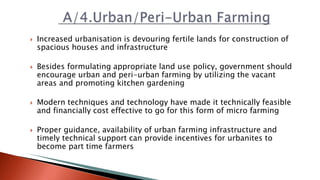
 Increased urbanisation is devouring fertile lands for construction of
spacious houses and infrastructure
 Besides formulating appropriate land use policy, government should
encourage urban and peri-urban farming by utilizing the vacant
areas and promoting kitchen gardening
 Modern techniques and technology have made it technically feasible
and financially cost effective to go for this form of micro farming
 Proper guidance, availability of urban farming infrastructure and
timely technical support can provide incentives for urbanites to
become part time farmers
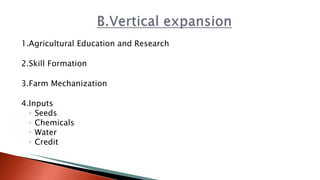
1.Agricultural Education and Research
2.Skill Formation
3.Farm Mechanization
4.Inputs
◦ Seeds
◦ Chemicals
◦ Water
◦ Credit
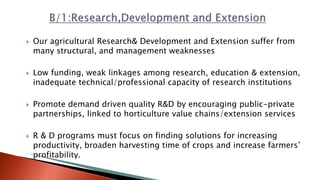
 Our agricultural Research& Development and Extension suffer from
many structural, and management weaknesses
 Low funding, weak linkages among research, education & extension,
inadequate technical/professional capacity of research institutions
 Promote demand driven quality R&D by encouraging public-private
partnerships, linked to horticulture value chains/extension services
 R & D programs must focus on finding solutions for increasing
productivity, broaden harvesting time of crops and increase farmers’
profitability.
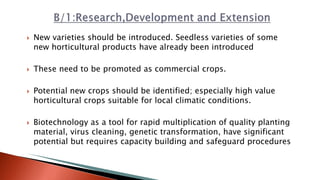
 New varieties should be introduced. Seedless varieties of some
new horticultural products have already been introduced
 These need to be promoted as commercial crops.
 Potential new crops should be identified; especially high value
horticultural crops suitable for local climatic conditions.
 Biotechnology as a tool for rapid multiplication of quality planting
material, virus cleaning, genetic transformation, have significant
potential but requires capacity building and safeguard procedures
 Skill development through in-service training at different R&D
institutions can enhance capabilities of extension staff.
 Postgraduate programs in fruits, vegetables, floriculture, medicinal
and spices crops and post harvest management should help providing
skilled human resource for the horticulture industry.
 Such programs should be initiated in agriculture universities and
research institutes in all provinces.
 Skilled labor should be attracted and retained through competitive
minimum wages for the agricultural labor and the development of
industry vocational training programs
 Intensification and diversification of farm mechanization by ensuring easy
access of the farmers to essential horticultural machinery
 Its efficient and optimal use by incentivizing the private sector for opening
machinery leasing/hiring outlets in villages
 Federal Government should exempt the duties and surcharge on import of
horticulture machinery like grading units, cold storage chambers, greenhouses
and trickle irrigation accessories such as micro-tubes, mini sprinkler and
bubblers for interested businessmen
 Expansion and modernization of local machinery manufacturing by providing
them training, incentives and technical/financial support to produce
horticultural implements as per international standards
 Limited availability of true to type root stock is the biggest handicap in
establishing state of art fruit and vegetables nurseries in the country
 State should promote the establishment of such nurseries by providing
appropriate legislative cover, financial support and technical guidance
 All nurseries must work according to the approved nursery protocol,
developed in consultation with technical experts and stakeholders
 Only registered nurseries should be eligible for support and facilities
offered by the government
 There are various estimates of production losses due to non-use
of appropriate chemicals by the farmers
 Ignorance, fear and costs of using-general reasons for this
neglect
 There is need to create awareness among the farmers for
judicious use of chemicals for reducing the production losses
 There are eco friendly measures to reduce this loss for those who
are excessively conscious of use of chemical inputs
 Water was already scarce but its scarcity is becoming acute due
to its increased demand, misuse, wastage and climate change.
 There is thus need to rationalize its use even for farming
purposes where it is wasted the most.
 New water saving techniques and technologies have provided
hope for mitigating its impact
 Innovative methods such as rain water harvesting and recycling
of sewage water for kitchen gardening need to be encouraged
 The sector is informal and profit margin is low which has
diverted investment to other sectors
 Lack of financial resources and high interest rates of financial
services available are biggest handicaps for its growth
 Government should facilitate soft loans for promotion of
horticulture industry for a period of five years
 The government should facilitate the stakeholders involved in
horticulture business to access commercial credit by reducing
compliance and transaction costs
1. Processing
2. Marketing
3. Value addition
4. Diversification
5. Production Relations
 Provide information to the growers on harvest technologies of
fruits, removal of field heat, grading of the produce and
appropriate packaging.
 Post harvest losses must be examined and programs planned to
minimize these losses, when financially viable, through linking
production to agro industrial transformation and through
encouraging private sector to build cold storages.
 The development of appropriate packaging technologies that
minimize product damage.
 Marketing of horticultural products is supply based- producers being
price takers and receiving lower prices during high supply periods.
 Government should develop integrated value chains with producers
and producer groups as an integral component of these value chains.
 The building of contract farming, collaborative marketing
arrangements with processors etc be prioritized
 Market information system be established including price-clearing
houses of agricultural commodities in provincial/federal capitals.
 Government should promote public-private partnerships and provide
incentives/ support for value addition and value creation through
development of:
Environment-friendly packaging/ packaging industry
Cold chain infrastructure
Wholesale market infrastructure
Fruit and vegetable processing and dehydration industry
Integrated pest management industry and services
Organic and herbal/ medicinal crop production/processing
 Enhanced quality should be enforced in accordance with World Trade
Organization’s (WTO) requirements
 Horticulture production should be based on quality that will promote
exports for which accredited quality control and testing laboratories
must be established to certify quality of the produce for exports and in
the domestic market.
 A coherent sanitary and phyto sanitary (SPS) management system for
strong coordination and effective interaction between various
departments involved in inspection, testing and other related activities
should be facilitated
 The regulations and procedures of export and import of horticulture
industry commodities should be reformed to reduce compliance and
transaction costs as part of achieving efficiency gains
 Besides increasing production of indigenous fruits and vegetables, we
have to diversify our horticultural portfolio by promoting the cultivation
of exotic fruits and vegetables which are in demand at global level
 This is a centuries old process and is continuing all over the world. We
will not face much problems as our terrain and climate suitable for
production of variety of exotic horticultural products
 We need the services of marketing people and researchers to find
globally traded products which can be grown here from agronomic point
 Organic farming is another niche area which needs to be exploited by
providing appropriate legal framework and proper incentives and
support should be promoted
 Production relations relate to the way land is owned, cultivated and
crops are disposed of
 In Pakistan only two types of production relations are in vogue i.e.
owner cultivation and tenant cultivation
 Promote three other modes which are essential for modernising our
horticultural transformation –cooperative, contract and corporate
 These are in operation in some areas but with limited success. Time
has come to provide a comprehensive legal framework and
institutional mechanism to streamline these production relations
 Formulation of comprehensive Land Use Policy
 Improving Rural Infrastructure
 Environmental Sustainability
 Creating Linkages and promoting Investment
 Gender Mainstreaming
 Rural Non-farm Sector
 Developing a national land use policy for rational use of land
resources is the need of the day as valuable arable land is being
converted for non-farming purposes at alarming rates
 Add to it the declining fertility of our agricultural lands due to
non sustainable agricultural practices plus the degradation of our
lands due to water logging and salinity going on for decades, a
negative side effect of our irrigation practices
 Lastly we are misusing our scarce land resources as we are
cultivating crops on lands extremely suitable for horticultural use
 All these issues needed to be addressed by formulating a long
term comprehensive land use policy by the government
 Government should facilitate developing modern infrastructure
(wholesale markets, pack houses, cold stores, reefer containers)
under public - private partnerships, managed by private sector
 Improvement of infrastructure like roads for the safe
transportation of horticulture commodities
 Developing airport facilities for wide bodied cargo planes to land
at airports in the main production areas, improving handling
facilities at ports providing one window operation and
establishing of effective and viable cold chain development
 Create awareness among farmers about looming threat of climate change/
environmental degradation, popularizing the good sustainable agricultural practices
 We will have to synchronise the extension services of the provincial agricultural
departments and marketing outlets of the private agro services providers to promote
environment friendly practices
 Government should promulgation legislation for stopping of practices aggravating the
threat of climate change and allocate resources for carrying out research to develop
varieties responsive to climate change
 They need to look into adjusting the cropping pattern and fine-tuning the planting and
harvesting schedules, practicing crop rotation and diversifying crop mix
 Recent growth has wrought enormous environmental destruction in India.
 In a recently released report commissioned by the Indian government, the
World Bank estimates that environmental degradation annually costs India a
horrific 5.7 percent of GDP.
 This shaves off almost all of the annual six percent per capita GDP growth
recorded between 2000-01 and 2010-11. Outdoor pollution alone kills 1.16
lakh people every year.
 Almost a quarter of India’s child deaths can be attributed to inadequate
availability of clean water and sanitation, itself related to environmental
degradation.
 Government should allocate substantial funds for investment in rural
areas and provide necessary legal framework, proper fiscal and financial
incentives to encourage private sector for investing in critical areas
 Government should invest in improving the rural infrastructure, skill
formation, research institutions and establishment of common
facilitation centers
 It should encourage the private sector to come forward in cool chain,
storage and reefer containers value addition and scientific modern
processing and new technologies
 All the non-crop agricultural activities provide excellent
opportunities for accelerated gender mainstreaming
 Even presently women play an important role in livestock
husbandry, poultry farming, dairy production and horticultural
cultivation
 Targeted attention to create gender balance through skill formation,
awareness campaign, financial assistance and technical support can
yield handsome dividends in short period
 It will also help government in its efforts to reduce rural poverty
 Agricultural sector cannot grow to its full potential unless the rural non farm
sector develop along with its formal farm sector
 Development of efficient and effective agri-based supply chains that link the
agriculture sector with their corresponding upstream and downstream links in
the rural non-farm (RNF) to the national and international markets
 RNF provides 40-60% of incomes/jobs in rural areas, much of its activity occurs
in the trading, services and processing sector having strong forward and
backward linkages with agriculture
 Informal and low capital using entities catering mostly to domestic markets,
RNF presents opportunities for providing value addition to primary production
at the farm level
 Pakistan has a great potential to increase its horticultural production by bringing
in new areas under cultivation of horticultural products
 However, there is need for introducing new exotic products in its horticultural
portfolio, improving the productivity, adding value and increasing its exports
 In order to do so it will have to put more resources in research and development,
extension, improving marketing infrastructure improving processing etc
 This demands lot of resources which can be provided by the private sector, local
and foreign, if we fine-tune our legal framework supported by appropriate
institutional mechanism and added by a strict dispute resolution mechanism
 Thank you for viewing the presentation
 If you liked it, can you please download its EBook version for US$
3.46 at the following
URLhttps://www.amazon.com/dp/B010TMK28S
 Kindly see the list of my articles available at my website in next few slides
52
 Pakistan’s Difficulties at the Time of her Independence
http://www.shahidhussainraja.com/pakistans-difficulties-at-the-time-of-her-independence/
 Why Countries Break? Case of Bangladesh
http://www.shahidhussainraja.com/why-countries-break-case-of-bangladesh/
 Pakistan’s 13th IMF Programme: Prospects & Challenges
http://www.shahidhussainraja.com/pakistans-13th-imf-programme-prospects-challenges/
 Federalism in Pakistan: Challenges & Response
https://www.shahidhussainraja.com/federalism-in-pakistan-challengers-response/
 Water Issues in Pakistan
http://www.shahidhussainraja.com/water-issues-in-pakistan/
 Governance Reforms in Pakistan: Need and Content
http://www.shahidhussainraja.com/governance-reforms-in-pakistan-need-and-content/
 Pakistan’s Strategic Culture: Determinants & Dimensions
http://www.shahidhussainraja.com/pakistans-strategic-culture-determinants-dimensions/
 Pakistani Culture: Sources & Drivers
http://www.shahidhussainraja.com/pakistani-culture-sources-drivers/
 Improving Pakistan’s Global Image
http://www.shahidhussainraja.com/improving-pakistans-global-image/
 Two Nations Theory: Myths and Reality
http://www.shahidhussainraja.com/two-nations-theory-myths-and-reality/
 Why do Civil Service Reforms in Pakistan Fail?
http://www.shahidhussainraja.com/why-do-civil-service-reforms-in-pakistan-fail/
 Is Pakistan a Failed State?
http://www.shahidhussainraja.com/is-pakistan-a-failed-state/
 Pakistan Ideology: Sources & Features
http://www.shahidhussainraja.com/what-is-pakistan-ideology-myths-and-content/
 International Relations: Definition, Scope & Subject Matter
(http://www.shahidhussainraja.com/the-scope-of-international-relations/)
 Modern Nation-state System: Challenges & Prospects
(http://www.shahidhussainraja.com/modern-nation-state-system-challenges-prospects/)
 Foreign Policy: Features, Success Factors & Challenges
(http://www.shahidhussainraja.com/foreign-policy-features-success-factors-challenges/)
 Clash of Civilisations by Huntington
http://www.shahidhussainraja.com/clash-of-civilizations-a-critique/
 Globalization: Compressing Time and Space -Part 1& 2
http://www.shahidhussainraja.com/globalization-compressing-time-and-space-part-1/
/http://www.shahidhussainraja.com/globalization-compressing-time-and-space-part-2/
 Determinants of Foreign Policy
http://www.shahidhussainraja.com/determinants-of-foreign-policy/
 Foreign Policy: Tools & Implements
http://www.shahidhussainraja.com/foreign-policy-tools-instruments/
 National Interest: Meaning & Components
http://www.shahidhussainraja.com/national-interest-meaning-components/
 World Peace: A Norm or an Aberration?
http://www.shahidhussainraja.com/world-peace-a-norm-or-an-aberration/
 End of History by Francis Fukuyama
http://www.shahidhussainraja.com/end-of-history-by-francis-fukuyama-a-critique/
 Breakup of Soviet Union: Causes & Consequences
http://www.shahidhussainraja.com/breakup-of-the-soviet-union-causes-consequences/
 Global Terrorism: Challenges & Response – Part 1 & 2
http://www.shahidhussainraja.com/global-terrorism-challenges-response/
http://www.shahidhussainraja.com/global-terrorism-challenges-response-part-2/
 War on Terror: Causes, Course, Costs and Consequences Part 1 & 2
http://www.shahidhussainraja.com/war-on-terror-causes-course-costs-and-consequences-part-1/
http://www.shahidhussainraja.com/war-on-terror-causes-course-costs-and-consequences-part-2/
 Arab Spring: Genesis, Causes of Failure & Lessons Learnt
http://www.shahidhussainraja.com/arab-spring-genesis-causes-of-failure-lessons-learnt/
 Islamophobia: Genesis, Challenges & Response
http://www.shahidhussainraja.com/islamophobia-genesis-challenges-response/
 Vietnam War: Causes & Consequences
http://www.shahidhussainraja.com/vietnam-war-causes-course-and-consequences/
 Nine Drivers of Sino-American Cold War
http://www.shahidhussainraja.com/9-drivers-of-america-china-cold-war/
 IMF Programmes: Do they help Developing Countries?
http://www.shahidhussainraja.com/imf-programme-does-it-help-a-developing-country/
 American Interests in Afghanistan
http://www.shahidhussainraja.com/american-interests-in-afghanistan/
 Reasons for Soviet Invasion of Afghanistan in 1979
http://www.shahidhussainraja.com/why-did-soviet-union-enter-afghanistan-in-1979/
 The Middle East Crises: Genesis and Dimensions
http://www.shahidhussainraja.com/the-middle-east-crises-genesis-and-dimensions/
 China Iran Relations: Past, Present & Future
http://www.shahidhussainraja.com/china-iran-relations-past-present-future/
Pakistan's  Horticulture Sector: Challenges & Response

Pakistan's Horticulture Sector: Challenges & Response

  • 1.
  • 2.
     Introduction  HorticultureSector-Profile  SWOT Analysis  Issues and Challenges  Recommendations  Conclusions
  • 3.
     Despite itssignificance in agricultural growth, commercial activities and poverty alleviation, the horticulture sector has not received the attention it deserves. As a result, horticulture has not developed to its full potential  Its slow development reflects a weak policy and regulatory framework, production and productivity problems, post harvest losses, marketing problems and limited capital investment.  These problems contributed to low quality standards, minimal export of horticulture products, low rates of return on investment that consequently fail to attract new investment.  This presentation explains the ground realities about horticultural sector of Pakistan and suggests a strategy to develop this sector to its full potential
  • 4.
     Despite itsrelative decline in formal economy in percentage terms, agriculture is still dominant sector in overall economic structure  Pakistan’s survival and growth are directly dependent on its agriculture due to its socio-political interconnectedness and its economic and financial linkages-backward and forward  Its performance still dictates all our macro indicators - GDP, Poverty, External Balance, Inflation etc
  • 5.
     Out oftotal area of Pakistan of approximately 80 million hectares, about 58 million hectares have been surveyed  The area under cultivation is 22 million hectares (38%) out of which nearly 19 million hectares is irrigated; the rest is rain fed  The area under forest is 4 million hectares (7%) and the balance surveyed area 8 million hectares can be classified as the cultivable waste  Coupled with suitable climate and availability of good water resources, agriculture has been major activity for centuries in this part of the world
  • 6.
     Pakistan’s Agriculturesector- livestock, crop, forest and fisheries  Livestock contributes 56% of the total agriculture production, crop sector adds 38% while fisheries and forestry contributes 2% each  Out of crops sector ,horticulture occupies fairly significant position in terms of area, production, share in GDP and employment.  A viable and profitable horticulture sector can provide a sustainable livelihood to the rural agriculture community .  However small land holding precludes the possibility of horticultural cultivation on commercial lines
  • 7.
     Great potentialfor horticulture due to variety in land and climate which provide opportunities to produce wide range of horticulture crops.  Besides producing large number of indigenous fruits, vegetables and floriculture commodities, there is scope for cultivation of exotic crops.  Pakistan occupies prominent world position in terms of production i.e. apricots(6th),date palm(5th), Onion(7th),mandarin (6th),mango (4th) etc  With 435,000 hectares under vegetables, Pakistan ranks 17th globally while producing 5,500,1000 tons it ranks 20th in production
  • 8.
     With anarea around 200,000 hectares under production, Pakistan produces 2.15 million tons per annum( 95% of world’s Kinnows) out of which around 370,000 tons worth Rs.10 billion is exported.  Apples are grown on 111,600 hectares and getting annual production of 366,000 tons out of which ----million tons worth --- are exported  Peaches are mostly grown over an area under 15,000 hectares and production is 54,000 tons.  Mango, the second important fruit crop, is grown on173,700 hectares and production is around 2 million tons. It produces approximately 6% of the world’s total production and is currently the third largest producer.
  • 9.
     Grapes, lowwater crop is planted over 16,000 hectares & increasing owing to rise in demand. Production of grapes-70,000 tons.  Guava is widely grown in Pakistan with production of about 500,000 tons over an area of 62,000 hectares.  Produced in all the four provinces, the area under cultivation of dates is 90,000 hectares with production of 531,000 tons.  Other fruits-banana, persimmon, pomegranates, cherries, plums
  • 10.
     Onions, grownin all the four provinces is cultivated on an area of 125,000 hectares and production is 1.70 million tons  Garlic is grown in all the four provinces of Pakistan over an area of 6,800 hectares producing 57,000 tons  Potato, fourth most important crop in terms of volume, cultivated on an area of 140,000 hectares with production of 3 million tons  Chillies grown on 75,000 hectares with production of 188,000 tons
  • 12.
     Huge areaavailable for horticultural plantation  Climate suitable for Indigenous and exotic fruits and vegetables  Possibilities of fruit/crop inter-cropping  Year round availability of fruits/veg due to geographical spread  widespread adoption of tunnel farming/drip irrigation
  • 13.
     Low production,often geographically dispersed -less area/low yields  Side business to crops/livestock-less attention  Bad horticultural practices -huge production losses  Low technological base-less production/productivity  Poor marketing leading to lower profitability  Inadequate value addition-less profitability  Unsatisfactory processing-post production losses
  • 14.
     Global corporateinterest in food products  Growing population-domestic and world which expands the market  Growing prosperity increases demand for luxuries, including fruits  Improved transportation network saving time  Regional integration reducing costs of doing business  New technologies resulting in efficiency gains & time/costs reduction
  • 15.
     Climate changeand environmental degradation  Sudden death syndrome diseases affecting certain food trees  Similarly reports of post harvest fungal disease  Increasingly strict food safety standards in developed countries  Bio-fuel production adversely affecting food security, horticulture  Lack of land use policy-agricultural land being used for houses
  • 16.
    How to meetthe increasing demand of high quality horticultural products by increasing its production on sustainable basis without adversely affecting the production of food/cash crops or habitat for livestock in the face of looming threat of climate change and environmental degradation
  • 17.
     We needto formulate a comprehensive horticultural policy which should indicate the broad direction, create institutions and define their respective roles, make rules for coordination, set safety standards and provide an incentive and rewards system for various stake holders  Within this framework the Government’s role should be confined to policy formulation, regulation, capacity building and facilitation, while the private sector will take the lead in investment and value chain development, on its own or on public-private partnership basis  Within the national policy settings, horticulture will be developed with the following five broad objectives;
  • 18.
     Increase productivityby increasing efficiency in all horticultural operations through public as well as private sector investment in R&D and Extension  Increase profitability by rationalizing input and output prices, reducing production and post production losses and developing efficient marketing infrastructure  Make horticultural produce competitive in the rapidly globalizing world by reducing cost of production, improving quality and ensuring Sanitary and Phyto-Sanitary (SPS) compliance
  • 19.
     Ensure sustainabilityby promoting environment friendly good horticultural practices through incentives and rewards, awareness campaigns and promulgation of appropriate legal framework  Ensure equitable distribution of gains from enhanced productivity by making available public sector goods and services to all stakeholders without distinction
  • 20.
     Accelerating thenational economic growth by increasing the rate of growth of this important subsector of the economy  Reducing unemployment by creating jobs in horticulture sector  Increasing Pakistan's foreign exchange earnings by increasing quantity, quality and variety of horticultural exports  Ensuring food security and nutritional balance of the people’s food intake by providing them vitamin rich horticultural products  Helping the state in its poverty alleviation efforts by providing them a labour intensive, low capital intensive investment  Improving the condition and status of women by providing them opportunities to own resources
  • 21.
    A. Horizontal expansion- increasing the area under horticultural products B. Vertical expansion - increasing the yield of the horticultural products C. Structural transformation - diversification and value addition D. Cross Cutting Interventions - Agrarian Reforms
  • 22.
    1.Bringing new areasunder horticultural cultivation 2.Reclaiming degraded lands 3.Intercropping 4.Urban/peri-urban farming
  • 23.
     There isa vast scope of horizontal expansion in respect of horticultural products due to their agronomic qualities  New techniques of tunnel farming and drip irrigation has revolutionized this sector  Increased productivity in crop sector can release additional lands for horticulture  Even marginal/mountain lands, not fit for profitable cultivation of cash/food crops can be brought under fruit/vegetables
  • 24.
     Degraded lands,not fit for profitable cultivation of cash/food crops can be brought under horticultural production with the help of technology, chemicals and water  New techniques and technology of saving water has made it possible to use these land for horticultural production on profitable basis
  • 25.
     Encourage eco-friendlyinter-cropping practices as it increases the area under cultivation by cultivating vegetables in between rows.  Farmers can plant crops in orchards to increase their profitability  Agro-forestry is another profitable option for farmers and country  However farmers must be given proper technical support for this practice to be cost effective and eco-friendly
  • 26.
     Increased urbanisationis devouring fertile lands for construction of spacious houses and infrastructure  Besides formulating appropriate land use policy, government should encourage urban and peri-urban farming by utilizing the vacant areas and promoting kitchen gardening  Modern techniques and technology have made it technically feasible and financially cost effective to go for this form of micro farming  Proper guidance, availability of urban farming infrastructure and timely technical support can provide incentives for urbanites to become part time farmers
  • 27.
    1.Agricultural Education andResearch 2.Skill Formation 3.Farm Mechanization 4.Inputs ◦ Seeds ◦ Chemicals ◦ Water ◦ Credit
  • 28.
     Our agriculturalResearch& Development and Extension suffer from many structural, and management weaknesses  Low funding, weak linkages among research, education & extension, inadequate technical/professional capacity of research institutions  Promote demand driven quality R&D by encouraging public-private partnerships, linked to horticulture value chains/extension services  R & D programs must focus on finding solutions for increasing productivity, broaden harvesting time of crops and increase farmers’ profitability.
  • 29.
     New varietiesshould be introduced. Seedless varieties of some new horticultural products have already been introduced  These need to be promoted as commercial crops.  Potential new crops should be identified; especially high value horticultural crops suitable for local climatic conditions.  Biotechnology as a tool for rapid multiplication of quality planting material, virus cleaning, genetic transformation, have significant potential but requires capacity building and safeguard procedures
  • 30.
     Skill developmentthrough in-service training at different R&D institutions can enhance capabilities of extension staff.  Postgraduate programs in fruits, vegetables, floriculture, medicinal and spices crops and post harvest management should help providing skilled human resource for the horticulture industry.  Such programs should be initiated in agriculture universities and research institutes in all provinces.  Skilled labor should be attracted and retained through competitive minimum wages for the agricultural labor and the development of industry vocational training programs
  • 31.
     Intensification anddiversification of farm mechanization by ensuring easy access of the farmers to essential horticultural machinery  Its efficient and optimal use by incentivizing the private sector for opening machinery leasing/hiring outlets in villages  Federal Government should exempt the duties and surcharge on import of horticulture machinery like grading units, cold storage chambers, greenhouses and trickle irrigation accessories such as micro-tubes, mini sprinkler and bubblers for interested businessmen  Expansion and modernization of local machinery manufacturing by providing them training, incentives and technical/financial support to produce horticultural implements as per international standards
  • 32.
     Limited availabilityof true to type root stock is the biggest handicap in establishing state of art fruit and vegetables nurseries in the country  State should promote the establishment of such nurseries by providing appropriate legislative cover, financial support and technical guidance  All nurseries must work according to the approved nursery protocol, developed in consultation with technical experts and stakeholders  Only registered nurseries should be eligible for support and facilities offered by the government
  • 33.
     There arevarious estimates of production losses due to non-use of appropriate chemicals by the farmers  Ignorance, fear and costs of using-general reasons for this neglect  There is need to create awareness among the farmers for judicious use of chemicals for reducing the production losses  There are eco friendly measures to reduce this loss for those who are excessively conscious of use of chemical inputs
  • 34.
     Water wasalready scarce but its scarcity is becoming acute due to its increased demand, misuse, wastage and climate change.  There is thus need to rationalize its use even for farming purposes where it is wasted the most.  New water saving techniques and technologies have provided hope for mitigating its impact  Innovative methods such as rain water harvesting and recycling of sewage water for kitchen gardening need to be encouraged
  • 35.
     The sectoris informal and profit margin is low which has diverted investment to other sectors  Lack of financial resources and high interest rates of financial services available are biggest handicaps for its growth  Government should facilitate soft loans for promotion of horticulture industry for a period of five years  The government should facilitate the stakeholders involved in horticulture business to access commercial credit by reducing compliance and transaction costs
  • 36.
    1. Processing 2. Marketing 3.Value addition 4. Diversification 5. Production Relations
  • 37.
     Provide informationto the growers on harvest technologies of fruits, removal of field heat, grading of the produce and appropriate packaging.  Post harvest losses must be examined and programs planned to minimize these losses, when financially viable, through linking production to agro industrial transformation and through encouraging private sector to build cold storages.  The development of appropriate packaging technologies that minimize product damage.
  • 38.
     Marketing ofhorticultural products is supply based- producers being price takers and receiving lower prices during high supply periods.  Government should develop integrated value chains with producers and producer groups as an integral component of these value chains.  The building of contract farming, collaborative marketing arrangements with processors etc be prioritized  Market information system be established including price-clearing houses of agricultural commodities in provincial/federal capitals.
  • 39.
     Government shouldpromote public-private partnerships and provide incentives/ support for value addition and value creation through development of: Environment-friendly packaging/ packaging industry Cold chain infrastructure Wholesale market infrastructure Fruit and vegetable processing and dehydration industry Integrated pest management industry and services Organic and herbal/ medicinal crop production/processing  Enhanced quality should be enforced in accordance with World Trade Organization’s (WTO) requirements
  • 40.
     Horticulture productionshould be based on quality that will promote exports for which accredited quality control and testing laboratories must be established to certify quality of the produce for exports and in the domestic market.  A coherent sanitary and phyto sanitary (SPS) management system for strong coordination and effective interaction between various departments involved in inspection, testing and other related activities should be facilitated  The regulations and procedures of export and import of horticulture industry commodities should be reformed to reduce compliance and transaction costs as part of achieving efficiency gains
  • 41.
     Besides increasingproduction of indigenous fruits and vegetables, we have to diversify our horticultural portfolio by promoting the cultivation of exotic fruits and vegetables which are in demand at global level  This is a centuries old process and is continuing all over the world. We will not face much problems as our terrain and climate suitable for production of variety of exotic horticultural products  We need the services of marketing people and researchers to find globally traded products which can be grown here from agronomic point  Organic farming is another niche area which needs to be exploited by providing appropriate legal framework and proper incentives and support should be promoted
  • 42.
     Production relationsrelate to the way land is owned, cultivated and crops are disposed of  In Pakistan only two types of production relations are in vogue i.e. owner cultivation and tenant cultivation  Promote three other modes which are essential for modernising our horticultural transformation –cooperative, contract and corporate  These are in operation in some areas but with limited success. Time has come to provide a comprehensive legal framework and institutional mechanism to streamline these production relations
  • 43.
     Formulation ofcomprehensive Land Use Policy  Improving Rural Infrastructure  Environmental Sustainability  Creating Linkages and promoting Investment  Gender Mainstreaming  Rural Non-farm Sector
  • 44.
     Developing anational land use policy for rational use of land resources is the need of the day as valuable arable land is being converted for non-farming purposes at alarming rates  Add to it the declining fertility of our agricultural lands due to non sustainable agricultural practices plus the degradation of our lands due to water logging and salinity going on for decades, a negative side effect of our irrigation practices  Lastly we are misusing our scarce land resources as we are cultivating crops on lands extremely suitable for horticultural use  All these issues needed to be addressed by formulating a long term comprehensive land use policy by the government
  • 45.
     Government shouldfacilitate developing modern infrastructure (wholesale markets, pack houses, cold stores, reefer containers) under public - private partnerships, managed by private sector  Improvement of infrastructure like roads for the safe transportation of horticulture commodities  Developing airport facilities for wide bodied cargo planes to land at airports in the main production areas, improving handling facilities at ports providing one window operation and establishing of effective and viable cold chain development
  • 46.
     Create awarenessamong farmers about looming threat of climate change/ environmental degradation, popularizing the good sustainable agricultural practices  We will have to synchronise the extension services of the provincial agricultural departments and marketing outlets of the private agro services providers to promote environment friendly practices  Government should promulgation legislation for stopping of practices aggravating the threat of climate change and allocate resources for carrying out research to develop varieties responsive to climate change  They need to look into adjusting the cropping pattern and fine-tuning the planting and harvesting schedules, practicing crop rotation and diversifying crop mix
  • 47.
     Recent growthhas wrought enormous environmental destruction in India.  In a recently released report commissioned by the Indian government, the World Bank estimates that environmental degradation annually costs India a horrific 5.7 percent of GDP.  This shaves off almost all of the annual six percent per capita GDP growth recorded between 2000-01 and 2010-11. Outdoor pollution alone kills 1.16 lakh people every year.  Almost a quarter of India’s child deaths can be attributed to inadequate availability of clean water and sanitation, itself related to environmental degradation.
  • 48.
     Government shouldallocate substantial funds for investment in rural areas and provide necessary legal framework, proper fiscal and financial incentives to encourage private sector for investing in critical areas  Government should invest in improving the rural infrastructure, skill formation, research institutions and establishment of common facilitation centers  It should encourage the private sector to come forward in cool chain, storage and reefer containers value addition and scientific modern processing and new technologies
  • 49.
     All thenon-crop agricultural activities provide excellent opportunities for accelerated gender mainstreaming  Even presently women play an important role in livestock husbandry, poultry farming, dairy production and horticultural cultivation  Targeted attention to create gender balance through skill formation, awareness campaign, financial assistance and technical support can yield handsome dividends in short period  It will also help government in its efforts to reduce rural poverty
  • 50.
     Agricultural sectorcannot grow to its full potential unless the rural non farm sector develop along with its formal farm sector  Development of efficient and effective agri-based supply chains that link the agriculture sector with their corresponding upstream and downstream links in the rural non-farm (RNF) to the national and international markets  RNF provides 40-60% of incomes/jobs in rural areas, much of its activity occurs in the trading, services and processing sector having strong forward and backward linkages with agriculture  Informal and low capital using entities catering mostly to domestic markets, RNF presents opportunities for providing value addition to primary production at the farm level
  • 51.
     Pakistan hasa great potential to increase its horticultural production by bringing in new areas under cultivation of horticultural products  However, there is need for introducing new exotic products in its horticultural portfolio, improving the productivity, adding value and increasing its exports  In order to do so it will have to put more resources in research and development, extension, improving marketing infrastructure improving processing etc  This demands lot of resources which can be provided by the private sector, local and foreign, if we fine-tune our legal framework supported by appropriate institutional mechanism and added by a strict dispute resolution mechanism
  • 52.
     Thank youfor viewing the presentation  If you liked it, can you please download its EBook version for US$ 3.46 at the following URLhttps://www.amazon.com/dp/B010TMK28S  Kindly see the list of my articles available at my website in next few slides 52
  • 53.
     Pakistan’s Difficultiesat the Time of her Independence http://www.shahidhussainraja.com/pakistans-difficulties-at-the-time-of-her-independence/  Why Countries Break? Case of Bangladesh http://www.shahidhussainraja.com/why-countries-break-case-of-bangladesh/  Pakistan’s 13th IMF Programme: Prospects & Challenges http://www.shahidhussainraja.com/pakistans-13th-imf-programme-prospects-challenges/  Federalism in Pakistan: Challenges & Response https://www.shahidhussainraja.com/federalism-in-pakistan-challengers-response/  Water Issues in Pakistan http://www.shahidhussainraja.com/water-issues-in-pakistan/  Governance Reforms in Pakistan: Need and Content http://www.shahidhussainraja.com/governance-reforms-in-pakistan-need-and-content/  Pakistan’s Strategic Culture: Determinants & Dimensions http://www.shahidhussainraja.com/pakistans-strategic-culture-determinants-dimensions/
  • 54.
     Pakistani Culture:Sources & Drivers http://www.shahidhussainraja.com/pakistani-culture-sources-drivers/  Improving Pakistan’s Global Image http://www.shahidhussainraja.com/improving-pakistans-global-image/  Two Nations Theory: Myths and Reality http://www.shahidhussainraja.com/two-nations-theory-myths-and-reality/  Why do Civil Service Reforms in Pakistan Fail? http://www.shahidhussainraja.com/why-do-civil-service-reforms-in-pakistan-fail/  Is Pakistan a Failed State? http://www.shahidhussainraja.com/is-pakistan-a-failed-state/  Pakistan Ideology: Sources & Features http://www.shahidhussainraja.com/what-is-pakistan-ideology-myths-and-content/
  • 55.
     International Relations:Definition, Scope & Subject Matter (http://www.shahidhussainraja.com/the-scope-of-international-relations/)  Modern Nation-state System: Challenges & Prospects (http://www.shahidhussainraja.com/modern-nation-state-system-challenges-prospects/)  Foreign Policy: Features, Success Factors & Challenges (http://www.shahidhussainraja.com/foreign-policy-features-success-factors-challenges/)  Clash of Civilisations by Huntington http://www.shahidhussainraja.com/clash-of-civilizations-a-critique/  Globalization: Compressing Time and Space -Part 1& 2 http://www.shahidhussainraja.com/globalization-compressing-time-and-space-part-1/ /http://www.shahidhussainraja.com/globalization-compressing-time-and-space-part-2/
  • 56.
     Determinants ofForeign Policy http://www.shahidhussainraja.com/determinants-of-foreign-policy/  Foreign Policy: Tools & Implements http://www.shahidhussainraja.com/foreign-policy-tools-instruments/  National Interest: Meaning & Components http://www.shahidhussainraja.com/national-interest-meaning-components/  World Peace: A Norm or an Aberration? http://www.shahidhussainraja.com/world-peace-a-norm-or-an-aberration/  End of History by Francis Fukuyama http://www.shahidhussainraja.com/end-of-history-by-francis-fukuyama-a-critique/  Breakup of Soviet Union: Causes & Consequences http://www.shahidhussainraja.com/breakup-of-the-soviet-union-causes-consequences/
  • 57.
     Global Terrorism:Challenges & Response – Part 1 & 2 http://www.shahidhussainraja.com/global-terrorism-challenges-response/ http://www.shahidhussainraja.com/global-terrorism-challenges-response-part-2/  War on Terror: Causes, Course, Costs and Consequences Part 1 & 2 http://www.shahidhussainraja.com/war-on-terror-causes-course-costs-and-consequences-part-1/ http://www.shahidhussainraja.com/war-on-terror-causes-course-costs-and-consequences-part-2/  Arab Spring: Genesis, Causes of Failure & Lessons Learnt http://www.shahidhussainraja.com/arab-spring-genesis-causes-of-failure-lessons-learnt/  Islamophobia: Genesis, Challenges & Response http://www.shahidhussainraja.com/islamophobia-genesis-challenges-response/  Vietnam War: Causes & Consequences http://www.shahidhussainraja.com/vietnam-war-causes-course-and-consequences/
  • 58.
     Nine Driversof Sino-American Cold War http://www.shahidhussainraja.com/9-drivers-of-america-china-cold-war/  IMF Programmes: Do they help Developing Countries? http://www.shahidhussainraja.com/imf-programme-does-it-help-a-developing-country/  American Interests in Afghanistan http://www.shahidhussainraja.com/american-interests-in-afghanistan/  Reasons for Soviet Invasion of Afghanistan in 1979 http://www.shahidhussainraja.com/why-did-soviet-union-enter-afghanistan-in-1979/  The Middle East Crises: Genesis and Dimensions http://www.shahidhussainraja.com/the-middle-east-crises-genesis-and-dimensions/  China Iran Relations: Past, Present & Future http://www.shahidhussainraja.com/china-iran-relations-past-present-future/