Global Environmental Issues
Mr. Manoj H. Mota
SITCOE, Yadrav.
The major issues are………..
• Global warming
• Acid rain
• Ozone depletion
• Photochemical smog
• Occurred only due to uncontrolled air pollution.
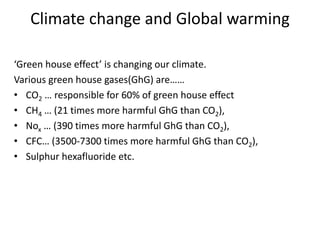
Climate change and Global warming
‘Green house effect’ is changing our climate.
Various green house gases(GhG) are……
• CO2 … responsible for 60% of green house effect
• CH4 … (21 times more harmful GhG than CO2),
• Nox … (390 times more harmful GhG than CO2),
• CFC… (3500-7300 times more harmful GhG than CO2),
• Sulphur hexafluoride etc.
• Avarage CO2 volume in atmosphere is increased form 316ppmv
in 1959 to 379ppmv in 2006.
• Largest single year jump of 2.87 ppmv in 1997-98.
• Earths temp. on average has increased @1oC in last 100 years.
• Water level in ocean has gone up by 15cm in same span.
Reasons…
 Excessive burning of fossile fuel and deforestation.
 Large scale decomposition of organic matter.
 Use and subsequent release of CFCs from refrigeration and air
conditioning units.
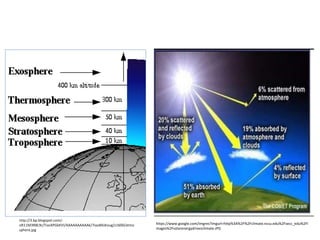
http://3.bp.blogspot.com/-
oR11M3R8L9c/TiasXPGkKVI/AAAAAAAAAAk/7iao8XsKoug/s1600/atmo
sphere.jpg
https://www.google.com/imgres?imgurl=http%3A%2F%2Fclimate.ncsu.edu%2Fsecc_edu%2Fi
mages%2Fsolarenergydrivesclimate.JPG
Effects of climate change and global warming……
• Earths temp to rise by 4-5oC in next 200 yrs.
• Rise in sea level expected is up to 7m.submerging several low
lying costal regions and islands.(about 2% of total land area)
• Increase in the occurrence of floods and drought .
• Increase in the frequency and intensity of tropical cyclones
with increase in associated wind speed and height of storm
surge.
• Reduction in summer season flow in perennial rivers.
• Less availability of clean and fresh water.
• Adverse effect on public health.
• Large scale migration and displacement of people.
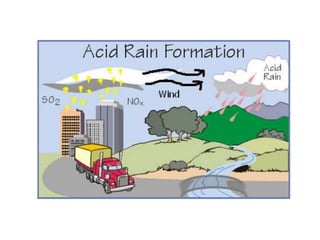
Acid rain
• Clean rainfall in pollution free atmosphere is slightly acidic
due to equilibrium reaction between water and CO2.
• Acid rain is rain, snow or fog that is polluted by acid in the
atmosphere and damages the environment.(specifically pH 5.6
or below)
• Main responsible pollutants are SO2 and nitrogen oxides (NOx)
 CO2 dissolves in H2O……Creates carbonic acid (H2CO3)
 Sulfur dioxide mixes with H2O …… Sulfuric Acid (H2SO4)
 Nitrogen oxides mixes with H2O …… Nitric Acid (HNO3)
• Acid precipitation may have a pH as low as 3. Very Acidic!
• Acids in the air may be carried thousands of miles from their
source, polluting air, soil & water
Effects of acid rains……
• It has potential to convert forests into waste lands by damaging
trees, plants and crops.
• Acidify fresh waters and affecting aquatic food chain.
• Induce respiratory illness in humans.
• Inflict irreversible damage on building deface the old treasured
monuments etc.
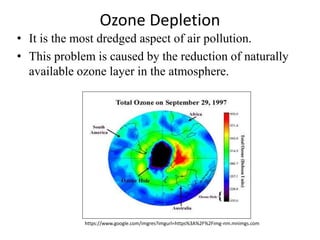
Ozone Depletion
• It is the most dredged aspect of air pollution.
• This problem is caused by the reduction of naturally
available ozone layer in the atmosphere.
https://www.google.com/imgres?imgurl=https%3A%2F%2Fimg-nm.mnimgs.com
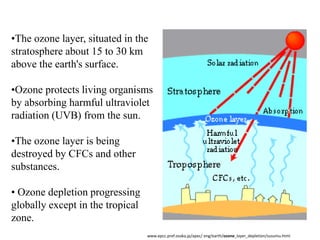
•The ozone layer, situated in the
stratosphere about 15 to 30 km
above the earth's surface.
•Ozone protects living organisms
by absorbing harmful ultraviolet
radiation (UVB) from the sun.
•The ozone layer is being
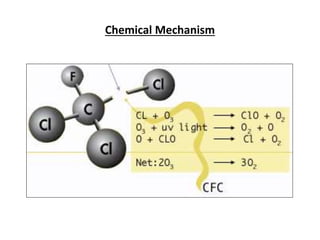
destroyed by CFCs and other
substances.
• Ozone depletion progressing
globally except in the tropical
zone.
www.epcc.pref.osaka.jp/apec/ eng/earth/ozone_layer_depletion/susumu.html
Chemical Mechanism
Adverse effects of UV radiation includes……
• Skin cancer
• Eye damage such as cataracts
• Immune system damage
• Reduction in phytoplankton
• Damage to the DNA in various life-forms
– this has been as observed in Antarctic ice-fish that lack
pigments to shield them from the ultra-violet light (they've
never needed them before)
• Interference with photosynthesis to reduce crop yield.
• Possibly other things too that we don't know about at the
moment .
Photochemical Smog
• Smog is a mixture of smoke and fog.
The atmospheric conditions favorable are
 Presence of high concentration of hydrocarbon,
 Air stagnation,
 Abundant sunlight.
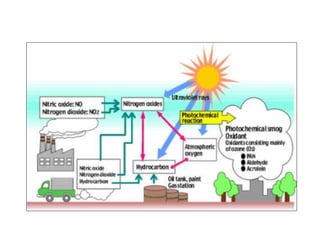
Smog is caused by the interaction of some hydrocarbons and
oxidants like SO2 or NOx under the influence of sunlight
giving rise to the formation of dangerous peroxil-acetyl-
nitrate.(PAN) the main constituent are nitrogen oxide, PAN,
hydrocarbon, carbon monoxide and large quantity of ozone.
A very prominent example is ‘London smog’.(5-8 Dec.1952)
Kyoto Protocol……
International treaty to control global warming and climate change
• The agreement was drawn on 11.12.1997which was committed
by the delegates of several countries. Under which many
industrialized countries committed to legally binding overall
reduction of 5.2% in green house gas emission below 1990
levels by 2008-12.
• Due to many technical / non technical reasons the treaty was
come in force16.02.2005.
• The flexible mechanism has been build into the protocol is two
fold ……
1. Joint implementation (JI)
2. Clean development mechanism(CDM)
Environmental friendly techniques to earn carbon
credits……
• Replacing part of cement by fly ash cement concrete.
• Adopting non polluting energies like wind or solar energy.
• Providing mass transport to replace individual cars.
• Producing power from waste using GhG produced from
sanitary landfills for power generation.
• Using energy efficient appliances including CFLs.
• Developing forests.
• https://www.slideshare.net
• https://en.wikipedia.org
• https://www.conserve-energy-future.com/ozone-
layer-and-causes-of-ozone-depletion
• https://www.google.com/imgres?imgurl=https%3A%
2F%2Fimg-nm.mnimgs.com
• Environmental engineering vol. II….. S K Garg

Global environmental issues

  • 1.
    Global Environmental Issues Mr.Manoj H. Mota SITCOE, Yadrav.
  • 2.
    The major issuesare……….. • Global warming • Acid rain • Ozone depletion • Photochemical smog • Occurred only due to uncontrolled air pollution.
  • 3.
    Climate change andGlobal warming ‘Green house effect’ is changing our climate. Various green house gases(GhG) are…… • CO2 … responsible for 60% of green house effect • CH4 … (21 times more harmful GhG than CO2), • Nox … (390 times more harmful GhG than CO2), • CFC… (3500-7300 times more harmful GhG than CO2), • Sulphur hexafluoride etc.
  • 4.
    • Avarage CO2volume in atmosphere is increased form 316ppmv in 1959 to 379ppmv in 2006. • Largest single year jump of 2.87 ppmv in 1997-98. • Earths temp. on average has increased @1oC in last 100 years. • Water level in ocean has gone up by 15cm in same span. Reasons…  Excessive burning of fossile fuel and deforestation.  Large scale decomposition of organic matter.  Use and subsequent release of CFCs from refrigeration and air conditioning units.
  • 5.
  • 6.
    Effects of climatechange and global warming…… • Earths temp to rise by 4-5oC in next 200 yrs. • Rise in sea level expected is up to 7m.submerging several low lying costal regions and islands.(about 2% of total land area) • Increase in the occurrence of floods and drought . • Increase in the frequency and intensity of tropical cyclones with increase in associated wind speed and height of storm surge. • Reduction in summer season flow in perennial rivers. • Less availability of clean and fresh water. • Adverse effect on public health. • Large scale migration and displacement of people.
  • 7.
    Acid rain • Cleanrainfall in pollution free atmosphere is slightly acidic due to equilibrium reaction between water and CO2. • Acid rain is rain, snow or fog that is polluted by acid in the atmosphere and damages the environment.(specifically pH 5.6 or below) • Main responsible pollutants are SO2 and nitrogen oxides (NOx)  CO2 dissolves in H2O……Creates carbonic acid (H2CO3)  Sulfur dioxide mixes with H2O …… Sulfuric Acid (H2SO4)  Nitrogen oxides mixes with H2O …… Nitric Acid (HNO3) • Acid precipitation may have a pH as low as 3. Very Acidic! • Acids in the air may be carried thousands of miles from their source, polluting air, soil & water
  • 9.
    Effects of acidrains…… • It has potential to convert forests into waste lands by damaging trees, plants and crops. • Acidify fresh waters and affecting aquatic food chain. • Induce respiratory illness in humans. • Inflict irreversible damage on building deface the old treasured monuments etc.
  • 10.
    Ozone Depletion • Itis the most dredged aspect of air pollution. • This problem is caused by the reduction of naturally available ozone layer in the atmosphere. https://www.google.com/imgres?imgurl=https%3A%2F%2Fimg-nm.mnimgs.com
  • 11.
    •The ozone layer,situated in the stratosphere about 15 to 30 km above the earth's surface. •Ozone protects living organisms by absorbing harmful ultraviolet radiation (UVB) from the sun. •The ozone layer is being destroyed by CFCs and other substances. • Ozone depletion progressing globally except in the tropical zone. www.epcc.pref.osaka.jp/apec/ eng/earth/ozone_layer_depletion/susumu.html
  • 12.
  • 13.
    Adverse effects ofUV radiation includes…… • Skin cancer • Eye damage such as cataracts • Immune system damage • Reduction in phytoplankton • Damage to the DNA in various life-forms – this has been as observed in Antarctic ice-fish that lack pigments to shield them from the ultra-violet light (they've never needed them before) • Interference with photosynthesis to reduce crop yield. • Possibly other things too that we don't know about at the moment .
  • 14.
    Photochemical Smog • Smogis a mixture of smoke and fog. The atmospheric conditions favorable are  Presence of high concentration of hydrocarbon,  Air stagnation,  Abundant sunlight. Smog is caused by the interaction of some hydrocarbons and oxidants like SO2 or NOx under the influence of sunlight giving rise to the formation of dangerous peroxil-acetyl- nitrate.(PAN) the main constituent are nitrogen oxide, PAN, hydrocarbon, carbon monoxide and large quantity of ozone. A very prominent example is ‘London smog’.(5-8 Dec.1952)
  • 16.
    Kyoto Protocol…… International treatyto control global warming and climate change • The agreement was drawn on 11.12.1997which was committed by the delegates of several countries. Under which many industrialized countries committed to legally binding overall reduction of 5.2% in green house gas emission below 1990 levels by 2008-12. • Due to many technical / non technical reasons the treaty was come in force16.02.2005. • The flexible mechanism has been build into the protocol is two fold …… 1. Joint implementation (JI) 2. Clean development mechanism(CDM)
  • 17.
    Environmental friendly techniquesto earn carbon credits…… • Replacing part of cement by fly ash cement concrete. • Adopting non polluting energies like wind or solar energy. • Providing mass transport to replace individual cars. • Producing power from waste using GhG produced from sanitary landfills for power generation. • Using energy efficient appliances including CFLs. • Developing forests.
  • 18.
    • https://www.slideshare.net • https://en.wikipedia.org •https://www.conserve-energy-future.com/ozone- layer-and-causes-of-ozone-depletion • https://www.google.com/imgres?imgurl=https%3A% 2F%2Fimg-nm.mnimgs.com • Environmental engineering vol. II….. S K Garg