Mr. Manoj H. Mota
Department of Civil Engineering
SITCOE
Capacity Building for Sustainable Development
Sustainable development……
 “Sustainable development is the development that meets
the needs of the present (people) without compromising
the ability of future generation to meet their own needs”.
 In other words it is improving the quality of life of the
present generation without excessive use or abuse of
natural resources, so that they can be preserved for the
next generation.
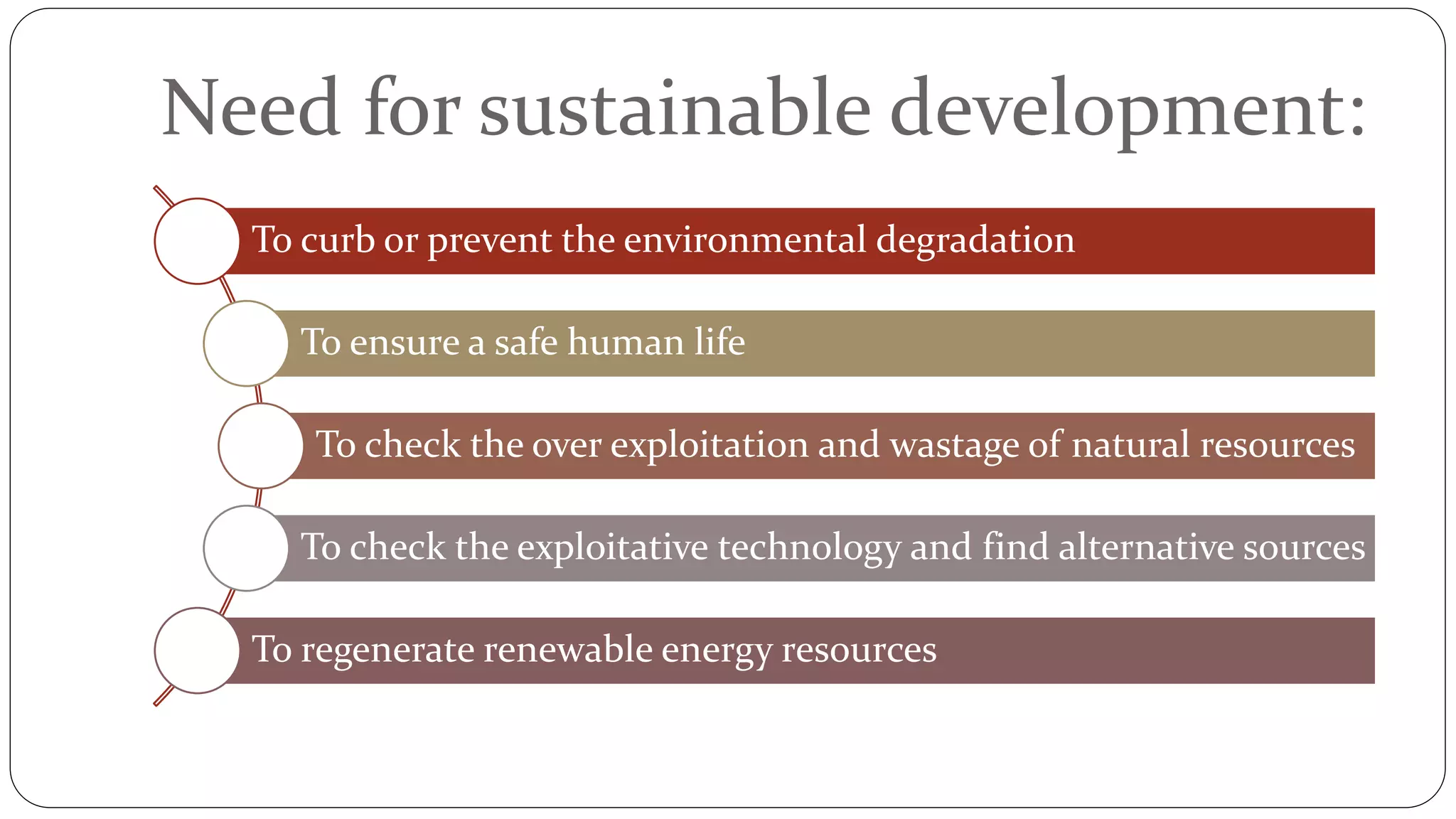
Need for sustainable development:
To curb or prevent the environmental degradation
To ensure a safe human life
To check the over exploitation and wastage of natural resources
To check the exploitative technology and find alternative sources
To regenerate renewable energy resources
Capacity Building for Sustainable Development
 Building abilities, relationships and values that will enable
organizations, groups and individuals to improve their
performance and achieve their development objectives.
 Capacity building was also described as initiating and
sustaining a process of individual and organizational change
that can equally refer to change within a state, civil society or
the private sector, as well as a change in processes that enhance
cooperation between different groups of society.
This definition puts emphasis on three aspects:
(a) capacity building as the catalyst and constant fuel
for a process of change,
(b) The importance of building institutional capacity,
(c) Involvement of a wide range of different groups in
society.
Ways to Improve the Effectiveness of
Capacity Building
 Identifying needs and building on existing capacities
 Being clear about the objectives
 Using a wide range of capacity building approaches
 Target the right people to build a critical mass
 Making the training-of-trainers approach work
 Institutionalizing capacity building programmes at
regional and national level
Identifying needs and building on
existing capacities
 Carefully performed needs assessments are critical to priority setting
and programme design and are essential if the capacity building
programmes are to reflect the specific conditions and priorities of
beneficiary countries.
 Capacity building will be most efficient when beneficiary countries
take the lead in conducting such needs assessments.
 A needs assessment, initiated by an external organisation, raises
expectations, and should only be done with a clear long-term strategy
for how the identified needs will be prioritized and addressed.
Being clear about the objectives
There is a need for a clear understanding of the objectives of
capacity building between providers and beneficiaries. Above
all, any capacity building programme should make a clear
contribution to achieving sustainable development, whatever
the focus of the programme is (i.e. water, climate, trade,
impact assessment etc.).
A clearer set of objectives, mutually agreed among beneficiaries
and providers, will help to effectively target activities, reduce
redundancy, improve synergies and ensure that capacity
building genuinely meets the needs of countries
Using a wide range of capacity building approaches
A wide range of approaches is available to build capacities,
including training, formal education, capacity building
projects, networking and others. Which approach will be most
effective strongly depends on the specific objective to be
achieved.
A training workshop usually can go as far as building human
capacities at an awareness raising level. If specifically designed,
training may also succeed in building analytical capacity.
However, there is a tendency to call a wide range of activities
‘capacity building’, which rather are policy dialogues, discussion
workshops, regional meetings, etc.
In addition to seeing and listening adults usually need real life
experiences to acquire new abilities.
Target the right people to build a critical mass
Capacity building activities of international organizations often
put strong emphasize on training key players in government,
such as senior officials that actually take decisions. This can
lead to a situation where a fairly limited group of people, who
usually already received a comparably good education, is
involved in all sorts of capacity building activities.
While senior official are definitely an important target group,
more emphasis needs to be put on building the capacities of
other groups in society. One major constraint of developing
country administrations is often the capacity to implement
reforms.
 While - as in the case of EIA - most countries have
drafted necessary legislation, problems arise in the
implementation. Implementation, however, is not
merely the task of senior officials at national level,
but involves different levels of governments, usually
putting a lot of responsibility into hands of
provincial or local officials. There is tremendous
need to build capacity at these levels, but the
attention for those groups is comparatively low.
Target the right people to build a critical mass
Making the training-of-trainers approach work
 One approach frequently promoted for multiplication is the
training-of-trainers approach, meaning that trainings offered
by international agencies focus on training a smaller group of
professionals, who would then be equipped to themselves
train others in their country.
 Using this approach, two questions need to be carefully
addressed from the beginning:
− What knowledge and skills does a person need to be able to
train others?
− What structures will be available for the person to pass on
knowledge to others in his/her country?
Institutionalizing capacity building programes at
regional and national level
Bringing the different aspects addressed above together, one
suggestion to increase the effectiveness of capacity building
activities could be that international organizations focus their
efforts on institutionalizing capacity building programmes at
regional and national level. Instead of offering capacity building
programmes and training courses themselves and spending
tremendous resources on participants’ travel, efforts should
focus on building the structures in the countries through which
capacity building programmes could be offered on a regular and
long-term basis.
Institutionalizing capacity building programs at
regional and national level
In most developing countries, capacity building providers of
different type are already available but they are usually
under funded and not well equipped (e.g. national cleaner
production centers, universities, government training
centers, etc.).
 The ultimate goal of capacity building is to sustain a process of
individual and organizational change and to enable organizations,
groups and individuals to achieve their development objectives. Any
capacity building activity needs to be carefully designed so that it
contributes to this goal. In this process, it is essential that the needs
of the beneficiaries as well as the already existing capacities in a
country are carefully assessed and that the specific capacity
building objectives are clarified.
Capacity development for Sustainable development

Capacity development for Sustainable development

  • 1.
    Mr. Manoj H.Mota Department of Civil Engineering SITCOE Capacity Building for Sustainable Development
  • 2.
    Sustainable development……  “Sustainabledevelopment is the development that meets the needs of the present (people) without compromising the ability of future generation to meet their own needs”.  In other words it is improving the quality of life of the present generation without excessive use or abuse of natural resources, so that they can be preserved for the next generation.
  • 3.
    Need for sustainabledevelopment: To curb or prevent the environmental degradation To ensure a safe human life To check the over exploitation and wastage of natural resources To check the exploitative technology and find alternative sources To regenerate renewable energy resources
  • 5.
    Capacity Building forSustainable Development  Building abilities, relationships and values that will enable organizations, groups and individuals to improve their performance and achieve their development objectives.  Capacity building was also described as initiating and sustaining a process of individual and organizational change that can equally refer to change within a state, civil society or the private sector, as well as a change in processes that enhance cooperation between different groups of society.
  • 6.
    This definition putsemphasis on three aspects: (a) capacity building as the catalyst and constant fuel for a process of change, (b) The importance of building institutional capacity, (c) Involvement of a wide range of different groups in society.
  • 7.
    Ways to Improvethe Effectiveness of Capacity Building  Identifying needs and building on existing capacities  Being clear about the objectives  Using a wide range of capacity building approaches  Target the right people to build a critical mass  Making the training-of-trainers approach work  Institutionalizing capacity building programmes at regional and national level
  • 8.
    Identifying needs andbuilding on existing capacities  Carefully performed needs assessments are critical to priority setting and programme design and are essential if the capacity building programmes are to reflect the specific conditions and priorities of beneficiary countries.  Capacity building will be most efficient when beneficiary countries take the lead in conducting such needs assessments.  A needs assessment, initiated by an external organisation, raises expectations, and should only be done with a clear long-term strategy for how the identified needs will be prioritized and addressed.
  • 9.
    Being clear aboutthe objectives There is a need for a clear understanding of the objectives of capacity building between providers and beneficiaries. Above all, any capacity building programme should make a clear contribution to achieving sustainable development, whatever the focus of the programme is (i.e. water, climate, trade, impact assessment etc.). A clearer set of objectives, mutually agreed among beneficiaries and providers, will help to effectively target activities, reduce redundancy, improve synergies and ensure that capacity building genuinely meets the needs of countries
  • 10.
    Using a widerange of capacity building approaches A wide range of approaches is available to build capacities, including training, formal education, capacity building projects, networking and others. Which approach will be most effective strongly depends on the specific objective to be achieved. A training workshop usually can go as far as building human capacities at an awareness raising level. If specifically designed, training may also succeed in building analytical capacity. However, there is a tendency to call a wide range of activities ‘capacity building’, which rather are policy dialogues, discussion workshops, regional meetings, etc. In addition to seeing and listening adults usually need real life experiences to acquire new abilities.
  • 11.
    Target the rightpeople to build a critical mass Capacity building activities of international organizations often put strong emphasize on training key players in government, such as senior officials that actually take decisions. This can lead to a situation where a fairly limited group of people, who usually already received a comparably good education, is involved in all sorts of capacity building activities. While senior official are definitely an important target group, more emphasis needs to be put on building the capacities of other groups in society. One major constraint of developing country administrations is often the capacity to implement reforms.
  • 12.
     While -as in the case of EIA - most countries have drafted necessary legislation, problems arise in the implementation. Implementation, however, is not merely the task of senior officials at national level, but involves different levels of governments, usually putting a lot of responsibility into hands of provincial or local officials. There is tremendous need to build capacity at these levels, but the attention for those groups is comparatively low. Target the right people to build a critical mass
  • 13.
    Making the training-of-trainersapproach work  One approach frequently promoted for multiplication is the training-of-trainers approach, meaning that trainings offered by international agencies focus on training a smaller group of professionals, who would then be equipped to themselves train others in their country.  Using this approach, two questions need to be carefully addressed from the beginning: − What knowledge and skills does a person need to be able to train others? − What structures will be available for the person to pass on knowledge to others in his/her country?
  • 14.
    Institutionalizing capacity buildingprogrames at regional and national level Bringing the different aspects addressed above together, one suggestion to increase the effectiveness of capacity building activities could be that international organizations focus their efforts on institutionalizing capacity building programmes at regional and national level. Instead of offering capacity building programmes and training courses themselves and spending tremendous resources on participants’ travel, efforts should focus on building the structures in the countries through which capacity building programmes could be offered on a regular and long-term basis.
  • 15.
    Institutionalizing capacity buildingprograms at regional and national level In most developing countries, capacity building providers of different type are already available but they are usually under funded and not well equipped (e.g. national cleaner production centers, universities, government training centers, etc.).
  • 16.
     The ultimategoal of capacity building is to sustain a process of individual and organizational change and to enable organizations, groups and individuals to achieve their development objectives. Any capacity building activity needs to be carefully designed so that it contributes to this goal. In this process, it is essential that the needs of the beneficiaries as well as the already existing capacities in a country are carefully assessed and that the specific capacity building objectives are clarified.