Lesson 11:
Poverty and Environment: The Linkages
P.B. Dharmasena
0777 - 613234, 0717 - 613234
dharmasenapb@ymail.com , dharmasenapb@gmail.com
https://independent.academia.edu/PunchiBandageDharmasena
https://www.researchgate.net/profile/Punchi_Bandage_Dharmasena/contr
ibutions http://www.slideshare.net/DharmasenaPb
Poverty and Environment
Course code: ECON/EMGT 4214
Friday from 8.30-11.30 a.m
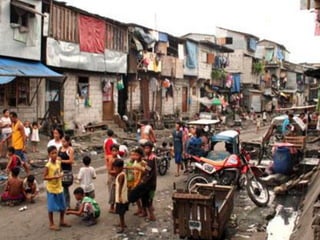
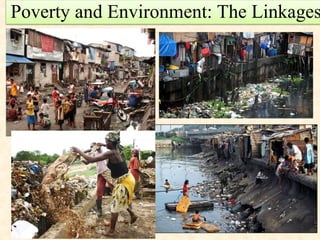
Poverty and Environment: The Linkages
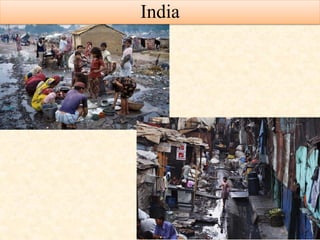
India
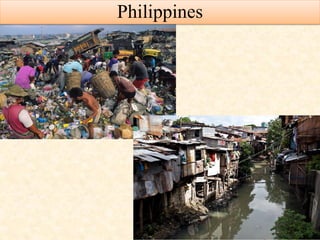
Philippines
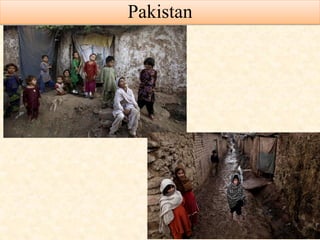
Pakistan
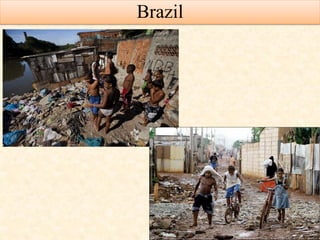
Brazil
Srilanka????
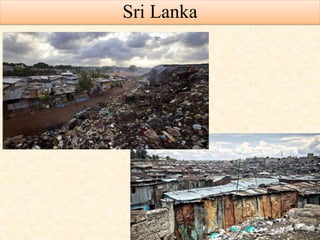
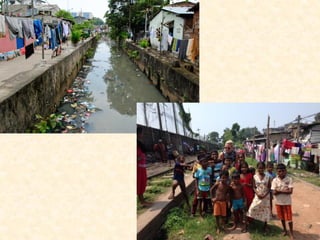
Sri Lanka
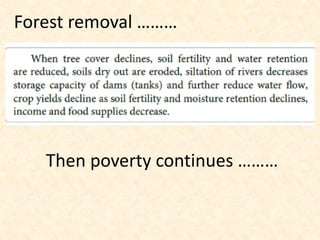
Forest removal ………
Then poverty continues ………
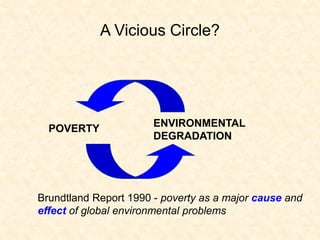
A Vicious Circle?
POVERTY
ENVIRONMENTAL
DEGRADATION
Brundtland Report 1990 - poverty as a major cause and
effect of global environmental problems
Poverty and Environment: The Linkages
• Internationally, there is a known correlation between
poverty and environmental danger
• Because of lack of money, education, and concern, poor
families disregard the environment to uphold a
“survival mentality”
• Poor countries do not see the environment as priority
because of all the other problems happening within
the society, so nothing is done to conserve
• These people are not to be blamed for the world’s
environmental problems, we must look ahead and
focus on a solution
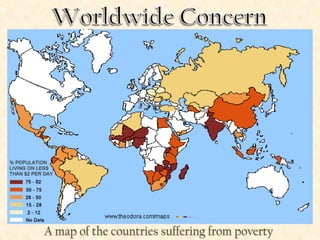
A map of the countries suffering from poverty
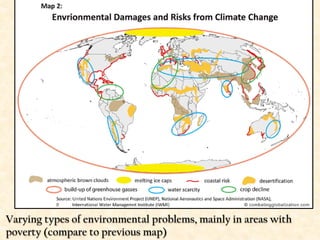
Varying types of environmental problems, mainly in areas with
poverty (compare to previous map)
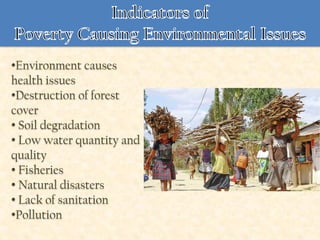
•Environment causes
health issues
•Destruction of forest
cover
• Soil degradation
• Low water quantity and
quality
• Fisheries
• Natural disasters
• Lack of sanitation
•Pollution
EXAMPLES OF POVERTY-ENVIRONMENT LINKS
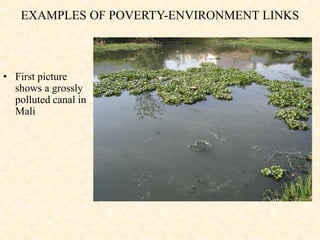
• First picture
shows a grossly
polluted canal in
Mali
• First picture shows a grossly polluted canal in Mali
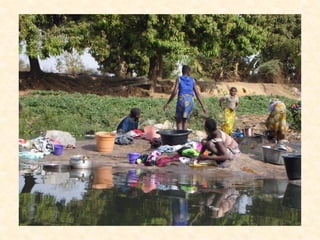
• The 2nd is people living next to that canal & using this
polluted water – because they do not have any other source of
water.
• So they get sick from water borne diseases & malaria – ie
pollution causes sickness & the costs associated with that
EXAMPLES OF POVERTY-ENVIRONMENT LINKS
• First picture shows a grossly polluted canal in Mali
• The 2nd is people living next to that canal & using this
polluted water – because they do not have any other source of
water.
• So they get sick from water borne diseases & malaria – ie
pollution causes sickness & the costs associated with that
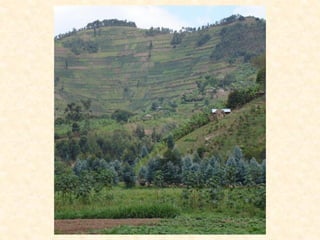
• The 3rd picture is of a very steep hillside in Rwanda – soil
erosion is a major problem
• Soil erosion reduces agricultural productivity & causes silting
of hydro electricity reservoirs = decreased electricity
production
EXAMPLES OF POVERTY-ENVIRONMENT LINKS
Poverty and Environment nexus
Two of the most important global issues today are pervasive poverty and
problems related to environmental degradation. The causal factors are
complex.
Since the 1970s it has been almost universally agreed that poverty and
environmental degradation are inextricably linked.
Holmberg (1991) pointed out that the relationship between the environment and
poverty is not so straight forward.
Insufficient attention had been paid to some intuitive and field experience and
that there was even a possibility of conflict between the goals of poverty
alleviation and environmental protection.
A number of studies have been carried out on how both poverty and wealth
have impacted on the environment, resulting in a number of environmental
threats such as degradation of the soil, water and marine resources which are
essential for life supporting systems, pollution which is becoming health
threatening, loss of biodiversity and global climatic changes which
jeopardize the very existence of life on the planet.
The World Commission on Environment and Development
(Brundtland Commission) wrote (1987):
“Poverty is a major cause and effect of global environmental
problems. It is therefore futile to attempt to deal with
environmental problems without a broader perspective that
encompasses the factors underlying world poverty and
international inequality.”
The links between poverty and environment were also seen to be
self-enforcing. The Commission also wrote:
“Many parts of the world are caught in a vicious downwards
spiral: poor people are forced to overuse environmental
resources to survive from day to day, and their impoverishment
of their environment further impoverishes them, making their
survival ever more difficult and uncertain.”
Poverty and Environment nexus
The environment-poverty nexus is a two-way relationship.
Environment affects poverty situations in three distinct
dimensions:
i. by providing sources of livelihoods to poor people,
ii. by affecting their health and
iii. by influencing their vulnerability.
On the other hand, poverty also affects environment in
various ways:
i. by forcing poor people to degrade environment,
ii. by encouraging countries to promote economic
growth at the expense of environment, and
iii. by inducing societies to downgrade environmental
concerns, including failing to channel resources to
address such concerns.
Poverty and Environment nexus
poverty– environmental interactions:
Conclusions from UNDP/EC
Poverty necessarily leads to environmental
degradation. Studies have failed to show a
common pattern in the relationship; in certain
situations the poor are immediately
responsible for degradation while in others they
are seen to take great care in maintaining or
improving the environment.
1. Poverty necessarily leads to environmental
degradation.
Studies have failed to show a common pattern in the
relationship; in certain situations the poor are
immediately responsible for degradation while in
others they are seen to take great care in maintaining
or improving the environment.
poverty– environmental interactions:
Conclusions from UNDP/EC
2. It is necessary first to tackle poverty concerns
before dealing with environmental improvement.
Some of the most extreme degradation takes place in
boom (good) periods rather than slumps (collapses);
neither rural poverty nor environmental programmes
should be conducted in isolation but rather as part of
an integrated and well-analyzed approach.
poverty– environmental interactions:
Conclusions from UNDP/EC
3. Poor people are too poor to invest in the
environment.
Where incentives are favourable, poor people mobilize
resources, particularly labour, and invest in
environmental improvement. This is not to suggest
that external help cannot also be a valuable aid.
poverty– environmental interactions:
Conclusions from UNDP/EC
4. Population growth necessarily leads to
degradation.
Most agricultural landscapes can support higher
populations in a sustainable way by adopting more
intensive technologies and farming methods; in some
situations population growth may provide economies
of scale helpful to the economy.
poverty– environmental interactions:
Conclusions from UNDP/EC
5. The poor lack the technical know-how for good
resource management.
Although lacking in formal education, poor people have
an enormous store of indigenous technical knowledge
and develop sophisticated resource management
systems. Supposedly primitive water and agricultural
systems can be equitable, efficient and sustainable,
especially under low population densities.
poverty– environmental interactions:
Conclusions from UNDP/EC
6. Markets always lead to efficient allocation of
resources.
While markets can be conducive to good management,
they may also encourage over-exploitation of natural
resources (e.g. timber and non-timber forest
products). This is especially so where factor prices do
not reflect wider social and environmental costs.
poverty– environmental interactions:
Conclusions from UNDP/EC
Myth 1- “Poor people are the principal creators of
environmental damage.”
Not true. Even though poor people bear the brunt of
environmental damage, the irony is that they are not its
principal creators. It is the rich who pollute and
contribute most to global warming. They are the ones
who degrade the global commons, making resources
scarce for poor people.
In many areas, the non-poor, commercial companies, and
state agencies actually cause the majority of
environmental damage through land cleaning, agro-
chemical use, and water appropriation (owning).
Myth 1- “Poor people are the principal creators of
environmental damage.”
The rich also generate more waste and create stress on
nature’s sink. Thus, poor people become victims of the
consumption levels and patterns of the rich.
One of the environmental challenges that stem from
growing poverty and environmental damage is that it
pushes more and more people to the periphery – to the
most ecologically fragile land where they become even
more vulnerable. Yet there are many examples in which
poor people take care of the environment and invest in
improving it.
Myth 2 - “The poverty-environment nexus basically
stems from low incomes.”
It’s not that simple.
Arguments that maintain that poor people degrade the
environment basically explain the poverty-environment
nexus in terms of income levels only.
The poverty- environment nexus is more complex.
Questions of ownership of natural resources, access to
common resources, the strength or weakness of
communities and local institutions, the way information
about poor people’s entitlements and rights to resources
is shared with them, the way people cope with risk and
uncertainty, the way people use scarce time – all these
are important in explaining the environmental
behaviour of poor people.
Many of the natural resources that are degraded are communal
property. Rights are ill-defined, often because they were
originally defined within a local social and political framework
that is no longer there.
Institutions for managing common property that reflect the
consensus of owners and can control use are lacking. In
ecologically fragile ecosystems, people tend to minimize risks,
not maximize output, whether they are poor or rich.
Over-exploitation of sources of fuel-wood is linked more to the time
available to women than to their poverty status. There is a gender
dimension, but not necessarily an income dimension.
Many factors shape human behaviour towards the environment,
some related to poverty or affluence (wealth), others independent
of either income or poverty.
Myth 2 - “The poverty-environment nexus basically
stems from low incomes.”
Responding to environmental threats
• Demand for environmental quality ...
– … is a luxury - the poor are too busy thinking about
basic survival to concern themselves with
environmental issues
• Ability to respond to such demands ...
– … is dependent on aggregate wealth - economic
prosperity and technological sophistication allow
nations to react to environmental challenges
– Environmentalism is the exclusive concern of the rich,
in the advanced industrial nations
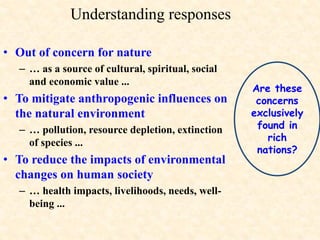
Are these
concerns
exclusively
found in
rich
nations?
Understanding responses
• Out of concern for nature
– … as a source of cultural, spiritual, social
and economic value ...
• To mitigate anthropogenic influences on
the natural environment
– … pollution, resource depletion, extinction
of species ...
• To reduce the impacts of environmental
changes on human society
– … health impacts, livelihoods, needs, well-
being ...
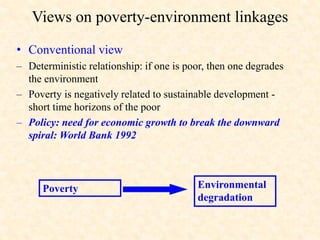
Views on poverty-environment linkages
• Conventional view
– Deterministic relationship: if one is poor, then one degrades
the environment
– Poverty is negatively related to sustainable development -
short time horizons of the poor
– Policy: need for economic growth to break the downward
spiral: World Bank 1992
Environmental
degradation
Poverty
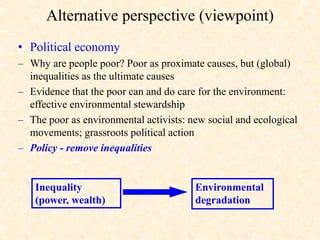
Alternative perspective (viewpoint)
• Political economy
– Why are people poor? Poor as proximate causes, but (global)
inequalities as the ultimate causes
– Evidence that the poor can and do care for the environment:
effective environmental stewardship
– The poor as environmental activists: new social and ecological
movements; grassroots political action
– Policy - remove inequalities
Environmental
degradation
Inequality
(power, wealth)
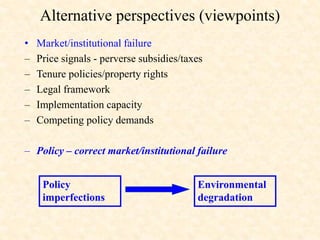
• Market/institutional failure
– Price signals - perverse subsidies/taxes
– Tenure policies/property rights
– Legal framework
– Implementation capacity
– Competing policy demands
– Policy – correct market/institutional failure
Environmental
degradation
Policy
imperfections
Alternative perspectives (viewpoints)
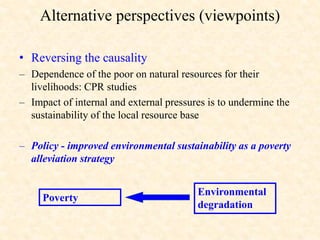
• Reversing the causality
– Dependence of the poor on natural resources for their
livelihoods: CPR studies
– Impact of internal and external pressures is to undermine the
sustainability of the local resource base
– Policy - improved environmental sustainability as a poverty
alleviation strategy
Environmental
degradation
Poverty
Alternative perspectives (viewpoints)
Understanding human well-being
• Multiple dimensions of well-being
– Physical/financial resources - wealth
– Human resources - education, health
– Natural resources - ecosystem services
– Political resources - democracy, accountability
– Social/cultural resources - networks, norms, relationships
SUSTAINABLE LIVELIHOODS (SL)
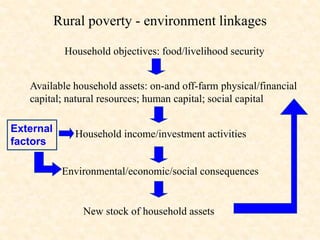
Rural poverty - environment linkages
Household objectives: food/livelihood security
Available household assets: on-and off-farm physical/financial
capital; natural resources; human capital; social capital
Household income/investment activities
Environmental/economic/social consequences
New stock of household assets
External
factors
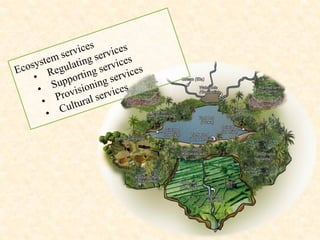
Ecosystem services
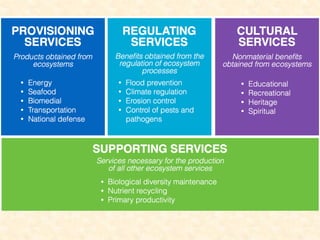
• Definition
– Ecosystem services are the conditions and processes
through which natural ecosystems, and the species
that make them up, sustain and fulfil human life.
Daily et al 1997
* Provisioning functions
* Regulating functions
* Enriching/cultural functions
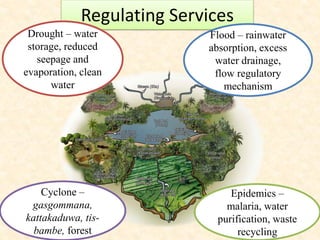
Regulating Services
Drought – water
storage, reduced
seepage and
evaporation, clean
water
Flood – rainwater
absorption, excess
water drainage,
flow regulatory
mechanism
Cyclone –
gasgommana,
kattakaduwa, tis-
bambe, forest
Epidemics –
malaria, water
purification, waste
recycling
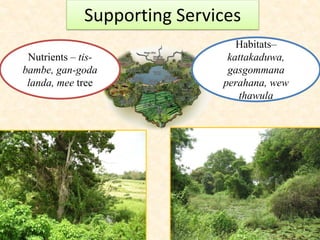
Supporting Services
Nutrients – tis-
bambe, gan-goda
landa, mee tree
Habitats–
kattakaduwa,
gasgommana
perahana, wew
thawula
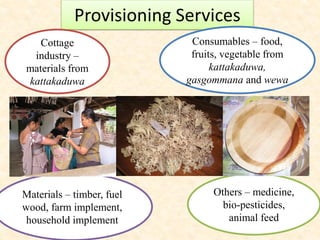
Provisioning Services
Cottage
industry –
materials from
kattakaduwa
Consumables – food,
fruits, vegetable from
kattakaduwa,
gasgommana and wewa
Materials – timber, fuel
wood, farm implement,
household implement
Others – medicine,
bio-pesticides,
animal feed
Ecosystem services: provisioning
• Magnitude/rate of goods harvested (‘flows’),
Examples:
– Food
– Micro-organisms, plant and animal products
– Genetic material, biochemicals & pharmaceuticals
– Fuels/energy
– Fodder
– Fibre
– Non-living material
– Fresh water
Ecosystem services: regulating
• Life support functions, determined by ‘stock’
of the ecosystem,
• Examples:
– Purification of air and water
– Mitigation of floods and droughts
– Detoxification and decomposition of wastes
– Preservation of soil and soil fertility
– Pollination of crops and vegetation
– Control of pests
– Dispersal of seeds
– Maintenance of biodiversity
– Stabilisation of climate
Ecosystem services: enriching/cultural
• Beliefs and values surrounding natural forces,
providing spiritual/religious/cultural support
(determined by ‘stock’),
• Examples:
– Spiritual components
– Aesthetic values
– Social relations and values
– Educational/scientific values
Ecosystem services: well-being issues
• Provisioning: access of the poor for basic
needs; distributional issues
• Regulating: equitable sharing of benefits and
costs associated with protection
• Enriching/cultural: conflicting cognitive
paradigms and value/moral systems
Potential conflict between these services, but
also scope for synergy/win-win scenarios
11. poverty & environment; the linkages

11. poverty & environment; the linkages

  • 1.
    Lesson 11: Poverty andEnvironment: The Linkages P.B. Dharmasena 0777 - 613234, 0717 - 613234 dharmasenapb@ymail.com , dharmasenapb@gmail.com https://independent.academia.edu/PunchiBandageDharmasena https://www.researchgate.net/profile/Punchi_Bandage_Dharmasena/contr ibutions http://www.slideshare.net/DharmasenaPb Poverty and Environment Course code: ECON/EMGT 4214 Friday from 8.30-11.30 a.m
  • 3.
  • 4.
  • 5.
  • 6.
  • 7.
  • 8.
  • 9.
  • 11.
    Forest removal ……… Thenpoverty continues ………
  • 12.
    A Vicious Circle? POVERTY ENVIRONMENTAL DEGRADATION BrundtlandReport 1990 - poverty as a major cause and effect of global environmental problems
  • 13.
    Poverty and Environment:The Linkages • Internationally, there is a known correlation between poverty and environmental danger • Because of lack of money, education, and concern, poor families disregard the environment to uphold a “survival mentality” • Poor countries do not see the environment as priority because of all the other problems happening within the society, so nothing is done to conserve • These people are not to be blamed for the world’s environmental problems, we must look ahead and focus on a solution
  • 14.
    A map ofthe countries suffering from poverty
  • 15.
    Varying types ofenvironmental problems, mainly in areas with poverty (compare to previous map)
  • 16.
    •Environment causes health issues •Destructionof forest cover • Soil degradation • Low water quantity and quality • Fisheries • Natural disasters • Lack of sanitation •Pollution
  • 17.
    EXAMPLES OF POVERTY-ENVIRONMENTLINKS • First picture shows a grossly polluted canal in Mali
  • 18.
    • First pictureshows a grossly polluted canal in Mali • The 2nd is people living next to that canal & using this polluted water – because they do not have any other source of water. • So they get sick from water borne diseases & malaria – ie pollution causes sickness & the costs associated with that EXAMPLES OF POVERTY-ENVIRONMENT LINKS
  • 20.
    • First pictureshows a grossly polluted canal in Mali • The 2nd is people living next to that canal & using this polluted water – because they do not have any other source of water. • So they get sick from water borne diseases & malaria – ie pollution causes sickness & the costs associated with that • The 3rd picture is of a very steep hillside in Rwanda – soil erosion is a major problem • Soil erosion reduces agricultural productivity & causes silting of hydro electricity reservoirs = decreased electricity production EXAMPLES OF POVERTY-ENVIRONMENT LINKS
  • 22.
    Poverty and Environmentnexus Two of the most important global issues today are pervasive poverty and problems related to environmental degradation. The causal factors are complex. Since the 1970s it has been almost universally agreed that poverty and environmental degradation are inextricably linked. Holmberg (1991) pointed out that the relationship between the environment and poverty is not so straight forward. Insufficient attention had been paid to some intuitive and field experience and that there was even a possibility of conflict between the goals of poverty alleviation and environmental protection. A number of studies have been carried out on how both poverty and wealth have impacted on the environment, resulting in a number of environmental threats such as degradation of the soil, water and marine resources which are essential for life supporting systems, pollution which is becoming health threatening, loss of biodiversity and global climatic changes which jeopardize the very existence of life on the planet.
  • 23.
    The World Commissionon Environment and Development (Brundtland Commission) wrote (1987): “Poverty is a major cause and effect of global environmental problems. It is therefore futile to attempt to deal with environmental problems without a broader perspective that encompasses the factors underlying world poverty and international inequality.” The links between poverty and environment were also seen to be self-enforcing. The Commission also wrote: “Many parts of the world are caught in a vicious downwards spiral: poor people are forced to overuse environmental resources to survive from day to day, and their impoverishment of their environment further impoverishes them, making their survival ever more difficult and uncertain.” Poverty and Environment nexus
  • 24.
    The environment-poverty nexusis a two-way relationship. Environment affects poverty situations in three distinct dimensions: i. by providing sources of livelihoods to poor people, ii. by affecting their health and iii. by influencing their vulnerability. On the other hand, poverty also affects environment in various ways: i. by forcing poor people to degrade environment, ii. by encouraging countries to promote economic growth at the expense of environment, and iii. by inducing societies to downgrade environmental concerns, including failing to channel resources to address such concerns. Poverty and Environment nexus
  • 25.
    poverty– environmental interactions: Conclusionsfrom UNDP/EC Poverty necessarily leads to environmental degradation. Studies have failed to show a common pattern in the relationship; in certain situations the poor are immediately responsible for degradation while in others they are seen to take great care in maintaining or improving the environment.
  • 26.
    1. Poverty necessarilyleads to environmental degradation. Studies have failed to show a common pattern in the relationship; in certain situations the poor are immediately responsible for degradation while in others they are seen to take great care in maintaining or improving the environment. poverty– environmental interactions: Conclusions from UNDP/EC
  • 27.
    2. It isnecessary first to tackle poverty concerns before dealing with environmental improvement. Some of the most extreme degradation takes place in boom (good) periods rather than slumps (collapses); neither rural poverty nor environmental programmes should be conducted in isolation but rather as part of an integrated and well-analyzed approach. poverty– environmental interactions: Conclusions from UNDP/EC
  • 28.
    3. Poor peopleare too poor to invest in the environment. Where incentives are favourable, poor people mobilize resources, particularly labour, and invest in environmental improvement. This is not to suggest that external help cannot also be a valuable aid. poverty– environmental interactions: Conclusions from UNDP/EC
  • 29.
    4. Population growthnecessarily leads to degradation. Most agricultural landscapes can support higher populations in a sustainable way by adopting more intensive technologies and farming methods; in some situations population growth may provide economies of scale helpful to the economy. poverty– environmental interactions: Conclusions from UNDP/EC
  • 30.
    5. The poorlack the technical know-how for good resource management. Although lacking in formal education, poor people have an enormous store of indigenous technical knowledge and develop sophisticated resource management systems. Supposedly primitive water and agricultural systems can be equitable, efficient and sustainable, especially under low population densities. poverty– environmental interactions: Conclusions from UNDP/EC
  • 31.
    6. Markets alwayslead to efficient allocation of resources. While markets can be conducive to good management, they may also encourage over-exploitation of natural resources (e.g. timber and non-timber forest products). This is especially so where factor prices do not reflect wider social and environmental costs. poverty– environmental interactions: Conclusions from UNDP/EC
  • 32.
    Myth 1- “Poorpeople are the principal creators of environmental damage.” Not true. Even though poor people bear the brunt of environmental damage, the irony is that they are not its principal creators. It is the rich who pollute and contribute most to global warming. They are the ones who degrade the global commons, making resources scarce for poor people. In many areas, the non-poor, commercial companies, and state agencies actually cause the majority of environmental damage through land cleaning, agro- chemical use, and water appropriation (owning).
  • 33.
    Myth 1- “Poorpeople are the principal creators of environmental damage.” The rich also generate more waste and create stress on nature’s sink. Thus, poor people become victims of the consumption levels and patterns of the rich. One of the environmental challenges that stem from growing poverty and environmental damage is that it pushes more and more people to the periphery – to the most ecologically fragile land where they become even more vulnerable. Yet there are many examples in which poor people take care of the environment and invest in improving it.
  • 34.
    Myth 2 -“The poverty-environment nexus basically stems from low incomes.” It’s not that simple. Arguments that maintain that poor people degrade the environment basically explain the poverty-environment nexus in terms of income levels only. The poverty- environment nexus is more complex. Questions of ownership of natural resources, access to common resources, the strength or weakness of communities and local institutions, the way information about poor people’s entitlements and rights to resources is shared with them, the way people cope with risk and uncertainty, the way people use scarce time – all these are important in explaining the environmental behaviour of poor people.
  • 35.
    Many of thenatural resources that are degraded are communal property. Rights are ill-defined, often because they were originally defined within a local social and political framework that is no longer there. Institutions for managing common property that reflect the consensus of owners and can control use are lacking. In ecologically fragile ecosystems, people tend to minimize risks, not maximize output, whether they are poor or rich. Over-exploitation of sources of fuel-wood is linked more to the time available to women than to their poverty status. There is a gender dimension, but not necessarily an income dimension. Many factors shape human behaviour towards the environment, some related to poverty or affluence (wealth), others independent of either income or poverty. Myth 2 - “The poverty-environment nexus basically stems from low incomes.”
  • 36.
    Responding to environmentalthreats • Demand for environmental quality ... – … is a luxury - the poor are too busy thinking about basic survival to concern themselves with environmental issues • Ability to respond to such demands ... – … is dependent on aggregate wealth - economic prosperity and technological sophistication allow nations to react to environmental challenges – Environmentalism is the exclusive concern of the rich, in the advanced industrial nations
  • 37.
    Are these concerns exclusively found in rich nations? Understandingresponses • Out of concern for nature – … as a source of cultural, spiritual, social and economic value ... • To mitigate anthropogenic influences on the natural environment – … pollution, resource depletion, extinction of species ... • To reduce the impacts of environmental changes on human society – … health impacts, livelihoods, needs, well- being ...
  • 38.
    Views on poverty-environmentlinkages • Conventional view – Deterministic relationship: if one is poor, then one degrades the environment – Poverty is negatively related to sustainable development - short time horizons of the poor – Policy: need for economic growth to break the downward spiral: World Bank 1992 Environmental degradation Poverty
  • 39.
    Alternative perspective (viewpoint) •Political economy – Why are people poor? Poor as proximate causes, but (global) inequalities as the ultimate causes – Evidence that the poor can and do care for the environment: effective environmental stewardship – The poor as environmental activists: new social and ecological movements; grassroots political action – Policy - remove inequalities Environmental degradation Inequality (power, wealth)
  • 40.
    • Market/institutional failure –Price signals - perverse subsidies/taxes – Tenure policies/property rights – Legal framework – Implementation capacity – Competing policy demands – Policy – correct market/institutional failure Environmental degradation Policy imperfections Alternative perspectives (viewpoints)
  • 41.
    • Reversing thecausality – Dependence of the poor on natural resources for their livelihoods: CPR studies – Impact of internal and external pressures is to undermine the sustainability of the local resource base – Policy - improved environmental sustainability as a poverty alleviation strategy Environmental degradation Poverty Alternative perspectives (viewpoints)
  • 42.
    Understanding human well-being •Multiple dimensions of well-being – Physical/financial resources - wealth – Human resources - education, health – Natural resources - ecosystem services – Political resources - democracy, accountability – Social/cultural resources - networks, norms, relationships SUSTAINABLE LIVELIHOODS (SL)
  • 43.
    Rural poverty -environment linkages Household objectives: food/livelihood security Available household assets: on-and off-farm physical/financial capital; natural resources; human capital; social capital Household income/investment activities Environmental/economic/social consequences New stock of household assets External factors
  • 44.
    Ecosystem services • Definition –Ecosystem services are the conditions and processes through which natural ecosystems, and the species that make them up, sustain and fulfil human life. Daily et al 1997 * Provisioning functions * Regulating functions * Enriching/cultural functions
  • 46.
    Regulating Services Drought –water storage, reduced seepage and evaporation, clean water Flood – rainwater absorption, excess water drainage, flow regulatory mechanism Cyclone – gasgommana, kattakaduwa, tis- bambe, forest Epidemics – malaria, water purification, waste recycling
  • 47.
    Supporting Services Nutrients –tis- bambe, gan-goda landa, mee tree Habitats– kattakaduwa, gasgommana perahana, wew thawula
  • 48.
    Provisioning Services Cottage industry – materialsfrom kattakaduwa Consumables – food, fruits, vegetable from kattakaduwa, gasgommana and wewa Materials – timber, fuel wood, farm implement, household implement Others – medicine, bio-pesticides, animal feed
  • 49.
    Ecosystem services: provisioning •Magnitude/rate of goods harvested (‘flows’), Examples: – Food – Micro-organisms, plant and animal products – Genetic material, biochemicals & pharmaceuticals – Fuels/energy – Fodder – Fibre – Non-living material – Fresh water
  • 50.
    Ecosystem services: regulating •Life support functions, determined by ‘stock’ of the ecosystem, • Examples: – Purification of air and water – Mitigation of floods and droughts – Detoxification and decomposition of wastes – Preservation of soil and soil fertility – Pollination of crops and vegetation – Control of pests – Dispersal of seeds – Maintenance of biodiversity – Stabilisation of climate
  • 51.
    Ecosystem services: enriching/cultural •Beliefs and values surrounding natural forces, providing spiritual/religious/cultural support (determined by ‘stock’), • Examples: – Spiritual components – Aesthetic values – Social relations and values – Educational/scientific values
  • 52.
    Ecosystem services: well-beingissues • Provisioning: access of the poor for basic needs; distributional issues • Regulating: equitable sharing of benefits and costs associated with protection • Enriching/cultural: conflicting cognitive paradigms and value/moral systems Potential conflict between these services, but also scope for synergy/win-win scenarios