Air Pollution and  its effect on mankind                  Dr. Manisha Jain Chemistry Department Acharya Narendra Dev College
Pollutant   is any solid, liquid or gaseous substance including energy, which is present in nature   in concentrations greater than the natural abundance, due to human or natural  activities and has a detrimental effect on the environment including both animate and  inanimate objects. Contaminant   is a material that is not present in nature but is introduced by human activities nto the environment effecting its composition. A contaminant is classified as pollutant  when it has detrimental effect on environment . Source   is the origin of pollutant Receptor   is the medium, which is affected by a pollutant Sink   is   the medium, which retains a long-lived pollutant through interaction e.g.; ocean is a sink for atmospheric carbon dioxide and heat. Marble wall is a sink for atmospheric  sulphuric acid. Pathways of Pollutants   is the mechanism by which the pollutant is transported from a source  into the environment. Speciation   is the different chemical forms or species of the inorganic, organic or organometallic  pollutants are called speciation.
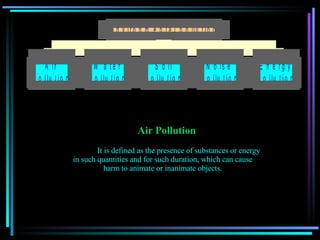
    It is defined as the presence of substances or energy in such quantities and for such duration, which can cause harm to animate or inanimate objects. Air Pollution
 
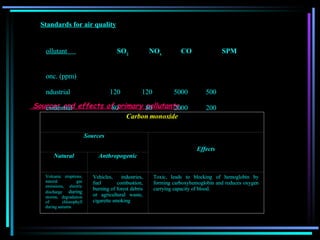
Standards for air quality   Sources and effects of primary pollutants  Pollutant  SO 2 NO x CO   SPM Conc. (ppm)  Industrial 120 120 5000 500 Residential  80   80 2000 200     Carbon monoxide Sources Effects Natural Anthropogenic Volcanic eruptions, natural gas emissions, electric discharge  during  storms, degradation of chlorophyll during autumn Vehicles, industries, fuel combustion, burning of forest debris or agricultural waste, cigarette smoking Toxic, leads to blocking of hemoglobin by forming carboxyhemoglobin and reduces oxygen carrying capacity of blood.
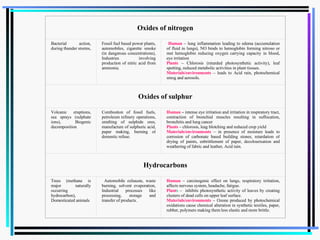
Oxides of nitrogen Bacterial action, during thunder storms,  Fossil fuel based power plants, automobiles, cigarette smoke (in dangerous concentrations), Industries involving production of nitric acid from ammonia. Human  – lung inflammation leading to edema (accumulation of fluid in lungs), NO binds to hemoglobin forming nitroso or met hemoglobin reducing oxygen carrying capacity in blood, eye irritation Plants  – Chlorosis (retarded photosynthetic activity), leaf spotting, reduced metabolic activities in plant tissues. Materials/environments  – leads to Acid rain, photochemical smog and aerosols. Oxides of sulphur Volcanic eruptions, sea sprays (sulphate ions), Biogenic decomposition Combustion of fossil fuels, petroleum refinery operations, smelting of sulphide ores, manufacture of sulphuric acid, paper making, burning of domestic refuse. Human  –  intense eye irritation and irritation in respiratory tract, contraction of bronchial muscles resulting in suffocation, bronchitis and lung cancer Plants  – chlorosis, leag blotching and reduced crop yield Materials/environments  – in presence of moisture leads to corrosion of carbonate based building stones, retardation of drying of paints, enbrittlement of paper, decolourisation and weathering of fabric and leather, Acid rain. Hydrocarbons Trees (methane is major naturally occurring hydrocarbon), Domesticated animals Automobile exhausts, waste burning, solvent evaporation, Industrial processes like processing, storage and transfer of products. Human   – carcinogenic effect on lungs, respiratory irritation, affects nervous system, headache, fatigue. Plant s   –  inhibits photosynthetic activity of leaves by creating clusters of dead cells on upper leaf surface. Materials/environments  – Ozone produced by photochemical oxidations cause chemical alteration in synthetic textiles, paper, rubber, polymers making them less elastic and more brittle.
Particulates Mineral pollutants, NaCl near oceans, pollens, volcanic ash Stone crushing, combustion  process, flyash, metallurgical operations, leaded petrol Fine particulates (size < 2.5 μ) carry adsorbed pollutants on surface and transport them to lungs., Black lung disease, Asbestosis (pulmonary fibriosis), Berylliosis Tobacco smoke containing tar and nicotine is carcinogenic.
Smog
Control of Photochemical smog Installation of  efficient catalytic converters  in automobiles  Petrol reformulation : Since September 1995, leaded petrol is replaced by unleaded petrol, which is a reformulated gasoline  Use of natural gas  as an alternative to petrol – Delhi is the first city in world to have all its public ransport run on CNG.
  Global Warming   (Enhanced Green House effect) absorption of infrared radiations of longer wavelengths, reflected by earths surface by gases like carbon dioxide, methane, chlorofluorocarbons,  producing a warming effect  Consequences of  Global Warming     On Global Climate : an average temperature increase from 3.5 ºC to 4.5 ºC:  º a.  Melting of ice and rise in sea level . frequency and severity of floods, damage coastal areas,   destruction of soil enrichment, and cause seawater intrusion into fresh water rivers and other aquatic systems near oceans   Evaporation of more water from the aquatic systems -  increased green house effect c 1 .      Effect on Plants. Carbon dioxide fertilization-  benefecial as well as harmful, exceecive growth of weeds.
Decomposition of  dead plant matter and soil organic matter would  at a higher rate   – more methane and carbon di oxide – increased global  warming          Decreased  moisture content of soil -  decreased fertility towards many crops  Bleaching of coral reefs  because of warming of ocean water Depletion of dissolved oxygen –  threat to marine life 1.       c.   Effect on Human beings:  An increase in global temperature is suspected to extend the range of vectors – the mosquitoes, flies and snails- that transmit infectious diseases.  Wild life :    For every 1 rise in temperature, plants have to spread 90 km towards pole. Fast spreading not possible for every species – destruction of habitats – no  chance of reestablishments.
Control of Global Warming Naturally -  Oceans as sink of Carbon di oxide,  atmospheric hydroxyl radical destroys methane,  Volcanic debris has anti green house effect Restricting green house gases emission: by using alternate fuels (to fossil fuel)  controlling deforestation or planting more trees, alternative to CFC’s. KYOTO PROTOCOL United Nations Climate Conference held at Kyoto, Japan in Dec. 1997   ‘ The protocol demands that developed countries should reduce the emission of three green house gases carbon dioxide, methane and nitrous oxides by an average of 5 % till 2010’  Three main components of Kyoto protocol are: Clean development mechanism   Emission trading mechanism   Joint implementation mechanism
Ozone depletion ozone layer acts - protective blanket for earth - shields earth from harmful UV radiations of the sun – adversely effected by air pollution. Culprits:  CFC’s, Oxides of nitrogen.  Consequences of ozone depletion: Penetration of UV – B radiations in  earth’s atmosphere damages immune system of skin, leads   to skin cancer, damage eye lens  MONTREAL PROTOCOL ( 1987) agreement aimed at step-by-step reduction of production and use of CFC’s to 50 % up to 1999 . Amended in 1990  50 % reduction in CFC’s production would be achieved upto 1995 and 100 % phase out to be completed by year 2000 . India became signatory to it in 1990.
Acid Rain pH < 5.6 Includes acid fog and acid snow Mainly nitric acid and sulphuric acid ( from NOx and SOx) Consequences of acid rain Reduction in aquatic plant growth,  Deteriorates soil quality by leaching out essential nutrients Decreased fish population because of weakened egg shells High metal ion content in ground water as result of leaching of soil. Monuments and statues esp. of marble are severely effected e.g.. Tajmahal
5. Global  Dimming   Research of about five decades shows that amount of sunlight reaching the earth’s surface has been gradually falling  .  The particulate in form of soot, ash and other pollutants are major cause of it. This visible air pollution reflects sunlight back into space preventing it to reach the surface   Dimming, may disrupt the pattern of world’s rainfall. It might have detrimental effect on Asian monsoon.
What are we waiting for ?
Start working towards protection of environment Give Earth a Chance
Encourage your family to walk to the neighbourhood market Whenever possible take your bicycle.    As far as possible use public form of transport.     Don’t drop your child at school by car. Encourage him to take school bus.     Encourage your family and friends to use car pool to office and back.     Reduce the use of aerosols in households.     Look after the trees in your neighbourhood.     Begin a tree watch group to ensure that they are well tended and cared for.     Swith off all lights and fans when not required.     If possible share your room with others when the air conditioner, cooler or fan is on.     Do not burn leaves in your garden. Put them in compost pit.  
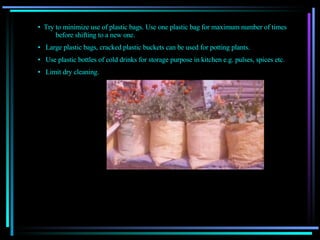
Try to minimize use of plastic bags. Use one plastic bag for maximum number of times  before shifting to a new one.     Large plastic bags, cracked plastic buckets can be used for potting plants.     Use plastic bottles of cold drinks for storage purpose in kitchen e.g. pulses, spices etc.     Limit dry cleaning.  
THANK YOU !

Air Pollution Presentation

  • 1.
    Air Pollution and its effect on mankind                  Dr. Manisha Jain Chemistry Department Acharya Narendra Dev College
  • 2.
    Pollutant is any solid, liquid or gaseous substance including energy, which is present in nature in concentrations greater than the natural abundance, due to human or natural activities and has a detrimental effect on the environment including both animate and inanimate objects. Contaminant is a material that is not present in nature but is introduced by human activities nto the environment effecting its composition. A contaminant is classified as pollutant when it has detrimental effect on environment . Source is the origin of pollutant Receptor is the medium, which is affected by a pollutant Sink is the medium, which retains a long-lived pollutant through interaction e.g.; ocean is a sink for atmospheric carbon dioxide and heat. Marble wall is a sink for atmospheric sulphuric acid. Pathways of Pollutants is the mechanism by which the pollutant is transported from a source into the environment. Speciation is the different chemical forms or species of the inorganic, organic or organometallic pollutants are called speciation.
  • 3.
        Itis defined as the presence of substances or energy in such quantities and for such duration, which can cause harm to animate or inanimate objects. Air Pollution
  • 4.
  • 5.
    Standards for airquality Sources and effects of primary pollutants Pollutant SO 2 NO x CO SPM Conc. (ppm) Industrial 120 120 5000 500 Residential 80 80 2000 200     Carbon monoxide Sources Effects Natural Anthropogenic Volcanic eruptions, natural gas emissions, electric discharge during storms, degradation of chlorophyll during autumn Vehicles, industries, fuel combustion, burning of forest debris or agricultural waste, cigarette smoking Toxic, leads to blocking of hemoglobin by forming carboxyhemoglobin and reduces oxygen carrying capacity of blood.
  • 6.
    Oxides of nitrogenBacterial action, during thunder storms, Fossil fuel based power plants, automobiles, cigarette smoke (in dangerous concentrations), Industries involving production of nitric acid from ammonia. Human – lung inflammation leading to edema (accumulation of fluid in lungs), NO binds to hemoglobin forming nitroso or met hemoglobin reducing oxygen carrying capacity in blood, eye irritation Plants – Chlorosis (retarded photosynthetic activity), leaf spotting, reduced metabolic activities in plant tissues. Materials/environments – leads to Acid rain, photochemical smog and aerosols. Oxides of sulphur Volcanic eruptions, sea sprays (sulphate ions), Biogenic decomposition Combustion of fossil fuels, petroleum refinery operations, smelting of sulphide ores, manufacture of sulphuric acid, paper making, burning of domestic refuse. Human – intense eye irritation and irritation in respiratory tract, contraction of bronchial muscles resulting in suffocation, bronchitis and lung cancer Plants – chlorosis, leag blotching and reduced crop yield Materials/environments – in presence of moisture leads to corrosion of carbonate based building stones, retardation of drying of paints, enbrittlement of paper, decolourisation and weathering of fabric and leather, Acid rain. Hydrocarbons Trees (methane is major naturally occurring hydrocarbon), Domesticated animals Automobile exhausts, waste burning, solvent evaporation, Industrial processes like processing, storage and transfer of products. Human – carcinogenic effect on lungs, respiratory irritation, affects nervous system, headache, fatigue. Plant s – inhibits photosynthetic activity of leaves by creating clusters of dead cells on upper leaf surface. Materials/environments – Ozone produced by photochemical oxidations cause chemical alteration in synthetic textiles, paper, rubber, polymers making them less elastic and more brittle.
  • 7.
    Particulates Mineral pollutants,NaCl near oceans, pollens, volcanic ash Stone crushing, combustion process, flyash, metallurgical operations, leaded petrol Fine particulates (size < 2.5 μ) carry adsorbed pollutants on surface and transport them to lungs., Black lung disease, Asbestosis (pulmonary fibriosis), Berylliosis Tobacco smoke containing tar and nicotine is carcinogenic.
  • 8.
  • 9.
    Control of Photochemicalsmog Installation of efficient catalytic converters in automobiles Petrol reformulation : Since September 1995, leaded petrol is replaced by unleaded petrol, which is a reformulated gasoline Use of natural gas as an alternative to petrol – Delhi is the first city in world to have all its public ransport run on CNG.
  • 10.
    GlobalWarming (Enhanced Green House effect) absorption of infrared radiations of longer wavelengths, reflected by earths surface by gases like carbon dioxide, methane, chlorofluorocarbons, producing a warming effect Consequences of Global Warming   On Global Climate : an average temperature increase from 3.5 ºC to 4.5 ºC: º a. Melting of ice and rise in sea level . frequency and severity of floods, damage coastal areas, destruction of soil enrichment, and cause seawater intrusion into fresh water rivers and other aquatic systems near oceans Evaporation of more water from the aquatic systems - increased green house effect c 1 .     Effect on Plants. Carbon dioxide fertilization- benefecial as well as harmful, exceecive growth of weeds.
  • 11.
    Decomposition of dead plant matter and soil organic matter would at a higher rate – more methane and carbon di oxide – increased global warming         Decreased moisture content of soil - decreased fertility towards many crops Bleaching of coral reefs because of warming of ocean water Depletion of dissolved oxygen – threat to marine life 1.       c. Effect on Human beings: An increase in global temperature is suspected to extend the range of vectors – the mosquitoes, flies and snails- that transmit infectious diseases. Wild life : For every 1 rise in temperature, plants have to spread 90 km towards pole. Fast spreading not possible for every species – destruction of habitats – no chance of reestablishments.
  • 12.
    Control of GlobalWarming Naturally - Oceans as sink of Carbon di oxide, atmospheric hydroxyl radical destroys methane, Volcanic debris has anti green house effect Restricting green house gases emission: by using alternate fuels (to fossil fuel) controlling deforestation or planting more trees, alternative to CFC’s. KYOTO PROTOCOL United Nations Climate Conference held at Kyoto, Japan in Dec. 1997 ‘ The protocol demands that developed countries should reduce the emission of three green house gases carbon dioxide, methane and nitrous oxides by an average of 5 % till 2010’ Three main components of Kyoto protocol are: Clean development mechanism Emission trading mechanism Joint implementation mechanism
  • 13.
    Ozone depletion ozonelayer acts - protective blanket for earth - shields earth from harmful UV radiations of the sun – adversely effected by air pollution. Culprits: CFC’s, Oxides of nitrogen. Consequences of ozone depletion: Penetration of UV – B radiations in earth’s atmosphere damages immune system of skin, leads to skin cancer, damage eye lens MONTREAL PROTOCOL ( 1987) agreement aimed at step-by-step reduction of production and use of CFC’s to 50 % up to 1999 . Amended in 1990 50 % reduction in CFC’s production would be achieved upto 1995 and 100 % phase out to be completed by year 2000 . India became signatory to it in 1990.
  • 14.
    Acid Rain pH< 5.6 Includes acid fog and acid snow Mainly nitric acid and sulphuric acid ( from NOx and SOx) Consequences of acid rain Reduction in aquatic plant growth, Deteriorates soil quality by leaching out essential nutrients Decreased fish population because of weakened egg shells High metal ion content in ground water as result of leaching of soil. Monuments and statues esp. of marble are severely effected e.g.. Tajmahal
  • 15.
    5. Global Dimming Research of about five decades shows that amount of sunlight reaching the earth’s surface has been gradually falling . The particulate in form of soot, ash and other pollutants are major cause of it. This visible air pollution reflects sunlight back into space preventing it to reach the surface Dimming, may disrupt the pattern of world’s rainfall. It might have detrimental effect on Asian monsoon.
  • 16.
    What are wewaiting for ?
  • 17.
    Start working towardsprotection of environment Give Earth a Chance
  • 18.
    Encourage your familyto walk to the neighbourhood market Whenever possible take your bicycle.   As far as possible use public form of transport.    Don’t drop your child at school by car. Encourage him to take school bus.    Encourage your family and friends to use car pool to office and back.    Reduce the use of aerosols in households.    Look after the trees in your neighbourhood.    Begin a tree watch group to ensure that they are well tended and cared for.    Swith off all lights and fans when not required.    If possible share your room with others when the air conditioner, cooler or fan is on.    Do not burn leaves in your garden. Put them in compost pit.  
  • 19.
    Try to minimizeuse of plastic bags. Use one plastic bag for maximum number of times before shifting to a new one.    Large plastic bags, cracked plastic buckets can be used for potting plants.    Use plastic bottles of cold drinks for storage purpose in kitchen e.g. pulses, spices etc.    Limit dry cleaning.  
  • 20.