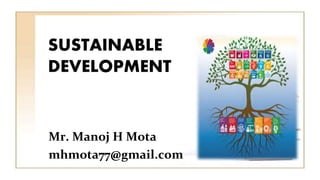

SUSTAINABLE
DEVELOPMENT
Mr. Manoj H Mota
mhmota77@gmail.com
Outline…..
• Definition of SD
• Need of SD
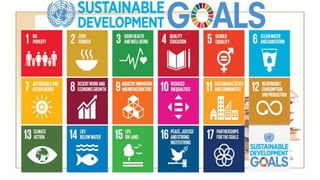
• Goals of SD set by UN
• Targets set by NITI Aayog, India
• Pillars of SD
• How to achieve SD???
• What we can do???
Definition of SD
 Generally ‘Development’ is the gradual growth of a
situation that becomes more advanced and strong than
previous one.
 Development is a unfolding of human potentials for
meaningful participation in economic, social, political
and cultural process and institutions, so that people can
improve their conditions.
Definition of SD
• According to the UN, sustainable development, “meets
the needs of the present without sacrificing the ability of
future generations to meet their own needs.”
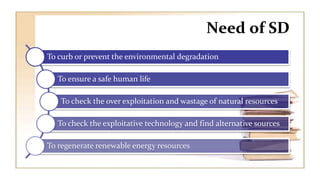
Need of SD
• To meet environmental, economic, and social goals
simultaneously.
• In other words it is improving the quality of life of
the present generation without excessive use or
abuse resources, so that they can be preserved for the
next generation.
Need of SD
To curb or prevent the environmental degradation
To ensure a safe human life
To check the over exploitation and wastage of natural resources
To check the exploitative technology and find alternative sources
To regenerate renewable energy resources
Targets set by NITI Aayog, India
• The Post 2015 UN Development Agenda is a
unique participatory exercise that has led to the
design of a Sustainable Development framework
consisting of 17 Goals that address the key
concerns of humanity and 169 interlinked
Targets within these Goals that reflect the
complex and interrelated nature of social,
economic and ecological well-being parameters.
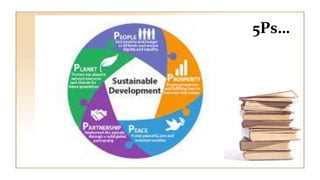
5Ps…
Pillars of Sustainable development
Economy
Society
Environment
Major hurdles
Major hurdles in achieving SD goals..
• Poverty
• Population growth
• Environmental degradation
• Political instability
• Diseases like aids/Covid 19
• Marginalization
How to achieve SD???
• Awareness……ideas about sustainability
• Strategies for promoting sustainable development
• Governance for sustainable development
• Societal transformations
• Innovation for sustainable development
• Capacity development for innovation
• Environmental Management
Awareness…
• Public talk
• Seminars
• Webinars
• Social media
• Short films
• Road shows
Strategies…
• Country ownership and participation, leadership and initiative
in developing their strategies.
• Broad consultation, including particularly with the poor and
with civil society, to open up debate on new ideas and
information, expose issues to be addressed, and build
consensus and political support on action.
• Ensuring sustained beneficial impacts on disadvantaged and
marginalised groups and on future generations.
• Building on existing strategies and processes, rather than
adding additional ones, to enable convergence and coherence.
Strategies…
• A solid analytical basis, taking account also of relevant regional
issues, including a comprehensive review of the present
situation and forecasts of trends and risks.
• Integration of economic, social and environmental objectives
through mutually supportive policies and practices and the
management of tradeoffs.
• Realistic targets with clear budgetary priorities.
Governance for SD
 Good governance is characterized by predictable, open and
enlightened policy-making, a bureaucracy filled with a professional
philosophy acting in the promotion of the public good, the rule of
law, transparent processes, and a strong civil society participating in
public affairs. (The World Bank)
 Good governance is at the heart of any successful dealing. It is vital
for a company or organization to achieve its objectives and drive
improvement, as well as maintain legal and ethical standing in the
eyes of all stakeholders,
 Governance is not simply a concern for any nation, business or
organization of any shape or size.
 Governance involves interaction between the formal
institutions and those in civil society. Governance refers to
a process whereby elements in society exercise power,
authority and influence and enact policies and decisions
concerning public life and social upliftment.
 "Governance", therefore, go beyond the collective meaning
of related concepts like the state, government, regime and
good government.
 Many of the elements and principles underlying "good
government" have become an integral part of the meaning
of "governance".
Eight Elements of Good Governance
Good governance has 8 major characteristics. It is …..
 Participatory,
 Consensus oriented,
 Accountable,
 Transparent,
 Responsive,
 Effective and efficient,
 Equitable and inclusive, and
 Follows the rule of law.
Societal transformations…
• Social transformation refers to the process of change in
institutionalized relationships, norms, values, and
hierarchies over time.
• During the process of social transformation, a person
moves from an ascribed status to an achieved status.
• Social transformation affects people's interactions and
lifestyle.
 Social transformation means the restructuring of all aspects of
life; from culture to social relations; from politics to economy;
from the way we think to the way we live.
 Gradual change is necessary and desirable and typically stems
from such things as population growth, technological advances,
and interaction with other societies that brings new ways of
thinking and acting.
Social Transformations in recognition of the necessity to
address crises….
 Reduction of natural resources
 Food, water and energy shortages
 Loss of biodiversity
 The pressure of accelerating urbanization and population
growth
 Climate change and natural disasters.
Innovation for SD…
• Innovation has become the new buzzword across the
globe. International organizations, governments,
corporate, academia and civil society see it as the
answer to the major economic, social and
environmental transformations challenging the models
of the 20th century.
Capacity development for innovation
• Building abilities, relationships and values that will enable
organizations, groups and individuals to improve their
performance and achieve their development objectives.
• Capacity building was also described as initiating and
sustaining a process of individual and organizational change
that can equally refer to change within a state, civil society or
the private sector, as well as a change in processes that
enhance cooperation between different groups of society.
This definition puts emphasis on three aspects:
(a) capacity building as the catalyst and constant fuel
for a process of change,
(b) The importance of building institutional capacity,
(c) Involvement of a wide range of different groups in
society.
Ways to Improve the Effectiveness of
Capacity Building
 Identifying needs and building on existing capacities
 Being clear about the objectives
 Using a wide range of capacity building approaches
 Target the right people to build a critical mass
 Making the training-of-trainers approach work
 Institutionalizing capacity building programmes at
regional and national level
Environmental Management …
 Environmental Management can be defined as
“the management of the interaction and impact of human
activities on the natural environment”.
 Environmental management tries to identify the factors
that have a stake in the conflicts that may rise between
meeting the needs but protecting the environment.
 An environmental management system protects public
health and safety by establishing procedures to limit or
eliminate harmful substances from entering
the environment, including public water systems. Every
organization in some way affects the environment, which
directly affects public health.
 In brief, environmental management is necessary
for environmental planning which implies the optimal
utilization of the earth's resources and preservation of the
quality of environment for the healthy growth of society.
Some key area for research
Energy
Alternate fuels
Improving efficiency
Waste management
EIA and much more
Mail at….
mhmota77@gmail.com
Environmental Engineering

Sustainable development

  • 1.
    SUSTAINABLE DEVELOPMENT Mr. Manoj HMota mhmota77@gmail.com
  • 2.
    Outline….. • Definition ofSD • Need of SD • Goals of SD set by UN • Targets set by NITI Aayog, India • Pillars of SD • How to achieve SD??? • What we can do???
  • 3.
    Definition of SD Generally ‘Development’ is the gradual growth of a situation that becomes more advanced and strong than previous one.  Development is a unfolding of human potentials for meaningful participation in economic, social, political and cultural process and institutions, so that people can improve their conditions.
  • 4.
    Definition of SD •According to the UN, sustainable development, “meets the needs of the present without sacrificing the ability of future generations to meet their own needs.”
  • 5.
    Need of SD •To meet environmental, economic, and social goals simultaneously. • In other words it is improving the quality of life of the present generation without excessive use or abuse resources, so that they can be preserved for the next generation.
  • 6.
    Need of SD Tocurb or prevent the environmental degradation To ensure a safe human life To check the over exploitation and wastage of natural resources To check the exploitative technology and find alternative sources To regenerate renewable energy resources
  • 8.
    Targets set byNITI Aayog, India • The Post 2015 UN Development Agenda is a unique participatory exercise that has led to the design of a Sustainable Development framework consisting of 17 Goals that address the key concerns of humanity and 169 interlinked Targets within these Goals that reflect the complex and interrelated nature of social, economic and ecological well-being parameters.
  • 9.
  • 10.
    Pillars of Sustainabledevelopment Economy Society Environment
  • 11.
    Major hurdles Major hurdlesin achieving SD goals.. • Poverty • Population growth • Environmental degradation • Political instability • Diseases like aids/Covid 19 • Marginalization
  • 12.
    How to achieveSD??? • Awareness……ideas about sustainability • Strategies for promoting sustainable development • Governance for sustainable development • Societal transformations • Innovation for sustainable development • Capacity development for innovation • Environmental Management
  • 13.
    Awareness… • Public talk •Seminars • Webinars • Social media • Short films • Road shows
  • 14.
    Strategies… • Country ownershipand participation, leadership and initiative in developing their strategies. • Broad consultation, including particularly with the poor and with civil society, to open up debate on new ideas and information, expose issues to be addressed, and build consensus and political support on action. • Ensuring sustained beneficial impacts on disadvantaged and marginalised groups and on future generations. • Building on existing strategies and processes, rather than adding additional ones, to enable convergence and coherence.
  • 15.
    Strategies… • A solidanalytical basis, taking account also of relevant regional issues, including a comprehensive review of the present situation and forecasts of trends and risks. • Integration of economic, social and environmental objectives through mutually supportive policies and practices and the management of tradeoffs. • Realistic targets with clear budgetary priorities.
  • 16.
    Governance for SD Good governance is characterized by predictable, open and enlightened policy-making, a bureaucracy filled with a professional philosophy acting in the promotion of the public good, the rule of law, transparent processes, and a strong civil society participating in public affairs. (The World Bank)  Good governance is at the heart of any successful dealing. It is vital for a company or organization to achieve its objectives and drive improvement, as well as maintain legal and ethical standing in the eyes of all stakeholders,  Governance is not simply a concern for any nation, business or organization of any shape or size.
  • 17.
     Governance involvesinteraction between the formal institutions and those in civil society. Governance refers to a process whereby elements in society exercise power, authority and influence and enact policies and decisions concerning public life and social upliftment.  "Governance", therefore, go beyond the collective meaning of related concepts like the state, government, regime and good government.  Many of the elements and principles underlying "good government" have become an integral part of the meaning of "governance".
  • 18.
    Eight Elements ofGood Governance Good governance has 8 major characteristics. It is …..  Participatory,  Consensus oriented,  Accountable,  Transparent,  Responsive,  Effective and efficient,  Equitable and inclusive, and  Follows the rule of law.
  • 19.
    Societal transformations… • Socialtransformation refers to the process of change in institutionalized relationships, norms, values, and hierarchies over time. • During the process of social transformation, a person moves from an ascribed status to an achieved status. • Social transformation affects people's interactions and lifestyle.
  • 20.
     Social transformationmeans the restructuring of all aspects of life; from culture to social relations; from politics to economy; from the way we think to the way we live.  Gradual change is necessary and desirable and typically stems from such things as population growth, technological advances, and interaction with other societies that brings new ways of thinking and acting.
  • 21.
    Social Transformations inrecognition of the necessity to address crises….  Reduction of natural resources  Food, water and energy shortages  Loss of biodiversity  The pressure of accelerating urbanization and population growth  Climate change and natural disasters.
  • 22.
    Innovation for SD… •Innovation has become the new buzzword across the globe. International organizations, governments, corporate, academia and civil society see it as the answer to the major economic, social and environmental transformations challenging the models of the 20th century.
  • 23.
    Capacity development forinnovation • Building abilities, relationships and values that will enable organizations, groups and individuals to improve their performance and achieve their development objectives. • Capacity building was also described as initiating and sustaining a process of individual and organizational change that can equally refer to change within a state, civil society or the private sector, as well as a change in processes that enhance cooperation between different groups of society.
  • 24.
    This definition putsemphasis on three aspects: (a) capacity building as the catalyst and constant fuel for a process of change, (b) The importance of building institutional capacity, (c) Involvement of a wide range of different groups in society.
  • 25.
    Ways to Improvethe Effectiveness of Capacity Building  Identifying needs and building on existing capacities  Being clear about the objectives  Using a wide range of capacity building approaches  Target the right people to build a critical mass  Making the training-of-trainers approach work  Institutionalizing capacity building programmes at regional and national level
  • 26.
    Environmental Management … Environmental Management can be defined as “the management of the interaction and impact of human activities on the natural environment”.  Environmental management tries to identify the factors that have a stake in the conflicts that may rise between meeting the needs but protecting the environment.
  • 27.
     An environmentalmanagement system protects public health and safety by establishing procedures to limit or eliminate harmful substances from entering the environment, including public water systems. Every organization in some way affects the environment, which directly affects public health.  In brief, environmental management is necessary for environmental planning which implies the optimal utilization of the earth's resources and preservation of the quality of environment for the healthy growth of society.
  • 28.
    Some key areafor research Energy Alternate fuels Improving efficiency Waste management EIA and much more
  • 30.