Overview
of
Climate Change
What is Climate Change?
• “A change of climate which is attributed directly or
indirectly to human activity that alters the
composition of the global atmosphere which is in
addition to natural climate variability observed over
a comparable period of time.” (United Nations Framework
Convention on Climate Change (UNFCCC)
• “Any change in climate over time, whether due to
natural variability or as a result of human activity.”
(Intergovernmental Panel on Climate Change (IPCC)
To be able to understand
climate change is to understand
first the concept of
greenhouse effect.
www.eere.energy.gov
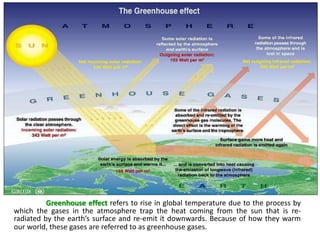
Greenhouse effect refers to rise in global temperature due to the process by
which the gases in the atmosphere trap the heat coming from the sun that is re-
radiated by the earth’s surface and re-emit it downwards. Because of how they warm
our world, these gases are referred to as greenhouse gases.
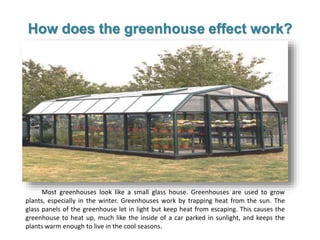
Most greenhouses look like a small glass house. Greenhouses are used to grow
plants, especially in the winter. Greenhouses work by trapping heat from the sun. The
glass panels of the greenhouse let in light but keep heat from escaping. This causes the
greenhouse to heat up, much like the inside of a car parked in sunlight, and keeps the
plants warm enough to live in the cool seasons.
How does the greenhouse effect work?
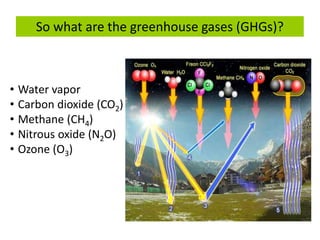
So what are the greenhouse gases (GHGs)?
• Water vapor
• Carbon dioxide (CO2)
• Methane (CH4)
• Nitrous oxide (N2O)
• Ozone (O3)
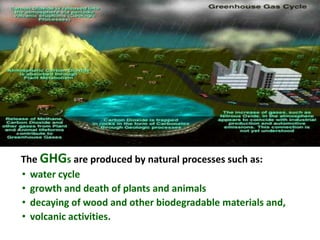
The GHGs are produced by natural processes such as:
• water cycle
• growth and death of plants and animals
• decaying of wood and other biodegradable materials and,
• volcanic activities.
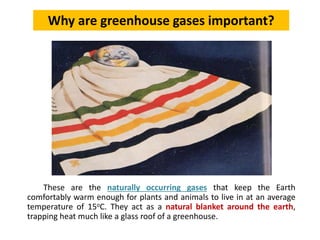
These are the naturally occurring gases that keep the Earth
comfortably warm enough for plants and animals to live in at an average
temperature of 15oC. They act as a natural blanket around the earth,
trapping heat much like a glass roof of a greenhouse.
Why are greenhouse gases important?
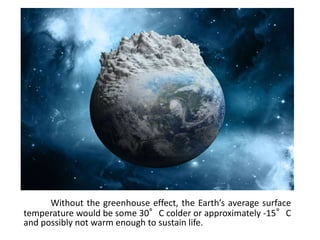
Without the greenhouse effect, the Earth’s average surface
temperature would be some 30°C colder or approximately -15°C
and possibly not warm enough to sustain life.
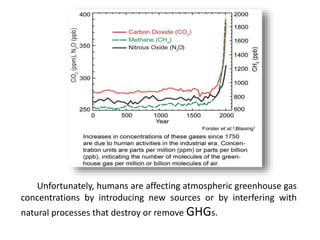
Unfortunately, humans are affecting atmospheric greenhouse gas
concentrations by introducing new sources or by interfering with
natural processes that destroy or remove GHGs.
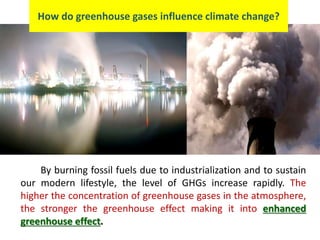
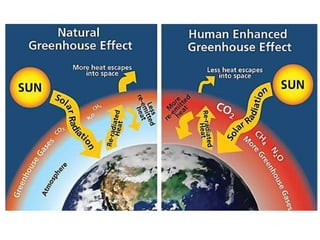
By burning fossil fuels due to industrialization and to sustain
our modern lifestyle, the level of GHGs increase rapidly. The
higher the concentration of greenhouse gases in the atmosphere,
the stronger the greenhouse effect making it into enhanced
greenhouse effect.
How do greenhouse gases influence climate change?
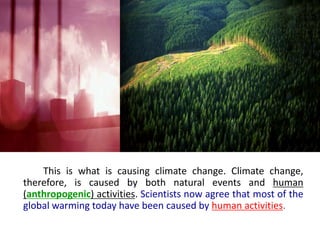
This is what is causing climate change. Climate change,
therefore, is caused by both natural events and human
(anthropogenic) activities. Scientists now agree that most of the
global warming today have been caused by human activities.
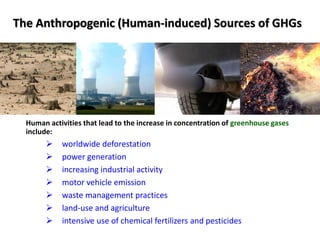
The Anthropogenic (Human-induced) Sources of GHGs
Human activities that lead to the increase in concentration of greenhouse gases
include:
 worldwide deforestation
 power generation
 increasing industrial activity
 motor vehicle emission
 waste management practices
 land-use and agriculture
 intensive use of chemical fertilizers and pesticides
Effects of Climate Change
• Temperature increase
• Sea-level rise
• Melting of glaciers
• Extreme weather events
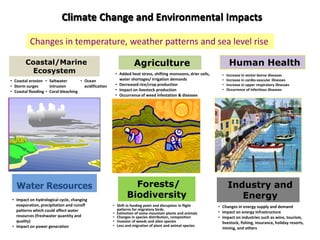
Water Resources
Climate Change and Environmental Impacts
Changes in temperature, weather patterns and sea level rise
Agriculture
Forests/
Biodiversity
Coastal/Marine
Ecosystem
Human Health
Industry and
Energy
• Added heat stress, shifting monsoons, drier soils,
water shortages/ irrigation demands
• Decreased rice/crop production
• Impact on livestock production
• Occurrence of weed infestation & diseases
• Coastal erosion
• Storm surges
• Coastal flooding
• Saltwater
intrusion
• Coral bleaching
• Ocean
acidification
• Increase in vector-borne diseases
• Increase in cardio-vascular illnesses
• Increase in upper respiratory illnesses
• Occurrence of infectious diseases
• Impact on hydrological cycle, changing
evaporation, precipitation and runoff
patterns which could affect water
resources (freshwater quantity and
quality)
• Impact on power generation
• Shift in feeding point and disruption in flight
patterns for migratory birds.
• Extinction of some mountain plants and animals
• Changes in species distribution, composition
• Invasion of weeds and alien species
• Loss and migration of plant and animal species
• Changes in energy supply and demand
• Impact on energy infrastructure
• Impact on industries such as wine, tourism,
livestock, fishing, insurance, holiday resorts,
mining, and others
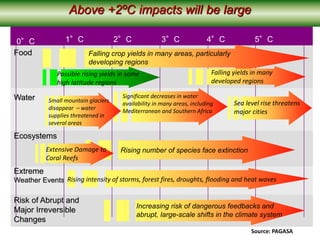
1°C 2°C 5°C4°C3°C
Sea level rise threatens
major cities
Falling crop yields in many areas, particularly
developing regions
Food
Water
Ecosystems
Risk of Abrupt and
Major Irreversible
Changes
0°C
Falling yields in many
developed regions
Rising number of species face extinction
Increasing risk of dangerous feedbacks and
abrupt, large-scale shifts in the climate system
Significant decreases in water
availability in many areas, including
Mediterranean and Southern Africa
Small mountain glaciers
disappear – water
supplies threatened in
several areas
Extensive Damage to
Coral Reefs
Extreme
Weather Events Rising intensity of storms, forest fires, droughts, flooding and heat waves
Possible rising yields in some
high latitude regions
Above +2ºC impacts will be large
Source: PAGASA
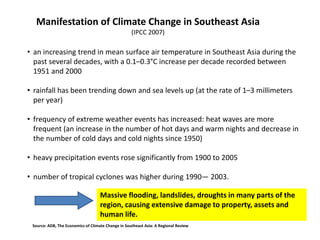
• an increasing trend in mean surface air temperature in Southeast Asia during the
past several decades, with a 0.1–0.3°C increase per decade recorded between
1951 and 2000
• rainfall has been trending down and sea levels up (at the rate of 1–3 millimeters
per year)
• frequency of extreme weather events has increased: heat waves are more
frequent (an increase in the number of hot days and warm nights and decrease in
the number of cold days and cold nights since 1950)
• heavy precipitation events rose significantly from 1900 to 2005
• number of tropical cyclones was higher during 1990— 2003.
Manifestation of Climate Change in Southeast Asia
(IPCC 2007)
Massive flooding, landslides, droughts in many parts of the
region, causing extensive damage to property, assets and
human life.
Source: ADB, The Economics of Climate Change in Southeast Asia: A Regional Review
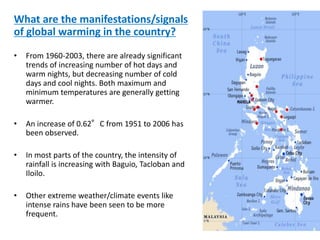
What are the manifestations/signals
of global warming in the country?
• From 1960-2003, there are already significant
trends of increasing number of hot days and
warm nights, but decreasing number of cold
days and cool nights. Both maximum and
minimum temperatures are generally getting
warmer.
• An increase of 0.62°C from 1951 to 2006 has
been observed.
• In most parts of the country, the intensity of
rainfall is increasing with Baguio, Tacloban and
Iloilo.
• Other extreme weather/climate events like
intense rains have been seen to be more
frequent.
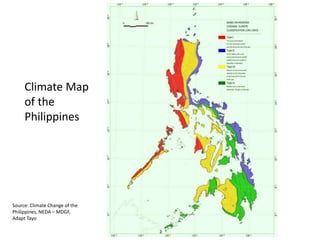
Climate Map
of the
Philippines
Source: Climate Change of the
Philippines, NEDA – MDGF,
Adapt Tayo
ACCORDING TO THE UNITED NATIONS,
VULNERABILITY TO CLIMATE CHANGE
WILL BE GREATER IN DEVELOPING
COUNTRIES, WHICH ARE LOCATED IN
WARMER LATITUDES, LIKE THE
PHILIPPINES.
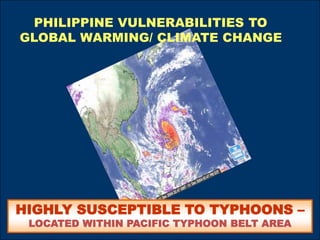
PHILIPPINE VULNERABILITIES TO
GLOBAL WARMING/ CLIMATE CHANGE
HIGHLY SUSCEPTIBLE TO TYPHOONS –
LOCATED WITHIN PACIFIC TYPHOON BELT AREA
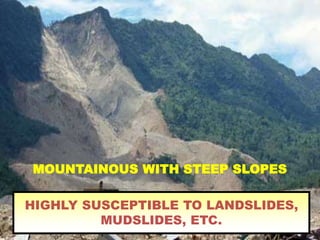
MOUNTAINOUS WITH STEEP SLOPES
HIGHLY SUSCEPTIBLE TO LANDSLIDES,
MUDSLIDES, ETC.
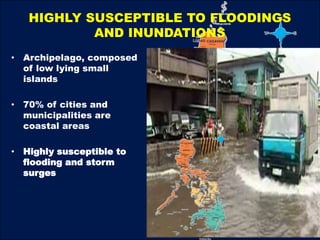
HIGHLY SUSCEPTIBLE TO FLOODINGS
AND INUNDATIONS
• Archipelago, composed
of low lying small
islands
• 70% of cities and
municipalities are
coastal areas
• Highly susceptible to
flooding and storm
surges
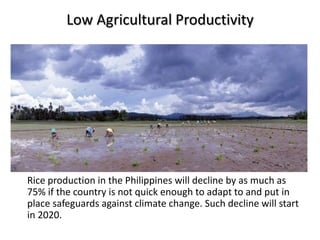
Low Agricultural Productivity
Rice production in the Philippines will decline by as much as
75% if the country is not quick enough to adapt to and put in
place safeguards against climate change. Such decline will start
in 2020.
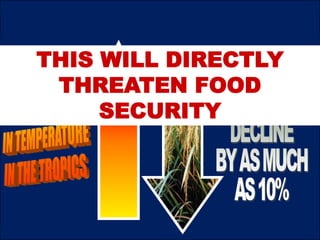
THIS WILL DIRECTLY
THREATEN FOOD
SECURITY
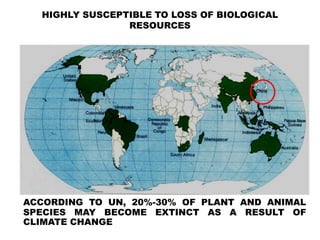
HIGHLY SUSCEPTIBLE TO LOSS OF BIOLOGICAL
RESOURCES
ACCORDING TO UN, 20%-30% OF PLANT AND ANIMAL
SPECIES MAY BECOME EXTINCT AS A RESULT OF
CLIMATE CHANGE
HIGHLY SUSCEPTIBLE TO ILLNESSES
PHILIPPINES AS A TROPICAL COUNTRY
Water-borne and parasitic illnesses will
become prevalent with climate change.
What can we do?
• Limit the cause of climate change
through measures that could slow
down the build up of atmospheric
GHGs concentrations by reducing
current and future emissions and by
increasing GHG sinks (Mitigation)
• Adjustment in natural or human
systems in response to actual or
expected climatic stimuli or their
effects, which moderates harm or
exploits beneficial opportunities
(Adaptation)
Increase the resilience and coping
capacity of the sector with the current
and future changes
We can make a difference . . .
• Read and share what we have learned about
climate change
• Save electricity
– turn off lights and electric appliance when
not in use
– use more energy efficient electric
appliances
– use compact fluorescent bulbs (CFLs) that
last 4 times longer and use just 1/4 of the
electricity compared to incandescent bulbs
• Plant trees in your neighborhood and look after
them. Trees absorb carbon dioxide from the
air.
We can make a difference . . .
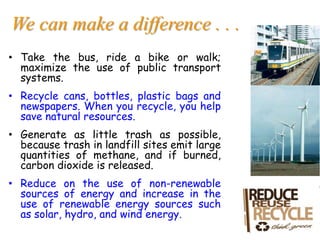
• Take the bus, ride a bike or walk;
maximize the use of public transport
systems.
• Recycle cans, bottles, plastic bags and
newspapers. When you recycle, you help
save natural resources.
• Generate as little trash as possible,
because trash in landfill sites emit large
quantities of methane, and if burned,
carbon dioxide is released.
• Reduce on the use of non-renewable
sources of energy and increase in the
use of renewable energy sources such
as solar, hydro, and wind energy.
We can make a difference . . .
• Review on your institution’s current policies
and programs that may work as either
mitigation or adaptation strategies and
measures in addressing climate change.
• Encourage cooperation and partnerships
among other institutions in programs and
activities that would help fight global
warming.
• Strengthen environmental awareness and
action among your colleagues by initiating
innovative and creative information and
education campaigns.
• Consume less, share more, live simply.
“Climate change will not
be effectively managed
until individuals and
communities recognise
that their behaviour can
make a difference.”
-The Royal Society, Climate Change: what we know
and what we need to know. (2002)
Thank you
For your questions / queries:
Climate Change Office (CCO)
DNA - CDM Secretariat Office
Environmental Management Bureau
DENR Compound, Visayas Avenue, Diliman, Quezon City
Telefax: (+63-2) 920-2251; 928-4674
Website: www.emb.gov.ph;

Overview of climate change

  • 1.
  • 2.
    What is ClimateChange? • “A change of climate which is attributed directly or indirectly to human activity that alters the composition of the global atmosphere which is in addition to natural climate variability observed over a comparable period of time.” (United Nations Framework Convention on Climate Change (UNFCCC) • “Any change in climate over time, whether due to natural variability or as a result of human activity.” (Intergovernmental Panel on Climate Change (IPCC)
  • 3.
    To be ableto understand climate change is to understand first the concept of greenhouse effect.
  • 4.
    www.eere.energy.gov Greenhouse effect refersto rise in global temperature due to the process by which the gases in the atmosphere trap the heat coming from the sun that is re- radiated by the earth’s surface and re-emit it downwards. Because of how they warm our world, these gases are referred to as greenhouse gases.
  • 5.
    Most greenhouses looklike a small glass house. Greenhouses are used to grow plants, especially in the winter. Greenhouses work by trapping heat from the sun. The glass panels of the greenhouse let in light but keep heat from escaping. This causes the greenhouse to heat up, much like the inside of a car parked in sunlight, and keeps the plants warm enough to live in the cool seasons. How does the greenhouse effect work?
  • 6.
    So what arethe greenhouse gases (GHGs)? • Water vapor • Carbon dioxide (CO2) • Methane (CH4) • Nitrous oxide (N2O) • Ozone (O3)
  • 7.
    The GHGs areproduced by natural processes such as: • water cycle • growth and death of plants and animals • decaying of wood and other biodegradable materials and, • volcanic activities.
  • 8.
    These are thenaturally occurring gases that keep the Earth comfortably warm enough for plants and animals to live in at an average temperature of 15oC. They act as a natural blanket around the earth, trapping heat much like a glass roof of a greenhouse. Why are greenhouse gases important?
  • 9.
    Without the greenhouseeffect, the Earth’s average surface temperature would be some 30°C colder or approximately -15°C and possibly not warm enough to sustain life.
  • 11.
    Unfortunately, humans areaffecting atmospheric greenhouse gas concentrations by introducing new sources or by interfering with natural processes that destroy or remove GHGs.
  • 12.
    By burning fossilfuels due to industrialization and to sustain our modern lifestyle, the level of GHGs increase rapidly. The higher the concentration of greenhouse gases in the atmosphere, the stronger the greenhouse effect making it into enhanced greenhouse effect. How do greenhouse gases influence climate change?
  • 14.
    This is whatis causing climate change. Climate change, therefore, is caused by both natural events and human (anthropogenic) activities. Scientists now agree that most of the global warming today have been caused by human activities.
  • 15.
    The Anthropogenic (Human-induced)Sources of GHGs Human activities that lead to the increase in concentration of greenhouse gases include:  worldwide deforestation  power generation  increasing industrial activity  motor vehicle emission  waste management practices  land-use and agriculture  intensive use of chemical fertilizers and pesticides
  • 16.
    Effects of ClimateChange • Temperature increase • Sea-level rise • Melting of glaciers • Extreme weather events
  • 17.
    Water Resources Climate Changeand Environmental Impacts Changes in temperature, weather patterns and sea level rise Agriculture Forests/ Biodiversity Coastal/Marine Ecosystem Human Health Industry and Energy • Added heat stress, shifting monsoons, drier soils, water shortages/ irrigation demands • Decreased rice/crop production • Impact on livestock production • Occurrence of weed infestation & diseases • Coastal erosion • Storm surges • Coastal flooding • Saltwater intrusion • Coral bleaching • Ocean acidification • Increase in vector-borne diseases • Increase in cardio-vascular illnesses • Increase in upper respiratory illnesses • Occurrence of infectious diseases • Impact on hydrological cycle, changing evaporation, precipitation and runoff patterns which could affect water resources (freshwater quantity and quality) • Impact on power generation • Shift in feeding point and disruption in flight patterns for migratory birds. • Extinction of some mountain plants and animals • Changes in species distribution, composition • Invasion of weeds and alien species • Loss and migration of plant and animal species • Changes in energy supply and demand • Impact on energy infrastructure • Impact on industries such as wine, tourism, livestock, fishing, insurance, holiday resorts, mining, and others
  • 18.
    1°C 2°C 5°C4°C3°C Sealevel rise threatens major cities Falling crop yields in many areas, particularly developing regions Food Water Ecosystems Risk of Abrupt and Major Irreversible Changes 0°C Falling yields in many developed regions Rising number of species face extinction Increasing risk of dangerous feedbacks and abrupt, large-scale shifts in the climate system Significant decreases in water availability in many areas, including Mediterranean and Southern Africa Small mountain glaciers disappear – water supplies threatened in several areas Extensive Damage to Coral Reefs Extreme Weather Events Rising intensity of storms, forest fires, droughts, flooding and heat waves Possible rising yields in some high latitude regions Above +2ºC impacts will be large Source: PAGASA
  • 19.
    • an increasingtrend in mean surface air temperature in Southeast Asia during the past several decades, with a 0.1–0.3°C increase per decade recorded between 1951 and 2000 • rainfall has been trending down and sea levels up (at the rate of 1–3 millimeters per year) • frequency of extreme weather events has increased: heat waves are more frequent (an increase in the number of hot days and warm nights and decrease in the number of cold days and cold nights since 1950) • heavy precipitation events rose significantly from 1900 to 2005 • number of tropical cyclones was higher during 1990— 2003. Manifestation of Climate Change in Southeast Asia (IPCC 2007) Massive flooding, landslides, droughts in many parts of the region, causing extensive damage to property, assets and human life. Source: ADB, The Economics of Climate Change in Southeast Asia: A Regional Review
  • 20.
    What are themanifestations/signals of global warming in the country? • From 1960-2003, there are already significant trends of increasing number of hot days and warm nights, but decreasing number of cold days and cool nights. Both maximum and minimum temperatures are generally getting warmer. • An increase of 0.62°C from 1951 to 2006 has been observed. • In most parts of the country, the intensity of rainfall is increasing with Baguio, Tacloban and Iloilo. • Other extreme weather/climate events like intense rains have been seen to be more frequent.
  • 21.
    Climate Map of the Philippines Source:Climate Change of the Philippines, NEDA – MDGF, Adapt Tayo
  • 22.
    ACCORDING TO THEUNITED NATIONS, VULNERABILITY TO CLIMATE CHANGE WILL BE GREATER IN DEVELOPING COUNTRIES, WHICH ARE LOCATED IN WARMER LATITUDES, LIKE THE PHILIPPINES.
  • 23.
    PHILIPPINE VULNERABILITIES TO GLOBALWARMING/ CLIMATE CHANGE HIGHLY SUSCEPTIBLE TO TYPHOONS – LOCATED WITHIN PACIFIC TYPHOON BELT AREA
  • 24.
    MOUNTAINOUS WITH STEEPSLOPES HIGHLY SUSCEPTIBLE TO LANDSLIDES, MUDSLIDES, ETC.
  • 25.
    HIGHLY SUSCEPTIBLE TOFLOODINGS AND INUNDATIONS • Archipelago, composed of low lying small islands • 70% of cities and municipalities are coastal areas • Highly susceptible to flooding and storm surges
  • 26.
    Low Agricultural Productivity Riceproduction in the Philippines will decline by as much as 75% if the country is not quick enough to adapt to and put in place safeguards against climate change. Such decline will start in 2020.
  • 27.
  • 28.
    HIGHLY SUSCEPTIBLE TOLOSS OF BIOLOGICAL RESOURCES ACCORDING TO UN, 20%-30% OF PLANT AND ANIMAL SPECIES MAY BECOME EXTINCT AS A RESULT OF CLIMATE CHANGE
  • 29.
    HIGHLY SUSCEPTIBLE TOILLNESSES PHILIPPINES AS A TROPICAL COUNTRY Water-borne and parasitic illnesses will become prevalent with climate change.
  • 30.
    What can wedo? • Limit the cause of climate change through measures that could slow down the build up of atmospheric GHGs concentrations by reducing current and future emissions and by increasing GHG sinks (Mitigation) • Adjustment in natural or human systems in response to actual or expected climatic stimuli or their effects, which moderates harm or exploits beneficial opportunities (Adaptation) Increase the resilience and coping capacity of the sector with the current and future changes
  • 31.
    We can makea difference . . . • Read and share what we have learned about climate change • Save electricity – turn off lights and electric appliance when not in use – use more energy efficient electric appliances – use compact fluorescent bulbs (CFLs) that last 4 times longer and use just 1/4 of the electricity compared to incandescent bulbs • Plant trees in your neighborhood and look after them. Trees absorb carbon dioxide from the air.
  • 32.
    We can makea difference . . . • Take the bus, ride a bike or walk; maximize the use of public transport systems. • Recycle cans, bottles, plastic bags and newspapers. When you recycle, you help save natural resources. • Generate as little trash as possible, because trash in landfill sites emit large quantities of methane, and if burned, carbon dioxide is released. • Reduce on the use of non-renewable sources of energy and increase in the use of renewable energy sources such as solar, hydro, and wind energy.
  • 33.
    We can makea difference . . . • Review on your institution’s current policies and programs that may work as either mitigation or adaptation strategies and measures in addressing climate change. • Encourage cooperation and partnerships among other institutions in programs and activities that would help fight global warming. • Strengthen environmental awareness and action among your colleagues by initiating innovative and creative information and education campaigns. • Consume less, share more, live simply.
  • 34.
    “Climate change willnot be effectively managed until individuals and communities recognise that their behaviour can make a difference.” -The Royal Society, Climate Change: what we know and what we need to know. (2002)
  • 35.
    Thank you For yourquestions / queries: Climate Change Office (CCO) DNA - CDM Secretariat Office Environmental Management Bureau DENR Compound, Visayas Avenue, Diliman, Quezon City Telefax: (+63-2) 920-2251; 928-4674 Website: www.emb.gov.ph;