Strategic Environmental
Assessment
Process and Methods
Strategic Environmental Assessment Workshop | 24-27 May 2016
Jeremy Carew-
Reid
1
What are SEAs?
2
 a development planning tool aiming to
ensure that environmental, social and
economic aspects of sustainability are
considered systematically in policies and
plans
 SEAs promote social and economic equity
and ecological sustainability in
development decisions
The purpose of SEAs – they:
 address broad strategic issues early in the planning
process:
 relating to more than one project
 always affecting more than one development sector
 relating to large areas
 affecting many people and communities and
 that need to be resolved and decided prior to making
project specific plans and decisions
 follow similar steps to EIAs but have much larger
scope in terms of time, space and subject coverage
 serve as an umbrella level of analysis that feeds
and guides more specific EIAs and improves their
3
Environmental assessment and
monitoring tools
4
Four main tools
for environmental
assessment:
 SEA family
 EIA family
 M&E
 Audit family
 Takes place at earlier stages of
decision-making cycle
 Multi-stage process with variations
e.g. policy v plans
 Pro-active, out-in-front approach
to development proposals
 Broad level of analysis, e.g. focus
on cross-sector links and issues
 Considers potentially wide range
of development alternatives
 Gives early warning of cumulative
impacts (sector or region wide)
 Emphasis on meeting
sustainability goals and
safeguards
 Focus on ‘do most good’ – ie
 Takes place at end of decision-
making cycle
 Well-defined process, clear
beginning and end
 Reacts to specific development
proposal
 Detailed, cause-effect analysis of the
impact of project components
 Considers limited range of feasible
alternatives (how to carry out
projects)
 Limited opportunity to address
cumulative impacts at project level
 Emphasis on mitigating and
minimising impacts
 Focus on do no/least harm
SEA and EIA compared
SEA EIA
SEAs can:
6
 assess an existing plan to improve
environmental and socio-economic
performance in on-going implementation
 assess a plan which is to be revised to
guide adjustments to its revised form
 contribute to preparing a new plan (so that
it addresses environmental and socio-
economic concerns as the plan takes
shape)
SEAs may have different forms
7
They can:
 Focus only on environmental impacts, or
integrate environmental, social and
economic dimensions of sustainability
 Engage a broad range of stakeholders, or
be limited to expert evaluation
 Be conducted in a short time frame, or
over a long period
To be most effective, SEAs are:
8
 best carried out as part of plan formulation,
 based on quick appraisal techniques so
that results remain fresh and relevant to
planning and decision making.
 SEAs are much less effective as a “stand
alone” procedure, a one-off event or as a
“mega-EIA” which cannot be replicated as
a normal part of the planning process.
SEAs in Mekong region differ from
SEAs in Europe9
In Europe SEAs were designed to be rapid, desk-top
sustainability audits (15-20 pages) –
That approach works where:
 planning laws and processes are robust and embrace
sustainability
 planning processes are consultative
 data and information is plentiful
 development plans already consider alternatives
In the Mekong region:
 planning frameworks are often uncertain and evolving
rapidly
 Consultation with stakeholders is not systematic
 data are limited
 SEAs are often much larger affairs because they must
In the Mekong region, SEAs tend
to “stand in the shoes” of planners
 Often plans are not in place or are not adequate (eg in
considering alternatives or cumulative effects)
 There are few guiding sustainability objectives
 Spatial planning is absent or inadequate
 With limited information SEAs need to expand beyond
a rapid sustainability audit of development plans
 SEAs become an integral part of the planning process
by:
 Filling critical information gaps with new analysis and
research
 Facilitating a consultative process that allows for debate and
builds consensus on “hot” issues
 Introducing consideration of alternatives and their
environmental, social and economic consequences
 Assessing long term trends and cumulative effects
10
Some challenges for SEA
 Being accepted at senior and decision-making
levels and adopted for systematic use
 Assessing alternatives and cumulative
impacts
 Addressing cross-boundary & trans-national
issues
 SEA at the policy level (how to integrate with
political functions and processes?)
 Integrating with development planning and
across sectors
 Effective public & stakeholder participation
Importance of stakeholder
involvement12
SEA as a credible process
13
 SEA reports need to be credible and to have
authority – otherwise decisions makers will ignore
them
 To be credible the reports must be balanced
 They must describe the benefits and the risks in an
objective way
 They must indicate where there is a divergence of
views on strategic issues and give reasons for the
conclusions it draws
 Stakeholder input and guidance is key to improving
SEA reports to ensure they are credible so that
decision makers will take them seriously
The need for stakeholder involvement
14
 Major changes are usually involved if the proposed
developments are to proceed. Change can:
 affect many communities and even many countries
 Affect many development sectors relying on the same resources and
areas
 lead to long term gains/benefits
 be irreversible and lead to permanent losses
 Who gains and who looses? – who, where and how
 Uncertainty: Most often dealing with situations of extreme
uncertainty
 Expert judgments: Decisions need to be made based on:
 the best available information and analysis (often limited and of
uncertain reliability)
 expert judgments on the levels of risk (involves values and
In strategic developments benefits are often
more readily defined than risks
15
 The benefits become evident in commercial and
economic terms from the early stages
 EIA often comes late in the planning process when
economic benefits are already well defined
 The definition of risks or negative impacts is not as easy
 They are often hard to express in economic or
commercial terms and difficult to integrate with
economic decisions
 SEAs are often confronted with situations where benefits
are relatively well enunciated and expressed in
economic terms while the risks are unclear,
unsubstantiated and indirect
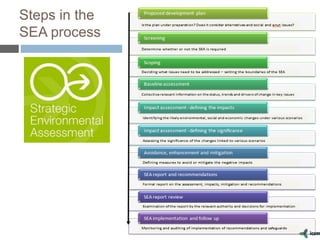
SEA steps16
Steps in the
SEA process
Steps in the SEA process – MRC SEA
of Mekong hydropower development
18
Inception and scoping
Report
Baseline
Assessment
Report
Impact Assessment Report Final
Report
National Government consultations
Regional Government Consultations
Civil society Organizations (CSO) Consultations
Developer consultations
May – June
2009
June-Sep 2009 Feb-May 2010 May-July 2010
Scoping phase Baseline
phase
Impact
assessments
Avoidance
enhancement &
Mitigation phase
AME
Report
Oct 2010
Staged approach – analysis, consultation & documentation
at each stage
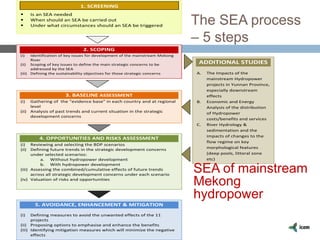
The SEA process
– 5 steps
2. SCOPING
(i) Identification of key issues for development of the mainstream Mekong
River
(ii) Scoping of key issues to define the main strategic concerns to be
addressed by the SEA
(iii) Defining the sustainability objectives for those strategic concerns
3. BASELINE ASSESSMENT
(i) Gathering of the “evidence base” in each country and at regional
level
(ii) Analysis of past trends and current situation in the strategic
development concerns
4. OPPORTUNITIES AND RISKS ASSESSMENT
(i) Reviewing and selecting the BDP scenarios
(ii) Defining future trends in the strategic development concerns
under selected scenarios:
a. Without hydropower development
b. With hydropower development
(iii) Assessing the combined/cumulative effects of future trends
across all strategic development concerns under each scenario
(iv) Valuation of risks and opportunities
5. AVOIDANCE, ENHANCEMENT & MITIGATION
(i) Defining measures to avoid the unwanted effects of the 11
projects
(ii) Proposing options to emphasise and enhance the benefits
(iii) Identifying mitigation measures which will minimize the negative
effects
ADDITIONAL STUDIES
A. The Impacts of the
mainstream Hydropower
projects in Yunnan Province,
especially downstream
effects
B. Economic and Energy
Analysis of the distribution
of Hydropower
costs/benefits and services
C. River Hydrology &
sedimentation and the
impacts of changes to the
flow regime on key
morphological features
(deep pools, littoral zone
etc)
1. SCREENING
 Is an SEA needed
 When should an SEA be carried out
 Under what circumstances should an SEA be triggered
1. SCREENING
SEA of mainstream
Mekong
hydropower
MRC mainstream hydro SEA
20
National Scoping & Capacity
Building Workshop & Civil Society
Meetings
• 4 National Scoping Workshops
•3 Civil Society meeting
•ThaiCivil Society meeting to follow in
November
8 THEMES (~30 - 40 KEY ISSUES)
Government Line Agency
Meetings
•meetings with 40 agencies in the LMB
2 Field Missions & Opinion from
17 experts
•Luang Prabang, Xayabouly, Pak Lay,
Sanakhan, Pak Chom
100s of development Issues
past present future
Without mainstream
hydropower
Issue 2
Issue 1
With mainstream
hydropower
2. BASELINE ASSESSMENT
With mitigation
1.SCOPING
3. OPPORTUNITIES & RISKS ASSESSMENT
4.MITIGATION
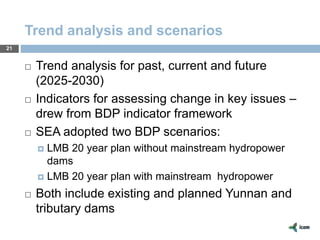
Trend analysis and scenarios
21
 Trend analysis for past, current and future
(2025-2030)
 Indicators for assessing change in key issues –
drew from BDP indicator framework
 SEA adopted two BDP scenarios:
 LMB 20 year plan without mainstream hydropower
dams
 LMB 20 year plan with mainstream hydropower
 Both include existing and planned Yunnan and
tributary dams
Screening22
The purpose of screening
The purpose of screening is to determine:
 whether or not a proposed development
strategy, plan or policy requires an SEA
 what level of SEA is required – eg quick or
comprehensive
Outcomes of screening
24
 full or comprehensive SEA required
 more limited SEA required
 further study needed to determine SEA
requirement
 SEA not required
Screening and scoping compared
25
 Screening
determines the requirement for SEA
establishes the level of review necessary
 Scoping
identifies the key issues to be considered
sets the boundaries for the assessment
establishes the terms of reference
Screening methods
26
 legal/policy definition
 inclusion list of plans (with/without
thresholds)
 exclusion list of plans
 criteria for case-by-case screening
Typical plans requiring SEAs include
27
 River basin plans
 Hydropower development plans - dam and reservoir
cascades
 Infrastructure sector and area wide plans (e.g. transport
and irrigation)
 Industrial zone management plans (e.g. manufacturing
and special economic zones)
 Minerals and energy extraction sector plans (e.g. oil &
gas, coal)
 Waste management and disposal of hazardous and toxic
materials plans
 Power development plans (including multiple power
Social and environmental criteria for
case-by-case screening
28
The following are important in determining significant
effects:
 affective large number of people
 affective poor and disadvantaged groups
 affecting many other users of the same resources
 abundance and quality of natural resources
 assimilative capacity of the natural environment
 environmental sensitivity, e.g. wetlands, coastal and
mountain zones
 existing land uses of strategic importance
 adjacent to protected or designated special use areas
 within landscapes of special heritage value
Scoping29
Scoping
30
 Staged approach – analysis, documentation and
consultation at each stage
 Scoping – strategic themes and issues
identified
 What are the most important issues of concern
to sustainable development and use of the
area and resources concerned?
 How can those issues be categories and
prioritized – ie given strategic focus?
Scoping
31
 open, interactive process - involves
stakeholders
 lays the foundation of an SEA - by
identifying
time and space boundaries of the
assessment
the information necessary for decision-
making
key issues and potential impacts to be
considered
Key objectives of scoping
32
 inform and identify stakeholders
 find out their initial concerns
 identify feasible and practical alternatives
 identify the main issues and impacts to be
studied
 define the boundaries of the assessment
 agree on means of public involvement
 establish the Terms of Reference
MRC SEA of hydro on mainstream
Mekong
33
 REGIONAL: upper and lower segments of the river but
focuses on transboundary concerns and the socio-
economic and natural system linkages between the LMB
countries.
 NATIONAL: The LMB countries – Cambodia, Lao PDR,
Thailand and Vietnam – and the effects of mainstream
projects on each of their distinctive economies, and
social and natural systems. The 12 proposed projects
are assessed against national interests and development
priorities of the four LMB countries.
 HYDRO-ECOLOGICAL ZONES Assessing THE
PROJECTS within 6 hydro-ecological zones. The zones
have distinctive bio-physical characteristics.
Steps in the scoping process
34
1. prepare an outline scope
2. develop the outline through informal consultation
3. make the outline available to stakeholders
4. compile the range of concerns (long list)
5. evaluate these to establish key issues (short list)
6. organise these into impact themes (study list)
7. amend the outline to incorporate the above information
8. develop Terms of Reference
Baseline assessment35
Baseline assessment
36
 Baseline – projected baseline and trend
analysis
1. What have been past trends for each of
the key issues?
2. What will the trends look like when
projected to 2030?
 Without mainstream projects
 When other trends and drivers are considered
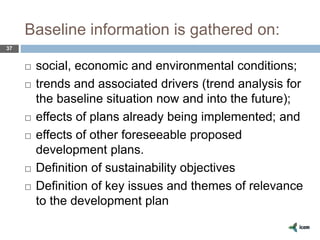
Baseline information is gathered on:
37
 social, economic and environmental conditions;
 trends and associated drivers (trend analysis for
the baseline situation now and into the future);
 effects of plans already being implemented; and
 effects of other foreseeable proposed
development plans.
 Definition of sustainability objectives
 Definition of key issues and themes of relevance
to the development plan
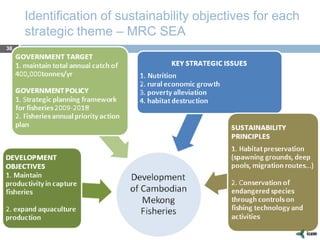
Identification of sustainability objectives for each
strategic theme – MRC SEA
38
Impact assessment39
Impact assessment
40
 Impacts – overlay the proposed development
plan onto the baseline
1. Will the proposed development plan affect the
trends in key issues?
2. Will those affects provide benefits and/or
costs?
3. Will those affects enhance or reduce
sustainability?
 SEAs are a form of sustainability analysis –
where economic, social and biophysical trends
and effects under different development
Forecasting the potential impacts
41
 identification of impacts — to specify the
impacts associated with each component
and phase of the plan
 forecasting — to forecast the nature,
magnitude, extent and duration of the main
impacts
 evaluation of significance — to determine
the significance of the impacts
 evaluation of impacts on sustainability
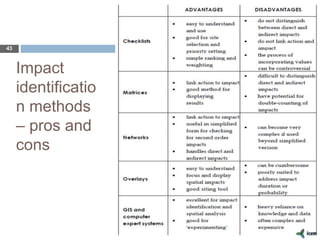
Methods used for impact identification
42
 Trend analysis
 checklists;
 matrices;
 networks or causal effect diagrams to identify
indirect, cumulative impacts
 overlays and geographic information systems
(GIS);
 computer expert systems; and
 professional judgement
Impact
identificatio
n methods
– pros and
cons
43
Forecasting impacts
44
Typical parameters to be taken into account in impact
prediction include:
 nature (positive, negative, direct, indirect, cumulative);
 magnitude (severe, moderate, low);
 extent/location (area/volume covered, distribution);
 timing (during construction, operation, decommissioning,
immediate, delayed, rate of change);
 duration (short term, long term, intermittent, continuous);
 reversibility/irreversibility;
 likelihood (probability, uncertainty or confidence in the
prediction); and
 significance (local, regional, global).
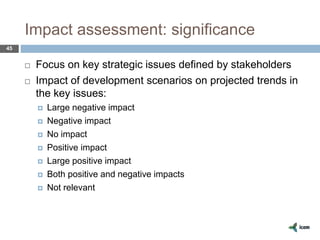
Impact assessment: significance
45
 Focus on key strategic issues defined by stakeholders
 Impact of development scenarios on projected trends in
the key issues:
 Large negative impact
 Negative impact
 No impact
 Positive impact
 Large positive impact
 Both positive and negative impacts
 Not relevant
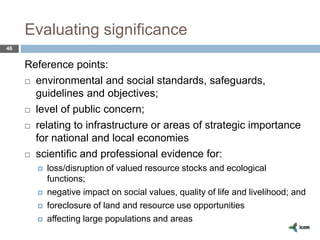
Evaluating significance
46
Reference points:
 environmental and social standards, safeguards,
guidelines and objectives;
 level of public concern;
 relating to infrastructure or areas of strategic importance
for national and local economies
 scientific and professional evidence for:
 loss/disruption of valued resource stocks and ecological
functions;
 negative impact on social values, quality of life and livelihood; and
 foreclosure of land and resource use opportunities
 affecting large populations and areas
Evaluating sustainability
47
 Impact of the plan on sustainability
 SEA sustainability objectives defined through
stakeholder workshops and review of
government policies
 One or two sustainability objectives identified for
each strategic theme
 The impact question – “what effect will the
development plan have on achieving the
sustainability objective”?
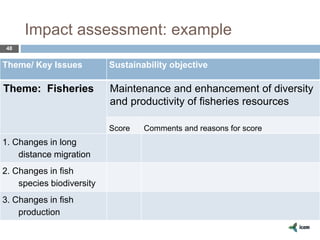
Impact assessment: example
48
Theme/ Key Issues Sustainability objective
Theme: Fisheries Maintenance and enhancement of diversity
and productivity of fisheries resources
Score Comments and reasons for score
1. Changes in long
distance migration
2. Changes in fish
species biodiversity
3. Changes in fish
production
Impact assessment (4) - example
49
Theme/ Key Issues Sustainability objective
Theme: Energy
and power
Ensuring a secure and diverse energy
supply from renewable resources without
losses in sustainability of social and natural
systems
Score Comments and reasons for score
1. Achieving energy
security
2. Meeting national
energy demands
3. Meeting local energy
needs
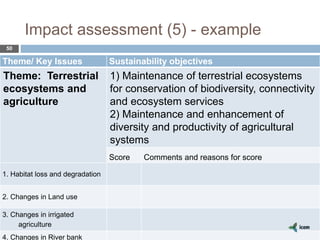
Impact assessment (5) - example
50
Theme/ Key Issues Sustainability objectives
Theme: Terrestrial
ecosystems and
agriculture
1) Maintenance of terrestrial ecosystems
for conservation of biodiversity, connectivity
and ecosystem services
2) Maintenance and enhancement of
diversity and productivity of agricultural
systems
Score Comments and reasons for score
1. Habitat loss and degradation
2. Changes in Land use
3. Changes in irrigated
agriculture
4. Changes in River bank
51
Avoidance, mitigation and
enhancement
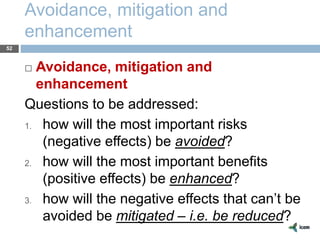
Avoidance, mitigation and
enhancement
52
 Avoidance, mitigation and
enhancement
Questions to be addressed:
1. how will the most important risks
(negative effects) be avoided?
2. how will the most important benefits
(positive effects) be enhanced?
3. how will the negative effects that can’t be
avoided be mitigated – i.e. be reduced?
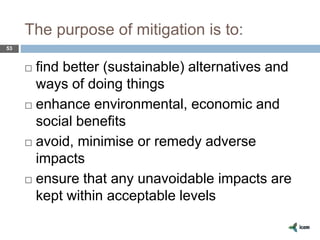
The purpose of mitigation is to:
53
 find better (sustainable) alternatives and
ways of doing things
 enhance environmental, economic and
social benefits
 avoid, minimise or remedy adverse
impacts
 ensure that any unavoidable impacts are
kept within acceptable levels
Development plan proponents have a
responsibility to:
54
 avoid, minimise and remedy adverse
impacts
 internalise the environmental and
social costs of the plan
 prepare plans for managing impacts
 repair or compensate for
environmental and social damages
(including offset arrangements)
Principles of mitigation
55
 give preference to measures for avoidance
and prevention
 consider feasible alternatives to the
proposed plans and its components
 identify customised measures to minimise
each major impact if avoidance not
feasible
 use compensation as a last resort (if
negative impacts cannot be avoided or
mitigated)
Objectives of impact management are
to:
56
 ensure that mitigation measures are
implemented
 establish systems, procedures and
responsibilities for managing impacts
 monitor the effectiveness of mitigation
measures; and
 take any necessary action when
unforeseen impacts occur.
2. SEA SYSTEMS IN MEKONG
COUNTRIES
SEA in Thailand
58
 One of the first in the Mekong region to explore SEA
 SEA guidelines adopted in 2004 (ONEP/MONRE)
 Voluntary but NEB can require an agency to conduct an
SEA
 ONEP now working with NESDB and 11 sectors to
determine when SEA should be mandatory
 Some 10 – 20 SEAs conducted (depending on the
definition) – current “SEAs”:
 SEA of Suvarnabhumi Airport (AOT)
 “SEA” of the Andaman Islands Environment Protection Area (DWR)
 “SEA” of the NE region water management (DWR)
 Five SEAs conducted in the water sectors
 Most big budget assessments: > 32million Baht
SEA in China59
One of the most rigorous mandatory systems in the world:
 A draft plan without an SEA cannot be approved and
implemented.
 Projects cannot proceed without an SEA of the umbrella
plan
 SEA mandatory for:
 river basin plans, land use plans, plans for regions and plans
prepared by ten main development sectors - industry, agriculture,
livestock, forestry, energy, water, conservation, transportation,
urban construction, tourism and natural resources development.
 Some 50 SEAs conducted at national level and more
than 150 at local government level.
SEA in Vietnam60
SEA mandatory for 6 categories of strategies and
plans:
1. National socio-economic development plan
2. SEDPs for all sectors (each central govt.
agency)
3. SEDPs for 64 provinces and cities
4. Inter-provincial (regional) – land use, forest
protection and development, natural resource
development
5. Special economic region plans
6. River basin plans
SEA in Vietnam61
 Strong legal basis for mandatory SEA of
development strategies and plans
 Shifts responsibility for SEAs to plan “owners”
 Must be an open process with stakeholder
involvement
 Started with extensive program of piloting SEAs –
now all sector SEDPs at national level and all
provincial SEDPs.
 SEAs must cover environmental, social and
economic effects
 River basins the focus of the most comprehensive
SEAs under the new legal framework
 Not been an easy tool to apply – many obstacles
Lao PDR62
 Lao PDR: Under Environmental Protection Law
2012 SEAs must be conducted for policies,
strategic plans, and programs, particularly in the
energy and mining, agriculture and forestry,
industry and commerce, public works and
transportation sectors. Some pilots:
 SEA of the national hydropower plan in Lao PDR, with a
focus on the Nam Thuen II Hydropower Project.
 SEA in the Golden Quadrangle tourism development (2011
to 2012)
 SEA of Sekong Provincial land use plan (2014–2015)
Myanmar – Dec 2015 EIA/SEA
regulation
63
 SEAs may be required for policies, strategies,
development plans, frameworks and programs that are
prepared or proposed by any arm of government or other
organisation or individual.
 Decision on whether to conduct an SEA determined by
initial screening for potential environmental and social
impacts in accordance with SEA guidelines issued by the
Ministry of Environmental Conservation and Forestry.
 SEAs must prepare and incorporate into target policies
and plans an environmental and social management and
monitoring framework comprehensively addressing
impacts.
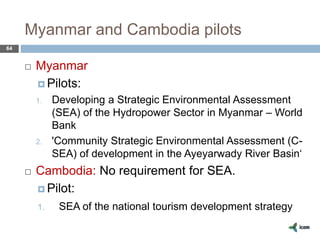
Myanmar and Cambodia pilots
64
 Myanmar
 Pilots:
1. Developing a Strategic Environmental Assessment
(SEA) of the Hydropower Sector in Myanmar – World
Bank
2. 'Community Strategic Environmental Assessment (C-
SEA) of development in the Ayeyarwady River Basin‘
 Cambodia: No requirement for SEA.
 Pilot:
1. SEA of the national tourism development strategy
Jeremy Carew-Reid
ICEM
Thank you65

Strategic Environmental Assessment Methodology

  • 1.
    Strategic Environmental Assessment Process andMethods Strategic Environmental Assessment Workshop | 24-27 May 2016 Jeremy Carew- Reid 1
  • 2.
    What are SEAs? 2 a development planning tool aiming to ensure that environmental, social and economic aspects of sustainability are considered systematically in policies and plans  SEAs promote social and economic equity and ecological sustainability in development decisions
  • 3.
    The purpose ofSEAs – they:  address broad strategic issues early in the planning process:  relating to more than one project  always affecting more than one development sector  relating to large areas  affecting many people and communities and  that need to be resolved and decided prior to making project specific plans and decisions  follow similar steps to EIAs but have much larger scope in terms of time, space and subject coverage  serve as an umbrella level of analysis that feeds and guides more specific EIAs and improves their 3
  • 4.
    Environmental assessment and monitoringtools 4 Four main tools for environmental assessment:  SEA family  EIA family  M&E  Audit family
  • 5.
     Takes placeat earlier stages of decision-making cycle  Multi-stage process with variations e.g. policy v plans  Pro-active, out-in-front approach to development proposals  Broad level of analysis, e.g. focus on cross-sector links and issues  Considers potentially wide range of development alternatives  Gives early warning of cumulative impacts (sector or region wide)  Emphasis on meeting sustainability goals and safeguards  Focus on ‘do most good’ – ie  Takes place at end of decision- making cycle  Well-defined process, clear beginning and end  Reacts to specific development proposal  Detailed, cause-effect analysis of the impact of project components  Considers limited range of feasible alternatives (how to carry out projects)  Limited opportunity to address cumulative impacts at project level  Emphasis on mitigating and minimising impacts  Focus on do no/least harm SEA and EIA compared SEA EIA
  • 6.
    SEAs can: 6  assessan existing plan to improve environmental and socio-economic performance in on-going implementation  assess a plan which is to be revised to guide adjustments to its revised form  contribute to preparing a new plan (so that it addresses environmental and socio- economic concerns as the plan takes shape)
  • 7.
    SEAs may havedifferent forms 7 They can:  Focus only on environmental impacts, or integrate environmental, social and economic dimensions of sustainability  Engage a broad range of stakeholders, or be limited to expert evaluation  Be conducted in a short time frame, or over a long period
  • 8.
    To be mosteffective, SEAs are: 8  best carried out as part of plan formulation,  based on quick appraisal techniques so that results remain fresh and relevant to planning and decision making.  SEAs are much less effective as a “stand alone” procedure, a one-off event or as a “mega-EIA” which cannot be replicated as a normal part of the planning process.
  • 9.
    SEAs in Mekongregion differ from SEAs in Europe9 In Europe SEAs were designed to be rapid, desk-top sustainability audits (15-20 pages) – That approach works where:  planning laws and processes are robust and embrace sustainability  planning processes are consultative  data and information is plentiful  development plans already consider alternatives In the Mekong region:  planning frameworks are often uncertain and evolving rapidly  Consultation with stakeholders is not systematic  data are limited  SEAs are often much larger affairs because they must
  • 10.
    In the Mekongregion, SEAs tend to “stand in the shoes” of planners  Often plans are not in place or are not adequate (eg in considering alternatives or cumulative effects)  There are few guiding sustainability objectives  Spatial planning is absent or inadequate  With limited information SEAs need to expand beyond a rapid sustainability audit of development plans  SEAs become an integral part of the planning process by:  Filling critical information gaps with new analysis and research  Facilitating a consultative process that allows for debate and builds consensus on “hot” issues  Introducing consideration of alternatives and their environmental, social and economic consequences  Assessing long term trends and cumulative effects 10
  • 11.
    Some challenges forSEA  Being accepted at senior and decision-making levels and adopted for systematic use  Assessing alternatives and cumulative impacts  Addressing cross-boundary & trans-national issues  SEA at the policy level (how to integrate with political functions and processes?)  Integrating with development planning and across sectors  Effective public & stakeholder participation
  • 12.
  • 13.
    SEA as acredible process 13  SEA reports need to be credible and to have authority – otherwise decisions makers will ignore them  To be credible the reports must be balanced  They must describe the benefits and the risks in an objective way  They must indicate where there is a divergence of views on strategic issues and give reasons for the conclusions it draws  Stakeholder input and guidance is key to improving SEA reports to ensure they are credible so that decision makers will take them seriously
  • 14.
    The need forstakeholder involvement 14  Major changes are usually involved if the proposed developments are to proceed. Change can:  affect many communities and even many countries  Affect many development sectors relying on the same resources and areas  lead to long term gains/benefits  be irreversible and lead to permanent losses  Who gains and who looses? – who, where and how  Uncertainty: Most often dealing with situations of extreme uncertainty  Expert judgments: Decisions need to be made based on:  the best available information and analysis (often limited and of uncertain reliability)  expert judgments on the levels of risk (involves values and
  • 15.
    In strategic developmentsbenefits are often more readily defined than risks 15  The benefits become evident in commercial and economic terms from the early stages  EIA often comes late in the planning process when economic benefits are already well defined  The definition of risks or negative impacts is not as easy  They are often hard to express in economic or commercial terms and difficult to integrate with economic decisions  SEAs are often confronted with situations where benefits are relatively well enunciated and expressed in economic terms while the risks are unclear, unsubstantiated and indirect
  • 16.
  • 17.
  • 18.
    Steps in theSEA process – MRC SEA of Mekong hydropower development 18 Inception and scoping Report Baseline Assessment Report Impact Assessment Report Final Report National Government consultations Regional Government Consultations Civil society Organizations (CSO) Consultations Developer consultations May – June 2009 June-Sep 2009 Feb-May 2010 May-July 2010 Scoping phase Baseline phase Impact assessments Avoidance enhancement & Mitigation phase AME Report Oct 2010 Staged approach – analysis, consultation & documentation at each stage
  • 19.
    The SEA process –5 steps 2. SCOPING (i) Identification of key issues for development of the mainstream Mekong River (ii) Scoping of key issues to define the main strategic concerns to be addressed by the SEA (iii) Defining the sustainability objectives for those strategic concerns 3. BASELINE ASSESSMENT (i) Gathering of the “evidence base” in each country and at regional level (ii) Analysis of past trends and current situation in the strategic development concerns 4. OPPORTUNITIES AND RISKS ASSESSMENT (i) Reviewing and selecting the BDP scenarios (ii) Defining future trends in the strategic development concerns under selected scenarios: a. Without hydropower development b. With hydropower development (iii) Assessing the combined/cumulative effects of future trends across all strategic development concerns under each scenario (iv) Valuation of risks and opportunities 5. AVOIDANCE, ENHANCEMENT & MITIGATION (i) Defining measures to avoid the unwanted effects of the 11 projects (ii) Proposing options to emphasise and enhance the benefits (iii) Identifying mitigation measures which will minimize the negative effects ADDITIONAL STUDIES A. The Impacts of the mainstream Hydropower projects in Yunnan Province, especially downstream effects B. Economic and Energy Analysis of the distribution of Hydropower costs/benefits and services C. River Hydrology & sedimentation and the impacts of changes to the flow regime on key morphological features (deep pools, littoral zone etc) 1. SCREENING  Is an SEA needed  When should an SEA be carried out  Under what circumstances should an SEA be triggered 1. SCREENING SEA of mainstream Mekong hydropower
  • 20.
    MRC mainstream hydroSEA 20 National Scoping & Capacity Building Workshop & Civil Society Meetings • 4 National Scoping Workshops •3 Civil Society meeting •ThaiCivil Society meeting to follow in November 8 THEMES (~30 - 40 KEY ISSUES) Government Line Agency Meetings •meetings with 40 agencies in the LMB 2 Field Missions & Opinion from 17 experts •Luang Prabang, Xayabouly, Pak Lay, Sanakhan, Pak Chom 100s of development Issues past present future Without mainstream hydropower Issue 2 Issue 1 With mainstream hydropower 2. BASELINE ASSESSMENT With mitigation 1.SCOPING 3. OPPORTUNITIES & RISKS ASSESSMENT 4.MITIGATION
  • 21.
    Trend analysis andscenarios 21  Trend analysis for past, current and future (2025-2030)  Indicators for assessing change in key issues – drew from BDP indicator framework  SEA adopted two BDP scenarios:  LMB 20 year plan without mainstream hydropower dams  LMB 20 year plan with mainstream hydropower  Both include existing and planned Yunnan and tributary dams
  • 22.
  • 23.
    The purpose ofscreening The purpose of screening is to determine:  whether or not a proposed development strategy, plan or policy requires an SEA  what level of SEA is required – eg quick or comprehensive
  • 24.
    Outcomes of screening 24 full or comprehensive SEA required  more limited SEA required  further study needed to determine SEA requirement  SEA not required
  • 25.
    Screening and scopingcompared 25  Screening determines the requirement for SEA establishes the level of review necessary  Scoping identifies the key issues to be considered sets the boundaries for the assessment establishes the terms of reference
  • 26.
    Screening methods 26  legal/policydefinition  inclusion list of plans (with/without thresholds)  exclusion list of plans  criteria for case-by-case screening
  • 27.
    Typical plans requiringSEAs include 27  River basin plans  Hydropower development plans - dam and reservoir cascades  Infrastructure sector and area wide plans (e.g. transport and irrigation)  Industrial zone management plans (e.g. manufacturing and special economic zones)  Minerals and energy extraction sector plans (e.g. oil & gas, coal)  Waste management and disposal of hazardous and toxic materials plans  Power development plans (including multiple power
  • 28.
    Social and environmentalcriteria for case-by-case screening 28 The following are important in determining significant effects:  affective large number of people  affective poor and disadvantaged groups  affecting many other users of the same resources  abundance and quality of natural resources  assimilative capacity of the natural environment  environmental sensitivity, e.g. wetlands, coastal and mountain zones  existing land uses of strategic importance  adjacent to protected or designated special use areas  within landscapes of special heritage value
  • 29.
  • 30.
    Scoping 30  Staged approach– analysis, documentation and consultation at each stage  Scoping – strategic themes and issues identified  What are the most important issues of concern to sustainable development and use of the area and resources concerned?  How can those issues be categories and prioritized – ie given strategic focus?
  • 31.
    Scoping 31  open, interactiveprocess - involves stakeholders  lays the foundation of an SEA - by identifying time and space boundaries of the assessment the information necessary for decision- making key issues and potential impacts to be considered
  • 32.
    Key objectives ofscoping 32  inform and identify stakeholders  find out their initial concerns  identify feasible and practical alternatives  identify the main issues and impacts to be studied  define the boundaries of the assessment  agree on means of public involvement  establish the Terms of Reference
  • 33.
    MRC SEA ofhydro on mainstream Mekong 33  REGIONAL: upper and lower segments of the river but focuses on transboundary concerns and the socio- economic and natural system linkages between the LMB countries.  NATIONAL: The LMB countries – Cambodia, Lao PDR, Thailand and Vietnam – and the effects of mainstream projects on each of their distinctive economies, and social and natural systems. The 12 proposed projects are assessed against national interests and development priorities of the four LMB countries.  HYDRO-ECOLOGICAL ZONES Assessing THE PROJECTS within 6 hydro-ecological zones. The zones have distinctive bio-physical characteristics.
  • 34.
    Steps in thescoping process 34 1. prepare an outline scope 2. develop the outline through informal consultation 3. make the outline available to stakeholders 4. compile the range of concerns (long list) 5. evaluate these to establish key issues (short list) 6. organise these into impact themes (study list) 7. amend the outline to incorporate the above information 8. develop Terms of Reference
  • 35.
  • 36.
    Baseline assessment 36  Baseline– projected baseline and trend analysis 1. What have been past trends for each of the key issues? 2. What will the trends look like when projected to 2030?  Without mainstream projects  When other trends and drivers are considered
  • 37.
    Baseline information isgathered on: 37  social, economic and environmental conditions;  trends and associated drivers (trend analysis for the baseline situation now and into the future);  effects of plans already being implemented; and  effects of other foreseeable proposed development plans.  Definition of sustainability objectives  Definition of key issues and themes of relevance to the development plan
  • 38.
    Identification of sustainabilityobjectives for each strategic theme – MRC SEA 38
  • 39.
  • 40.
    Impact assessment 40  Impacts– overlay the proposed development plan onto the baseline 1. Will the proposed development plan affect the trends in key issues? 2. Will those affects provide benefits and/or costs? 3. Will those affects enhance or reduce sustainability?  SEAs are a form of sustainability analysis – where economic, social and biophysical trends and effects under different development
  • 41.
    Forecasting the potentialimpacts 41  identification of impacts — to specify the impacts associated with each component and phase of the plan  forecasting — to forecast the nature, magnitude, extent and duration of the main impacts  evaluation of significance — to determine the significance of the impacts  evaluation of impacts on sustainability
  • 42.
    Methods used forimpact identification 42  Trend analysis  checklists;  matrices;  networks or causal effect diagrams to identify indirect, cumulative impacts  overlays and geographic information systems (GIS);  computer expert systems; and  professional judgement
  • 43.
  • 44.
    Forecasting impacts 44 Typical parametersto be taken into account in impact prediction include:  nature (positive, negative, direct, indirect, cumulative);  magnitude (severe, moderate, low);  extent/location (area/volume covered, distribution);  timing (during construction, operation, decommissioning, immediate, delayed, rate of change);  duration (short term, long term, intermittent, continuous);  reversibility/irreversibility;  likelihood (probability, uncertainty or confidence in the prediction); and  significance (local, regional, global).
  • 45.
    Impact assessment: significance 45 Focus on key strategic issues defined by stakeholders  Impact of development scenarios on projected trends in the key issues:  Large negative impact  Negative impact  No impact  Positive impact  Large positive impact  Both positive and negative impacts  Not relevant
  • 46.
    Evaluating significance 46 Reference points: environmental and social standards, safeguards, guidelines and objectives;  level of public concern;  relating to infrastructure or areas of strategic importance for national and local economies  scientific and professional evidence for:  loss/disruption of valued resource stocks and ecological functions;  negative impact on social values, quality of life and livelihood; and  foreclosure of land and resource use opportunities  affecting large populations and areas
  • 47.
    Evaluating sustainability 47  Impactof the plan on sustainability  SEA sustainability objectives defined through stakeholder workshops and review of government policies  One or two sustainability objectives identified for each strategic theme  The impact question – “what effect will the development plan have on achieving the sustainability objective”?
  • 48.
    Impact assessment: example 48 Theme/Key Issues Sustainability objective Theme: Fisheries Maintenance and enhancement of diversity and productivity of fisheries resources Score Comments and reasons for score 1. Changes in long distance migration 2. Changes in fish species biodiversity 3. Changes in fish production
  • 49.
    Impact assessment (4)- example 49 Theme/ Key Issues Sustainability objective Theme: Energy and power Ensuring a secure and diverse energy supply from renewable resources without losses in sustainability of social and natural systems Score Comments and reasons for score 1. Achieving energy security 2. Meeting national energy demands 3. Meeting local energy needs
  • 50.
    Impact assessment (5)- example 50 Theme/ Key Issues Sustainability objectives Theme: Terrestrial ecosystems and agriculture 1) Maintenance of terrestrial ecosystems for conservation of biodiversity, connectivity and ecosystem services 2) Maintenance and enhancement of diversity and productivity of agricultural systems Score Comments and reasons for score 1. Habitat loss and degradation 2. Changes in Land use 3. Changes in irrigated agriculture 4. Changes in River bank
  • 51.
  • 52.
    Avoidance, mitigation and enhancement 52 Avoidance, mitigation and enhancement Questions to be addressed: 1. how will the most important risks (negative effects) be avoided? 2. how will the most important benefits (positive effects) be enhanced? 3. how will the negative effects that can’t be avoided be mitigated – i.e. be reduced?
  • 53.
    The purpose ofmitigation is to: 53  find better (sustainable) alternatives and ways of doing things  enhance environmental, economic and social benefits  avoid, minimise or remedy adverse impacts  ensure that any unavoidable impacts are kept within acceptable levels
  • 54.
    Development plan proponentshave a responsibility to: 54  avoid, minimise and remedy adverse impacts  internalise the environmental and social costs of the plan  prepare plans for managing impacts  repair or compensate for environmental and social damages (including offset arrangements)
  • 55.
    Principles of mitigation 55 give preference to measures for avoidance and prevention  consider feasible alternatives to the proposed plans and its components  identify customised measures to minimise each major impact if avoidance not feasible  use compensation as a last resort (if negative impacts cannot be avoided or mitigated)
  • 56.
    Objectives of impactmanagement are to: 56  ensure that mitigation measures are implemented  establish systems, procedures and responsibilities for managing impacts  monitor the effectiveness of mitigation measures; and  take any necessary action when unforeseen impacts occur.
  • 57.
    2. SEA SYSTEMSIN MEKONG COUNTRIES
  • 58.
    SEA in Thailand 58 One of the first in the Mekong region to explore SEA  SEA guidelines adopted in 2004 (ONEP/MONRE)  Voluntary but NEB can require an agency to conduct an SEA  ONEP now working with NESDB and 11 sectors to determine when SEA should be mandatory  Some 10 – 20 SEAs conducted (depending on the definition) – current “SEAs”:  SEA of Suvarnabhumi Airport (AOT)  “SEA” of the Andaman Islands Environment Protection Area (DWR)  “SEA” of the NE region water management (DWR)  Five SEAs conducted in the water sectors  Most big budget assessments: > 32million Baht
  • 59.
    SEA in China59 Oneof the most rigorous mandatory systems in the world:  A draft plan without an SEA cannot be approved and implemented.  Projects cannot proceed without an SEA of the umbrella plan  SEA mandatory for:  river basin plans, land use plans, plans for regions and plans prepared by ten main development sectors - industry, agriculture, livestock, forestry, energy, water, conservation, transportation, urban construction, tourism and natural resources development.  Some 50 SEAs conducted at national level and more than 150 at local government level.
  • 60.
    SEA in Vietnam60 SEAmandatory for 6 categories of strategies and plans: 1. National socio-economic development plan 2. SEDPs for all sectors (each central govt. agency) 3. SEDPs for 64 provinces and cities 4. Inter-provincial (regional) – land use, forest protection and development, natural resource development 5. Special economic region plans 6. River basin plans
  • 61.
    SEA in Vietnam61 Strong legal basis for mandatory SEA of development strategies and plans  Shifts responsibility for SEAs to plan “owners”  Must be an open process with stakeholder involvement  Started with extensive program of piloting SEAs – now all sector SEDPs at national level and all provincial SEDPs.  SEAs must cover environmental, social and economic effects  River basins the focus of the most comprehensive SEAs under the new legal framework  Not been an easy tool to apply – many obstacles
  • 62.
    Lao PDR62  LaoPDR: Under Environmental Protection Law 2012 SEAs must be conducted for policies, strategic plans, and programs, particularly in the energy and mining, agriculture and forestry, industry and commerce, public works and transportation sectors. Some pilots:  SEA of the national hydropower plan in Lao PDR, with a focus on the Nam Thuen II Hydropower Project.  SEA in the Golden Quadrangle tourism development (2011 to 2012)  SEA of Sekong Provincial land use plan (2014–2015)
  • 63.
    Myanmar – Dec2015 EIA/SEA regulation 63  SEAs may be required for policies, strategies, development plans, frameworks and programs that are prepared or proposed by any arm of government or other organisation or individual.  Decision on whether to conduct an SEA determined by initial screening for potential environmental and social impacts in accordance with SEA guidelines issued by the Ministry of Environmental Conservation and Forestry.  SEAs must prepare and incorporate into target policies and plans an environmental and social management and monitoring framework comprehensively addressing impacts.
  • 64.
    Myanmar and Cambodiapilots 64  Myanmar  Pilots: 1. Developing a Strategic Environmental Assessment (SEA) of the Hydropower Sector in Myanmar – World Bank 2. 'Community Strategic Environmental Assessment (C- SEA) of development in the Ayeyarwady River Basin‘  Cambodia: No requirement for SEA.  Pilot: 1. SEA of the national tourism development strategy
  • 65.

Editor's Notes

  • #15 SEA reports need to be credible and to have authority – otherwise decisions makers will ignore them To be credible the report must be balanced. It must describe the benefits and the risks in an objective way. It must indicate where there is a divergence of views on strategic issues and give reasons for the conclusions it draws. Over the next two days we will need your input and guidance in improving the report to ensure that it is credible so that decision makers will take it seriously There are a number of reasons why having your strong input at this stage of the SEA is especially important in achieving balance. (i) Major changes involved; (ii) The assessment of impact on key issues is confronted with extreme uncertainties; (iii) expert judgment and values
  • #16 (iv) SEA focuses on filling the gaps
  • #46 Nature and significance of the effects
  • #59 The DWR “EIA” into the NE regional mega project to extract water from the Mekong river for irrigation is an SEA in all but name The USD5million Strategic assessment of the impacts of upstream development on the Mekong Delta