Presentation on
Samia Sultana
Ms (4th Batch)
Dept.of
Oceanography
University of Dhaka
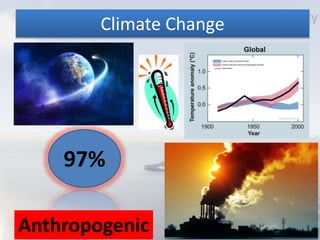
Climate Change
97%
Anthropogenic
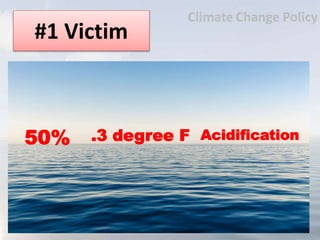
#1 Victim
50% .3 degree F Acidification
Cause Solution
Climate Change Policy
•The human enhancement of global warming leading
to climate change is seen as a worldwide problem.
•Policy responses have been led by international
negotiation, but have been qualified at the national
level, and so far largely ineffective, despite strong
international agreement on the matter.
•The principal focus is on reducing carbon dioxide
emissions.
United Nations Framework Convention on Climate
Change (UNFCCC)
• The United Nations Framework Convention on Climate
Change (UNFCCC) is an international environmental treaty
negotiated at the Earth Summit in Rio de Janeiro from 3 to 14
June 1992, then entered into force on 21 March 1994. The
UNFCCC objective is to "stabilize greenhouse gas
concentrations in the atmosphere at a level that would
prevent dangerous anthropogenic interference with
the climate system". The framework set no binding limits on
greenhouse gas emissions for individual countries and
contains no enforcement mechanisms.
Kyoto Protocol
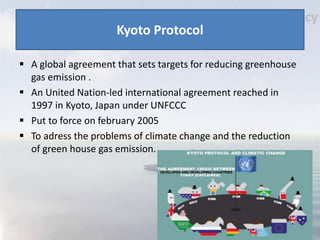
 A global agreement that sets targets for reducing greenhouse
gas emission .
 An United Nation-led international agreement reached in
1997 in Kyoto, Japan under UNFCCC
 Put to force on february 2005
 To adress the problems of climate change and the reduction
of green house gas emission.
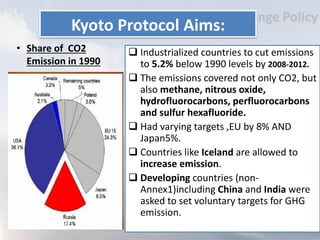
Kyoto Protocol Aims:
 Industrialized countries to cut emissions
to 5.2% below 1990 levels by 2008-2012.
 The emissions covered not only CO2, but
also methane, nitrous oxide,
hydrofluorocarbons, perfluorocarbons
and sulfur hexafluoride.
 Had varying targets ,EU by 8% AND
Japan5%.
 Countries like Iceland are allowed to
increase emission.
 Developing countries (non-
Annex1)including China and India were
asked to set voluntary targets for GHG
emission.
• Share of CO2
Emission in 1990
Paris Agreement
• After a decade of negotiations, research and advocacy, the Paris
Agreement represents a turning point in our collective effort to tackle
climate change. In 2011 efforts to hold global warming to below 2 or
1.5 °C relative to the pre-industrial level.
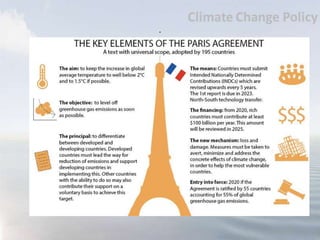
• In 2015, all (then) 196 then parties to the convention came together for
the UN Climate Change Conference in Paris 30 November - 12 December
and adopted by consensus the Paris Agreement, aimed at limiting global
warming to less than two degrees Celsius, and pursue efforts to limit the
rise to 1.5 degrees Celsius. The Paris Agreement is to be signed in 2016
and will enter into force upon ratification by 55 countries representing
over 55% of greenhouse gas emissions.
.
Other Decisions
• Bali Action Plan: As part of the Bali Action Plan,
adopted in 2007, all developed country Parties have
agreed to "quantified emission limitation and
reduction objectives, while ensuring the comparability
of efforts among them, taking into account differences
in their national circumstances."
• Copenhagen Accord and Cancún agreements:As part
of the 2009 Copenhagen negotiations, a number of
countries produced the Copenhagen Accord. The
Accord states that global warming should be limited to
below 2.0 °C (3.6 °F).
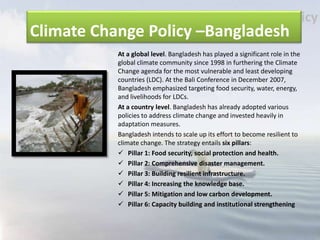
Climate Change Policy –Bangladesh
At a global level. Bangladesh has played a significant role in the
global climate community since 1998 in furthering the Climate
Change agenda for the most vulnerable and least developing
countries (LDC). At the Bali Conference in December 2007,
Bangladesh emphasized targeting food security, water, energy,
and livelihoods for LDCs.
At a country level. Bangladesh has already adopted various
policies to address climate change and invested heavily in
adaptation measures.
Bangladesh intends to scale up its effort to become resilient to
climate change. The strategy entails six pillars:
 Pillar 1: Food security, social protection and health.
 Pillar 2: Comprehensive disaster management.
 Pillar 3: Building resilient infrastructure.
 Pillar 4: Increasing the knowledge base.
 Pillar 5: Mitigation and low carbon development.
 Pillar 6: Capacity building and institutional strengthening
Policy and Strategy of Govt.
• Coastal Zone Policy 2005
• National Adaptation Program of Action (NAPA)
• Bangladesh Climate Change Strategy Action
Plan(BCCSAP) 2009
• Bangladesh Climate Change Trust Fund (BCCTF)
• Bangladesh Climate Change Resillience Fund
(BCCRF)
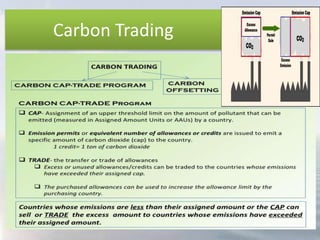
Carbon Trading
climate change Policy

climate change Policy

  • 2.
    Presentation on Samia Sultana Ms(4th Batch) Dept.of Oceanography University of Dhaka
  • 4.
  • 5.
    #1 Victim 50% .3degree F Acidification
  • 6.
  • 7.
    Climate Change Policy •Thehuman enhancement of global warming leading to climate change is seen as a worldwide problem. •Policy responses have been led by international negotiation, but have been qualified at the national level, and so far largely ineffective, despite strong international agreement on the matter. •The principal focus is on reducing carbon dioxide emissions.
  • 9.
    United Nations FrameworkConvention on Climate Change (UNFCCC) • The United Nations Framework Convention on Climate Change (UNFCCC) is an international environmental treaty negotiated at the Earth Summit in Rio de Janeiro from 3 to 14 June 1992, then entered into force on 21 March 1994. The UNFCCC objective is to "stabilize greenhouse gas concentrations in the atmosphere at a level that would prevent dangerous anthropogenic interference with the climate system". The framework set no binding limits on greenhouse gas emissions for individual countries and contains no enforcement mechanisms.
  • 10.
    Kyoto Protocol  Aglobal agreement that sets targets for reducing greenhouse gas emission .  An United Nation-led international agreement reached in 1997 in Kyoto, Japan under UNFCCC  Put to force on february 2005  To adress the problems of climate change and the reduction of green house gas emission.
  • 11.
    Kyoto Protocol Aims: Industrialized countries to cut emissions to 5.2% below 1990 levels by 2008-2012.  The emissions covered not only CO2, but also methane, nitrous oxide, hydrofluorocarbons, perfluorocarbons and sulfur hexafluoride.  Had varying targets ,EU by 8% AND Japan5%.  Countries like Iceland are allowed to increase emission.  Developing countries (non- Annex1)including China and India were asked to set voluntary targets for GHG emission. • Share of CO2 Emission in 1990
  • 12.
    Paris Agreement • Aftera decade of negotiations, research and advocacy, the Paris Agreement represents a turning point in our collective effort to tackle climate change. In 2011 efforts to hold global warming to below 2 or 1.5 °C relative to the pre-industrial level. • In 2015, all (then) 196 then parties to the convention came together for the UN Climate Change Conference in Paris 30 November - 12 December and adopted by consensus the Paris Agreement, aimed at limiting global warming to less than two degrees Celsius, and pursue efforts to limit the rise to 1.5 degrees Celsius. The Paris Agreement is to be signed in 2016 and will enter into force upon ratification by 55 countries representing over 55% of greenhouse gas emissions.
  • 13.
  • 14.
    Other Decisions • BaliAction Plan: As part of the Bali Action Plan, adopted in 2007, all developed country Parties have agreed to "quantified emission limitation and reduction objectives, while ensuring the comparability of efforts among them, taking into account differences in their national circumstances." • Copenhagen Accord and Cancún agreements:As part of the 2009 Copenhagen negotiations, a number of countries produced the Copenhagen Accord. The Accord states that global warming should be limited to below 2.0 °C (3.6 °F).
  • 15.
    Climate Change Policy–Bangladesh At a global level. Bangladesh has played a significant role in the global climate community since 1998 in furthering the Climate Change agenda for the most vulnerable and least developing countries (LDC). At the Bali Conference in December 2007, Bangladesh emphasized targeting food security, water, energy, and livelihoods for LDCs. At a country level. Bangladesh has already adopted various policies to address climate change and invested heavily in adaptation measures. Bangladesh intends to scale up its effort to become resilient to climate change. The strategy entails six pillars:  Pillar 1: Food security, social protection and health.  Pillar 2: Comprehensive disaster management.  Pillar 3: Building resilient infrastructure.  Pillar 4: Increasing the knowledge base.  Pillar 5: Mitigation and low carbon development.  Pillar 6: Capacity building and institutional strengthening
  • 16.
    Policy and Strategyof Govt. • Coastal Zone Policy 2005 • National Adaptation Program of Action (NAPA) • Bangladesh Climate Change Strategy Action Plan(BCCSAP) 2009 • Bangladesh Climate Change Trust Fund (BCCTF) • Bangladesh Climate Change Resillience Fund (BCCRF)
  • 17.