EIA
(Environment Impact
Assessment)
No. of Slides - 15
Date – 27th Nov’21
Time – 11:30 AM
Department of Environment Science
Indira Gandhi University, Meerpur
Student Name – Pradeep Mittal
M.Sc. EVS – 1st Sem.
Batch 2021 ~ 2023
Content 1/15
• Introduction
• History
• EIA Notification 2006
• Major Goals of EIA
• EIA Applicability
• EIA Process Flow
• Conclusion
Content
• Introduction
• History
• EIA Notification 2006
• Major Goals of EIA
• EIA Applicability
• EIA Process Flow
• Conclusion
Introduction
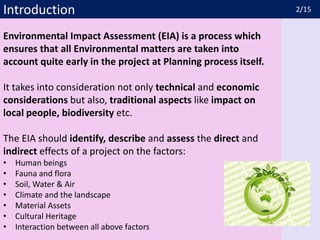
Environmental Impact Assessment (EIA) is a process which
ensures that all Environmental matters are taken into
account quite early in the project at Planning process itself.
It takes into consideration not only technical and economic
considerations but also, traditional aspects like impact on
local people, biodiversity etc.
The EIA should identify, describe and assess the direct and
indirect effects of a project on the factors:
• Human beings
• Fauna and flora
• Soil, Water & Air
• Climate and the landscape
• Material Assets
• Cultural Heritage
• Interaction between all above factors
2/15
Content
• Introduction
• History
• EIA Notification 2006
• Major Goals of EIA
• EIA Applicability
• EIA Process Flow
• Conclusion
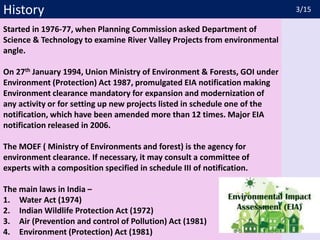
History
Started in 1976-77, when Planning Commission asked Department of
Science & Technology to examine River Valley Projects from environmental
angle.
On 27th January 1994, Union Ministry of Environment & Forests, GOI under
Environment (Protection) Act 1987, promulgated EIA notification making
Environment clearance mandatory for expansion and modernization of
any activity or for setting up new projects listed in schedule one of the
notification, which have been amended more than 12 times. Major EIA
notification released in 2006.
The MOEF ( Ministry of Environments and forest) is the agency for
environment clearance. If necessary, it may consult a committee of
experts with a composition specified in schedule III of notification.
The main laws in India –
1. Water Act (1974)
2. Indian Wildlife Protection Act (1972)
3. Air (Prevention and control of Pollution) Act (1981)
4. Environment (Protection) Act (1981)
3/15
Content
• Introduction
• History
• EIA Notification 2006
• Major Goals of EIA
• EIA Applicability
• EIA Process Flow
• Conclusion
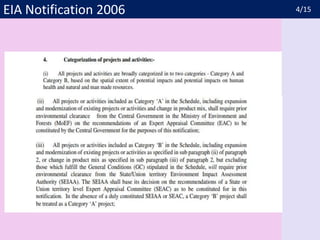
EIA Notification 2006 4/15
Content
• Introduction
• History
• EIA Notification 2006
• Major Goals of EIA
• EIA Applicability
• EIA Process Flow
• Conclusion
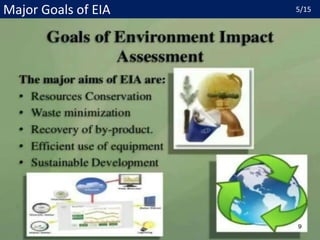
Major Goals of EIA 5/15
Content
• Introduction
• History
• EIA Notification 2006
• Major Goals of EIA
• EIA Applicability
• EIA Process Flow
• Conclusion
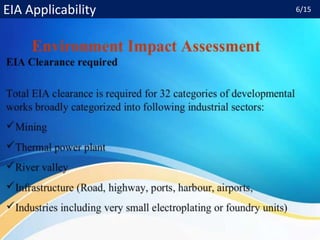
EIA Applicability 6/15
Content
• Introduction
• History
• EIA Notification 2006
• Major Goals of EIA
• EIA Applicability
• EIA Process Flow
• Conclusion
EIA Process Flow 7/15
EIA Process Flow 8/15
EIA Process Flow 9/15
EIA Process Flow 10/15
EIA Process Flow 11/15
EIA Process Flow 12/15
EIA Process Flow 13/15
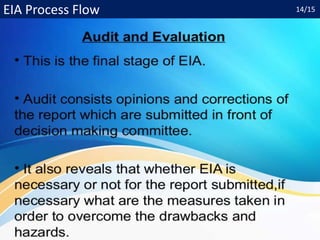
EIA Process Flow 14/15
Content
• Introduction
• History
• EIA Notification 2006
• Major Goals of EIA
• EIA Applicability
• EIA Process Flow
• Conclusion
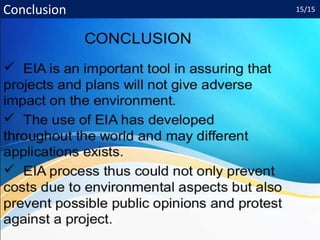
Conclusion 15/15
Thank You

Environment Impact Assessment - EIA

  • 1.
    EIA (Environment Impact Assessment) No. ofSlides - 15 Date – 27th Nov’21 Time – 11:30 AM Department of Environment Science Indira Gandhi University, Meerpur Student Name – Pradeep Mittal M.Sc. EVS – 1st Sem. Batch 2021 ~ 2023
  • 2.
    Content 1/15 • Introduction •History • EIA Notification 2006 • Major Goals of EIA • EIA Applicability • EIA Process Flow • Conclusion
  • 3.
    Content • Introduction • History •EIA Notification 2006 • Major Goals of EIA • EIA Applicability • EIA Process Flow • Conclusion
  • 4.
    Introduction Environmental Impact Assessment(EIA) is a process which ensures that all Environmental matters are taken into account quite early in the project at Planning process itself. It takes into consideration not only technical and economic considerations but also, traditional aspects like impact on local people, biodiversity etc. The EIA should identify, describe and assess the direct and indirect effects of a project on the factors: • Human beings • Fauna and flora • Soil, Water & Air • Climate and the landscape • Material Assets • Cultural Heritage • Interaction between all above factors 2/15
  • 5.
    Content • Introduction • History •EIA Notification 2006 • Major Goals of EIA • EIA Applicability • EIA Process Flow • Conclusion
  • 6.
    History Started in 1976-77,when Planning Commission asked Department of Science & Technology to examine River Valley Projects from environmental angle. On 27th January 1994, Union Ministry of Environment & Forests, GOI under Environment (Protection) Act 1987, promulgated EIA notification making Environment clearance mandatory for expansion and modernization of any activity or for setting up new projects listed in schedule one of the notification, which have been amended more than 12 times. Major EIA notification released in 2006. The MOEF ( Ministry of Environments and forest) is the agency for environment clearance. If necessary, it may consult a committee of experts with a composition specified in schedule III of notification. The main laws in India – 1. Water Act (1974) 2. Indian Wildlife Protection Act (1972) 3. Air (Prevention and control of Pollution) Act (1981) 4. Environment (Protection) Act (1981) 3/15
  • 7.
    Content • Introduction • History •EIA Notification 2006 • Major Goals of EIA • EIA Applicability • EIA Process Flow • Conclusion
  • 8.
  • 9.
    Content • Introduction • History •EIA Notification 2006 • Major Goals of EIA • EIA Applicability • EIA Process Flow • Conclusion
  • 10.
  • 11.
    Content • Introduction • History •EIA Notification 2006 • Major Goals of EIA • EIA Applicability • EIA Process Flow • Conclusion
  • 12.
  • 13.
    Content • Introduction • History •EIA Notification 2006 • Major Goals of EIA • EIA Applicability • EIA Process Flow • Conclusion
  • 14.
  • 15.
  • 16.
  • 17.
  • 18.
  • 19.
  • 20.
  • 21.
  • 22.
    Content • Introduction • History •EIA Notification 2006 • Major Goals of EIA • EIA Applicability • EIA Process Flow • Conclusion
  • 23.
  • 24.