Group 6
Ankita Mahajan (110)
  Briji Komban (115)
     Ramya UK (144)
   The Kyoto Protocol is a protocol to the United Nations
    Framework Convention on Climate Change (UNFCCC), aimed
    at fighting global warming
   The UNFCCC is an international environmental treaty with the
    goal of achieving the "stabilization of greenhouse gas
    concentrations in the atmosphere at a level that
    would prevent dangerous anthropogenic interference with
    the climate system.“
   The Protocol was initially adopted on 11 December 1997
    in Kyoto, Japan, and entered into force on 16 February 2005
    As of September 2011, 191 states have signed and
    ratified the protocol
Participation in Kyoto Protocol as of 2011


  Brown = Countries that have signed and ratified the treaty
        (Annex I & II countries in dark brown)
  Blue = No intention to ratify at this stage.
  Dark blue = Canada, which withdrew from the Protocol in December 2011.
  Grey = no position taken or position unknown
 Under the Protocol, 37 countries ("Annex I countries")
  commit themselves to a reduction of four greenhouse gases
  (GHG) (carbon dioxide, methane, nitrous oxide, sulphur
  hexafluoride) and two groups of gases (hydro
  fluorocarbons and per fluorocarbons) produced by them, and
  all member countries give general commitments
 At negotiations, Annex I countries (including the US)
  collectively agreed to reduce their greenhouse gas emissions
  by 5.2% on average for the period 2008-2012.
 Since the US has not ratified the treaty, the collective
  emissions reduction of Annex I Kyoto countries falls from
  5.2 % to 4.2% below base year
  Each Annex I Party has a binding commitment to limit or reduce GHG
   emissions and innovative mechanisms have been established for Parties to
   facilitate compliance with this commitment.
Other commitments include:
• Each Annex I Party must undertake domestic policies and measures to reduce
   GHG emissions and to enhance removals by sinks;
• In implementing these policies and measures, each Annex I Party must strive to
   minimize any adverse impact of these policies and measures on other Parties,
   particularly developing country Parties;
• Annex I Parties must provide additional financial resources to advance the
   implementation of commitments by developing countries;
• Both Annex I and non-Annex I Parties must cooperate in the areas of:
(a) The development, application and diffusion of climate friendly technologies;
(b) Research on and systematic observation of the climate system;
(c) Education, training, and public awareness of climate change;
(d) The improvement of methodologies and data for GHG inventories
Austria – 87%          Liechtenstein – 92%
                       Lithuania – 92%
Belarus – 95%          Luxembourg – 72%
Belgium – 92.5%
                       Netherlands – 94%
Bulgaria – 92%
Canada – 94%           New Zealand – 100%
Croatia – 95%          Norway – 101%
Czech Republic – 92%   Poland – 94%
Denmark – 79%          Portugal – 127%
Estonia – 92%          Romania – 92%
Finland – 100%         Russian Federation – 100%
France – 100%          Slovakia – 92%
Germany – 79%          Slovenia – 92%
Greece – 125%
                       Spain – 115%
Hungary – 94%
Iceland – 110%         Sweden – 104%
Ireland – 113%         United Kingdom – 87.5%
Italy – 93.5%          United States of America – 93%
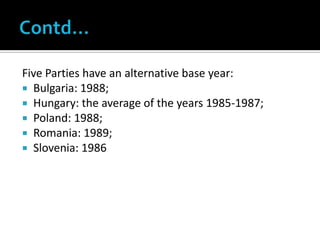
Five Parties have an alternative base year:
 Bulgaria: 1988;
 Hungary: the average of the years 1985-1987;
 Poland: 1988;
 Romania: 1989;
 Slovenia: 1986
1.   International Emissions Trading (IET)

    Under this mechanism, an Annex I Party may transfer Kyoto units to or
     acquire units from another Annex I Party.
    Emissions trading does not affect the total assigned amount of Annex I
     Parties collectively; rather, it re-distributes the assigned amount among
     them.
    A Party may acquire an unlimited number of units.
    The number of units that a Party may transfer to other Parties
      is limited by the Party’s commitment period reserve (CPR).
    The CPR is the minimum level of units that a Party must hold in its
     national registry at all times. The requirement for each Party to maintain
     a CPR prevents a Party from over-transferring units, and thus impair its
     ability to meet its commitments
2. Joint implementation (JI)

   It is a project-based mechanism by which one Annex I Party can invest in a project
    that reduces emissions or enhances sequestration in another Annex I Party, and
    receive credit for the emission reductions or removals achieved through that
    project.
   The unit associated with JI is called an emission reduction unit (ERU).
   The total projected emission savings from JI by 2012 are about one tenth that of
    the CDM.
   Russia accounts for about two-thirds of these savings, with the remainder divided
    up roughly equally between the Ukraine and the EU's New Member States.
3.   Clean Development Mechanism
    CDM credits may be generated from emission reduction projects or from
     afforestation and reforestation projects in non-Annex I Parties.
    Unlike emissions trading and JI, projects under the CDM create new Kyoto units
     and their acquisition by Annex I Parties increases both the total assigned
     amount available for those Annex I Parties collectively and their allowable level
     of emissions.
    CDM projects result in three types of Kyoto units.
     Certified emission reductions (CERs) are issued for projects that reduce
     emissions
    Temporary CERs (tCERs)
    Long-term CERs (lCERs) both of which may be issued for projects that enhance
     removals through afforestation and reforestation projects.
 National emission targets exclude international aviation
  and shipping
 Land use and forestry (‘sink’ activities) can be used in
  meeting targets
 Common but differentiated responsibility
    Largest share of emissions originated in developed
     countries
    Relatively low emissions in developing countries
    Share of emissions in developing countries will grow
     to meet their social and development needs
 Per capita emissions
   Financial Commitments:
     Developed countries have to pay billions of dollars
     and supply technology to other countries for
     climate related studies. E.g. The Adaptation Fund
   Enforcement:
     If a country is not in compliance with its emissions
      limitation, it is required to make up the difference
      during the 2nd commitment period plus an
      additional 30%
     It will also be suspended from making transfers
      under an emissions trading program
Emissions as a percentage of the global total,
per capita emissions in tons of GHG per capita
   China 15%, 5.8
   United States 16%, 24.1
   European Union 11%, 10.6
   Indonesia 6%, 12.9
   India 5%, 2.1


Source: International Energy Agency (IEA, 2007,p.201)
   Industrialized countries were committed to ‘take
    the lead’ in reducing emissions
   They were required to stabilize their emissions at
    1990 levels by 2000
   Failure to do so made Kyoto move to binding
    commitments
   Developing countries were not subject to emission
    reduction commitments in the first Kyoto
    commitment period
   Clean Development Mechanism was designed to
    limit emissions in developing countries
 The G77 wanted strong uniform emission cuts across the
developed world
 However, countries such as the US made suggestions to
reduce their responsibility to reduce emissions (inclusion
of carbon sinks, ignoring historical emissions)
 Countries over achieving in their first period
commitments were allowed to ‘bank’ their unused
allowances for use in the subsequent period
 The EU suggested a ‘bubble’ commitment
 The US was obliged to cut back emissions more than
other countries
   Exceptions to Kyoto Targets :Belarus, Malta, and Turkey are
    Annex I Parties but do not have Kyoto targets. The US has a
    Kyoto target of a 6% reduction relative to the 1990 level, but
    has not ratified the treaty. But Emissions in the US have
    increased 11% since 1990
   The Energy sector is found to be the largest source of
    emissions
   Due to non-US participation in the Kyoto treaty, cost
    estimates were found to be much lower than those
    estimated in IPCC third assessment report
   For multinationals, the Kyoto Protocol’s entry into force
    means new restrictions, a new source of income, or both
   Companies operating in industrialized countries will be
    subject to the programs developed by those countries to
    meet their Kyoto obligations.
   Companies with facilities in developing countries might be in
    a position to take advantage of a new source of “carbon”
    financing through the Clean Development Mechanism (CDM)
    Example: Through their Southeast Asian subsidiaries,
    companies such as Unocal have explored ways to use CDM
    transactions to finance new clean energy projects.
   No details on specific policies and measures to meet
    reduction targets
   No commitments from developing nations
   No details on implementing permits system
    including penalties
   No details on funding mechanisms for developing
    nations
   ‘bunkers fuels’ issue unresolved (i.e. The fuel used in
    shipping and air travels)
The United States has not ratified the Kyoto Protocol, but it
  hasn't withdrawn from it, either
 The main objection of the US to ratification is regarding the
  nature of participation of developing countries. The US will
  not ratify the Protocol unless developing countries are also
  required to keep greenhouse gas levels at targeted
  minimums.
 The US feels that the Kyoto Protocol is unfair in that
  countries like itself will be harmed economically because
  they will have to make the most changes in order to adhere
  to targeted levels of CO2 levels set forth in the Kyoto
  Protocol.
   May 2011: Russia, Japan and Canada told the G8 they would
    not join a second round of carbon cuts under the Kyoto
    Protocol at United Nations talks and the US reiterated it
    would remain outside the treaty. They argued that the Kyoto
    format did not require developing countries, including China,
    the world’s No. 1 carbon emitter, to make targeted emission
    cuts
   Aug 2011: The European Union, the major developing
    countries, and most African and Pacific island nations
    declared that they would like to see the Kyoto process
    extended as a prelude to a more ambitious, binding
    international agreement that would take effect by 2020
   A primary focus of the conference was to secure a global
    climate agreement as the Kyoto Protocol's first commitment
    period (2008–2012) was about to end
   Also expected to focus on finalising at least some of the
    Cancun Agreements such as co-operation on clean
    technology, as well as forest protection, adaptation to
    climate impacts, etc
   Canada's environment minister Peter Kent announced his
    country's withdrawal from the Kyoto Protocol
   After two weeks of negotiations a deal was reached only on the
    last day, Sunday 11 December, after a 60-hour marathon
    negotiation session. Negotiators agreed to be part of a legally
    binding treaty to address global warming

   The terms of the future treaty are to be defined by 2015 and
    become effective in 2020.
   The agreement, referred to as the "Durban platform" includes
    developing countries such as China and India, as well as the US
    which refused to sign the Kyoto Protocol
   Green fund : The conference led to progress regarding the
    creation of a Green Climate Fund for which a management
    framework was adopted. The fund is to distribute US$100bn per
    year to help poor countries adapt to climate impact
   India will not sign any legally binding global agreement
    for emission reduction as the country needs to eradicate
    poverty through economic growth
   India argues that since the CO2 in the atmosphere is
    from developed countries it is their responsibility to cut
    down the emissions. However India will make all efforts
    to cut down on green house gas emissions but that
    would be voluntary
    India being a developing country is still not stable
    enough to take up global warming as the emission cuts
    will slow down its development and cripple it
    economically
Open to Feedback…

Kyoto protocol

  • 1.
    Group 6 Ankita Mahajan(110) Briji Komban (115) Ramya UK (144)
  • 2.
    The Kyoto Protocol is a protocol to the United Nations Framework Convention on Climate Change (UNFCCC), aimed at fighting global warming  The UNFCCC is an international environmental treaty with the goal of achieving the "stabilization of greenhouse gas concentrations in the atmosphere at a level that would prevent dangerous anthropogenic interference with the climate system.“  The Protocol was initially adopted on 11 December 1997 in Kyoto, Japan, and entered into force on 16 February 2005  As of September 2011, 191 states have signed and ratified the protocol
  • 3.
    Participation in KyotoProtocol as of 2011 Brown = Countries that have signed and ratified the treaty (Annex I & II countries in dark brown) Blue = No intention to ratify at this stage. Dark blue = Canada, which withdrew from the Protocol in December 2011. Grey = no position taken or position unknown
  • 5.
     Under theProtocol, 37 countries ("Annex I countries") commit themselves to a reduction of four greenhouse gases (GHG) (carbon dioxide, methane, nitrous oxide, sulphur hexafluoride) and two groups of gases (hydro fluorocarbons and per fluorocarbons) produced by them, and all member countries give general commitments  At negotiations, Annex I countries (including the US) collectively agreed to reduce their greenhouse gas emissions by 5.2% on average for the period 2008-2012.  Since the US has not ratified the treaty, the collective emissions reduction of Annex I Kyoto countries falls from 5.2 % to 4.2% below base year
  • 6.
     EachAnnex I Party has a binding commitment to limit or reduce GHG emissions and innovative mechanisms have been established for Parties to facilitate compliance with this commitment. Other commitments include: • Each Annex I Party must undertake domestic policies and measures to reduce GHG emissions and to enhance removals by sinks; • In implementing these policies and measures, each Annex I Party must strive to minimize any adverse impact of these policies and measures on other Parties, particularly developing country Parties; • Annex I Parties must provide additional financial resources to advance the implementation of commitments by developing countries; • Both Annex I and non-Annex I Parties must cooperate in the areas of: (a) The development, application and diffusion of climate friendly technologies; (b) Research on and systematic observation of the climate system; (c) Education, training, and public awareness of climate change; (d) The improvement of methodologies and data for GHG inventories
  • 8.
    Austria – 87% Liechtenstein – 92% Lithuania – 92% Belarus – 95% Luxembourg – 72% Belgium – 92.5% Netherlands – 94% Bulgaria – 92% Canada – 94% New Zealand – 100% Croatia – 95% Norway – 101% Czech Republic – 92% Poland – 94% Denmark – 79% Portugal – 127% Estonia – 92% Romania – 92% Finland – 100% Russian Federation – 100% France – 100% Slovakia – 92% Germany – 79% Slovenia – 92% Greece – 125% Spain – 115% Hungary – 94% Iceland – 110% Sweden – 104% Ireland – 113% United Kingdom – 87.5% Italy – 93.5% United States of America – 93%
  • 9.
    Five Parties havean alternative base year:  Bulgaria: 1988;  Hungary: the average of the years 1985-1987;  Poland: 1988;  Romania: 1989;  Slovenia: 1986
  • 10.
    1. International Emissions Trading (IET)  Under this mechanism, an Annex I Party may transfer Kyoto units to or acquire units from another Annex I Party.  Emissions trading does not affect the total assigned amount of Annex I Parties collectively; rather, it re-distributes the assigned amount among them.  A Party may acquire an unlimited number of units.  The number of units that a Party may transfer to other Parties is limited by the Party’s commitment period reserve (CPR).  The CPR is the minimum level of units that a Party must hold in its national registry at all times. The requirement for each Party to maintain a CPR prevents a Party from over-transferring units, and thus impair its ability to meet its commitments
  • 11.
    2. Joint implementation(JI)  It is a project-based mechanism by which one Annex I Party can invest in a project that reduces emissions or enhances sequestration in another Annex I Party, and receive credit for the emission reductions or removals achieved through that project.  The unit associated with JI is called an emission reduction unit (ERU).  The total projected emission savings from JI by 2012 are about one tenth that of the CDM.  Russia accounts for about two-thirds of these savings, with the remainder divided up roughly equally between the Ukraine and the EU's New Member States.
  • 12.
    3. Clean Development Mechanism  CDM credits may be generated from emission reduction projects or from afforestation and reforestation projects in non-Annex I Parties.  Unlike emissions trading and JI, projects under the CDM create new Kyoto units and their acquisition by Annex I Parties increases both the total assigned amount available for those Annex I Parties collectively and their allowable level of emissions.  CDM projects result in three types of Kyoto units.  Certified emission reductions (CERs) are issued for projects that reduce emissions  Temporary CERs (tCERs)  Long-term CERs (lCERs) both of which may be issued for projects that enhance removals through afforestation and reforestation projects.
  • 13.
     National emissiontargets exclude international aviation and shipping  Land use and forestry (‘sink’ activities) can be used in meeting targets  Common but differentiated responsibility  Largest share of emissions originated in developed countries  Relatively low emissions in developing countries  Share of emissions in developing countries will grow to meet their social and development needs  Per capita emissions
  • 14.
    Financial Commitments:  Developed countries have to pay billions of dollars and supply technology to other countries for climate related studies. E.g. The Adaptation Fund  Enforcement:  If a country is not in compliance with its emissions limitation, it is required to make up the difference during the 2nd commitment period plus an additional 30%  It will also be suspended from making transfers under an emissions trading program
  • 15.
    Emissions as apercentage of the global total, per capita emissions in tons of GHG per capita  China 15%, 5.8  United States 16%, 24.1  European Union 11%, 10.6  Indonesia 6%, 12.9  India 5%, 2.1 Source: International Energy Agency (IEA, 2007,p.201)
  • 16.
    Industrialized countries were committed to ‘take the lead’ in reducing emissions  They were required to stabilize their emissions at 1990 levels by 2000  Failure to do so made Kyoto move to binding commitments  Developing countries were not subject to emission reduction commitments in the first Kyoto commitment period  Clean Development Mechanism was designed to limit emissions in developing countries
  • 17.
     The G77wanted strong uniform emission cuts across the developed world  However, countries such as the US made suggestions to reduce their responsibility to reduce emissions (inclusion of carbon sinks, ignoring historical emissions)  Countries over achieving in their first period commitments were allowed to ‘bank’ their unused allowances for use in the subsequent period  The EU suggested a ‘bubble’ commitment  The US was obliged to cut back emissions more than other countries
  • 18.
    Exceptions to Kyoto Targets :Belarus, Malta, and Turkey are Annex I Parties but do not have Kyoto targets. The US has a Kyoto target of a 6% reduction relative to the 1990 level, but has not ratified the treaty. But Emissions in the US have increased 11% since 1990  The Energy sector is found to be the largest source of emissions  Due to non-US participation in the Kyoto treaty, cost estimates were found to be much lower than those estimated in IPCC third assessment report
  • 19.
    For multinationals, the Kyoto Protocol’s entry into force means new restrictions, a new source of income, or both  Companies operating in industrialized countries will be subject to the programs developed by those countries to meet their Kyoto obligations.  Companies with facilities in developing countries might be in a position to take advantage of a new source of “carbon” financing through the Clean Development Mechanism (CDM) Example: Through their Southeast Asian subsidiaries, companies such as Unocal have explored ways to use CDM transactions to finance new clean energy projects.
  • 20.
    No details on specific policies and measures to meet reduction targets  No commitments from developing nations  No details on implementing permits system including penalties  No details on funding mechanisms for developing nations  ‘bunkers fuels’ issue unresolved (i.e. The fuel used in shipping and air travels)
  • 21.
    The United Stateshas not ratified the Kyoto Protocol, but it hasn't withdrawn from it, either  The main objection of the US to ratification is regarding the nature of participation of developing countries. The US will not ratify the Protocol unless developing countries are also required to keep greenhouse gas levels at targeted minimums.  The US feels that the Kyoto Protocol is unfair in that countries like itself will be harmed economically because they will have to make the most changes in order to adhere to targeted levels of CO2 levels set forth in the Kyoto Protocol.
  • 22.
    May 2011: Russia, Japan and Canada told the G8 they would not join a second round of carbon cuts under the Kyoto Protocol at United Nations talks and the US reiterated it would remain outside the treaty. They argued that the Kyoto format did not require developing countries, including China, the world’s No. 1 carbon emitter, to make targeted emission cuts  Aug 2011: The European Union, the major developing countries, and most African and Pacific island nations declared that they would like to see the Kyoto process extended as a prelude to a more ambitious, binding international agreement that would take effect by 2020
  • 23.
    A primary focus of the conference was to secure a global climate agreement as the Kyoto Protocol's first commitment period (2008–2012) was about to end  Also expected to focus on finalising at least some of the Cancun Agreements such as co-operation on clean technology, as well as forest protection, adaptation to climate impacts, etc  Canada's environment minister Peter Kent announced his country's withdrawal from the Kyoto Protocol
  • 24.
    After two weeks of negotiations a deal was reached only on the last day, Sunday 11 December, after a 60-hour marathon negotiation session. Negotiators agreed to be part of a legally binding treaty to address global warming  The terms of the future treaty are to be defined by 2015 and become effective in 2020.  The agreement, referred to as the "Durban platform" includes developing countries such as China and India, as well as the US which refused to sign the Kyoto Protocol  Green fund : The conference led to progress regarding the creation of a Green Climate Fund for which a management framework was adopted. The fund is to distribute US$100bn per year to help poor countries adapt to climate impact
  • 25.
    India will not sign any legally binding global agreement for emission reduction as the country needs to eradicate poverty through economic growth  India argues that since the CO2 in the atmosphere is from developed countries it is their responsibility to cut down the emissions. However India will make all efforts to cut down on green house gas emissions but that would be voluntary  India being a developing country is still not stable enough to take up global warming as the emission cuts will slow down its development and cripple it economically
  • 26.