Calculating future
population using
Population forecasting
methods
Mr. M. H. Mota
Assistant professor
SITCOE
Outcome:
To estimate the future population using
various methods of population
forecasting
Population forecasting…
Design of water supply and sanitation scheme is based on the projected
population of a particular city, estimated for the design period. Any
underestimated value will make system inadequate for the purpose
intended; similarly overestimated value will make it costly.
Factors affecting changes in population are:
 increase due to births.
 decrease due to deaths.
 increase/ decrease due to migration.
The present and past population record for the city can be obtained from
the census population records. After collecting these population figures,
the population at the end of design period is predicted using various
methods as suitable for that city considering the growth pattern
followed by the city.
Methods of population forecasting…
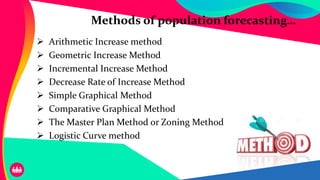
 Arithmetic Increase method
 Geometric Increase Method
 Incremental Increase Method
 Decrease Rate of Increase Method
 Simple Graphical Method
 Comparative Graphical Method
 The Master Plan Method or Zoning Method
 Logistic Curve method
Arithmetic increase method…
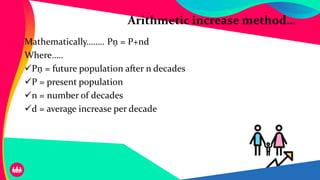
Mathematically…….. Pņ = P+nd
Where…..
Pņ = future population after n decades
P = present population
n = number of decades
d = average increase per decade
Arithmetic increase method…
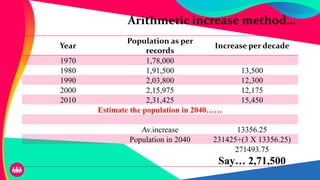
Year
Population as per
records
Increase per decade
1970 1,78,000
1980 1,91,500 13,500
1990 2,03,800 12,300
2000 2,15,975 12,175
2010 2,31,425 15,450
Estimate the population in 2040……
Av.increase 13356.25
Population in 2040 231425+(3 X 13356.25)
271493.75
Say… 2,71,500
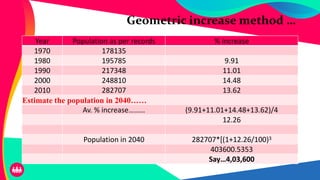
Geometric increase method …
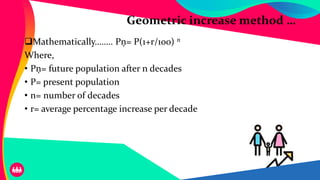
Mathematically…….. Pņ= P(1+r/100) 𝑛
Where,
• Pņ= future population after n decades
• P= present population
• n= number of decades
• r= average percentage increase per decade
Geometric increase method …
Year Population as per records % increase
1970 178135
1980 195785 9.91
1990 217348 11.01
2000 248810 14.48
2010 282707 13.62
Estimate the population in 2040……
Av. % increase……… (9.91+11.01+14.48+13.62)/4
12.26
Population in 2040 282707*[(1+12.26/100)3
403600.5353
Say…4,03,600
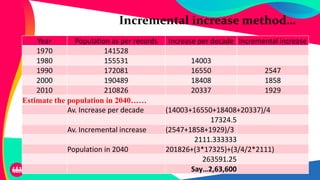
Incremental increase method…
Mathematically…….. Pņ=𝑃+𝑛𝑑+[(𝑛 /𝑛+1) /2]𝑡
Where,
Pņ = future population after n decades
P = present population
t = average incremental increase per decade
d = average increase in population per decade
Incremental increase method…
Year Population as per records Increase per decade Incremental increase
1970 141528
1980 155531 14003
1990 172081 16550 2547
2000 190489 18408 1858
2010 210826 20337 1929
Estimate the population in 2040……
Av. Increase per decade (14003+16550+18408+20337)/4
17324.5
Av. Incremental increase (2547+1858+1929)/3
2111.333333
Population in 2040 201826+(3*17325)+(3/4/2*2111)
263591.25
Say…2,63,600
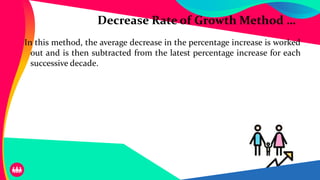
Decrease Rate of Growth Method …
In this method, the average decrease in the percentage increase is worked
out and is then subtracted from the latest percentage increase for each
successive decade.
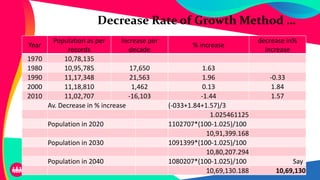
Decrease Rate of Growth Method …
Year
Population as per
records
Increase per
decade
% increase
decrease in%
increase
1970 10,78,135
1980 10,95,785 17,650 1.63
1990 11,17,348 21,563 1.96 -0.33
2000 11,18,810 1,462 0.13 1.84
2010 11,02,707 -16,103 -1.44 1.57
Av. Decrease in % increase (-033+1.84+1.57)/3
1.025461125
Population in 2020 1102707*(100-1.025)/100
10,91,399.168
Population in 2030 1091399*(100-1.025)/100
10,80,207.294
Population in 2040 1080207*(100-1.025)/100 Say
10,69,130.188 10,69,130
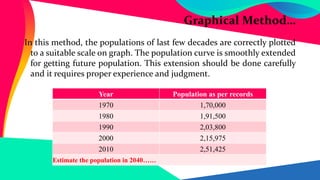
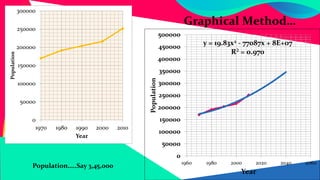
Graphical Method…
In this method, the populations of last few decades are correctly plotted
to a suitable scale on graph. The population curve is smoothly extended
for getting future population. This extension should be done carefully
and it requires proper experience and judgment.
Year Population as per records
1970 1,70,000
1980 1,91,500
1990 2,03,800
2000 2,15,975
2010 2,51,425
Estimate the population in 2040……
Graphical Method…
0
50000
100000
150000
200000
250000
300000
1970 1980 1990 2000 2010
Population
Year
y = 19.83x2 - 77087x + 8E+07
R² = 0.970
0
50000
100000
150000
200000
250000
300000
350000
400000
450000
500000
1960 1980 2000 2020 2040 2060
Population
Year
Population…..Say 3,45,000
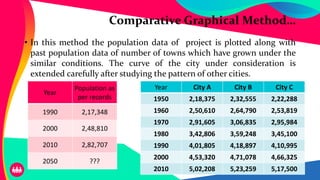
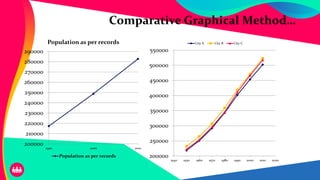
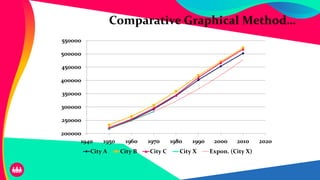
Comparative Graphical Method…
• In this method the population data of project is plotted along with
past population data of number of towns which have grown under the
similar conditions. The curve of the city under consideration is
extended carefully after studying the pattern of other cities.
Year
Population as
per records
1990 2,17,348
2000 2,48,810
2010 2,82,707
2050 ???
Year City A City B City C
1950 2,18,375 2,32,555 2,22,288
1960 2,50,610 2,64,790 2,53,819
1970 2,91,605 3,06,835 2,95,984
1980 3,42,806 3,59,248 3,45,100
1990 4,01,805 4,18,897 4,10,995
2000 4,53,320 4,71,078 4,66,325
2010 5,02,208 5,23,259 5,17,500
Comparative Graphical Method…
200000
210000
220000
230000
240000
250000
260000
270000
280000
290000
1990 2000 2010
Population as per records
Population as per records 200000
250000
300000
350000
400000
450000
500000
550000
1940 1950 1960 1970 1980 1990 2000 2010 2020
City A City B City C
Comparative Graphical Method…
200000
250000
300000
350000
400000
450000
500000
550000
1940 1950 1960 1970 1980 1990 2000 2010 2020
City A City B City C City X Expon. (City X)
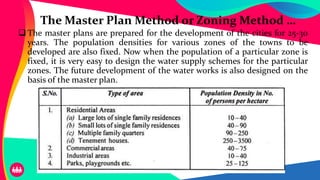
The Master Plan Method or Zoning Method …
 The master plans are prepared for the development of the cities for 25-30
years. The population densities for various zones of the towns to be
developed are also fixed. Now when the population of a particular zone is
fixed, it is very easy to design the water supply schemes for the particular
zones. The future development of the water works is also designed on the
basis of the master plan.
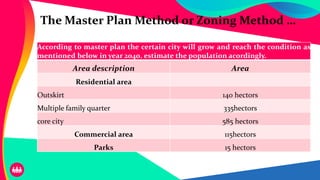
According to master plan the certain city will grow and reach the condition as
mentioned below in year 2040. estimate the population acordingly.
Area description Area
Residential area
Outskirt 140 hectors
Multiple family quarter 335hectors
core city 585 hectors
Commercial area 115hectors
Parks 15 hectors
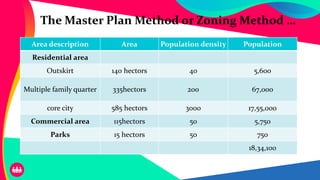
The Master Plan Method or Zoning Method …
Area description Area Population density Population
Residential area
Outskirt 140 hectors 40 5,600
Multiple family quarter 335hectors 200 67,000
core city 585 hectors 3000 17,55,000
Commercial area 115hectors 50 5,750
Parks 15 hectors 50 750
18,34,100
Please remember…..
 Suitability of each method is to be determined critically.
 Care has to be taken while selecting any method for the
forecasting in any given case.
 The trend of increase in the population shown by the city under
consideration can be the most suitable way to take the decision
to implement any method for forecasting the population.
That’s it for the session!!!!
Lets meet in next session
to learn more….
Calculating future population using  Population forecasting methods

Calculating future population using Population forecasting methods

  • 1.
    Calculating future population using Populationforecasting methods Mr. M. H. Mota Assistant professor SITCOE
  • 2.
    Outcome: To estimate thefuture population using various methods of population forecasting
  • 3.
    Population forecasting… Design ofwater supply and sanitation scheme is based on the projected population of a particular city, estimated for the design period. Any underestimated value will make system inadequate for the purpose intended; similarly overestimated value will make it costly. Factors affecting changes in population are:  increase due to births.  decrease due to deaths.  increase/ decrease due to migration. The present and past population record for the city can be obtained from the census population records. After collecting these population figures, the population at the end of design period is predicted using various methods as suitable for that city considering the growth pattern followed by the city.
  • 4.
    Methods of populationforecasting…  Arithmetic Increase method  Geometric Increase Method  Incremental Increase Method  Decrease Rate of Increase Method  Simple Graphical Method  Comparative Graphical Method  The Master Plan Method or Zoning Method  Logistic Curve method
  • 5.
    Arithmetic increase method… Mathematically……..Pņ = P+nd Where….. Pņ = future population after n decades P = present population n = number of decades d = average increase per decade
  • 6.
    Arithmetic increase method… Year Populationas per records Increase per decade 1970 1,78,000 1980 1,91,500 13,500 1990 2,03,800 12,300 2000 2,15,975 12,175 2010 2,31,425 15,450 Estimate the population in 2040…… Av.increase 13356.25 Population in 2040 231425+(3 X 13356.25) 271493.75 Say… 2,71,500
  • 7.
    Geometric increase method… Mathematically…….. Pņ= P(1+r/100) 𝑛 Where, • Pņ= future population after n decades • P= present population • n= number of decades • r= average percentage increase per decade
  • 8.
    Geometric increase method… Year Population as per records % increase 1970 178135 1980 195785 9.91 1990 217348 11.01 2000 248810 14.48 2010 282707 13.62 Estimate the population in 2040…… Av. % increase……… (9.91+11.01+14.48+13.62)/4 12.26 Population in 2040 282707*[(1+12.26/100)3 403600.5353 Say…4,03,600
  • 9.
    Incremental increase method… Mathematically……..Pņ=𝑃+𝑛𝑑+[(𝑛 /𝑛+1) /2]𝑡 Where, Pņ = future population after n decades P = present population t = average incremental increase per decade d = average increase in population per decade
  • 10.
    Incremental increase method… YearPopulation as per records Increase per decade Incremental increase 1970 141528 1980 155531 14003 1990 172081 16550 2547 2000 190489 18408 1858 2010 210826 20337 1929 Estimate the population in 2040…… Av. Increase per decade (14003+16550+18408+20337)/4 17324.5 Av. Incremental increase (2547+1858+1929)/3 2111.333333 Population in 2040 201826+(3*17325)+(3/4/2*2111) 263591.25 Say…2,63,600
  • 11.
    Decrease Rate ofGrowth Method … In this method, the average decrease in the percentage increase is worked out and is then subtracted from the latest percentage increase for each successive decade.
  • 12.
    Decrease Rate ofGrowth Method … Year Population as per records Increase per decade % increase decrease in% increase 1970 10,78,135 1980 10,95,785 17,650 1.63 1990 11,17,348 21,563 1.96 -0.33 2000 11,18,810 1,462 0.13 1.84 2010 11,02,707 -16,103 -1.44 1.57 Av. Decrease in % increase (-033+1.84+1.57)/3 1.025461125 Population in 2020 1102707*(100-1.025)/100 10,91,399.168 Population in 2030 1091399*(100-1.025)/100 10,80,207.294 Population in 2040 1080207*(100-1.025)/100 Say 10,69,130.188 10,69,130
  • 13.
    Graphical Method… In thismethod, the populations of last few decades are correctly plotted to a suitable scale on graph. The population curve is smoothly extended for getting future population. This extension should be done carefully and it requires proper experience and judgment. Year Population as per records 1970 1,70,000 1980 1,91,500 1990 2,03,800 2000 2,15,975 2010 2,51,425 Estimate the population in 2040……
  • 14.
    Graphical Method… 0 50000 100000 150000 200000 250000 300000 1970 19801990 2000 2010 Population Year y = 19.83x2 - 77087x + 8E+07 R² = 0.970 0 50000 100000 150000 200000 250000 300000 350000 400000 450000 500000 1960 1980 2000 2020 2040 2060 Population Year Population…..Say 3,45,000
  • 15.
    Comparative Graphical Method… •In this method the population data of project is plotted along with past population data of number of towns which have grown under the similar conditions. The curve of the city under consideration is extended carefully after studying the pattern of other cities. Year Population as per records 1990 2,17,348 2000 2,48,810 2010 2,82,707 2050 ??? Year City A City B City C 1950 2,18,375 2,32,555 2,22,288 1960 2,50,610 2,64,790 2,53,819 1970 2,91,605 3,06,835 2,95,984 1980 3,42,806 3,59,248 3,45,100 1990 4,01,805 4,18,897 4,10,995 2000 4,53,320 4,71,078 4,66,325 2010 5,02,208 5,23,259 5,17,500
  • 16.
    Comparative Graphical Method… 200000 210000 220000 230000 240000 250000 260000 270000 280000 290000 19902000 2010 Population as per records Population as per records 200000 250000 300000 350000 400000 450000 500000 550000 1940 1950 1960 1970 1980 1990 2000 2010 2020 City A City B City C
  • 17.
    Comparative Graphical Method… 200000 250000 300000 350000 400000 450000 500000 550000 19401950 1960 1970 1980 1990 2000 2010 2020 City A City B City C City X Expon. (City X)
  • 18.
    The Master PlanMethod or Zoning Method …  The master plans are prepared for the development of the cities for 25-30 years. The population densities for various zones of the towns to be developed are also fixed. Now when the population of a particular zone is fixed, it is very easy to design the water supply schemes for the particular zones. The future development of the water works is also designed on the basis of the master plan.
  • 19.
    According to masterplan the certain city will grow and reach the condition as mentioned below in year 2040. estimate the population acordingly. Area description Area Residential area Outskirt 140 hectors Multiple family quarter 335hectors core city 585 hectors Commercial area 115hectors Parks 15 hectors The Master Plan Method or Zoning Method …
  • 20.
    The Master PlanMethod or Zoning Method … Area description Area Population density Population Residential area Outskirt 140 hectors 40 5,600 Multiple family quarter 335hectors 200 67,000 core city 585 hectors 3000 17,55,000 Commercial area 115hectors 50 5,750 Parks 15 hectors 50 750 18,34,100
  • 21.
    Please remember…..  Suitabilityof each method is to be determined critically.  Care has to be taken while selecting any method for the forecasting in any given case.  The trend of increase in the population shown by the city under consideration can be the most suitable way to take the decision to implement any method for forecasting the population.
  • 22.
    That’s it forthe session!!!! Lets meet in next session to learn more….