



Mr. M. H. Mota
Assistant professor
SITCOE
 Institutions are the rules of the game in a society.
 Institutions operate at different levels of jurisdiction, from the
world system to localized interpersonal relationships.
 More formally they are the limitations to free behaviors
imposed on the individuals by the society, shaping the
relationships among individuals (North 1990, 1991)
Institutions are social structures that have attained a high degree
of resilience. They are composed of cultural-cognitive,
normative, and regulative elements that, together with
associated activities and resources, provide stability and
meaning to social life. Institutions are transmitted by various
types of carriers, including symbolic systems, relational
systems, routines, and artifacts.
 It is a theory on the deeper and more resilient aspects of
social structure. It considers the processes by which
structures, including schemes, rules, norms, and routines,
become established as authoritative guidelines for social
behavior.
 Different components of institutional theory explain how
these elements are created, diffused, adopted, and adapted
over space and time; and how they fall into decline and
disuse.
 Institutional theory is "a widely accepted theoretical
posture that emphasizes rational myths, isomorphism,
and legitimacy. (Scott 2008)
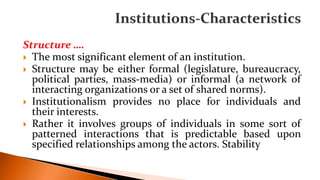
Structure ….
 The most significant element of an institution.
 Structure may be either formal (legislature, bureaucracy,
political parties, mass-media) or informal (a network of
interacting organizations or a set of shared norms).
 Institutionalism provides no place for individuals and
their interests.
 Rather it involves groups of individuals in some sort of
patterned interactions that is predictable based upon
specified relationships among the actors. Stability
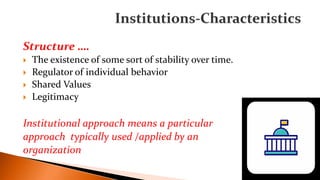
Structure ….
 The existence of some sort of stability over time.
 Regulator of individual behavior
 Shared Values
 Legitimacy
Institutional approach means a particular
approach typically used /applied by an
organization
Old Institutionalism… an approach to the study of
politics that focuses on formal institutions of
government.
New institutionalism… a social theory that focuses
on developing a sociological view of institutions,
the way they interact and the effects of institutions
on society.
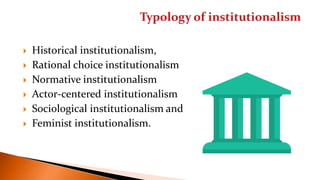
 Historical institutionalism,
 Rational choice institutionalism
 Normative institutionalism
 Actor-centered institutionalism
 Sociological institutionalism and
 Feminist institutionalism.
 For HI, what is mainly of importance is the construction,
maintenance and adaptation of institutions.
 The emphasis of historical Institutionalism is much more
on the persistence of organizations after they are formed
than it is on the facts of their initial creation.
 To some extent the emphasis on embodying ideas in the
structures that support institutions may be taken as a
definition of the formation of institution.
 It can be argued that when an idea becomes accepted and
it is embodied into the structural forms, then the
institution has been created.
 Rational choice institutionalism assume that individuals
are instrumentally convinced to maximize their utility.
 Rational-choice institutionalists think of institutions as a
system of rules and incentives.
 This theory permit, stipulate and exclude rules that is
designed to constrain behaviour.
 For rational choice theorists, institutions are easily
changeable: if correct set or rules or the correct payoff
matrix is selected then the desired outcome can be
engineered.
 Normative institutionalism underlines the role of values
and logic of appropriateness in defining institution
meaning that institutions can be considered as embedding
rules and routines that define what constitutes appropriate
action. (Peters 1999)
 The norms and formal rules of institutions will shape the
actions of those acting within them.
 Institutions are viewed as independent entities that over
time shape a policy by influencing actors, preferences,
perceptions and identities.
 In this sense, institutions are endogenous.
 This theory concerns the problem of whether institutions
in fact matter.
 This type of institutionalism believes in experimental
behavior and its outcome.
 For example, one of the questions empirical
institutionalism deals with is ‘presidential or
parliamentary system and whether is a better system or
not?’
 Actor-centered institutionalism, also called neo-
institutionalism, emphasizes the autonomy of political
institutions from society in which they exist. It assumes a
greater influence on human behavior coming from the
socio-political environment surrounding people and
organizations than from within individual or group-based
interactions.
 Sociological institutionalism is a form of new
institutionalism that concerns the way in which
institutions create meaning for individuals, providing
important theoretical building blocks for normative
institutionalism within political science
 Feminist institutionalism is a new institutionalist
approach which looks at "how gender norms operate
within institutions and how institutional processes
construct and maintain gender power dynamics”.
 Institutional isomorphism describes the process
in which organizations gain increasing similarity in
structure. This process is assumed to be driven
primarily by a desire of decision makers to create
organizations that conform and/or excel in their
practice of social rules, ideals, and practices.
The study field of institutions and institutionalism is
quite complex, encompassing theories, concepts, and
tools that can be applied in various ways related to
sustainable development. At the same time, sustainable
development can imply a range of policy, normative, or
resource use issues at various scales. Therefore,
institutions and their change over time can be analyzed
with regard to specific topics on sustainable development
such as institutional reforms, learning, institutional
interplay, and appropriate designs.
Often, institutional designs and institutional change
are useful approaches for investigating
unsustainability in economic development. This
happens when institutions are understood as a
structuring element of human–nature relationships,
and institutional change is used to redirect
institutional failures during the development
process. (Opschoor 1996).
Institutional theory

Institutional theory

  • 1.
    Mr. M. H.Mota Assistant professor SITCOE
  • 2.
     Institutions arethe rules of the game in a society.  Institutions operate at different levels of jurisdiction, from the world system to localized interpersonal relationships.  More formally they are the limitations to free behaviors imposed on the individuals by the society, shaping the relationships among individuals (North 1990, 1991)
  • 3.
    Institutions are socialstructures that have attained a high degree of resilience. They are composed of cultural-cognitive, normative, and regulative elements that, together with associated activities and resources, provide stability and meaning to social life. Institutions are transmitted by various types of carriers, including symbolic systems, relational systems, routines, and artifacts.
  • 4.
     It isa theory on the deeper and more resilient aspects of social structure. It considers the processes by which structures, including schemes, rules, norms, and routines, become established as authoritative guidelines for social behavior.  Different components of institutional theory explain how these elements are created, diffused, adopted, and adapted over space and time; and how they fall into decline and disuse.
  • 5.
     Institutional theoryis "a widely accepted theoretical posture that emphasizes rational myths, isomorphism, and legitimacy. (Scott 2008)
  • 6.
    Structure ….  Themost significant element of an institution.  Structure may be either formal (legislature, bureaucracy, political parties, mass-media) or informal (a network of interacting organizations or a set of shared norms).  Institutionalism provides no place for individuals and their interests.  Rather it involves groups of individuals in some sort of patterned interactions that is predictable based upon specified relationships among the actors. Stability
  • 7.
    Structure ….  Theexistence of some sort of stability over time.  Regulator of individual behavior  Shared Values  Legitimacy Institutional approach means a particular approach typically used /applied by an organization
  • 8.
    Old Institutionalism… anapproach to the study of politics that focuses on formal institutions of government. New institutionalism… a social theory that focuses on developing a sociological view of institutions, the way they interact and the effects of institutions on society.
  • 9.
     Historical institutionalism, Rational choice institutionalism  Normative institutionalism  Actor-centered institutionalism  Sociological institutionalism and  Feminist institutionalism.
  • 10.
     For HI,what is mainly of importance is the construction, maintenance and adaptation of institutions.  The emphasis of historical Institutionalism is much more on the persistence of organizations after they are formed than it is on the facts of their initial creation.  To some extent the emphasis on embodying ideas in the structures that support institutions may be taken as a definition of the formation of institution.  It can be argued that when an idea becomes accepted and it is embodied into the structural forms, then the institution has been created.
  • 11.
     Rational choiceinstitutionalism assume that individuals are instrumentally convinced to maximize their utility.  Rational-choice institutionalists think of institutions as a system of rules and incentives.  This theory permit, stipulate and exclude rules that is designed to constrain behaviour.  For rational choice theorists, institutions are easily changeable: if correct set or rules or the correct payoff matrix is selected then the desired outcome can be engineered.
  • 12.
     Normative institutionalismunderlines the role of values and logic of appropriateness in defining institution meaning that institutions can be considered as embedding rules and routines that define what constitutes appropriate action. (Peters 1999)  The norms and formal rules of institutions will shape the actions of those acting within them.  Institutions are viewed as independent entities that over time shape a policy by influencing actors, preferences, perceptions and identities.  In this sense, institutions are endogenous.
  • 13.
     This theoryconcerns the problem of whether institutions in fact matter.  This type of institutionalism believes in experimental behavior and its outcome.  For example, one of the questions empirical institutionalism deals with is ‘presidential or parliamentary system and whether is a better system or not?’
  • 14.
     Actor-centered institutionalism,also called neo- institutionalism, emphasizes the autonomy of political institutions from society in which they exist. It assumes a greater influence on human behavior coming from the socio-political environment surrounding people and organizations than from within individual or group-based interactions.
  • 15.
     Sociological institutionalismis a form of new institutionalism that concerns the way in which institutions create meaning for individuals, providing important theoretical building blocks for normative institutionalism within political science
  • 16.
     Feminist institutionalismis a new institutionalist approach which looks at "how gender norms operate within institutions and how institutional processes construct and maintain gender power dynamics”.
  • 17.
     Institutional isomorphismdescribes the process in which organizations gain increasing similarity in structure. This process is assumed to be driven primarily by a desire of decision makers to create organizations that conform and/or excel in their practice of social rules, ideals, and practices.
  • 18.
    The study fieldof institutions and institutionalism is quite complex, encompassing theories, concepts, and tools that can be applied in various ways related to sustainable development. At the same time, sustainable development can imply a range of policy, normative, or resource use issues at various scales. Therefore, institutions and their change over time can be analyzed with regard to specific topics on sustainable development such as institutional reforms, learning, institutional interplay, and appropriate designs.
  • 19.
    Often, institutional designsand institutional change are useful approaches for investigating unsustainability in economic development. This happens when institutions are understood as a structuring element of human–nature relationships, and institutional change is used to redirect institutional failures during the development process. (Opschoor 1996).