ENVIRONMENTAL
IMPACT ASSESSMENT
BY
N.K.KUTTIAPPAN
CHENNAI
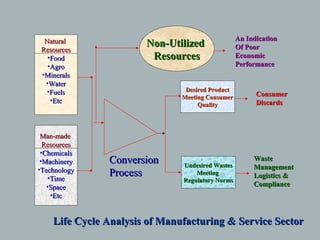
NaturalNatural
ResourcesResources
•FoodFood
•AgroAgro
•MineralsMinerals
•WaterWater
•FuelsFuels
•EtcEtc
Man-madeMan-made
ResourcesResources
•ChemicalsChemicals
•MachineryMachinery
•TechnologyTechnology
•TimeTime
•SpaceSpace
•EtcEtc
Desired ProductDesired Product
Meeting ConsumerMeeting Consumer
QualityQuality
Undesired WastesUndesired Wastes
MeetingMeeting
Regulatory NormsRegulatory Norms
Non-UtilizedNon-Utilized
ResourcesResources
ConsumerConsumer
DiscardsDiscards
WasteWaste
ManagementManagement
Logistics &Logistics &
ComplianceCompliance
ConversionConversion
ProcessProcess
An IndicationAn Indication
Of PoorOf Poor
EconomicEconomic
PerformancePerformance
Life Cycle Analysis of Manufacturing & Service SectorLife Cycle Analysis of Manufacturing & Service Sector
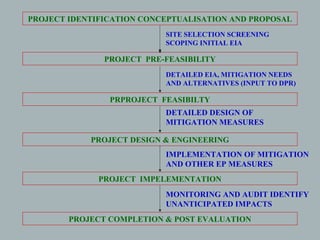
PROJECT IDENTIFICATION CONCEPTUALISATION AND PROPOSAL
PROJECT PRE-FEASIBILITY
PRPROJECT FEASIBILTY
PROJECT DESIGN & ENGINEERING
PROJECT IMPELEMENTATION
PROJECT COMPLETION & POST EVALUATION
SITE SELECTION SCREENING
SCOPING INITIAL EIA
DETAILED EIA, MITIGATION NEEDS
AND ALTERNATIVES (INPUT TO DPR)
DETAILED DESIGN OF
MITIGATION MEASURES
IMPLEMENTATION OF MITIGATION
AND OTHER EP MEASURES
MONITORING AND AUDIT IDENTIFY
UNANTICIPATED IMPACTS
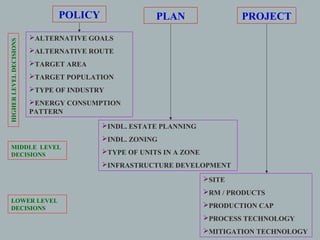
POLICY PLAN PROJECT
ALTERNATIVE GOALS
ALTERNATIVE ROUTE
TARGET AREA
TARGET POPULATION
TYPE OF INDUSTRY
ENERGY CONSUMPTION
PATTERN
HIGHERLEVELDECISIONS
INDL. ESTATE PLANNING
INDL. ZONING
TYPE OF UNITS IN A ZONE
INFRASTRUCTURE DEVELOPMENT
SITE
RM / PRODUCTS
PRODUCTION CAP
PROCESS TECHNOLOGY
MITIGATION TECHNOLOGY
MIDDLE LEVEL
DECISIONS
LOWER LEVEL
DECISIONS
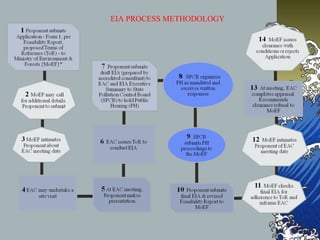
EIA PROCESS METHODOLOGY
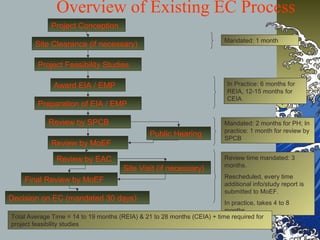
Overview of Existing EC Process
Project Conception
Site Clearance (if necessary)
Project Feasibility Studies
Award EIA / EMP
Preparation of EIA / EMP
Review by SPCB
Review by MoEF
Review by EAC
Final Review by MoEF
Decision on EC (mandated 30 days)
Public Hearing
Site Visit (if necessary)
Mandated: 1 month
In Practice: 6 months for
REIA, 12-15 months for
CEIA
Mandated: 2 months for PH; In
practice: 1 month for review by
SPCB
Review time mandated: 3
months.
Rescheduled, every time
additional info/study report is
submitted to MoEF.
In practice, takes 4 to 8
months
Total Average Time = 14 to 19 months (REIA) & 21 to 28 months (CEIA) + time required for
project feasibility studies
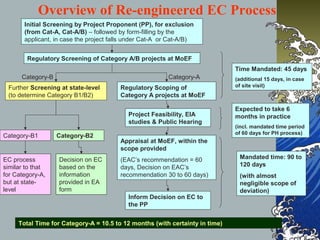
Overview of Re-engineered EC Process
Initial Screening by Project Proponent (PP), for exclusion
(from Cat-A, Cat-A/B) – followed by form-filling by the
applicant, in case the project falls under Cat-A or Cat-A/B)
Regulatory Screening of Category A/B projects at MoEF
Project Feasibility, EIA
studies & Public Hearing
Further Screening at state-level
(to determine Category B1/B2)
Appraisal at MoEF, within the
scope provided
(EAC’s recommendation = 60
days, Decision on EAC’s
recommendation 30 to 60 days)
Inform Decision on EC to
the PP
Category-B1 Category-B2
EC process
similar to that
for Category-A,
but at state-
level
Decision on EC
based on the
information
provided in EA
form
Total Time for Category-A = 10.5 to 12 months (with certainty in time)
Time Mandated: 45 days
(additional 15 days, in case
of site visit)
Expected to take 6
months in practice
(incl. mandated time period
of 60 days for PH process)
Mandated time: 90 to
120 days
(with almost
negligible scope of
deviation)
Category-ACategory-B
Regulatory Scoping of
Category A projects at MoEF
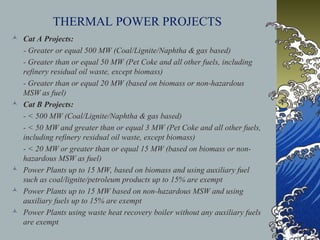
THERMAL POWER PROJECTS
 Cat A Projects:
- Greater or equal 500 MW (Coal/Lignite/Naphtha & gas based)
- Greater than or equal 50 MW (Pet Coke and all other fuels, including
refinery residual oil waste, except biomass)
- Greater than or equal 20 MW (based on biomass or non-hazardous
MSW as fuel)
 Cat B Projects:
- < 500 MW (Coal/Lignite/Naphtha & gas based)
- < 50 MW and greater than or equal 3 MW (Pet Coke and all other fuels,
including refinery residual oil waste, except biomass)
- < 20 MW or greater than or equal 15 MW (based on biomass or non-
hazardous MSW as fuel)
 Power Plants up to 15 MW, based on biomass and using auxiliary fuel
such as coal/lignite/petroleum products up to 15% are exempt
 Power Plants up to 15 MW based on non-hazardous MSW and using
auxiliary fuels up to 15% are exempt
 Power Plants using waste heat recovery boiler without any auxiliary fuels
are exempt
PRE-REQUISITE OF EIA ORGANIZATION
 The Organization carrying out EIA activity must be accredited by
NABET of Quality Council of India (as on date)
 As per Accreditation scheme, an EIA Organization must be legally
registered company (say a minimum of a Proprietary concern),
with minimum 3 experts having in-house Laboratory of either
MOEF recognized or NABL accredited or out-sourced having
MOEF recognition or NABL accreditation
 As per EIA Notification, there are 38 sectors (and five additional
of Donar or Multilateral Funding agency concerns, on voluntary
basis) for Environmental Clearance; To conduct EIA in such
sectors, qualified/skilled experts have to be approved by NABET,
NABET scheme insists the following:
 One In-house Environmental Coordinator (who is fully conversant with
the sector knowledge that he wishes to undertake) and 5 in-house
Functional Area Expertise (irrespective of sectors, domain knowledge is a
must), viz
- Air Pollution Control (AP)
- Water Pollution Control (WP)
- Solid & Hazardous Waste Control (MSW, HW & ISW)
- Ecology & Biodiversity (EB) and
- Socio-Economy (SE)
 In-house or out-sourced Functional Area expertise are additionally
required in domains like:
- Land Use (LU)
- Hydrology & Ground water Conservation (HG)
- Geology (Geo)
- Air Quality Monitoring & Dispersion Modeling (AQ)
- Risk & Hazard Management (RH)
- Noise & Vibration (NV)
- Soil Conservation (SC)
 Thus there will be sector specific Expert and 12 Functional Area
experts are required
 An Environmental Coordinator can be approved maximum of 5
sectors
 A Functional Area expert can be approved maximum of 4 Domains
 If an EIA Organization wish to carry out EIA, then such sector or
sectors must be approved by required number of Environmental
Coordinators
 The Accreditation is valid for 3 years, need to undergo
surveillance every 18 months and to be reaccredited for continual
improvement
 EAC or SEAC will allow EIA Organization to submit any
application, only if they are accredited for that sector and possess
required number of EIA Coordinators and Domain experts
 The EIA report must declare Expert involved for that EIA project
(EIA Coordinator & Domain experts) activity, duly signed by
everyone along with CEO of EIA Organization
EIA METHODOLOGY
 Following would be the sequence of activities:
a) Project Proponent (PP) identifies the qualified EIA Organization for the
EIA task
b) PP issues the Work Order
c) EIA Organization (EO) deploys right composition of EIA Coordinator (s)
and Functional Area experts
d) PP with the involvement of EO submits Form 1 or Form 1A (as per sector)
along with planned Terms of Reference (TOR) & Project Pre-Feasibility
Report to MOEF/SEIAA;
e) PP & EO makes a presentation and seeks firmed up TOR from
MOEF/SEIAA; if there are gaps, then there could be many rounds of
meetings and fine tuning
f) EO then conducts base line study/survey (which covers all 12 Functional
Area Expertise through measuring & monitoring, primary survey and
secondary survey etc)
g) Draft EIA Report is then submitted to MOEF/SEIAA;
h) If there are inadequacy or gaps, then based on discussion outcome with
EAC & SEAC, draft report is modified and firmed-up; there could be
several rounds of such submission
i) The firmed up draft EIA report is then made available to Public Domain ;
Based on MOEF/SEIAA and local SPCB coordination, date for Public
Hearing is fixed
j) SPCB with PP bearing the cost will announce the date of Public Hearing
at-least 30 days in advance in Two National Daily Newspaper; (one of
local language and other of English); In the meanwhile, public can access
to the draft EIA report as well Executive Summary of the EIA project
available in local language as well as in English. The other Interested
parties can send documented information via mail or letter as part of
“Consultation” inputs on EIA project & its impact
k) PP with the support of EO would make presentation and views of local
Public is registered/video-graphed;
l) Outcome of the Public Hearing & Consultation process is consolidated as
Minutes of Meeting;
m) PP along with EO is then required to address the issues in draft EIA
report
n) PP along with EO then submits “Final EIA Report” to MOEF/SEIAA
o) PP & EO would make presentation to EAC/SEAC and seek Environmental
Clearance; this could also take more than one meeting, depending on
gaps
p) Finally MOEF/SEIAA will issue Environmental Clearance (EC)
q) PP is required to announce the EC in two National daily Newspaper and
await for any further public response
r) If there are procedural violation or other serious public concerns not
addressed, then EC can be challenged under the provisions of National
Green Tribunal
s) After resolving any NGT cases & based on available EC, PP is then
required to avail “Consent-to-Establish” from local SPCB
t) After implementing all declared & agreed environmental mitigation
measures (EC conditions), PP seeks inspection formality with SPCB;
u) Based on “Inspection report Findings”, SPCB will then issue “Consent-
to-Operate” for commercial production of the facility
v) Regional MOEF Office is empowered to undertake periodic inspection of
the operating factory to oversee level of compliance of EC conditions; PP
is also required to submit every 6 months a progress report to SPCB and
MOEF on the compliance situation of EC conditions
SOME PROCEDURAL VIOLATIONS
 Baseline study has been done much prior to date of issue of TOR and the
reasons thereof not supported
 After draft EIA report and Public Hearing, the final EIA report contained
different base line data, additional chapters, study outcome etc
 Public Hearing has not been conducted properly – under protest etc
 In the eyes of well informed local community, still the Socio-Economy,
Ecology & Bio-diversity issues, and other such issues, are not properly
addressed through primary survey components in EIA report
 For Brown field projects (Existing factory is expanding or diversifying in
same project location/site), baseline data is not addressing “ground Truth
information”, compliance situation of earlier EC conditions etc
 EIA chapters are not consistent with EIA Notification dated 14th
Sept,
2006 and amendments thereof
 EIA is not carried out as per NABET accredited procedures
EIA CHAPTERS AS NOTIFIED BY MOEF
 Chapter -1 Introduction: Purpose of the report, Identification of project
& project proponent, Brief description of nature, size, location of the
project and its importance to the country, region; Scope of the study –
details of regulatory scoping carried out (As per Terms of Reference)
 Chapter-2 Project Description: Condensed description of those aspects of
the project (based on project feasibility study), likely to cause
environmental effects. Details should be provided to give clear picture of
the following:
- Type of project
- Need for the project
- Location (maps showing general location, specific location, project
boundary & project site layout)
- Size or magnitude of operation (incl. Associated activities required by or
for the project)
- Proposed schedule for approval and implementation
- Technology and process description
- Project description. Including drawings showing project layout,
components of project etc. Schematic representations of the feasibility
drawings which give information important for EIA purpose
- Description of mitigation measures incorporated into the project to meet
environmental standards, environmental operating conditions, or other
EIA requirements (as required by the scope)
- Assessment of New & untested technology for the risk of technological
failure
 Chapter-3 Description of the Environment: Study area, period,
components & methodology, Establishment of baseline for valued
environmental components, as identified in the scope, Base maps of all
environmental components
 Chapter-4 Anticipated Environmental Impacts & Mitigation Measures:
- Details of Investigated Environmental impacts due to project location,
possible accidents, project design, project construction, regular
operations, final decommissioning or rehabilitation of a completed project
- Measures for minimizing and / or offsetting adverse impacts identified
- Irreversible and Irretrievable commitments of environmental
components
- Assessment of significance of impacts (Criteria for determining
significance, Assigning significance)
- Mitigation measures
 Chapter-5: Analysis of Alternatives (Technology & Site):
- In case, the scoping exercise results in need for alternatives:
- Description of each alternative
- Summary of adverse impacts of each alternative
- Mitigation measures proposed for each alternative and
- Selection of alternative
 Chapter-6: Environmental Monitoring Programme:
- Technical aspects of monitoring the effectiveness of mitigation measures
(incl. Measurement methodologies, frequency, location, data analysis,
reporting schedules, emergency procedures, detailed budget &
procurement schedules)
 Chapter-7: Additional Studies:
- Public Consultation
- Risk assessment
- Social Impact Assessment. R&R Action Plans
 Chapter-8: Project benefits:
- Improvements in the physical infrastructure
- Improvements in the social infrastructure
- Employment potential –skilled; semi-skilled and unskilled
- Other tangible benefits
 Chapter-9: Environmental Cost benefit Analysis:
- If recommended at the Scoping stage
 Chapter-10: Environmental Management Plan:
- Description of the administrative aspects of ensuring that mitigative
measures are implemented and their effectiveness monitored, after
approval of the EIA
 Chapter-11: Summary & Conclusion (This will constitute the summary
of the EIA Report ):
- Overall justification for implementation of the project
- Explanation of how, adverse effects have been mitigated
 Chapter-12: Disclosure of Consultants engaged
- The names of the Consultants engaged with their brief resume and
nature of Consultancy rendered
- Above requirements with NABET procedure, EO is required to declare
with signature the NABET approved Environmental Coordinator and all
the approved 12 Functional Area experts , including signature of CEO of
EO
 Executive Summary (In Local Language and in English): to cover
 1. Project Description
 2. Description of the Environment
 3. Anticipated Environmental impacts and mitigation measures
 4. Environmental Monitoring Programme
 5. Additional Studies
 6. Project Benefits
 7. Environment Management Plan

FORM 1 PARTICULARS
 It is to be submitted by PP along with planned TOR and Pre-Feasibility
Report of the Project; As per MOEF Notification, following structured
information are sought:
 I – Basic Information:
- Name of the Project:
- Location / site alternatives under consideration:
- Size of the Project: Capacity corresponding to sectoral activity (such as
production capacity for manufacturing, mining lease area and production
capacity for mineral production, area for mineral exploration, length for
linear transport infrastructure, generation capacity for power generation
etc.,)
- Expected cost of the project:
- Contact Information:
- Screening Category:

 II – Activity:
 1) Construction, operation or decommissioning of the Project involving
actions, which will cause physical changes in the locality (topography,
land use, changes in water bodies, etc.)
- A checklist based Yes/No and brief descriptive information for 31 items
(1.1 to 1.31)
 2) Use of Natural resources for construction or operation of the Project
(such as land, water, materials or energy, especially any resources which
are non-renewable or in short supply):
- A checklist based Yes/No and brief descriptive information for 7 items
(2.1 to 2.7)
 3) Use, storage, transport, handling or production of substances or
materials, which could be harmful to human health or the environment
or raise concerns about actual or perceived risks to human health.
- A checklist based Yes/No and brief descriptive information for 5 items
(3.1 to 3.5)
 4) Production of solid wastes during construction or operation or
decommissioning (MT/month)
- A checklist based Yes/No and brief descriptive information for 11 items
(4.1 to 4.11)
 5) Release of pollutants or any hazardous, toxic or noxious substances to
air (Kg/hr)
- A checklist based Yes/No and brief descriptive information for 8 items
(5.1 to 5.8)
 6) Generation of Noise and Vibration, and Emissions of Light and
Heat:
- A checklist based Yes/No and brief descriptive information for 7 items
(6.1 to 6.7)
 7) Risks of contamination of land or water from releases of pollutants
into the ground or into sewers, surface waters, groundwater, coastal
waters or the sea:
- A checklist based Yes/No and brief descriptive information for 5 items
(7.1 to 7.5)
 8) Risk of accidents during construction or operation of the Project,
which could affect human health or the environment
- A checklist based Yes/No and brief descriptive information for 3 items
(8.1 to 8.3)
 9) Factors which should be considered (such as consequential
development) which could lead to environmental effects or the potential
for cumulative impacts with other existing or planned activities in the
locality
- A checklist based Yes/No and brief descriptive information for 4 items
(9.1 to 9.4)
 III : Environmental Sensitivity
- A checklist based Yes/No and brief descriptive information for 12 items
(1 to 12)
 IV : Proposed Terms of Reference for EIA studies
LEGAL REQUIREMENTS
 General Standards for disposal in to four recipient water bodies (35
parameters for compliance, with varying degree of limits)
 Ambient Noise (Day & Night Time) @ National Ambient Air Quality
standards (desirable, enforceable only on the basis of compliant) and
Source Noise norm for DG Sets
 DG Stack height; Emission Stack governed by height as well as
Particulate compliance norm of 150 mg/N.m3 (MINAS) or 100 mg/N.m3
(CREP) or 50 mg/N.m3 (of late stipulated as part of EAC)
 Minimal National Standards, like:
- Condenser cooling water (once through system): pH 6.5 to 8.5 and
Temperature < 5 Deg C of intake base line data
- Boiler Blow-down water: Free Available Chlorine < 0.5 mg/l, TSS <
100 mg/l, Oil & Grease < 20 mg/l, Copper (Total) < 1 mg/l and Total
Iron < 1 mg/l
- Cooling Tower Blow-down: Free Available Chlorine < 0.5 mg/l, Zinc <
1 mg/l, Chromium (Total) < 0.2 mg/l, Phosphate < 5 mg/l
- Ash Pond effluent: pH 6.5 to 8.5, TSS < 100 mg/l and Oil & Grease < 20
mg/l

 Stack Height : 500 MW and above – 275 m; > 200 MW and less than 500
MW – 220 m and others governed by dispersion equations
 Cooling water discharge norms:
A. New thermal power plants commissioned after June 1, 1999.
New thermal power plants, which will be using water from
rivers/lakes/reservoirs, shall install cooling towers irrespective of location
and capacity. Thermal power plants which will use sea water for cooling
purposes, the condition below will apply.
B. New projects in coastal areas using sea water.
The thermal power plants using sea water should adopt suitable system to
reduce water temperature at the final discharge point so that the resultant
rise in the temperature of receiving water does not exceed 7°C over and
above the ambient temperature of the receiving water bodies.
 C. Existing thermal power plants.
Rise in temperature of condenser cooling water from inlet to the outlet of
condenser shall not be more than 10°C.
D. D. Guidelines for discharge point.
1. The discharge point shall preferably be located at the bottom of the
water body at mid stream for proper dispersion of thermal discharge.
2. In case of discharge of cooling water into sea, proper marine outfall
shall be designed to achieve the prescribed standards the point of
discharge may be selected in consultation with concerned State
Authorities/ NIO.
3. No cooling water discharge shall be permitted in estuaries or near
ecologically sensitive areas such as mangroves, coal reefs/ spanning and
breeding grounds of aquatic flora and fauna
 Fly ash utilization rule: Fly-ash & Bottom ash are now considered at par
for total management; Fly ash to be used in cement Industries (Portland
Cement can take not more than 30% of total product mix- safer to
consider < 20%) ; Bottom ash for Brick Kiln etc within 100 Km radius
 Any ash slurry (30 to 35% consistency level only) to be disposed in a lined
pond system, with overflow passing through treatment & recycle system
back to ash conveyance circuit
 Hazardous Waste Management: Used Oil (spent lubricating, Transformer,
Turbine etc), Waste Oil, Discarded Containers, barrels, Batteries, E-
waste, Discarded Resin from Water Treatment Plant, etc
 Public Liability & Insurance Coverage (Provision to contribute to
Environmental relief Fund)
 Mercury can be emitted in three different forms: elemental (Hg), oxidized
(Hg2+) and particle bound (HgP). Upon combustion, coal fly ash tends to
have a higher concentration of mercury, and estimates indicate that
Indian coal ash has an average mercury concentration of 0.53 mg/kg,
based on measurements from a few selected power plants. Besides Indian
coal is very high in mercury contents. The levels in Indian coal are high in
comparison to other countries.
SITING CRITERIA
 Ecologically and/or otherwise sensitive areas: Preferably 5 km;
depending on the geoclimatic conditions the requisite distance may be
decided appropriate by the agency.
 Coastal Areas: Preferably half-a-kilometre away from high tide linė
(HTL).
 Flood Plain of the Riverine System: Preferably half-a-kilometre awaẏ
from flood plain or modified flood plain affected by dam in the upstream
or by flood control systems.
 Transport/Communication System: Preferably half-a-kilometre away froṁ
highway and railway line.
 Major Settlements (3,00,000 population): Distance from settlements iṡ
difficult to maintain because of urban sprawl. At the time of siting of the
industry, if the notified limit of any major settlement is located within 50
km, the spatial direction of growth of the settlement for at least a decade
must be assessed and the industry shall be sited at least 25 km away from
the projected growth boundary of the settlement.
 Critically polluted areas are identified by MoEF from time-to-time.̇
GENERAL SITING FACTORS
 General sitting factors
In any particular selected site, the following factors must also be
recognized.
 No forest land shall be used for non-forest activity for the sustenance oḟ
the industry (Ref: Forest Conversation Act, 1980).
 No prime agricultural land shall be converted into industrial site.̇
 Land acquired shall be sufficiently large to provide space for appropriatė
green cover including greenbelt, around the battery limit of the industry.
 Layout and from of the industry that may come up in the area musṫ
conform to the landscape of the area, without affecting the scenic features
of that place.
 Associated township of the industry may be created at a space havinġ
physiographic barrier between the industry and the township.
WATER CONSUMPTION
 The consumptive water requirement for coal based plants with cooling
tower used to be about 7 m3/h per MW without ash water recirculation
and 5 m3/h per MW with ash water recirculation.
 In recent past, plants have been designed with consumptive water
requirement in the range 3.5 - 4 m3/h per MW.
 In place of wet cooling system, a dry cooling system (air heat exchanger)
can reduce total water requirements drastically; however, techno-
economically not yet proven for TPP . Considering increasing trend
towards ZLD logic, the viability is expected to change in future

Environmental Impact Assessment

  • 1.
  • 2.
    NaturalNatural ResourcesResources •FoodFood •AgroAgro •MineralsMinerals •WaterWater •FuelsFuels •EtcEtc Man-madeMan-made ResourcesResources •ChemicalsChemicals •MachineryMachinery •TechnologyTechnology •TimeTime •SpaceSpace •EtcEtc Desired ProductDesired Product MeetingConsumerMeeting Consumer QualityQuality Undesired WastesUndesired Wastes MeetingMeeting Regulatory NormsRegulatory Norms Non-UtilizedNon-Utilized ResourcesResources ConsumerConsumer DiscardsDiscards WasteWaste ManagementManagement Logistics &Logistics & ComplianceCompliance ConversionConversion ProcessProcess An IndicationAn Indication Of PoorOf Poor EconomicEconomic PerformancePerformance Life Cycle Analysis of Manufacturing & Service SectorLife Cycle Analysis of Manufacturing & Service Sector
  • 3.
    PROJECT IDENTIFICATION CONCEPTUALISATIONAND PROPOSAL PROJECT PRE-FEASIBILITY PRPROJECT FEASIBILTY PROJECT DESIGN & ENGINEERING PROJECT IMPELEMENTATION PROJECT COMPLETION & POST EVALUATION SITE SELECTION SCREENING SCOPING INITIAL EIA DETAILED EIA, MITIGATION NEEDS AND ALTERNATIVES (INPUT TO DPR) DETAILED DESIGN OF MITIGATION MEASURES IMPLEMENTATION OF MITIGATION AND OTHER EP MEASURES MONITORING AND AUDIT IDENTIFY UNANTICIPATED IMPACTS
  • 4.
    POLICY PLAN PROJECT ALTERNATIVEGOALS ALTERNATIVE ROUTE TARGET AREA TARGET POPULATION TYPE OF INDUSTRY ENERGY CONSUMPTION PATTERN HIGHERLEVELDECISIONS INDL. ESTATE PLANNING INDL. ZONING TYPE OF UNITS IN A ZONE INFRASTRUCTURE DEVELOPMENT SITE RM / PRODUCTS PRODUCTION CAP PROCESS TECHNOLOGY MITIGATION TECHNOLOGY MIDDLE LEVEL DECISIONS LOWER LEVEL DECISIONS
  • 5.
  • 6.
    Overview of ExistingEC Process Project Conception Site Clearance (if necessary) Project Feasibility Studies Award EIA / EMP Preparation of EIA / EMP Review by SPCB Review by MoEF Review by EAC Final Review by MoEF Decision on EC (mandated 30 days) Public Hearing Site Visit (if necessary) Mandated: 1 month In Practice: 6 months for REIA, 12-15 months for CEIA Mandated: 2 months for PH; In practice: 1 month for review by SPCB Review time mandated: 3 months. Rescheduled, every time additional info/study report is submitted to MoEF. In practice, takes 4 to 8 months Total Average Time = 14 to 19 months (REIA) & 21 to 28 months (CEIA) + time required for project feasibility studies
  • 7.
    Overview of Re-engineeredEC Process Initial Screening by Project Proponent (PP), for exclusion (from Cat-A, Cat-A/B) – followed by form-filling by the applicant, in case the project falls under Cat-A or Cat-A/B) Regulatory Screening of Category A/B projects at MoEF Project Feasibility, EIA studies & Public Hearing Further Screening at state-level (to determine Category B1/B2) Appraisal at MoEF, within the scope provided (EAC’s recommendation = 60 days, Decision on EAC’s recommendation 30 to 60 days) Inform Decision on EC to the PP Category-B1 Category-B2 EC process similar to that for Category-A, but at state- level Decision on EC based on the information provided in EA form Total Time for Category-A = 10.5 to 12 months (with certainty in time) Time Mandated: 45 days (additional 15 days, in case of site visit) Expected to take 6 months in practice (incl. mandated time period of 60 days for PH process) Mandated time: 90 to 120 days (with almost negligible scope of deviation) Category-ACategory-B Regulatory Scoping of Category A projects at MoEF
  • 8.
    THERMAL POWER PROJECTS Cat A Projects: - Greater or equal 500 MW (Coal/Lignite/Naphtha & gas based) - Greater than or equal 50 MW (Pet Coke and all other fuels, including refinery residual oil waste, except biomass) - Greater than or equal 20 MW (based on biomass or non-hazardous MSW as fuel)  Cat B Projects: - < 500 MW (Coal/Lignite/Naphtha & gas based) - < 50 MW and greater than or equal 3 MW (Pet Coke and all other fuels, including refinery residual oil waste, except biomass) - < 20 MW or greater than or equal 15 MW (based on biomass or non- hazardous MSW as fuel)  Power Plants up to 15 MW, based on biomass and using auxiliary fuel such as coal/lignite/petroleum products up to 15% are exempt  Power Plants up to 15 MW based on non-hazardous MSW and using auxiliary fuels up to 15% are exempt  Power Plants using waste heat recovery boiler without any auxiliary fuels are exempt
  • 9.
    PRE-REQUISITE OF EIAORGANIZATION  The Organization carrying out EIA activity must be accredited by NABET of Quality Council of India (as on date)  As per Accreditation scheme, an EIA Organization must be legally registered company (say a minimum of a Proprietary concern), with minimum 3 experts having in-house Laboratory of either MOEF recognized or NABL accredited or out-sourced having MOEF recognition or NABL accreditation  As per EIA Notification, there are 38 sectors (and five additional of Donar or Multilateral Funding agency concerns, on voluntary basis) for Environmental Clearance; To conduct EIA in such sectors, qualified/skilled experts have to be approved by NABET, NABET scheme insists the following:
  • 10.
     One In-houseEnvironmental Coordinator (who is fully conversant with the sector knowledge that he wishes to undertake) and 5 in-house Functional Area Expertise (irrespective of sectors, domain knowledge is a must), viz - Air Pollution Control (AP) - Water Pollution Control (WP) - Solid & Hazardous Waste Control (MSW, HW & ISW) - Ecology & Biodiversity (EB) and - Socio-Economy (SE)  In-house or out-sourced Functional Area expertise are additionally required in domains like: - Land Use (LU) - Hydrology & Ground water Conservation (HG) - Geology (Geo) - Air Quality Monitoring & Dispersion Modeling (AQ) - Risk & Hazard Management (RH) - Noise & Vibration (NV) - Soil Conservation (SC)
  • 11.
     Thus therewill be sector specific Expert and 12 Functional Area experts are required  An Environmental Coordinator can be approved maximum of 5 sectors  A Functional Area expert can be approved maximum of 4 Domains  If an EIA Organization wish to carry out EIA, then such sector or sectors must be approved by required number of Environmental Coordinators  The Accreditation is valid for 3 years, need to undergo surveillance every 18 months and to be reaccredited for continual improvement  EAC or SEAC will allow EIA Organization to submit any application, only if they are accredited for that sector and possess required number of EIA Coordinators and Domain experts  The EIA report must declare Expert involved for that EIA project (EIA Coordinator & Domain experts) activity, duly signed by everyone along with CEO of EIA Organization
  • 12.
    EIA METHODOLOGY  Followingwould be the sequence of activities: a) Project Proponent (PP) identifies the qualified EIA Organization for the EIA task b) PP issues the Work Order c) EIA Organization (EO) deploys right composition of EIA Coordinator (s) and Functional Area experts d) PP with the involvement of EO submits Form 1 or Form 1A (as per sector) along with planned Terms of Reference (TOR) & Project Pre-Feasibility Report to MOEF/SEIAA; e) PP & EO makes a presentation and seeks firmed up TOR from MOEF/SEIAA; if there are gaps, then there could be many rounds of meetings and fine tuning f) EO then conducts base line study/survey (which covers all 12 Functional Area Expertise through measuring & monitoring, primary survey and secondary survey etc) g) Draft EIA Report is then submitted to MOEF/SEIAA;
  • 13.
    h) If thereare inadequacy or gaps, then based on discussion outcome with EAC & SEAC, draft report is modified and firmed-up; there could be several rounds of such submission i) The firmed up draft EIA report is then made available to Public Domain ; Based on MOEF/SEIAA and local SPCB coordination, date for Public Hearing is fixed j) SPCB with PP bearing the cost will announce the date of Public Hearing at-least 30 days in advance in Two National Daily Newspaper; (one of local language and other of English); In the meanwhile, public can access to the draft EIA report as well Executive Summary of the EIA project available in local language as well as in English. The other Interested parties can send documented information via mail or letter as part of “Consultation” inputs on EIA project & its impact k) PP with the support of EO would make presentation and views of local Public is registered/video-graphed; l) Outcome of the Public Hearing & Consultation process is consolidated as Minutes of Meeting; m) PP along with EO is then required to address the issues in draft EIA report n) PP along with EO then submits “Final EIA Report” to MOEF/SEIAA
  • 14.
    o) PP &EO would make presentation to EAC/SEAC and seek Environmental Clearance; this could also take more than one meeting, depending on gaps p) Finally MOEF/SEIAA will issue Environmental Clearance (EC) q) PP is required to announce the EC in two National daily Newspaper and await for any further public response r) If there are procedural violation or other serious public concerns not addressed, then EC can be challenged under the provisions of National Green Tribunal s) After resolving any NGT cases & based on available EC, PP is then required to avail “Consent-to-Establish” from local SPCB t) After implementing all declared & agreed environmental mitigation measures (EC conditions), PP seeks inspection formality with SPCB; u) Based on “Inspection report Findings”, SPCB will then issue “Consent- to-Operate” for commercial production of the facility v) Regional MOEF Office is empowered to undertake periodic inspection of the operating factory to oversee level of compliance of EC conditions; PP is also required to submit every 6 months a progress report to SPCB and MOEF on the compliance situation of EC conditions
  • 15.
    SOME PROCEDURAL VIOLATIONS Baseline study has been done much prior to date of issue of TOR and the reasons thereof not supported  After draft EIA report and Public Hearing, the final EIA report contained different base line data, additional chapters, study outcome etc  Public Hearing has not been conducted properly – under protest etc  In the eyes of well informed local community, still the Socio-Economy, Ecology & Bio-diversity issues, and other such issues, are not properly addressed through primary survey components in EIA report  For Brown field projects (Existing factory is expanding or diversifying in same project location/site), baseline data is not addressing “ground Truth information”, compliance situation of earlier EC conditions etc  EIA chapters are not consistent with EIA Notification dated 14th Sept, 2006 and amendments thereof  EIA is not carried out as per NABET accredited procedures
  • 16.
    EIA CHAPTERS ASNOTIFIED BY MOEF  Chapter -1 Introduction: Purpose of the report, Identification of project & project proponent, Brief description of nature, size, location of the project and its importance to the country, region; Scope of the study – details of regulatory scoping carried out (As per Terms of Reference)  Chapter-2 Project Description: Condensed description of those aspects of the project (based on project feasibility study), likely to cause environmental effects. Details should be provided to give clear picture of the following: - Type of project - Need for the project - Location (maps showing general location, specific location, project boundary & project site layout) - Size or magnitude of operation (incl. Associated activities required by or for the project) - Proposed schedule for approval and implementation
  • 17.
    - Technology andprocess description - Project description. Including drawings showing project layout, components of project etc. Schematic representations of the feasibility drawings which give information important for EIA purpose - Description of mitigation measures incorporated into the project to meet environmental standards, environmental operating conditions, or other EIA requirements (as required by the scope) - Assessment of New & untested technology for the risk of technological failure  Chapter-3 Description of the Environment: Study area, period, components & methodology, Establishment of baseline for valued environmental components, as identified in the scope, Base maps of all environmental components  Chapter-4 Anticipated Environmental Impacts & Mitigation Measures: - Details of Investigated Environmental impacts due to project location, possible accidents, project design, project construction, regular operations, final decommissioning or rehabilitation of a completed project
  • 18.
    - Measures forminimizing and / or offsetting adverse impacts identified - Irreversible and Irretrievable commitments of environmental components - Assessment of significance of impacts (Criteria for determining significance, Assigning significance) - Mitigation measures  Chapter-5: Analysis of Alternatives (Technology & Site): - In case, the scoping exercise results in need for alternatives: - Description of each alternative - Summary of adverse impacts of each alternative - Mitigation measures proposed for each alternative and - Selection of alternative  Chapter-6: Environmental Monitoring Programme: - Technical aspects of monitoring the effectiveness of mitigation measures (incl. Measurement methodologies, frequency, location, data analysis, reporting schedules, emergency procedures, detailed budget & procurement schedules)
  • 19.
     Chapter-7: AdditionalStudies: - Public Consultation - Risk assessment - Social Impact Assessment. R&R Action Plans  Chapter-8: Project benefits: - Improvements in the physical infrastructure - Improvements in the social infrastructure - Employment potential –skilled; semi-skilled and unskilled - Other tangible benefits  Chapter-9: Environmental Cost benefit Analysis: - If recommended at the Scoping stage  Chapter-10: Environmental Management Plan: - Description of the administrative aspects of ensuring that mitigative measures are implemented and their effectiveness monitored, after approval of the EIA
  • 20.
     Chapter-11: Summary& Conclusion (This will constitute the summary of the EIA Report ): - Overall justification for implementation of the project - Explanation of how, adverse effects have been mitigated  Chapter-12: Disclosure of Consultants engaged - The names of the Consultants engaged with their brief resume and nature of Consultancy rendered - Above requirements with NABET procedure, EO is required to declare with signature the NABET approved Environmental Coordinator and all the approved 12 Functional Area experts , including signature of CEO of EO  Executive Summary (In Local Language and in English): to cover  1. Project Description  2. Description of the Environment  3. Anticipated Environmental impacts and mitigation measures  4. Environmental Monitoring Programme  5. Additional Studies  6. Project Benefits  7. Environment Management Plan 
  • 21.
    FORM 1 PARTICULARS It is to be submitted by PP along with planned TOR and Pre-Feasibility Report of the Project; As per MOEF Notification, following structured information are sought:  I – Basic Information: - Name of the Project: - Location / site alternatives under consideration: - Size of the Project: Capacity corresponding to sectoral activity (such as production capacity for manufacturing, mining lease area and production capacity for mineral production, area for mineral exploration, length for linear transport infrastructure, generation capacity for power generation etc.,) - Expected cost of the project: - Contact Information: - Screening Category: 
  • 22.
     II –Activity:  1) Construction, operation or decommissioning of the Project involving actions, which will cause physical changes in the locality (topography, land use, changes in water bodies, etc.) - A checklist based Yes/No and brief descriptive information for 31 items (1.1 to 1.31)  2) Use of Natural resources for construction or operation of the Project (such as land, water, materials or energy, especially any resources which are non-renewable or in short supply): - A checklist based Yes/No and brief descriptive information for 7 items (2.1 to 2.7)  3) Use, storage, transport, handling or production of substances or materials, which could be harmful to human health or the environment or raise concerns about actual or perceived risks to human health. - A checklist based Yes/No and brief descriptive information for 5 items (3.1 to 3.5)
  • 23.
     4) Productionof solid wastes during construction or operation or decommissioning (MT/month) - A checklist based Yes/No and brief descriptive information for 11 items (4.1 to 4.11)  5) Release of pollutants or any hazardous, toxic or noxious substances to air (Kg/hr) - A checklist based Yes/No and brief descriptive information for 8 items (5.1 to 5.8)  6) Generation of Noise and Vibration, and Emissions of Light and Heat: - A checklist based Yes/No and brief descriptive information for 7 items (6.1 to 6.7)  7) Risks of contamination of land or water from releases of pollutants into the ground or into sewers, surface waters, groundwater, coastal waters or the sea: - A checklist based Yes/No and brief descriptive information for 5 items (7.1 to 7.5)
  • 24.
     8) Riskof accidents during construction or operation of the Project, which could affect human health or the environment - A checklist based Yes/No and brief descriptive information for 3 items (8.1 to 8.3)  9) Factors which should be considered (such as consequential development) which could lead to environmental effects or the potential for cumulative impacts with other existing or planned activities in the locality - A checklist based Yes/No and brief descriptive information for 4 items (9.1 to 9.4)  III : Environmental Sensitivity - A checklist based Yes/No and brief descriptive information for 12 items (1 to 12)  IV : Proposed Terms of Reference for EIA studies
  • 25.
    LEGAL REQUIREMENTS  GeneralStandards for disposal in to four recipient water bodies (35 parameters for compliance, with varying degree of limits)  Ambient Noise (Day & Night Time) @ National Ambient Air Quality standards (desirable, enforceable only on the basis of compliant) and Source Noise norm for DG Sets  DG Stack height; Emission Stack governed by height as well as Particulate compliance norm of 150 mg/N.m3 (MINAS) or 100 mg/N.m3 (CREP) or 50 mg/N.m3 (of late stipulated as part of EAC)  Minimal National Standards, like: - Condenser cooling water (once through system): pH 6.5 to 8.5 and Temperature < 5 Deg C of intake base line data - Boiler Blow-down water: Free Available Chlorine < 0.5 mg/l, TSS < 100 mg/l, Oil & Grease < 20 mg/l, Copper (Total) < 1 mg/l and Total Iron < 1 mg/l - Cooling Tower Blow-down: Free Available Chlorine < 0.5 mg/l, Zinc < 1 mg/l, Chromium (Total) < 0.2 mg/l, Phosphate < 5 mg/l - Ash Pond effluent: pH 6.5 to 8.5, TSS < 100 mg/l and Oil & Grease < 20 mg/l 
  • 26.
     Stack Height: 500 MW and above – 275 m; > 200 MW and less than 500 MW – 220 m and others governed by dispersion equations  Cooling water discharge norms: A. New thermal power plants commissioned after June 1, 1999. New thermal power plants, which will be using water from rivers/lakes/reservoirs, shall install cooling towers irrespective of location and capacity. Thermal power plants which will use sea water for cooling purposes, the condition below will apply. B. New projects in coastal areas using sea water. The thermal power plants using sea water should adopt suitable system to reduce water temperature at the final discharge point so that the resultant rise in the temperature of receiving water does not exceed 7°C over and above the ambient temperature of the receiving water bodies.
  • 27.
     C. Existingthermal power plants. Rise in temperature of condenser cooling water from inlet to the outlet of condenser shall not be more than 10°C. D. D. Guidelines for discharge point. 1. The discharge point shall preferably be located at the bottom of the water body at mid stream for proper dispersion of thermal discharge. 2. In case of discharge of cooling water into sea, proper marine outfall shall be designed to achieve the prescribed standards the point of discharge may be selected in consultation with concerned State Authorities/ NIO. 3. No cooling water discharge shall be permitted in estuaries or near ecologically sensitive areas such as mangroves, coal reefs/ spanning and breeding grounds of aquatic flora and fauna
  • 28.
     Fly ashutilization rule: Fly-ash & Bottom ash are now considered at par for total management; Fly ash to be used in cement Industries (Portland Cement can take not more than 30% of total product mix- safer to consider < 20%) ; Bottom ash for Brick Kiln etc within 100 Km radius  Any ash slurry (30 to 35% consistency level only) to be disposed in a lined pond system, with overflow passing through treatment & recycle system back to ash conveyance circuit  Hazardous Waste Management: Used Oil (spent lubricating, Transformer, Turbine etc), Waste Oil, Discarded Containers, barrels, Batteries, E- waste, Discarded Resin from Water Treatment Plant, etc  Public Liability & Insurance Coverage (Provision to contribute to Environmental relief Fund)  Mercury can be emitted in three different forms: elemental (Hg), oxidized (Hg2+) and particle bound (HgP). Upon combustion, coal fly ash tends to have a higher concentration of mercury, and estimates indicate that Indian coal ash has an average mercury concentration of 0.53 mg/kg, based on measurements from a few selected power plants. Besides Indian coal is very high in mercury contents. The levels in Indian coal are high in comparison to other countries.
  • 29.
    SITING CRITERIA  Ecologicallyand/or otherwise sensitive areas: Preferably 5 km; depending on the geoclimatic conditions the requisite distance may be decided appropriate by the agency.  Coastal Areas: Preferably half-a-kilometre away from high tide linė (HTL).  Flood Plain of the Riverine System: Preferably half-a-kilometre awaẏ from flood plain or modified flood plain affected by dam in the upstream or by flood control systems.  Transport/Communication System: Preferably half-a-kilometre away froṁ highway and railway line.  Major Settlements (3,00,000 population): Distance from settlements iṡ difficult to maintain because of urban sprawl. At the time of siting of the industry, if the notified limit of any major settlement is located within 50 km, the spatial direction of growth of the settlement for at least a decade must be assessed and the industry shall be sited at least 25 km away from the projected growth boundary of the settlement.  Critically polluted areas are identified by MoEF from time-to-time.̇
  • 30.
    GENERAL SITING FACTORS General sitting factors In any particular selected site, the following factors must also be recognized.  No forest land shall be used for non-forest activity for the sustenance oḟ the industry (Ref: Forest Conversation Act, 1980).  No prime agricultural land shall be converted into industrial site.̇  Land acquired shall be sufficiently large to provide space for appropriatė green cover including greenbelt, around the battery limit of the industry.  Layout and from of the industry that may come up in the area musṫ conform to the landscape of the area, without affecting the scenic features of that place.  Associated township of the industry may be created at a space havinġ physiographic barrier between the industry and the township.
  • 31.
    WATER CONSUMPTION  Theconsumptive water requirement for coal based plants with cooling tower used to be about 7 m3/h per MW without ash water recirculation and 5 m3/h per MW with ash water recirculation.  In recent past, plants have been designed with consumptive water requirement in the range 3.5 - 4 m3/h per MW.  In place of wet cooling system, a dry cooling system (air heat exchanger) can reduce total water requirements drastically; however, techno- economically not yet proven for TPP . Considering increasing trend towards ZLD logic, the viability is expected to change in future