ANAS KHAN
INTRODUCTION OF GLASS
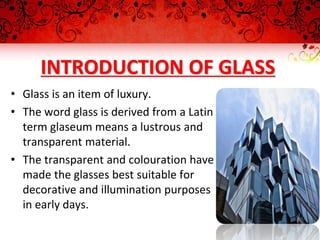
• Glass is an item of luxury.
• The word glass is derived from a Latin
term glaseum means a lustrous and
transparent material.
• The transparent and colouration have
made the glasses best suitable for
decorative and illumination purposes
in early days.
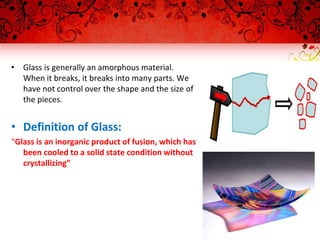
• Glass is generally an amorphous material.
When it breaks, it breaks into many parts. We
have not control over the shape and the size of
the pieces.
• Definition of Glass:
“Glass is an inorganic product of fusion, which has
been cooled to a solid state condition without
crystallizing”
How Can We Cut The Glass:
 In the Middle Ages glass was cut with a
heated and sharply pointed rod of iron.
The Diamond is also a material which can cut
the glass.
 Now days we used different methods to cut
the glass.
There are several methods to cut the glass:-
Wheel Cutting:-
This method is very low price. But If we use this
method then the glass have sharp edges.
Filament cutting / PS
Laser:
It is good for strengthened glass,
capability for free shapes, medium
edge strength.
CO2 Laser
This method offers high edge strength and clean.
PROPERTIES OF GLASSES
THERE ARE DIFFERENT TYPES OF
PROPERTIES:-
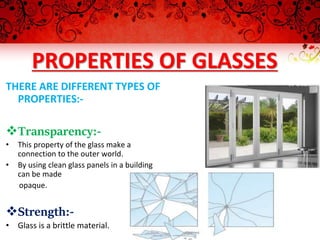
Transparency:-
• This property of the glass make a
connection to the outer world.
• By using clean glass panels in a building
can be made
opaque.
Strength:-
• Glass is a brittle material.
Greenhouse Effect:-
• The greenhouse effect refers to circumstances
where the short wavelengths of visible light from
the sun pass through glass and are absorbed.
Work Ability:
• It can be blown, drawn or pressed.
• It is possible to obtain glass with diversified properties
clear, colourless, diffused and stained.
Recyclable:
• Glass can be recycled indefinitely and not lose its quality.
• Recycled glass is also called cullet.
• Cullet is used as raw materials in glass manufacturing.
• Visible transmittance is the fraction of visible
light that comes through the glass.
• 86% of total solar light can be transferred from
the glass.
• 90% of the total visible light can be transferred
from the glass.
Thermal Expansion:-
• The coefficient of linear thermal expansion is almost
constant, for most types of glass, for temperatures
up to 400~-600°C.
• The actual value depends on the chemical
constitution of the glass.
The Weathering of Glass:-
• A reaction between sodium from the glass and
atmospheric water and carbon dioxide can lead to
the formation of sodium carbonate,which
crystallizes in fine needles.
TYPES OF GLASSES
The different types of glasses are different in their
properties and uses:-
 Soda glass or soda-lime glass
 Coloured glass
 Plate glass
 Safety glass
 Laminated glass
 Optical glass
 Pyrex glass
 Photo-chromatic glass
 Lead crystal glass
SODA GLASS OR SODA-LIME
GLASS
• It is the most common variety of glass.
• It is prepared by heating sodium carbonate and silica.
• It is used for making windowpanes, tableware, bottles and bulbs.
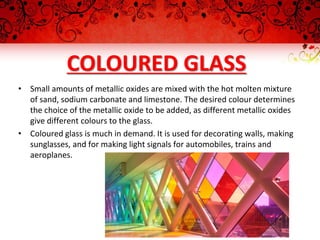
COLOURED GLASS
• Small amounts of metallic oxides are mixed with the hot molten mixture
of sand, sodium carbonate and limestone. The desired colour determines
the choice of the metallic oxide to be added, as different metallic oxides
give different colours to the glass.
• Coloured glass is much in demand. It is used for decorating walls, making
sunglasses, and for making light signals for automobiles, trains and
aeroplanes.
PLATE GLASS
• Plate glass is thicker than ordinary glass. It has a very smooth surface. It is
made by floating a layer of molten glass over a layer of molten tin.
• It is also called Float glass.
• It is used in shop windows and doors.
Another Example Of Float Glass
• The example image above of the Lippo
Center by Paul Rudolph of Wong-
Ouyang ltd ( an Australian), the Lippo
Centre is said to resemble Koala bears
climbing as tree. The building is part
retail and part office spaces, the
innovation was constructed with float
glass and steel.
SAFETY GLASS
• It can also be called shatterproof glass. It is made by placing a sheet of
plastic such as celluloid between sheets of glass. The special quality of this
glass is that in case of breakage the broken pieces stick to the plastic and
do not fly off. You must have noticed a broken window-pane of a bus or a
car still in its place. It is used in automobiles. It is also used for making
bulletproof screens.
LAMINATED GLASS
• It can also be called bulletproof glass. Several layers of safety glass are
bound together with a transparent adhesive. The larger the number of
layers used the greater is the strength of the glass. It is stronger than
safety glass. It is used in aeroplanes and windshields of cars.
OPTICAL GLASS
• Optical glass is softer than any other glass. It is clear and transparent.
Potassium and lead silicates are used in making optical glass. It is also
called flint glass. The main use of flint glass is in the manufacture of
lenses, prisms and other optical instruments.
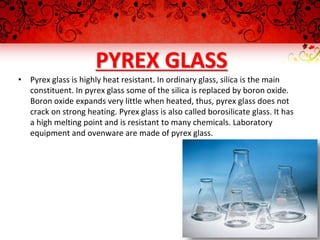
PYREX GLASS
• Pyrex glass is highly heat resistant. In ordinary glass, silica is the main
constituent. In pyrex glass some of the silica is replaced by boron oxide.
Boron oxide expands very little when heated, thus, pyrex glass does not
crack on strong heating. Pyrex glass is also called borosilicate glass. It has
a high melting point and is resistant to many chemicals. Laboratory
equipment and ovenware are made of pyrex glass.
PHOTO-CHROMATIC GLASS
• Photochromatic glass acquires a darker shade when exposed to bright
light and returns to its original lighter shade in dim light. This happens
because silver iodide is added to this glass. (silver iodide gets coloured
with the intensity of light.)
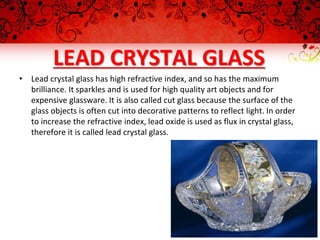
LEAD CRYSTAL GLASS
• Lead crystal glass has high refractive index, and so has the maximum
brilliance. It sparkles and is used for high quality art objects and for
expensive glassware. It is also called cut glass because the surface of the
glass objects is often cut into decorative patterns to reflect light. In order
to increase the refractive index, lead oxide is used as flux in crystal glass,
therefore it is called lead crystal glass.
APPLICATIONS OF GLASS
• Glass is an unlimited and innovative material that has plenty of
applications. It is an essential component of numerous products
that we use every day, most often without noticing it.
• It is clear that modern life would not be possible without glass!
• Packaging (jars for food, bottles for drinks, falcon for cosmetics
and pharmaceuticals).
• Tableware (drinking glasses, plate, cups, bowls)
• Housing and buildings (windows, facades, conservatory, insulation,
reinforcement structures)
• Packaging (jars for food, bottles for drinks,
falcon for cosmetics and pharmaceuticals).
• Tableware (drinking glasses, plate, cups,
bowls)
• Housing and buildings (windows, facades,
conservatory, insulation, reinforcement
structures)
• Interior design and furniture (mirrors,
partitions, balustrades, tables, shelves,
lighting).
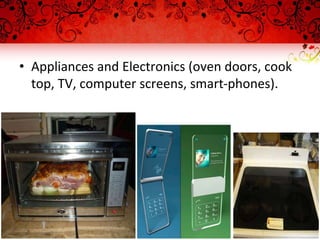
• Appliances and Electronics (oven doors, cook
top, TV, computer screens, smart-phones).
• Automotive and transport (windscreens,
backlights, light weight but reinforced
structural components of cars, aircrafts, ships,
etc.)
• Medical technology, biotechnology, life
science engineering, optical glass
• Radiation protection from X-Rays (radiology)
and gamma-rays (nuclear)
• Renewable energy (solar-energy glass, wind
turbines)
Glass as building material by Anas Khan

Glass as building material by Anas Khan

  • 1.
  • 3.
    INTRODUCTION OF GLASS •Glass is an item of luxury. • The word glass is derived from a Latin term glaseum means a lustrous and transparent material. • The transparent and colouration have made the glasses best suitable for decorative and illumination purposes in early days.
  • 4.
    • Glass isgenerally an amorphous material. When it breaks, it breaks into many parts. We have not control over the shape and the size of the pieces. • Definition of Glass: “Glass is an inorganic product of fusion, which has been cooled to a solid state condition without crystallizing”
  • 5.
    How Can WeCut The Glass:  In the Middle Ages glass was cut with a heated and sharply pointed rod of iron. The Diamond is also a material which can cut the glass.  Now days we used different methods to cut the glass. There are several methods to cut the glass:-
  • 6.
    Wheel Cutting:- This methodis very low price. But If we use this method then the glass have sharp edges.
  • 7.
    Filament cutting /PS Laser: It is good for strengthened glass, capability for free shapes, medium edge strength.
  • 8.
    CO2 Laser This methodoffers high edge strength and clean.
  • 9.
    PROPERTIES OF GLASSES THEREARE DIFFERENT TYPES OF PROPERTIES:- Transparency:- • This property of the glass make a connection to the outer world. • By using clean glass panels in a building can be made opaque. Strength:- • Glass is a brittle material.
  • 10.
    Greenhouse Effect:- • Thegreenhouse effect refers to circumstances where the short wavelengths of visible light from the sun pass through glass and are absorbed.
  • 11.
    Work Ability: • Itcan be blown, drawn or pressed. • It is possible to obtain glass with diversified properties clear, colourless, diffused and stained. Recyclable: • Glass can be recycled indefinitely and not lose its quality. • Recycled glass is also called cullet. • Cullet is used as raw materials in glass manufacturing.
  • 12.
    • Visible transmittanceis the fraction of visible light that comes through the glass. • 86% of total solar light can be transferred from the glass. • 90% of the total visible light can be transferred from the glass.
  • 13.
    Thermal Expansion:- • Thecoefficient of linear thermal expansion is almost constant, for most types of glass, for temperatures up to 400~-600°C. • The actual value depends on the chemical constitution of the glass. The Weathering of Glass:- • A reaction between sodium from the glass and atmospheric water and carbon dioxide can lead to the formation of sodium carbonate,which crystallizes in fine needles.
  • 14.
    TYPES OF GLASSES Thedifferent types of glasses are different in their properties and uses:-  Soda glass or soda-lime glass  Coloured glass  Plate glass  Safety glass  Laminated glass  Optical glass  Pyrex glass  Photo-chromatic glass  Lead crystal glass
  • 15.
    SODA GLASS ORSODA-LIME GLASS • It is the most common variety of glass. • It is prepared by heating sodium carbonate and silica. • It is used for making windowpanes, tableware, bottles and bulbs.
  • 16.
    COLOURED GLASS • Smallamounts of metallic oxides are mixed with the hot molten mixture of sand, sodium carbonate and limestone. The desired colour determines the choice of the metallic oxide to be added, as different metallic oxides give different colours to the glass. • Coloured glass is much in demand. It is used for decorating walls, making sunglasses, and for making light signals for automobiles, trains and aeroplanes.
  • 17.
    PLATE GLASS • Plateglass is thicker than ordinary glass. It has a very smooth surface. It is made by floating a layer of molten glass over a layer of molten tin. • It is also called Float glass. • It is used in shop windows and doors.
  • 18.
    Another Example OfFloat Glass • The example image above of the Lippo Center by Paul Rudolph of Wong- Ouyang ltd ( an Australian), the Lippo Centre is said to resemble Koala bears climbing as tree. The building is part retail and part office spaces, the innovation was constructed with float glass and steel.
  • 19.
    SAFETY GLASS • Itcan also be called shatterproof glass. It is made by placing a sheet of plastic such as celluloid between sheets of glass. The special quality of this glass is that in case of breakage the broken pieces stick to the plastic and do not fly off. You must have noticed a broken window-pane of a bus or a car still in its place. It is used in automobiles. It is also used for making bulletproof screens.
  • 20.
    LAMINATED GLASS • Itcan also be called bulletproof glass. Several layers of safety glass are bound together with a transparent adhesive. The larger the number of layers used the greater is the strength of the glass. It is stronger than safety glass. It is used in aeroplanes and windshields of cars.
  • 21.
    OPTICAL GLASS • Opticalglass is softer than any other glass. It is clear and transparent. Potassium and lead silicates are used in making optical glass. It is also called flint glass. The main use of flint glass is in the manufacture of lenses, prisms and other optical instruments.
  • 22.
    PYREX GLASS • Pyrexglass is highly heat resistant. In ordinary glass, silica is the main constituent. In pyrex glass some of the silica is replaced by boron oxide. Boron oxide expands very little when heated, thus, pyrex glass does not crack on strong heating. Pyrex glass is also called borosilicate glass. It has a high melting point and is resistant to many chemicals. Laboratory equipment and ovenware are made of pyrex glass.
  • 23.
    PHOTO-CHROMATIC GLASS • Photochromaticglass acquires a darker shade when exposed to bright light and returns to its original lighter shade in dim light. This happens because silver iodide is added to this glass. (silver iodide gets coloured with the intensity of light.)
  • 24.
    LEAD CRYSTAL GLASS •Lead crystal glass has high refractive index, and so has the maximum brilliance. It sparkles and is used for high quality art objects and for expensive glassware. It is also called cut glass because the surface of the glass objects is often cut into decorative patterns to reflect light. In order to increase the refractive index, lead oxide is used as flux in crystal glass, therefore it is called lead crystal glass.
  • 25.
    APPLICATIONS OF GLASS •Glass is an unlimited and innovative material that has plenty of applications. It is an essential component of numerous products that we use every day, most often without noticing it. • It is clear that modern life would not be possible without glass! • Packaging (jars for food, bottles for drinks, falcon for cosmetics and pharmaceuticals). • Tableware (drinking glasses, plate, cups, bowls) • Housing and buildings (windows, facades, conservatory, insulation, reinforcement structures)
  • 26.
    • Packaging (jarsfor food, bottles for drinks, falcon for cosmetics and pharmaceuticals).
  • 27.
    • Tableware (drinkingglasses, plate, cups, bowls)
  • 28.
    • Housing andbuildings (windows, facades, conservatory, insulation, reinforcement structures)
  • 29.
    • Interior designand furniture (mirrors, partitions, balustrades, tables, shelves, lighting).
  • 30.
    • Appliances andElectronics (oven doors, cook top, TV, computer screens, smart-phones).
  • 31.
    • Automotive andtransport (windscreens, backlights, light weight but reinforced structural components of cars, aircrafts, ships, etc.)
  • 32.
    • Medical technology,biotechnology, life science engineering, optical glass • Radiation protection from X-Rays (radiology) and gamma-rays (nuclear)
  • 33.
    • Renewable energy(solar-energy glass, wind turbines)