Introduction
•There is a special relationship between glass and
buildings. Glass is a magical material which has so
many different properties and uses, that it has
presented Architects with many new possibilities and
designs.
•Architectural glass is glass that is used as a building
material. It is most typically used as
transparent glazing material in the building envelope,
including windows in the external walls.
•Glass is also used for internal partitions and as an
architectural feature. When used in buildings, glass is
often of a safety type, which include reinforced,
toughened and laminated glasses.
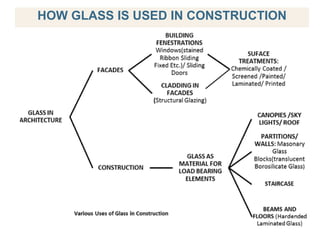
HOW GLASS IS USED IN CONSTRUCTION
PRODUCTION OF GLASS
Making glass is a very ancient process, with archaeological
evidence of glass making dating back to before 2500 BC.
Once a rare and prized art, manufacturing glass has
become a common industry thanks to the Pilkington
process.
Traditionally glass was made by blowing liquid glass
derived by melting sand calcium oxide and sodium
carbonate to extremely high temperatures and the cooling
the liquid to the desired shape. Since a few thousand years
The glass – float glass as we know - is manufactured
by the PPG process. This process was invented by
Sir Alistair Pilkington in 1952 and is the most popular
and widely used process in manufacturing
architectural glass in the world today.
Properties Of Glass
 It is solid and hard material.
 It has disordered and amorphous structure.
 It is fragile and easily breakable into sharp
pieces.
 It is transparent to visible light.
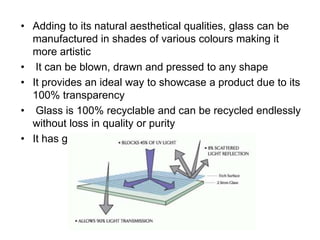
 When light falls on glass,
part of it is reflected at the
surface, part of it is
absorbed in the glass
and part of it is
transmitted.
 It is an biologically inactive material.
 It is recyclable.
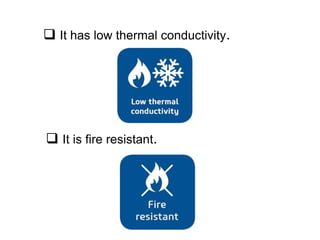
 It has low thermal conductivity.
 It is fire resistant.
 It has dimensional stability.
 The thermal, optical, electrical and
chemical properties of glass vary with its
composition.
 Glass is electrically insulating material; it
does not conduct electricity.
Transparency: This property allows visual connection with
the outside world. Its transparency can be permanently
altered by adding admixtures to the initial batch mix. By the
advent of technology clear glass panels used in buildings can
be made opaque. (Electro chromatic glazing)
U value: The U-value is the measure of how much heat is
transferred through the window. The lower the U-value the
better the insulation properties of the glass– the better it is at
keeping the heat or cold out.
Strength: Glass is a brittle material but with the advent of
science and technology, certain laminates and admixtures can
increase its modulus of rupture( ability to resist deformation
under load).
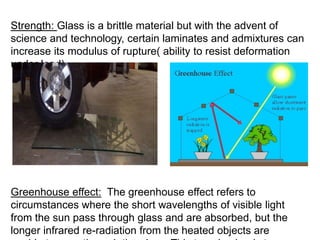
Greenhouse effect: The greenhouse effect refers to
circumstances where the short wavelengths of visible light
from the sun pass through glass and are absorbed, but the
longer infrared re-radiation from the heated objects are
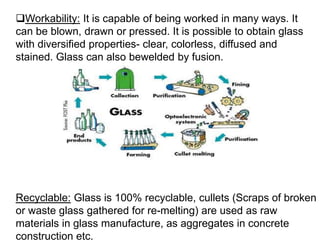
Workability: It is capable of being worked in many ways. It
can be blown, drawn or pressed. It is possible to obtain glass
with diversified properties- clear, colorless, diffused and
stained. Glass can also bewelded by fusion.
Recyclable: Glass is 100% recyclable, cullets (Scraps of broken
or waste glass gathered for re-melting) are used as raw
materials in glass manufacture, as aggregates in concrete
construction etc.
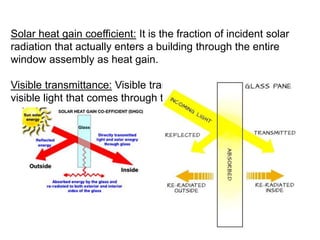
Solar heat gain coefficient: It is the fraction of incident solar
radiation that actually enters a building through the entire
window assembly as heat gain.
Visible transmittance: Visible transmittance is the fraction of
visible light that comes through the glass.
TYPES OF GLASS
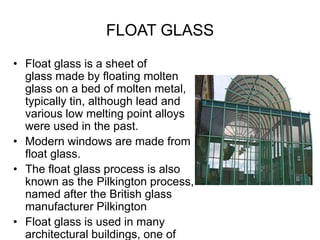
FLOAT GLASS
• Float glass is a sheet of
glass made by floating molten
glass on a bed of molten metal,
typically tin, although lead and
various low melting point alloys
were used in the past.
• Modern windows are made from
float glass.
• The float glass process is also
known as the Pilkington process,
named after the British glass
manufacturer Pilkington
• Float glass is used in many
architectural buildings, one of
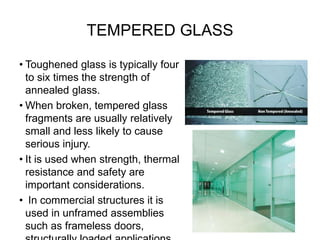
TEMPERED GLASS
• Toughened glass is typically four
to six times the strength of
annealed glass.
• When broken, tempered glass
fragments are usually relatively
small and less likely to cause
serious injury.
• It is used when strength, thermal
resistance and safety are
important considerations.
• In commercial structures it is
used in unframed assemblies
such as frameless doors,
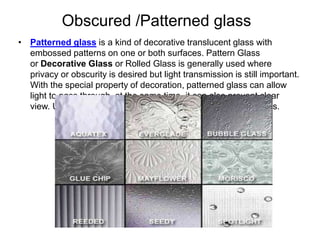
Obscured /Patterned glass
• Patterned glass is a kind of decorative translucent glass with
embossed patterns on one or both surfaces. Pattern Glass
or Decorative Glass or Rolled Glass is generally used where
privacy or obscurity is desired but light transmission is still important.
With the special property of decoration, patterned glass can allow
light to pass through, at the same time, it can also prevent clear
view. Usually it transmits only slightly less light than clear glass.
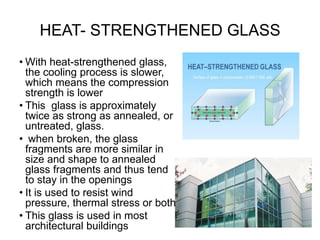
HEAT- STRENGTHENED GLASS
• With heat-strengthened glass,
the cooling process is slower,
which means the compression
strength is lower
• This glass is approximately
twice as strong as annealed, or
untreated, glass.
• when broken, the glass
fragments are more similar in
size and shape to annealed
glass fragments and thus tend
to stay in the openings
• It is used to resist wind
pressure, thermal stress or both
• This glass is used in most
architectural buildings
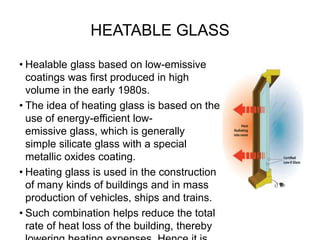
HEATABLE GLASS
• Healable glass based on low-emissive
coatings was first produced in high
volume in the early 1980s.
• The idea of heating glass is based on the
use of energy-efficient low-
emissive glass, which is generally
simple silicate glass with a special
metallic oxides coating.
• Heating glass is used in the construction
of many kinds of buildings and in mass
production of vehicles, ships and trains.
• Such combination helps reduce the total
rate of heat loss of the building, thereby
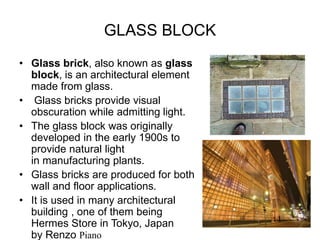
GLASS BLOCK
• Glass brick, also known as glass
block, is an architectural element
made from glass.
• Glass bricks provide visual
obscuration while admitting light.
• The glass block was originally
developed in the early 1900s to
provide natural light
in manufacturing plants.
• Glass bricks are produced for both
wall and floor applications.
• It is used in many architectural
building , one of them being
Hermes Store in Tokyo, Japan
by Renzo Piano
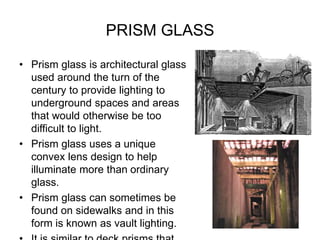
PRISM GLASS
• Prism glass is architectural glass
used around the turn of the
century to provide lighting to
underground spaces and areas
that would otherwise be too
difficult to light.
• Prism glass uses a unique
convex lens design to help
illuminate more than ordinary
glass.
• Prism glass can sometimes be
found on sidewalks and in this
form is known as vault lighting.
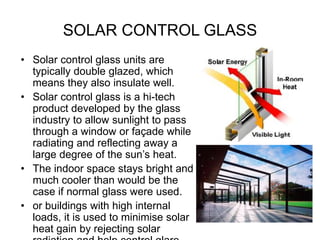
SOLAR CONTROL GLASS
• Solar control glass units are
typically double glazed, which
means they also insulate well.
• Solar control glass is a hi-tech
product developed by the glass
industry to allow sunlight to pass
through a window or façade while
radiating and reflecting away a
large degree of the sun’s heat.
• The indoor space stays bright and
much cooler than would be the
case if normal glass were used.
• or buildings with high internal
loads, it is used to minimise solar
heat gain by rejecting solar
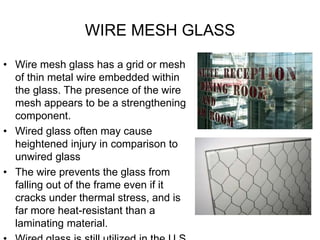
WIRE MESH GLASS
• Wire mesh glass has a grid or mesh
of thin metal wire embedded within
the glass. The presence of the wire
mesh appears to be a strengthening
component.
• Wired glass often may cause
heightened injury in comparison to
unwired glass
• The wire prevents the glass from
falling out of the frame even if it
cracks under thermal stress, and is
far more heat-resistant than a
laminating material.
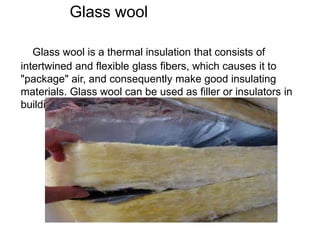
Glass wool
Glass wool is a thermal insulation that consists of
intertwined and flexible glass fibers, which causes it to
"package" air, and consequently make good insulating
materials. Glass wool can be used as filler or insulators in
buildings, also for soundproofing.
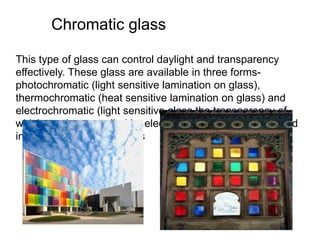
Chromatic glass
This type of glass can control daylight and transparency
effectively. These glass are available in three forms-
photochromatic (light sensitive lamination on glass),
thermochromatic (heat sensitive lamination on glass) and
electrochromatic (light sensitive glass the transparency of
which can be controlled by electricity switch.) It can be used
in meeting rooms and ICUs
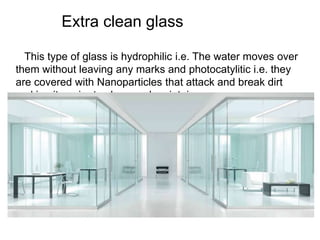
Extra clean glass
This type of glass is hydrophilic i.e. The water moves over
them without leaving any marks and photocatylitic i.e. they
are covered with Nanoparticles that attack and break dirt
making it easier to clean and maintain.
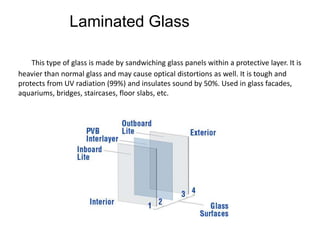
Laminated Glass
This type of glass is made by sandwiching glass panels within a protective layer. It is
heavier than normal glass and may cause optical distortions as well. It is tough and
protects from UV radiation (99%) and insulates sound by 50%. Used in glass facades,
aquariums, bridges, staircases, floor slabs, etc.
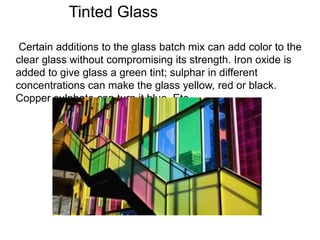
Tinted Glass
Certain additions to the glass batch mix can add color to the
clear glass without compromising its strength. Iron oxide is
added to give glass a green tint; sulphar in different
concentrations can make the glass yellow, red or black.
Copper sulphate can turn it blue. Etc
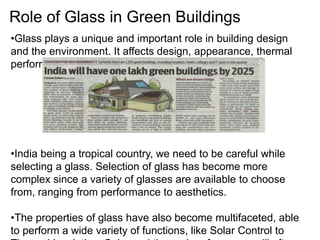
Role of Glass in Green Buildings
•Glass plays a unique and important role in building design
and the environment. It affects design, appearance, thermal
performance and occupant comfort. T
•India being a tropical country, we need to be careful while
selecting a glass. Selection of glass has become more
complex since a variety of glasses are available to choose
from, ranging from performance to aesthetics.
•The properties of glass have also become multifaceted, able
to perform a wide variety of functions, like Solar Control to
Use in facade
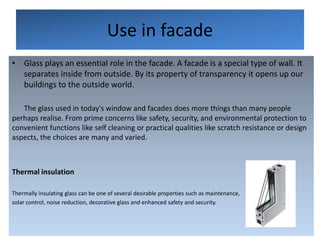
• Glass plays an essential role in the facade. A facade is a special type of wall. It
separates inside from outside. By its property of transparency it opens up our
buildings to the outside world.
The glass used in today's window and facades does more things than many people
perhaps realise. From prime concerns like safety, security, and environmental protection to
convenient functions like self cleaning or practical qualities like scratch resistance or design
aspects, the choices are many and varied.
Thermal insulation
Thermally insulating glass can be one of several desirable properties such as maintenance,
solar control, noise reduction, decorative glass and enhanced safety and security.
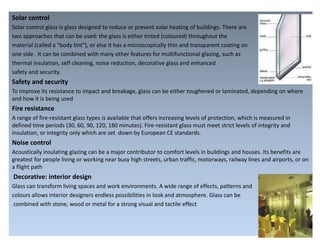
Solar control
Solar control glass is glass designed to reduce or prevent solar heating of buildings. There are
two approaches that can be used: the glass is either tinted (coloured) throughout the
material (called a "body tint"), or else it has a microscopically thin and transparent coating on
one side . It can be combined with many other features for multifunctional glazing, such as
thermal insulation, self cleaning, noise reduction, decorative glass and enhanced
safety and security.
Safety and security
To improve its resistance to impact and breakage, glass can be either toughened or laminated, depending on where
and how it is being used
Fire resistance
A range of fire-resistant glass types is available that offers increasing levels of protection, which is measured in
defined time periods (30, 60, 90, 120, 180 minutes). Fire-resistant glass must meet strict levels of integrity and
insulation, or integrity only which are set down by European CE standards.
Noise control
Acoustically insulating glazing can be a major contributor to comfort levels in buildings and houses. Its benefits are
greatest for people living or working near busy high streets, urban traffic, motorways, railway lines and airports, or on
a flight path
Decorative: interior design
Glass can transform living spaces and work environments. A wide range of effects, patterns and
colours allows interior designers endless possibilities in look and atmosphere. Glass can be
combined with stone, wood or metal for a strong visual and tactile effect
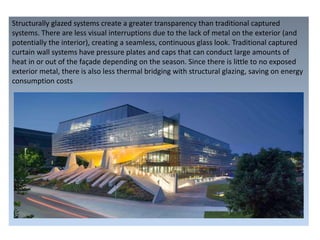
Structurally glazed systems create a greater transparency than traditional captured
systems. There are less visual interruptions due to the lack of metal on the exterior (and
potentially the interior), creating a seamless, continuous glass look. Traditional captured
curtain wall systems have pressure plates and caps that can conduct large amounts of
heat in or out of the façade depending on the season. Since there is little to no exposed
exterior metal, there is also less thermal bridging with structural glazing, saving on energy
consumption costs
Glass is a material for aesthetics and not for structural theory: Glass load-bearing structures contradict this
assumption. They enhance the glass facade with glass structures and help to create totally transparent rooms
Glass has taken on new life in recent building years. Long valued for its transparency and lightness, glass is now
also being considered for its structural and protective capabilities.
“When glass is load bearing it can serve three roles at
once: structure, envelope, and transparency,” says Mark
DUBOIS.
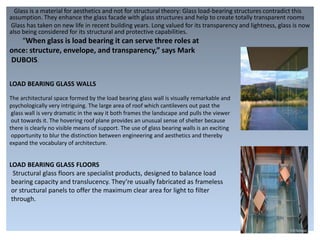
LOAD BEARING GLASS WALLS
The architectural space formed by the load bearing glass wall is visually remarkable and
psychologically very intriguing. The large area of roof which cantilevers out past the
glass wall is very dramatic in the way it both frames the landscape and pulls the viewer
out towards it. The hovering roof plane provides an unusual sense of shelter because
there is clearly no visible means of support. The use of glass bearing walls is an exciting
opportunity to blur the distinction between engineering and aesthetics and thereby
expand the vocabulary of architecture.
LOAD BEARING GLASS FLOORS
Structural glass floors are specialist products, designed to balance load
bearing capacity and translucency. They’re usually fabricated as frameless
or structural panels to offer the maximum clear area for light to filter
through.
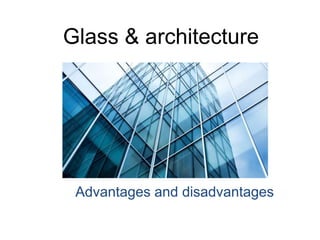
Glass & architecture
Advantages and disadvantages
advantages
• Use of glass adds beauty to the building. It makes it
more aesthetically pleasing
• Installation of glass ensures ample supply of natural
daylight which makes the construction more sustainable
• Glass tends to have great weather resistance. It shows
no significant loss of quality due to exposure to the
weather conditions through all the seasons
• Unlike metals, which are also used in building
construction, glass does not rust by exposure to humidity
and air.
• Cleaning of glass is a rather easy when compared to
other building materials
• usage of glass ensures passage of natural light even
• Adding to its natural aesthetical qualities, glass can be
manufactured in shades of various colours making it
more artistic
• It can be blown, drawn and pressed to any shape
• It provides an ideal way to showcase a product due to its
100% transparency
• Glass is 100% recyclable and can be recycled endlessly
without loss in quality or purity
• It has got no problem with UV degradation
• Glass has got Excellent abrasion resistance
• Glass shows high stability over a wide range of
temperature
• It is unaffected by air, water and most of the acids.
• Its use fulfils the architectural view for external
decoration
• By using glass in interior, it saves the space inside
the building
• Conserves heat and protects against outside
Disadvantages
• An expensive Material. So, increase the cost of building
• Breaks Easily, Very Rigid and Brittle
• When broken, the pieces may be sharp, injuries
• Less impact resistance
• It is affected by some alkalis
• It is affected by hydrofluoric acid.
• Use of glass also enhances the cost of security
• Glass is also unsafe for earthquake proven area
• Glass is poor in terms of heat preservation, leading to
higher costs in the operation of air-conditioners
• Glass absorbs heat and hence act as a greenhouse and
hence not suitable in warm and hot climates. It will
increase AC load and more energy consideration for air
conditioning.
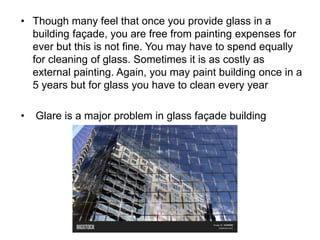
• Though many feel that once you provide glass in a
building façade, you are free from painting expenses for
ever but this is not fine. You may have to spend equally
for cleaning of glass. Sometimes it is as costly as
external painting. Again, you may paint building once in a
5 years but for glass you have to clean every year
• Glare is a major problem in glass façade building
PLASTIC
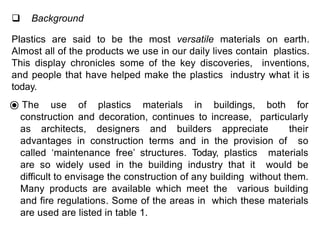
 Background
Plastics are said to be the most versatile materials on earth.
Almost all of the products we use in our daily lives contain plastics.
This display chronicles some of the key discoveries, inventions,
and people that have helped make the plastics industry what it is
today.
⦿ The use of plastics materials in buildings, both for
construction and decoration, continues to increase, particularly
as architects, designers and builders appreciate their
advantages in construction terms and in the provision of so
called ‘maintenance free’ structures. Today, plastics materials
are so widely used in the building industry that it would be
difficult to envisage the construction of any building without them.
Many products are available which meet the various building
and fire regulations. Some of the areas in which these materials
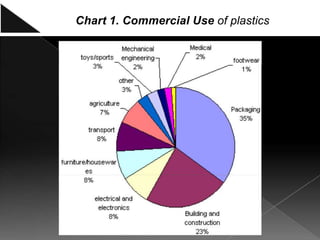
are used are listed in table 1.
Chart 1. Commercial Use of plastics
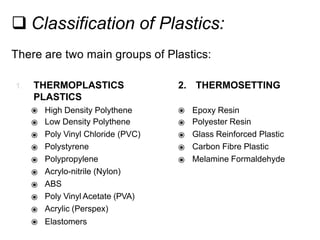
 Classification of Plastics:
There are two main groups of Plastics:
1. THERMOPLASTICS 2. THERMOSETTING
PLASTICS
⦿ High Density Polythene ⦿ Epoxy Resin
⦿ Low Density Polythene ⦿ Polyester Resin
⦿ Poly Vinyl Chloride (PVC) ⦿ Glass Reinforced Plastic
⦿ Polystyrene ⦿ Carbon Fibre Plastic
⦿ Polypropylene ⦿ Melamine Formaldehyde
⦿ Acrylo-nitrile (Nylon)
⦿ ABS
⦿ Poly Vinyl Acetate (PVA)
⦿ Acrylic (Perspex)
⦿ Elastomers
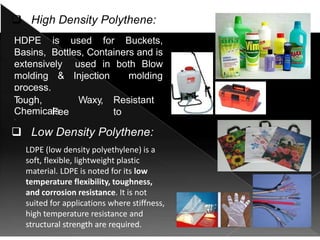
 High Density Polythene:
HDPE is used for Buckets,
Basins, Bottles, Containers and is
extensively used in both Blow
molding & Injection molding
process.
Properties:
T
ough,
Fee
ls
Waxy, Resistant
to
Chemicals
 Low Density Polythene:
 Polyolefins (LDPE, HDPE,
PP) are a major type of
thermoplastic.
LDPE (low density polyethylene) is a
soft, flexible, lightweight plastic
material. LDPE is noted for its low
temperature flexibility, toughness,
and corrosion resistance. It is not
suited for applications where stiffness,
high temperature resistance and
structural strength are required.
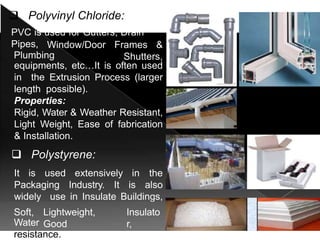
 Polyvinyl Chloride:
PVC is used for Gutters, Drain
Pipes,
Plumbing
Fixtur
es,
Window/Door Frames &
Shutters,
Furniture
equipments, etc…It is often used
in the Extrusion Process (larger
length possible).
Properties:
Rigid, Water & Weather Resistant,
Light Weight, Ease of fabrication
& Installation.
 Polystyrene:
It is used extensively in the
Packaging Industry. It is also
widely use in Insulate Buildings,
in Refrigerators, etc…
Properties:
Soft, Lightweight,
Good
Insulato
r,
Water
resistance.
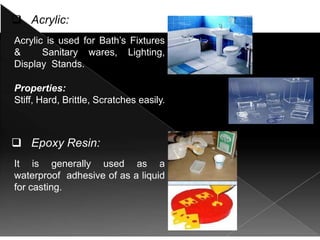
 Acrylic:
Acrylic is used for Bath’s Fixtures
& Sanitary wares, Lighting,
Display Stands.
Properties:
Stiff, Hard, Brittle, Scratches easily.
 Epoxy Resin:
It is generally used as a
waterproof adhesive of as a liquid
for casting.
Properties:
Strong (When Reinforced), Clear.
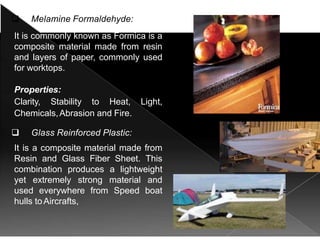
 Melamine Formaldehyde:
It is commonly known as Formica is a
composite material made from resin
and layers of paper, commonly used
for worktops.
Properties:
Clarity, Stability to Heat, Light,
Chemicals,Abrasion and Fire.
 Glass Reinforced Plastic:
It is a composite material made from
Resin and Glass Fiber Sheet. This
combination produces a lightweight
yet extremely strong material and
used everywhere from Speed boat
hulls toAircrafts,
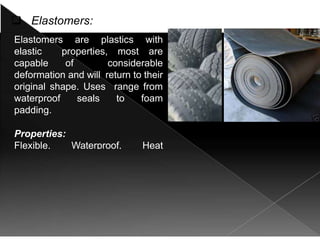
 Elastomers:
Elastomers are plastics with
elastic properties, most are
capable of considerable
deformation and will return to their
original shape. Uses range from
waterproof seals to foam
padding.
Properties:
Flexible, Waterproof, Heat
resistant.
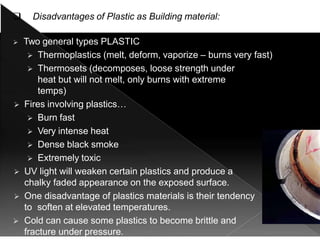
 Disadvantages of Plastic as Building material:
 Two general types PLASTIC
 Thermoplastics (melt, deform, vaporize – burns very fast)
 Thermosets (decomposes, loose strength under
heat but will not melt, only burns with extreme
temps)
 Fires involving plastics…
 Burn fast
 Very intense heat
 Dense black smoke
 Extremely toxic
 UV light will weaken certain plastics and produce a
chalky faded appearance on the exposed surface.
 One disadvantage of plastics materials is their tendency
to soften at elevated temperatures.
 Cold can cause some plastics to become brittle and
fracture under pressure.
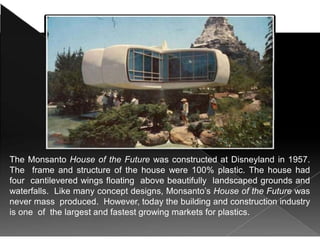
The Monsanto House of the Future was constructed at Disneyland in 1957.
The frame and structure of the house were 100% plastic. The house had
four cantilevered wings floating above beautifully landscaped grounds and
waterfalls. Like many concept designs, Monsanto’s House of the Future was
never mass produced. However, today the building and construction industry
is one of the largest and fastest growing markets for plastics.
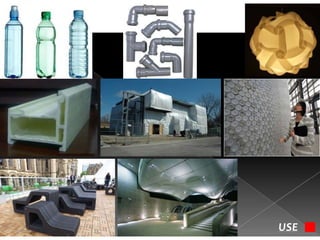
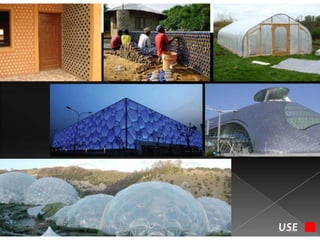
USE
USE
USES OF PLASTIC
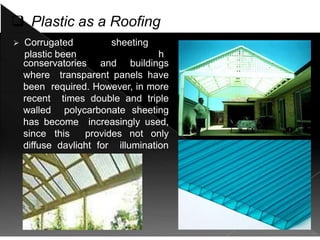
 Plastic as a Roofing
Systems:
 Corrugated
plastic been
used for
sheeting
h
as roofing
in
conservatories and buildings
where transparent panels have
been required. However, in more
recent times double and triple
walled polycarbonate sheeting
has become increasingly used,
since this provides not only
diffuse daylight for illumination
but also heat insulation and
hence reduced heating costs.
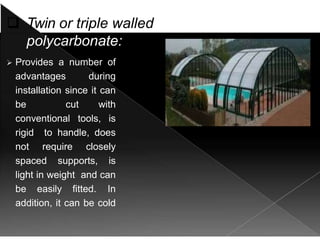
 Twin or triple walled
polycarbonate:
 Provides a number of
advantages during
installation since it can
be cut with
conventional tools, is
rigid to handle, does
not require closely
spaced supports, is
light in weight and can
be easily fitted. In
addition, it can be cold
formed or
thermoformed into a
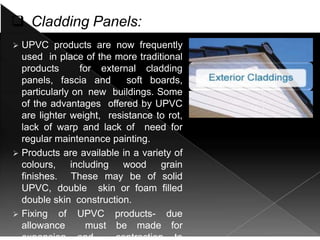
 Cladding Panels:
 UPVC products are now frequently
used in place of the more traditional
products for external cladding
panels, fascia and soft boards,
particularly on new buildings. Some
of the advantages offered by UPVC
are lighter weight, resistance to rot,
lack of warp and lack of need for
regular maintenance painting.
 Products are available in a variety of
colours, including wood grain
finishes. These may be of solid
UPVC, double skin or foam filled
double skin construction.
 Fixing of UPVC products- due
allowance must be made for
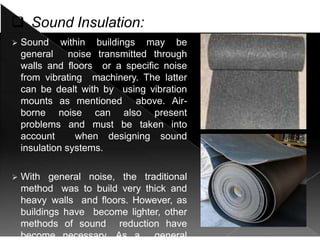
 Sound Insulation:
 Sound within buildings may be
general noise transmitted through
walls and floors or a specific noise
from vibrating machinery. The latter
can be dealt with by using vibration
mounts as mentioned above. Air-
borne noise can also present
problems and must be taken into
account when designing sound
insulation systems.
 With general noise, the traditional
method was to build very thick and
heavy walls and floors. However, as
buildings have become lighter, other
methods of sound reduction have
become necessary. As a general
 Thermal Insulation:
 As well as sound insulation,
buildings need thermal insulation
also. This can be
met
b
y
concret
e
using light weight
aerated building
block
s
of
th
e
during
th
e
or by
constructio
n
incorporatin
g
foam
ed within the
structure.
buildin
g
plastic
Typical
sheetin
g
foame
d
plastics include rigid polyurethane
foam and expanded polystyrene,
although various other foamed
plastics may also be used.
 Plasterboard can be readily obtained
with a 25 mm foamed polystyrene
backing. Other composite sheet
building products can be obtained
with polyurethane foam cores. They
can be kept clean with very little
effort.
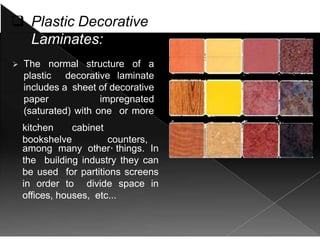
 Plastic Decorative
Laminates:
 The normal structure of a
plastic decorative laminate
includes a sheet of decorative
paper impregnated
(saturated) with one or more
resins.
 Plastic decorative laminates
have a wide range of uses,
they can be used in the
furniture industry for
kitchen
bookshelve
s
cabinet
counters,
and door
linings,
among many other things. In
the building industry they can
be used for partitions screens
in order to divide space in
offices, houses, etc...

BUILDING_MATERIAL_glass.pptx

  • 2.
    Introduction •There is aspecial relationship between glass and buildings. Glass is a magical material which has so many different properties and uses, that it has presented Architects with many new possibilities and designs. •Architectural glass is glass that is used as a building material. It is most typically used as transparent glazing material in the building envelope, including windows in the external walls. •Glass is also used for internal partitions and as an architectural feature. When used in buildings, glass is often of a safety type, which include reinforced, toughened and laminated glasses.
  • 3.
    HOW GLASS ISUSED IN CONSTRUCTION
  • 4.
    PRODUCTION OF GLASS Makingglass is a very ancient process, with archaeological evidence of glass making dating back to before 2500 BC. Once a rare and prized art, manufacturing glass has become a common industry thanks to the Pilkington process. Traditionally glass was made by blowing liquid glass derived by melting sand calcium oxide and sodium carbonate to extremely high temperatures and the cooling the liquid to the desired shape. Since a few thousand years
  • 5.
    The glass –float glass as we know - is manufactured by the PPG process. This process was invented by Sir Alistair Pilkington in 1952 and is the most popular and widely used process in manufacturing architectural glass in the world today.
  • 6.
    Properties Of Glass It is solid and hard material.  It has disordered and amorphous structure.  It is fragile and easily breakable into sharp pieces.  It is transparent to visible light.  When light falls on glass, part of it is reflected at the surface, part of it is absorbed in the glass and part of it is transmitted.
  • 7.
     It isan biologically inactive material.  It is recyclable.
  • 8.
     It haslow thermal conductivity.  It is fire resistant.
  • 9.
     It hasdimensional stability.  The thermal, optical, electrical and chemical properties of glass vary with its composition.  Glass is electrically insulating material; it does not conduct electricity.
  • 10.
    Transparency: This propertyallows visual connection with the outside world. Its transparency can be permanently altered by adding admixtures to the initial batch mix. By the advent of technology clear glass panels used in buildings can be made opaque. (Electro chromatic glazing) U value: The U-value is the measure of how much heat is transferred through the window. The lower the U-value the better the insulation properties of the glass– the better it is at keeping the heat or cold out.
  • 11.
    Strength: Glass isa brittle material but with the advent of science and technology, certain laminates and admixtures can increase its modulus of rupture( ability to resist deformation under load). Greenhouse effect: The greenhouse effect refers to circumstances where the short wavelengths of visible light from the sun pass through glass and are absorbed, but the longer infrared re-radiation from the heated objects are
  • 12.
    Workability: It iscapable of being worked in many ways. It can be blown, drawn or pressed. It is possible to obtain glass with diversified properties- clear, colorless, diffused and stained. Glass can also bewelded by fusion. Recyclable: Glass is 100% recyclable, cullets (Scraps of broken or waste glass gathered for re-melting) are used as raw materials in glass manufacture, as aggregates in concrete construction etc.
  • 13.
    Solar heat gaincoefficient: It is the fraction of incident solar radiation that actually enters a building through the entire window assembly as heat gain. Visible transmittance: Visible transmittance is the fraction of visible light that comes through the glass.
  • 14.
  • 15.
    FLOAT GLASS • Floatglass is a sheet of glass made by floating molten glass on a bed of molten metal, typically tin, although lead and various low melting point alloys were used in the past. • Modern windows are made from float glass. • The float glass process is also known as the Pilkington process, named after the British glass manufacturer Pilkington • Float glass is used in many architectural buildings, one of
  • 16.
    TEMPERED GLASS • Toughenedglass is typically four to six times the strength of annealed glass. • When broken, tempered glass fragments are usually relatively small and less likely to cause serious injury. • It is used when strength, thermal resistance and safety are important considerations. • In commercial structures it is used in unframed assemblies such as frameless doors,
  • 17.
    Obscured /Patterned glass •Patterned glass is a kind of decorative translucent glass with embossed patterns on one or both surfaces. Pattern Glass or Decorative Glass or Rolled Glass is generally used where privacy or obscurity is desired but light transmission is still important. With the special property of decoration, patterned glass can allow light to pass through, at the same time, it can also prevent clear view. Usually it transmits only slightly less light than clear glass.
  • 18.
    HEAT- STRENGTHENED GLASS •With heat-strengthened glass, the cooling process is slower, which means the compression strength is lower • This glass is approximately twice as strong as annealed, or untreated, glass. • when broken, the glass fragments are more similar in size and shape to annealed glass fragments and thus tend to stay in the openings • It is used to resist wind pressure, thermal stress or both • This glass is used in most architectural buildings
  • 19.
    HEATABLE GLASS • Healableglass based on low-emissive coatings was first produced in high volume in the early 1980s. • The idea of heating glass is based on the use of energy-efficient low- emissive glass, which is generally simple silicate glass with a special metallic oxides coating. • Heating glass is used in the construction of many kinds of buildings and in mass production of vehicles, ships and trains. • Such combination helps reduce the total rate of heat loss of the building, thereby
  • 20.
    GLASS BLOCK • Glassbrick, also known as glass block, is an architectural element made from glass. • Glass bricks provide visual obscuration while admitting light. • The glass block was originally developed in the early 1900s to provide natural light in manufacturing plants. • Glass bricks are produced for both wall and floor applications. • It is used in many architectural building , one of them being Hermes Store in Tokyo, Japan by Renzo Piano
  • 21.
    PRISM GLASS • Prismglass is architectural glass used around the turn of the century to provide lighting to underground spaces and areas that would otherwise be too difficult to light. • Prism glass uses a unique convex lens design to help illuminate more than ordinary glass. • Prism glass can sometimes be found on sidewalks and in this form is known as vault lighting.
  • 22.
    SOLAR CONTROL GLASS •Solar control glass units are typically double glazed, which means they also insulate well. • Solar control glass is a hi-tech product developed by the glass industry to allow sunlight to pass through a window or façade while radiating and reflecting away a large degree of the sun’s heat. • The indoor space stays bright and much cooler than would be the case if normal glass were used. • or buildings with high internal loads, it is used to minimise solar heat gain by rejecting solar
  • 23.
    WIRE MESH GLASS •Wire mesh glass has a grid or mesh of thin metal wire embedded within the glass. The presence of the wire mesh appears to be a strengthening component. • Wired glass often may cause heightened injury in comparison to unwired glass • The wire prevents the glass from falling out of the frame even if it cracks under thermal stress, and is far more heat-resistant than a laminating material.
  • 24.
    Glass wool Glass woolis a thermal insulation that consists of intertwined and flexible glass fibers, which causes it to "package" air, and consequently make good insulating materials. Glass wool can be used as filler or insulators in buildings, also for soundproofing.
  • 25.
    Chromatic glass This typeof glass can control daylight and transparency effectively. These glass are available in three forms- photochromatic (light sensitive lamination on glass), thermochromatic (heat sensitive lamination on glass) and electrochromatic (light sensitive glass the transparency of which can be controlled by electricity switch.) It can be used in meeting rooms and ICUs
  • 26.
    Extra clean glass Thistype of glass is hydrophilic i.e. The water moves over them without leaving any marks and photocatylitic i.e. they are covered with Nanoparticles that attack and break dirt making it easier to clean and maintain.
  • 27.
    Laminated Glass This typeof glass is made by sandwiching glass panels within a protective layer. It is heavier than normal glass and may cause optical distortions as well. It is tough and protects from UV radiation (99%) and insulates sound by 50%. Used in glass facades, aquariums, bridges, staircases, floor slabs, etc.
  • 28.
    Tinted Glass Certain additionsto the glass batch mix can add color to the clear glass without compromising its strength. Iron oxide is added to give glass a green tint; sulphar in different concentrations can make the glass yellow, red or black. Copper sulphate can turn it blue. Etc
  • 29.
    Role of Glassin Green Buildings •Glass plays a unique and important role in building design and the environment. It affects design, appearance, thermal performance and occupant comfort. T •India being a tropical country, we need to be careful while selecting a glass. Selection of glass has become more complex since a variety of glasses are available to choose from, ranging from performance to aesthetics. •The properties of glass have also become multifaceted, able to perform a wide variety of functions, like Solar Control to
  • 30.
    Use in facade •Glass plays an essential role in the facade. A facade is a special type of wall. It separates inside from outside. By its property of transparency it opens up our buildings to the outside world. The glass used in today's window and facades does more things than many people perhaps realise. From prime concerns like safety, security, and environmental protection to convenient functions like self cleaning or practical qualities like scratch resistance or design aspects, the choices are many and varied. Thermal insulation Thermally insulating glass can be one of several desirable properties such as maintenance, solar control, noise reduction, decorative glass and enhanced safety and security.
  • 31.
    Solar control Solar controlglass is glass designed to reduce or prevent solar heating of buildings. There are two approaches that can be used: the glass is either tinted (coloured) throughout the material (called a "body tint"), or else it has a microscopically thin and transparent coating on one side . It can be combined with many other features for multifunctional glazing, such as thermal insulation, self cleaning, noise reduction, decorative glass and enhanced safety and security. Safety and security To improve its resistance to impact and breakage, glass can be either toughened or laminated, depending on where and how it is being used Fire resistance A range of fire-resistant glass types is available that offers increasing levels of protection, which is measured in defined time periods (30, 60, 90, 120, 180 minutes). Fire-resistant glass must meet strict levels of integrity and insulation, or integrity only which are set down by European CE standards. Noise control Acoustically insulating glazing can be a major contributor to comfort levels in buildings and houses. Its benefits are greatest for people living or working near busy high streets, urban traffic, motorways, railway lines and airports, or on a flight path Decorative: interior design Glass can transform living spaces and work environments. A wide range of effects, patterns and colours allows interior designers endless possibilities in look and atmosphere. Glass can be combined with stone, wood or metal for a strong visual and tactile effect
  • 32.
    Structurally glazed systemscreate a greater transparency than traditional captured systems. There are less visual interruptions due to the lack of metal on the exterior (and potentially the interior), creating a seamless, continuous glass look. Traditional captured curtain wall systems have pressure plates and caps that can conduct large amounts of heat in or out of the façade depending on the season. Since there is little to no exposed exterior metal, there is also less thermal bridging with structural glazing, saving on energy consumption costs
  • 33.
    Glass is amaterial for aesthetics and not for structural theory: Glass load-bearing structures contradict this assumption. They enhance the glass facade with glass structures and help to create totally transparent rooms Glass has taken on new life in recent building years. Long valued for its transparency and lightness, glass is now also being considered for its structural and protective capabilities. “When glass is load bearing it can serve three roles at once: structure, envelope, and transparency,” says Mark DUBOIS. LOAD BEARING GLASS WALLS The architectural space formed by the load bearing glass wall is visually remarkable and psychologically very intriguing. The large area of roof which cantilevers out past the glass wall is very dramatic in the way it both frames the landscape and pulls the viewer out towards it. The hovering roof plane provides an unusual sense of shelter because there is clearly no visible means of support. The use of glass bearing walls is an exciting opportunity to blur the distinction between engineering and aesthetics and thereby expand the vocabulary of architecture. LOAD BEARING GLASS FLOORS Structural glass floors are specialist products, designed to balance load bearing capacity and translucency. They’re usually fabricated as frameless or structural panels to offer the maximum clear area for light to filter through.
  • 34.
  • 35.
    advantages • Use ofglass adds beauty to the building. It makes it more aesthetically pleasing • Installation of glass ensures ample supply of natural daylight which makes the construction more sustainable • Glass tends to have great weather resistance. It shows no significant loss of quality due to exposure to the weather conditions through all the seasons • Unlike metals, which are also used in building construction, glass does not rust by exposure to humidity and air. • Cleaning of glass is a rather easy when compared to other building materials • usage of glass ensures passage of natural light even
  • 36.
    • Adding toits natural aesthetical qualities, glass can be manufactured in shades of various colours making it more artistic • It can be blown, drawn and pressed to any shape • It provides an ideal way to showcase a product due to its 100% transparency • Glass is 100% recyclable and can be recycled endlessly without loss in quality or purity • It has got no problem with UV degradation
  • 37.
    • Glass hasgot Excellent abrasion resistance • Glass shows high stability over a wide range of temperature • It is unaffected by air, water and most of the acids. • Its use fulfils the architectural view for external decoration • By using glass in interior, it saves the space inside the building • Conserves heat and protects against outside
  • 38.
    Disadvantages • An expensiveMaterial. So, increase the cost of building • Breaks Easily, Very Rigid and Brittle • When broken, the pieces may be sharp, injuries • Less impact resistance • It is affected by some alkalis • It is affected by hydrofluoric acid.
  • 39.
    • Use ofglass also enhances the cost of security • Glass is also unsafe for earthquake proven area • Glass is poor in terms of heat preservation, leading to higher costs in the operation of air-conditioners • Glass absorbs heat and hence act as a greenhouse and hence not suitable in warm and hot climates. It will increase AC load and more energy consideration for air conditioning.
  • 40.
    • Though manyfeel that once you provide glass in a building façade, you are free from painting expenses for ever but this is not fine. You may have to spend equally for cleaning of glass. Sometimes it is as costly as external painting. Again, you may paint building once in a 5 years but for glass you have to clean every year • Glare is a major problem in glass façade building
  • 41.
  • 42.
     Background Plastics aresaid to be the most versatile materials on earth. Almost all of the products we use in our daily lives contain plastics. This display chronicles some of the key discoveries, inventions, and people that have helped make the plastics industry what it is today. ⦿ The use of plastics materials in buildings, both for construction and decoration, continues to increase, particularly as architects, designers and builders appreciate their advantages in construction terms and in the provision of so called ‘maintenance free’ structures. Today, plastics materials are so widely used in the building industry that it would be difficult to envisage the construction of any building without them. Many products are available which meet the various building and fire regulations. Some of the areas in which these materials are used are listed in table 1.
  • 43.
    Chart 1. CommercialUse of plastics
  • 44.
     Classification ofPlastics: There are two main groups of Plastics: 1. THERMOPLASTICS 2. THERMOSETTING PLASTICS ⦿ High Density Polythene ⦿ Epoxy Resin ⦿ Low Density Polythene ⦿ Polyester Resin ⦿ Poly Vinyl Chloride (PVC) ⦿ Glass Reinforced Plastic ⦿ Polystyrene ⦿ Carbon Fibre Plastic ⦿ Polypropylene ⦿ Melamine Formaldehyde ⦿ Acrylo-nitrile (Nylon) ⦿ ABS ⦿ Poly Vinyl Acetate (PVA) ⦿ Acrylic (Perspex) ⦿ Elastomers
  • 45.
     High DensityPolythene: HDPE is used for Buckets, Basins, Bottles, Containers and is extensively used in both Blow molding & Injection molding process. Properties: T ough, Fee ls Waxy, Resistant to Chemicals  Low Density Polythene:  Polyolefins (LDPE, HDPE, PP) are a major type of thermoplastic. LDPE (low density polyethylene) is a soft, flexible, lightweight plastic material. LDPE is noted for its low temperature flexibility, toughness, and corrosion resistance. It is not suited for applications where stiffness, high temperature resistance and structural strength are required.
  • 46.
     Polyvinyl Chloride: PVCis used for Gutters, Drain Pipes, Plumbing Fixtur es, Window/Door Frames & Shutters, Furniture equipments, etc…It is often used in the Extrusion Process (larger length possible). Properties: Rigid, Water & Weather Resistant, Light Weight, Ease of fabrication & Installation.  Polystyrene: It is used extensively in the Packaging Industry. It is also widely use in Insulate Buildings, in Refrigerators, etc… Properties: Soft, Lightweight, Good Insulato r, Water resistance.
  • 47.
     Acrylic: Acrylic isused for Bath’s Fixtures & Sanitary wares, Lighting, Display Stands. Properties: Stiff, Hard, Brittle, Scratches easily.  Epoxy Resin: It is generally used as a waterproof adhesive of as a liquid for casting. Properties: Strong (When Reinforced), Clear.
  • 48.
     Melamine Formaldehyde: Itis commonly known as Formica is a composite material made from resin and layers of paper, commonly used for worktops. Properties: Clarity, Stability to Heat, Light, Chemicals,Abrasion and Fire.  Glass Reinforced Plastic: It is a composite material made from Resin and Glass Fiber Sheet. This combination produces a lightweight yet extremely strong material and used everywhere from Speed boat hulls toAircrafts,
  • 49.
     Elastomers: Elastomers areplastics with elastic properties, most are capable of considerable deformation and will return to their original shape. Uses range from waterproof seals to foam padding. Properties: Flexible, Waterproof, Heat resistant.
  • 50.
     Disadvantages ofPlastic as Building material:  Two general types PLASTIC  Thermoplastics (melt, deform, vaporize – burns very fast)  Thermosets (decomposes, loose strength under heat but will not melt, only burns with extreme temps)  Fires involving plastics…  Burn fast  Very intense heat  Dense black smoke  Extremely toxic  UV light will weaken certain plastics and produce a chalky faded appearance on the exposed surface.  One disadvantage of plastics materials is their tendency to soften at elevated temperatures.  Cold can cause some plastics to become brittle and fracture under pressure.
  • 51.
    The Monsanto Houseof the Future was constructed at Disneyland in 1957. The frame and structure of the house were 100% plastic. The house had four cantilevered wings floating above beautifully landscaped grounds and waterfalls. Like many concept designs, Monsanto’s House of the Future was never mass produced. However, today the building and construction industry is one of the largest and fastest growing markets for plastics.
  • 52.
  • 53.
  • 54.
  • 55.
     Plastic asa Roofing Systems:  Corrugated plastic been used for sheeting h as roofing in conservatories and buildings where transparent panels have been required. However, in more recent times double and triple walled polycarbonate sheeting has become increasingly used, since this provides not only diffuse daylight for illumination but also heat insulation and hence reduced heating costs.
  • 56.
     Twin ortriple walled polycarbonate:  Provides a number of advantages during installation since it can be cut with conventional tools, is rigid to handle, does not require closely spaced supports, is light in weight and can be easily fitted. In addition, it can be cold formed or thermoformed into a
  • 57.
     Cladding Panels: UPVC products are now frequently used in place of the more traditional products for external cladding panels, fascia and soft boards, particularly on new buildings. Some of the advantages offered by UPVC are lighter weight, resistance to rot, lack of warp and lack of need for regular maintenance painting.  Products are available in a variety of colours, including wood grain finishes. These may be of solid UPVC, double skin or foam filled double skin construction.  Fixing of UPVC products- due allowance must be made for
  • 58.
     Sound Insulation: Sound within buildings may be general noise transmitted through walls and floors or a specific noise from vibrating machinery. The latter can be dealt with by using vibration mounts as mentioned above. Air- borne noise can also present problems and must be taken into account when designing sound insulation systems.  With general noise, the traditional method was to build very thick and heavy walls and floors. However, as buildings have become lighter, other methods of sound reduction have become necessary. As a general
  • 59.
     Thermal Insulation: As well as sound insulation, buildings need thermal insulation also. This can be met b y concret e using light weight aerated building block s of th e during th e or by constructio n incorporatin g foam ed within the structure. buildin g plastic Typical sheetin g foame d plastics include rigid polyurethane foam and expanded polystyrene, although various other foamed plastics may also be used.  Plasterboard can be readily obtained with a 25 mm foamed polystyrene backing. Other composite sheet building products can be obtained with polyurethane foam cores. They can be kept clean with very little effort.
  • 60.
     Plastic Decorative Laminates: The normal structure of a plastic decorative laminate includes a sheet of decorative paper impregnated (saturated) with one or more resins.  Plastic decorative laminates have a wide range of uses, they can be used in the furniture industry for kitchen bookshelve s cabinet counters, and door linings, among many other things. In the building industry they can be used for partitions screens in order to divide space in offices, houses, etc...

Editor's Notes

  • #6 Couldnt get what ppg stands fr