Glass Partition
Ajay Bhanushali 002
Glass sheet partitions
 Wooden frame work is used in which glass sheets
are fixed.
 It consists of a number of horizontal and vertical
posts spaced to divide the entire area into number of
panels.
 Glass sheets are kept in position in the panel either
by using timber beadings or by putty.(linseed oil and
whiting chalk)
 Such partitions are light weight, vermin proof and
sound proof.
 Ajay Bhanushali 0
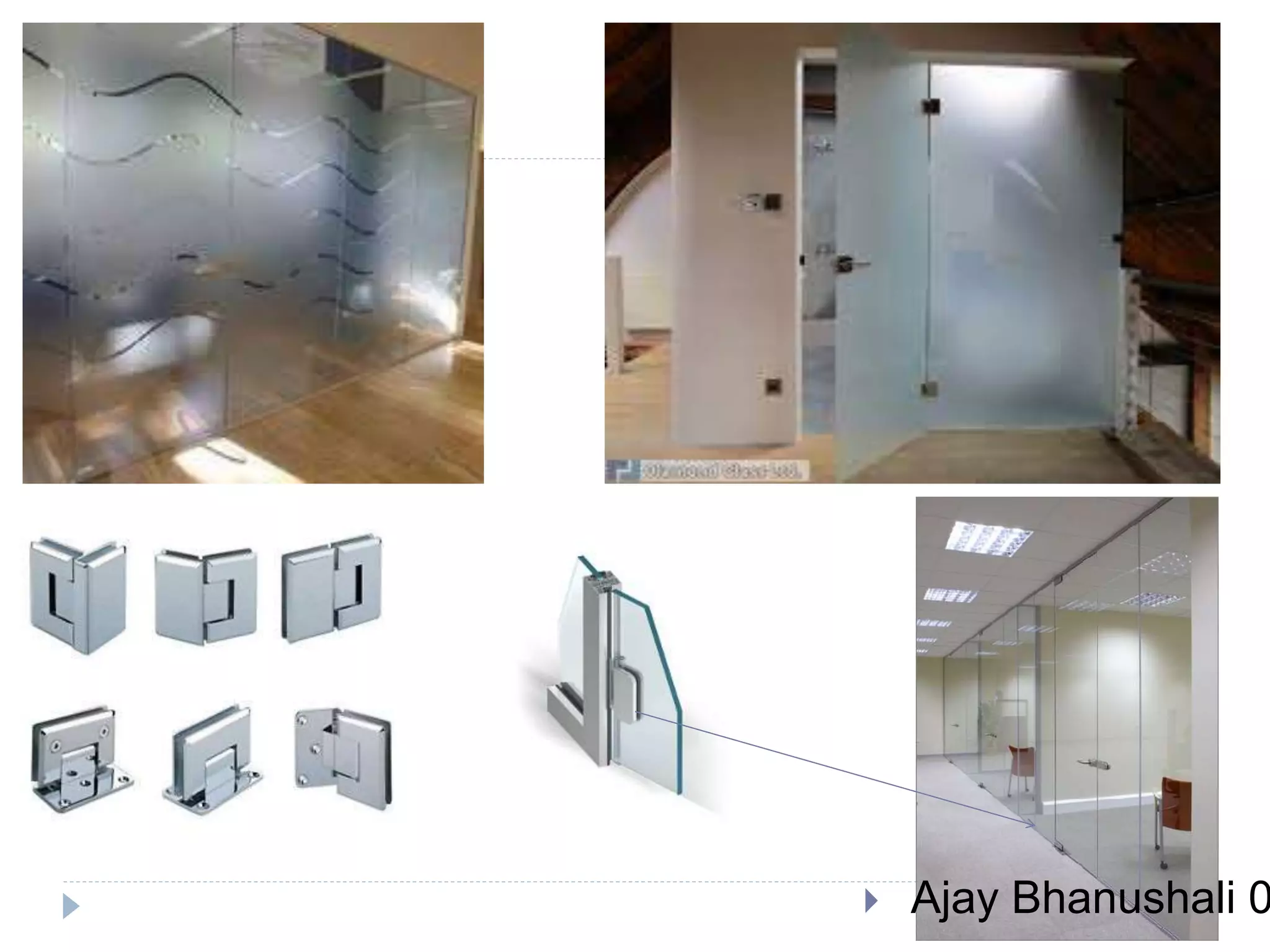
Types Of Glass Used
 Annealed glass
 Flat Glass
 Laminated Glass
 Alarm Glass
 Reflective Glass
 Anti-reflective Glass
 Fire-resistant Glass
 Tempered (toughened) Glass
 Low-emission Glass
 Acid-etched Glass
 Ajay Bhanushali 0
 Ajay Bhanushali 0
 Ajay Bhanushali 0
Hollow block
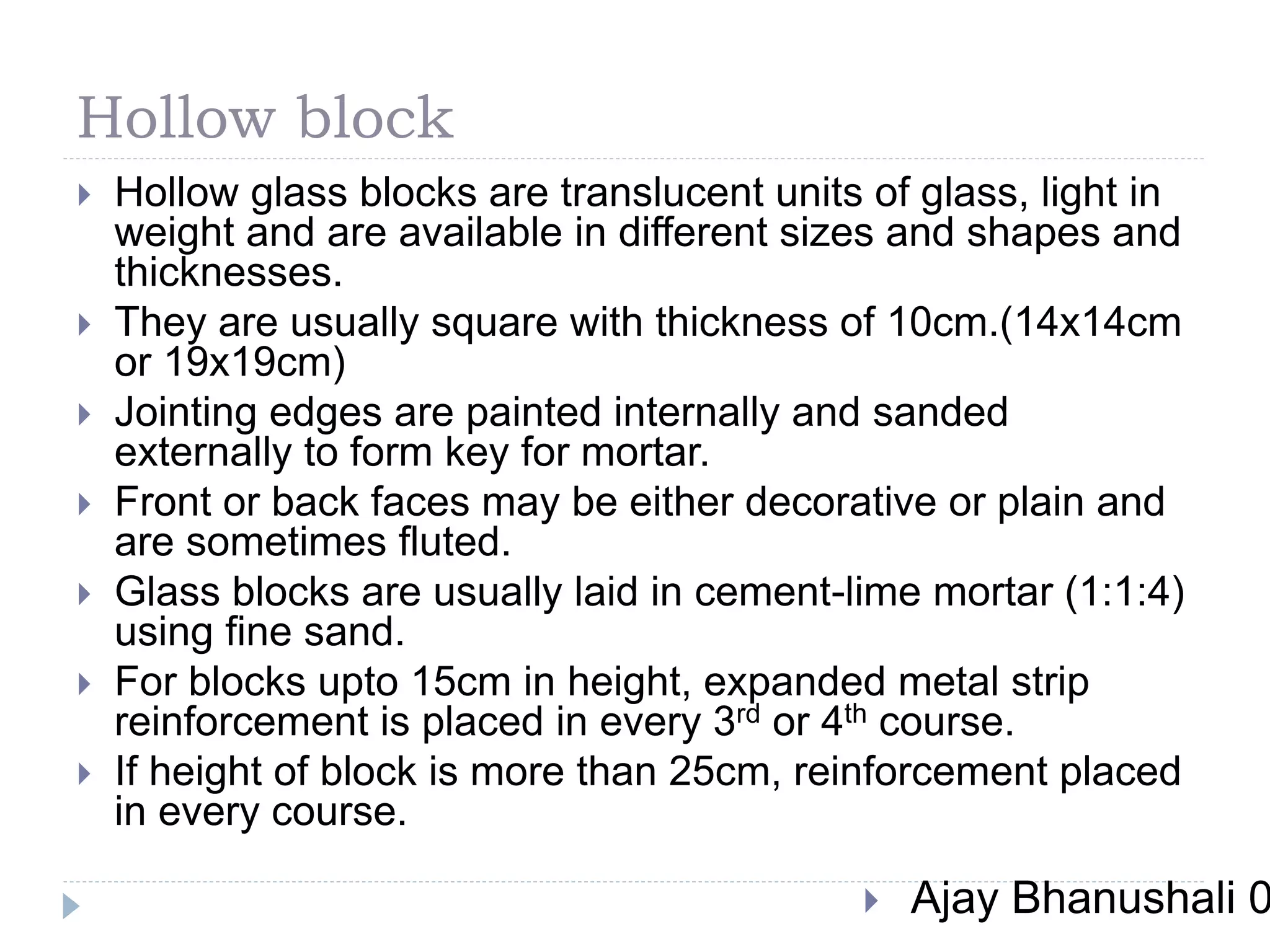
 Hollow glass blocks are translucent units of glass, light in
weight and are available in different sizes and shapes and
thicknesses.
 They are usually square with thickness of 10cm.(14x14cm
or 19x19cm)
 Jointing edges are painted internally and sanded
externally to form key for mortar.
 Front or back faces may be either decorative or plain and
are sometimes fluted.
 Glass blocks are usually laid in cement-lime mortar (1:1:4)
using fine sand.
 For blocks upto 15cm in height, expanded metal strip
reinforcement is placed in every 3rd or 4th course.
 If height of block is more than 25cm, reinforcement placed
in every course.
 Ajay Bhanushali 0
 Another type of glass blocks are in the form of glass
bricks with joggles and end grooves. ( sketch)
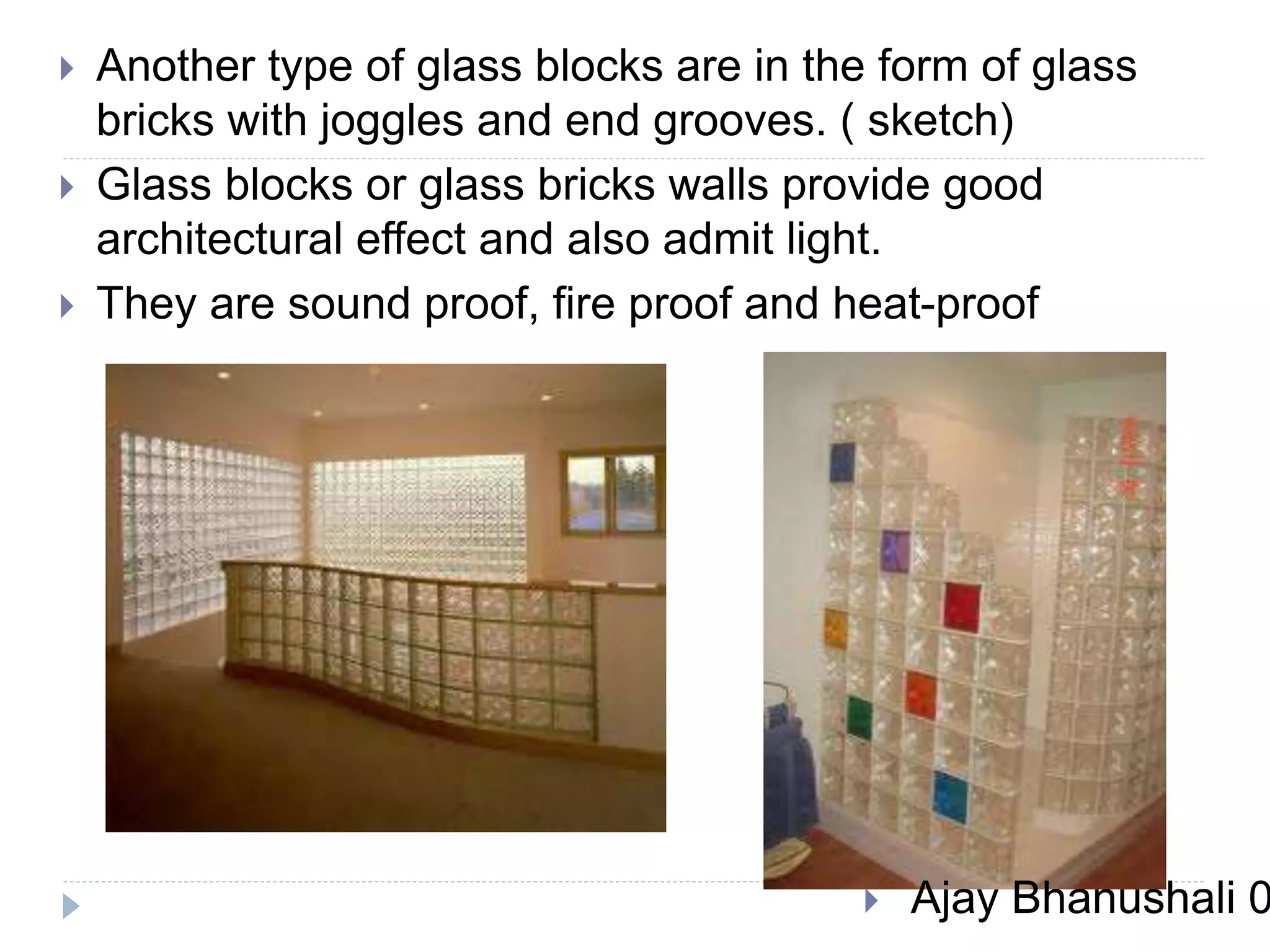
 Glass blocks or glass bricks walls provide good
architectural effect and also admit light.
 They are sound proof, fire proof and heat-proof
 Ajay Bhanushali 0
• Golden Rules - essential guidelines that need to be considered prior
to preparation of the opening and before beginning installation of
glass blocks.
• Glass block walls are self supporting, but not load bearing. Therefore
similar to doors & windows, support above should be provided in the
form of a lintel.
• For best integral strength, glass blocks should ideally be installed into
a four sided pre-prepared opening. This opening can be timber, brick,
steel, concrete or block work.
• Glass blocks expand and contract with temperature change.
• Glass blocks should not be installed when the surrounding
temperature is 5OC and falling or 30OC and rising.
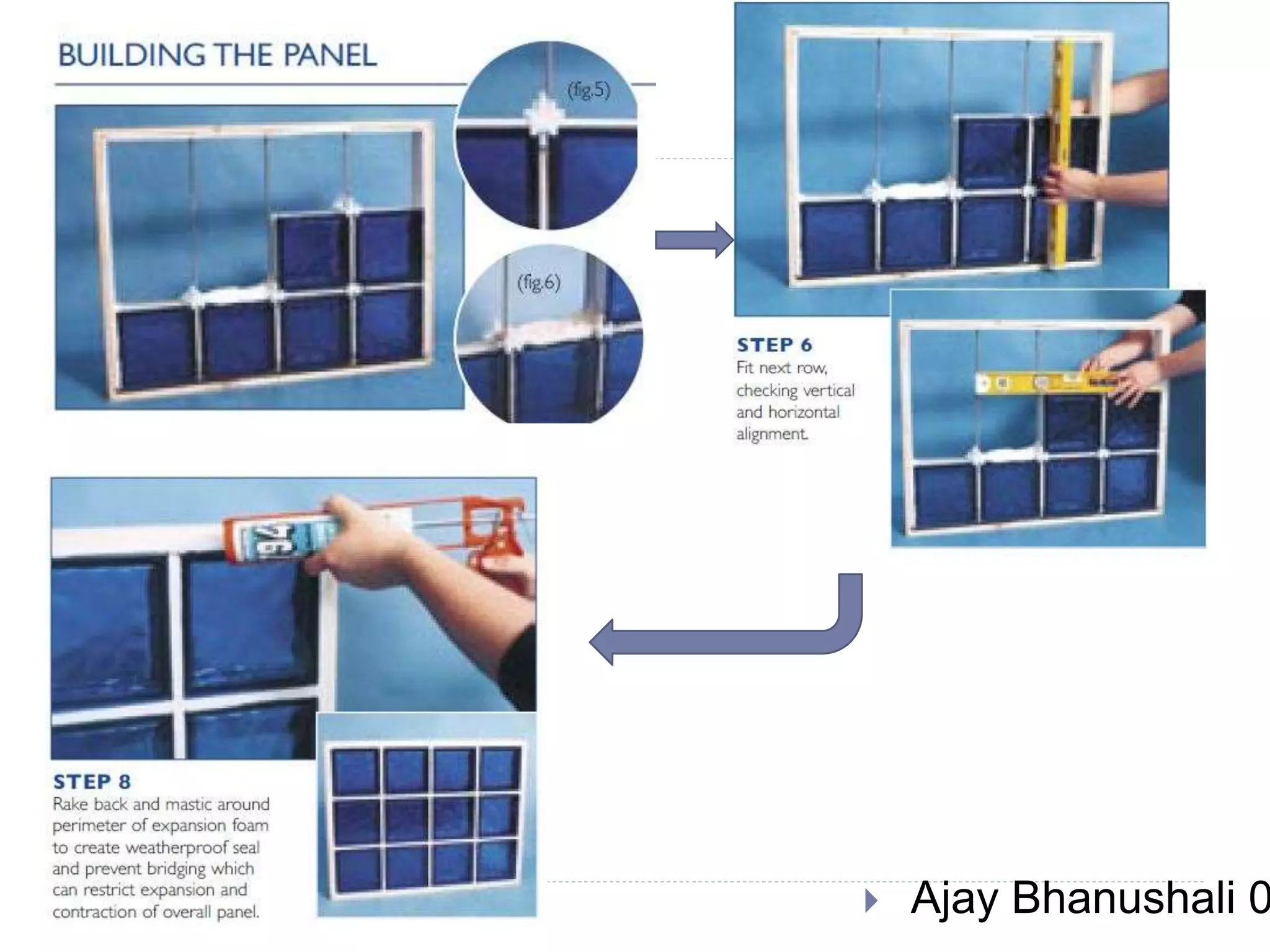
• Expansion material must be incorporated to the perimeter opening &
intermittently between vertical or horizontal joints if a panel exceeds
6m in any direction. Perimeter expansion should be weatherproofed
by caulking with silicon and not grouted over with mortar. If grouted
the joint is bridged, restricting expansion & contraction & may cause
blocks to crack.
• Openings must be square and perpendicular and made to suit glass
block modules. Glass blocks should not be cut like masonry bricks or
tiles.
• Maximum panel size without intermediate support or slip joints is
25m2 with no single dimension exceeding 6min any direction
 Ajay Bhanushali 0
 Ajay Bhanushali 0
 Ajay Bhanushali 0
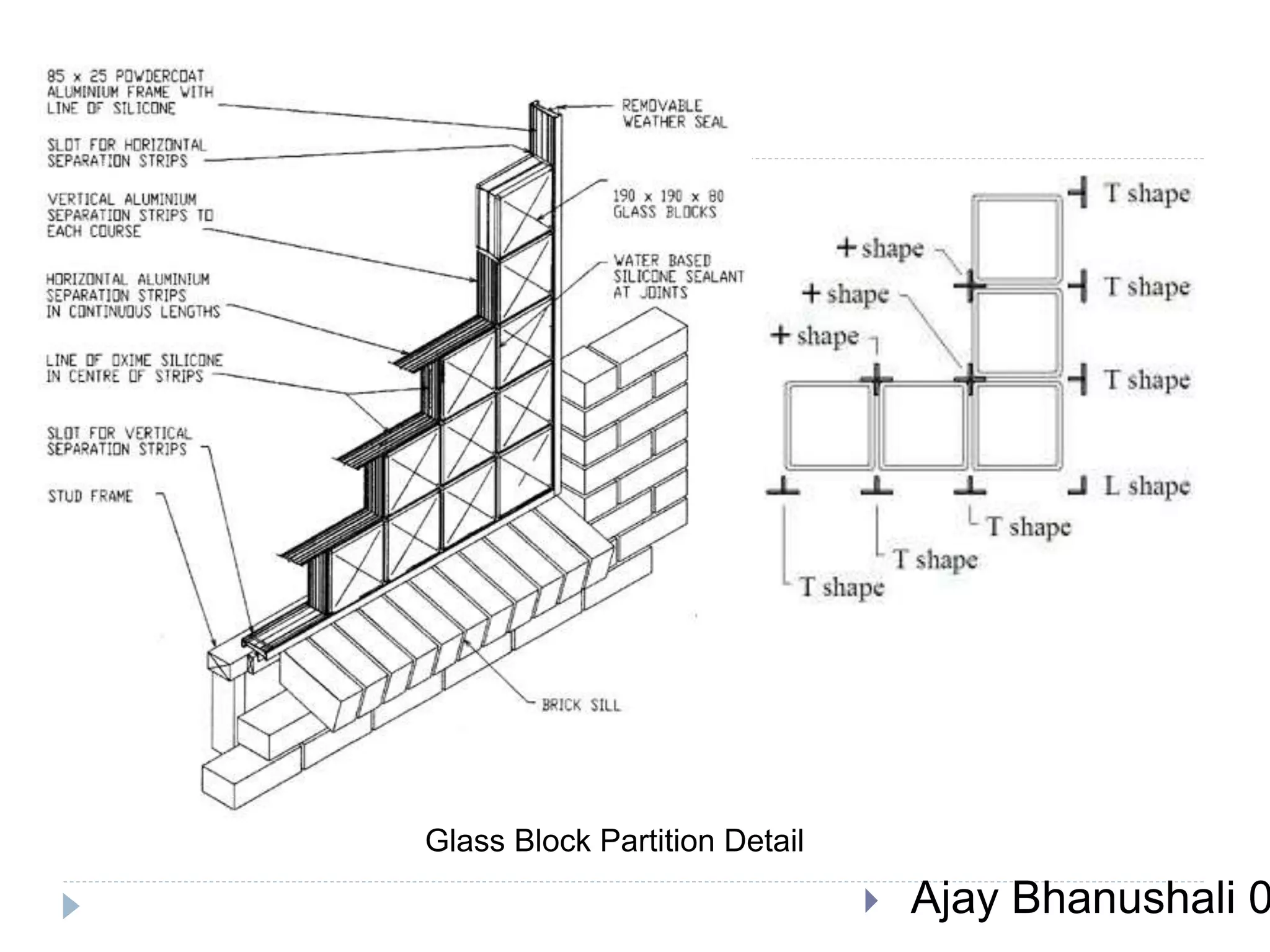
Glass Block Partition Detail
 Ajay Bhanushali 0
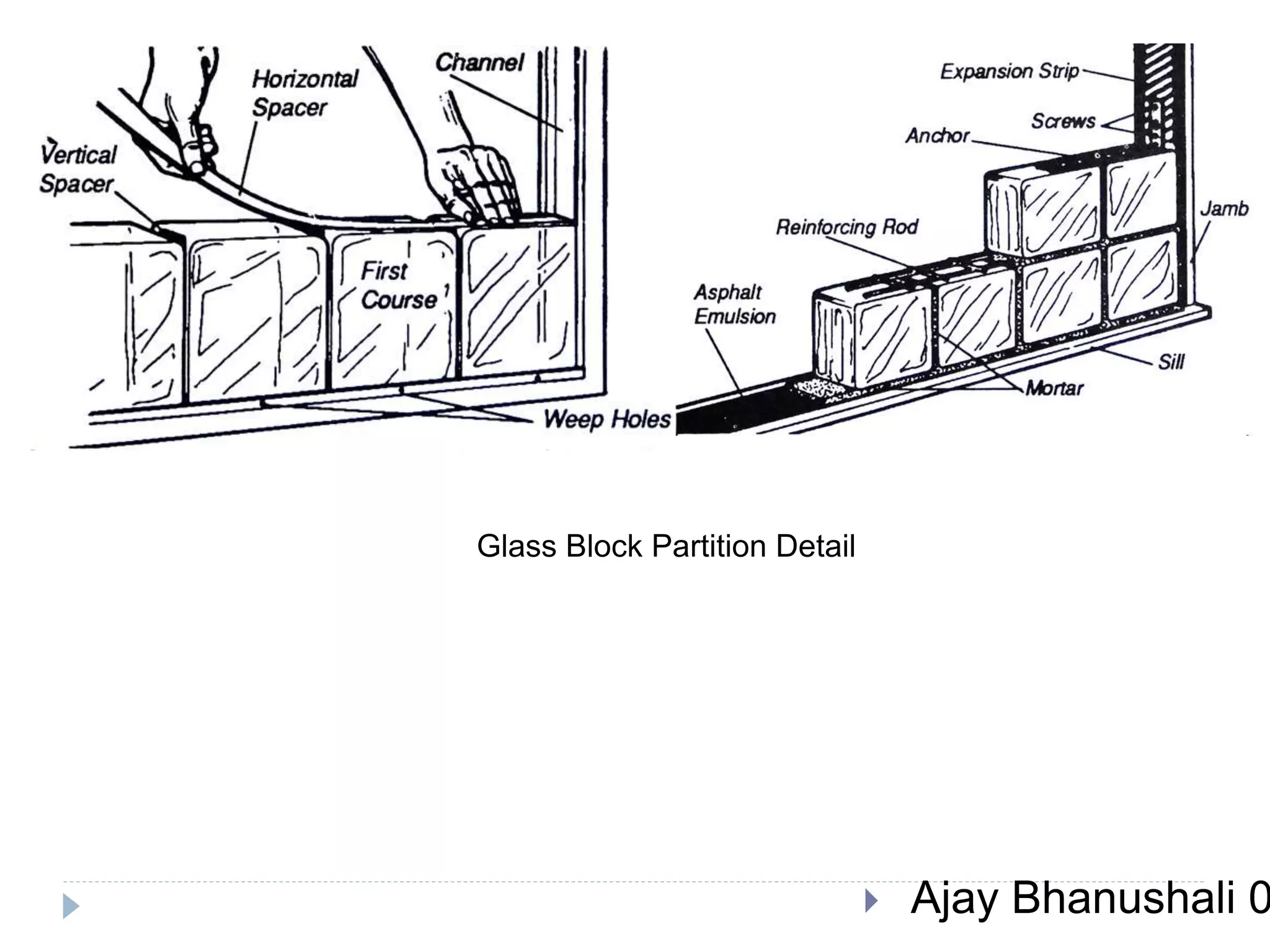
Glass Block Partition Detail
 Ajay Bhanushali 0

Glass partition 002

  • 1.
  • 2.
    Glass sheet partitions Wooden frame work is used in which glass sheets are fixed.  It consists of a number of horizontal and vertical posts spaced to divide the entire area into number of panels.  Glass sheets are kept in position in the panel either by using timber beadings or by putty.(linseed oil and whiting chalk)  Such partitions are light weight, vermin proof and sound proof.  Ajay Bhanushali 0
  • 3.
    Types Of GlassUsed  Annealed glass  Flat Glass  Laminated Glass  Alarm Glass  Reflective Glass  Anti-reflective Glass  Fire-resistant Glass  Tempered (toughened) Glass  Low-emission Glass  Acid-etched Glass  Ajay Bhanushali 0
  • 4.
  • 5.
  • 6.
    Hollow block  Hollowglass blocks are translucent units of glass, light in weight and are available in different sizes and shapes and thicknesses.  They are usually square with thickness of 10cm.(14x14cm or 19x19cm)  Jointing edges are painted internally and sanded externally to form key for mortar.  Front or back faces may be either decorative or plain and are sometimes fluted.  Glass blocks are usually laid in cement-lime mortar (1:1:4) using fine sand.  For blocks upto 15cm in height, expanded metal strip reinforcement is placed in every 3rd or 4th course.  If height of block is more than 25cm, reinforcement placed in every course.  Ajay Bhanushali 0
  • 7.
     Another typeof glass blocks are in the form of glass bricks with joggles and end grooves. ( sketch)  Glass blocks or glass bricks walls provide good architectural effect and also admit light.  They are sound proof, fire proof and heat-proof  Ajay Bhanushali 0
  • 8.
    • Golden Rules- essential guidelines that need to be considered prior to preparation of the opening and before beginning installation of glass blocks. • Glass block walls are self supporting, but not load bearing. Therefore similar to doors & windows, support above should be provided in the form of a lintel. • For best integral strength, glass blocks should ideally be installed into a four sided pre-prepared opening. This opening can be timber, brick, steel, concrete or block work. • Glass blocks expand and contract with temperature change. • Glass blocks should not be installed when the surrounding temperature is 5OC and falling or 30OC and rising. • Expansion material must be incorporated to the perimeter opening & intermittently between vertical or horizontal joints if a panel exceeds 6m in any direction. Perimeter expansion should be weatherproofed by caulking with silicon and not grouted over with mortar. If grouted the joint is bridged, restricting expansion & contraction & may cause blocks to crack. • Openings must be square and perpendicular and made to suit glass block modules. Glass blocks should not be cut like masonry bricks or tiles. • Maximum panel size without intermediate support or slip joints is 25m2 with no single dimension exceeding 6min any direction  Ajay Bhanushali 0
  • 9.
  • 10.
  • 11.
    Glass Block PartitionDetail  Ajay Bhanushali 0
  • 12.
    Glass Block PartitionDetail  Ajay Bhanushali 0