Afaq Nawaz
Roll No 103
Presentation : Glass
Glass
Introduction: Many high-rise buildings now made of
glass. The glass used is typically of the type not glossy
, to avoid excessive glare to people who were outside
the building. In addition, the glass that absorbs
infrared waves are used to prevent heat from
penetrating into the building . This can lead to high
costs of air conditioners . In addition, the use of
double-glazed windows for heat insulation outside
from entering , and cool air in the building can t get off
from building and thus the tempreature of building
remain stabilized.
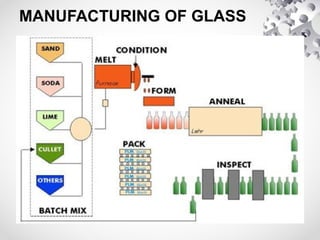
MANUFACTURING OF GLASS
• Glass is produced in a two step process, and then shaped to
make it suitable for a variety of applications.
• Step 1 - Batch mixing
• The mixture of ingredients to make up the glass (silica,
Na2CO3, CaCO3 and recycled glass, together with small
quantities of various other minor ingredients) are mixed in a
rotary mixer to ensure an even mix of ingredients and fed into
the furnace.
• Step 2 - Batch melting
• The mixture is heated to 1500-1550 C, where the ingredients
melt, various chemical reactions take place and CO2 and SO3
are evolved.
• Shaping plate glass
• The molten glass is cooled to 1000 C in a drawing
canal, and then drawn up a tower (the drawing tower)
where it is pressed into the desired width and
thickness, and cools to 280 C. Individual plates of
glass are further cooled before being put into storage
ready for sale.
• Molding glass containers
• Here molten glass is channeled off in forehearths
(heated channels) where it is slowly cooled to
tempertaures of 1100 - 1150 C to increase its
viscosity. Precisely weighed slugs of glass are cut off,
molded with compressed air, cooled slowly in
annealing lehrs (special ovens) and coated with a
special spray to prevent scratching.
Types of glass
ROLLED GLASS
• Definition --> a flat glass of considerable thickness,the
molten glass is poured over flat iron table which has
rollers fixed at one edge. The molten glass is rolled into
sheet of glass.
• The glass used for this purpose is typically whiter in
colour than the clear glasses used for other applications.
• This glass can be laminated depending on the depth of
the pattern to produce a safety glass.
Rolled Glass
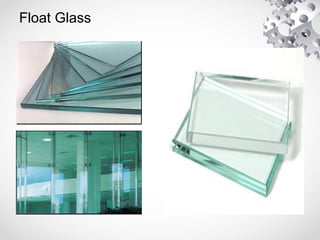
Float Glass
• Made by floating molten glass on a bed of molten tin
through float process
• As the continuous ribbon of glass floats along the tin
bath, it is cooled gradually until it has hardened
enough to go off into a conveyor system (the tin
remains molten at this stage) for cutting and packing.
• The float process or Pilkington process is generally
acknowledged as the best way of producing glass.
• This method gives the glass uniform thickness and
very flat surfaces with no distortion and high clarity
• Tinted float glasses can be made by adding colouring
agents during the melt process.
Float Glass
TOUGHENED GLASS
• (Toughened glass is created with uneven heating that causes
the cooling glass to form layers instead of a solid sheet,
making it much more resistant to impact than "annealed"
glass.)
• The technique used to create toughened glass involves heating
glass objects to beyond the annealing point (600°C). Once the
glass is heated, the outside is cooled by air jets.
• This method solidifies only the outside, leaving the interior
molten and fluid. as the inner layers try to follow, they throw
the outer layers into compression, tending to close the
microscopic cracks. That's what creates the various layers
within the glass. Because of its layering, the surface of this
glass is more resistant.
Toughened Glass
ADVANTAGES
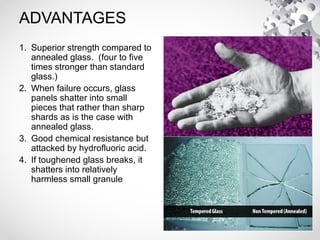
1. Superior strength compared to
annealed glass. (four to five
times stronger than standard
glass.)
2. When failure occurs, glass
panels shatter into small
pieces that rather than sharp
shards as is the case with
annealed glass.
3. Good chemical resistance but
attacked by hydrofluoric acid.
4. If toughened glass breaks, it
shatters into relatively
harmless small granule
laminated glass
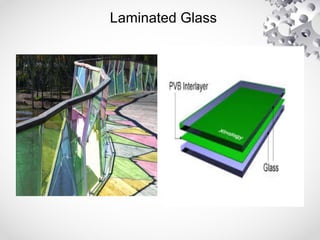
• 2 sheets of glass bonded with thin film of plastic
such as Polyvinyl Butyrate under some pressure
and temperature about 100 Celsius.
• The interlayer keeps the layers of glass bonded
even when broken.
• This produces the characteristic ”spider web”
cracking pattern when the impact not enough to
pierce the glass.
LAMINATED GLASS
• +This type of glass is not broken into pieces when it
breaks.
• +Ensures safety at places where glass is liable to
shatter.
• +Glazing windows and doors.
• +95% of uv rays from sun is being controlled.
• +In the cases of storms such as hurricanes, tornadoes
and large thunderstorms, laminated glass windows
provide the strongest layer of protection possible.
• -Not sound proof and installed with poor construction.
• -The strength is less than toughened glass
Laminated Glass
Other types
• Insulating glass:Two layers of glass separated
by 6mm to 12mm of air space are sealed to
provide heat insulation
• Colored glass:By adding oxides of metals to
metal glass the finish product get colored.Used
for decoration works in building construction
• Flint glass:It is lead glass which shines.Used for
glass work as optical glass, for making electric
bulbs.
Duarbility of Glass
• Glass doesn’t affected by atmosphere and
most acids except Hydroflouric Acid.
• Alkalis that occur in cement / chemical
paint strippers, attack glass and destroy
the smooth surface

GLASS

  • 2.
    Afaq Nawaz Roll No103 Presentation : Glass
  • 3.
    Glass Introduction: Many high-risebuildings now made of glass. The glass used is typically of the type not glossy , to avoid excessive glare to people who were outside the building. In addition, the glass that absorbs infrared waves are used to prevent heat from penetrating into the building . This can lead to high costs of air conditioners . In addition, the use of double-glazed windows for heat insulation outside from entering , and cool air in the building can t get off from building and thus the tempreature of building remain stabilized.
  • 4.
  • 5.
    MANUFACTURING OF GLASS •Glass is produced in a two step process, and then shaped to make it suitable for a variety of applications. • Step 1 - Batch mixing • The mixture of ingredients to make up the glass (silica, Na2CO3, CaCO3 and recycled glass, together with small quantities of various other minor ingredients) are mixed in a rotary mixer to ensure an even mix of ingredients and fed into the furnace. • Step 2 - Batch melting • The mixture is heated to 1500-1550 C, where the ingredients melt, various chemical reactions take place and CO2 and SO3 are evolved.
  • 6.
    • Shaping plateglass • The molten glass is cooled to 1000 C in a drawing canal, and then drawn up a tower (the drawing tower) where it is pressed into the desired width and thickness, and cools to 280 C. Individual plates of glass are further cooled before being put into storage ready for sale. • Molding glass containers • Here molten glass is channeled off in forehearths (heated channels) where it is slowly cooled to tempertaures of 1100 - 1150 C to increase its viscosity. Precisely weighed slugs of glass are cut off, molded with compressed air, cooled slowly in annealing lehrs (special ovens) and coated with a special spray to prevent scratching.
  • 7.
    Types of glass ROLLEDGLASS • Definition --> a flat glass of considerable thickness,the molten glass is poured over flat iron table which has rollers fixed at one edge. The molten glass is rolled into sheet of glass. • The glass used for this purpose is typically whiter in colour than the clear glasses used for other applications. • This glass can be laminated depending on the depth of the pattern to produce a safety glass.
  • 8.
  • 9.
    Float Glass • Madeby floating molten glass on a bed of molten tin through float process • As the continuous ribbon of glass floats along the tin bath, it is cooled gradually until it has hardened enough to go off into a conveyor system (the tin remains molten at this stage) for cutting and packing. • The float process or Pilkington process is generally acknowledged as the best way of producing glass. • This method gives the glass uniform thickness and very flat surfaces with no distortion and high clarity • Tinted float glasses can be made by adding colouring agents during the melt process.
  • 10.
  • 11.
    TOUGHENED GLASS • (Toughenedglass is created with uneven heating that causes the cooling glass to form layers instead of a solid sheet, making it much more resistant to impact than "annealed" glass.) • The technique used to create toughened glass involves heating glass objects to beyond the annealing point (600°C). Once the glass is heated, the outside is cooled by air jets. • This method solidifies only the outside, leaving the interior molten and fluid. as the inner layers try to follow, they throw the outer layers into compression, tending to close the microscopic cracks. That's what creates the various layers within the glass. Because of its layering, the surface of this glass is more resistant.
  • 12.
  • 13.
    ADVANTAGES 1. Superior strengthcompared to annealed glass. (four to five times stronger than standard glass.) 2. When failure occurs, glass panels shatter into small pieces that rather than sharp shards as is the case with annealed glass. 3. Good chemical resistance but attacked by hydrofluoric acid. 4. If toughened glass breaks, it shatters into relatively harmless small granule
  • 14.
    laminated glass • 2sheets of glass bonded with thin film of plastic such as Polyvinyl Butyrate under some pressure and temperature about 100 Celsius. • The interlayer keeps the layers of glass bonded even when broken. • This produces the characteristic ”spider web” cracking pattern when the impact not enough to pierce the glass.
  • 15.
    LAMINATED GLASS • +Thistype of glass is not broken into pieces when it breaks. • +Ensures safety at places where glass is liable to shatter. • +Glazing windows and doors. • +95% of uv rays from sun is being controlled. • +In the cases of storms such as hurricanes, tornadoes and large thunderstorms, laminated glass windows provide the strongest layer of protection possible. • -Not sound proof and installed with poor construction. • -The strength is less than toughened glass
  • 16.
  • 17.
    Other types • Insulatingglass:Two layers of glass separated by 6mm to 12mm of air space are sealed to provide heat insulation • Colored glass:By adding oxides of metals to metal glass the finish product get colored.Used for decoration works in building construction • Flint glass:It is lead glass which shines.Used for glass work as optical glass, for making electric bulbs.
  • 18.
    Duarbility of Glass •Glass doesn’t affected by atmosphere and most acids except Hydroflouric Acid. • Alkalis that occur in cement / chemical paint strippers, attack glass and destroy the smooth surface