CASE STUDY:HOME FOR
CONSTRUCTION WORKERS
By:-SHOURYA PURI
ARCHITECTURAL DESIGN
 AMITY SCHOOL OF ARCHITECTURE AND PLANNING
TOPIC
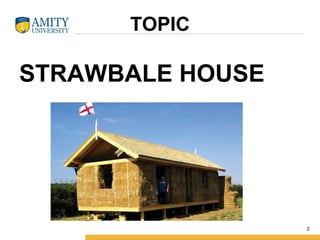
STRAWBALE HOUSE
2
3
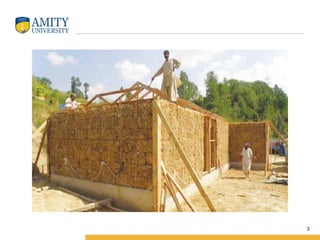
STRAWBALE CONSTRUCTION
• Uses bales of straw commonly wheat,
rice, rye and oats straw as structural
elements, building insulation, or both.
• Natural building.
• Sustainable method construction.
• Low cost.
• Energy efficiency of thick, super-insulated
walls.
4
MATERIAL
• Baled straw from wheat, oats, barley, rye,
rice and others.
• Walls covered by earthen or lime stucco.
• Straw bale are traditionally a waste
product which farmers do not till under the
soil, but do sell as animal bedding or
landscape supply due to their durable
nature
5
ADVANTAGES
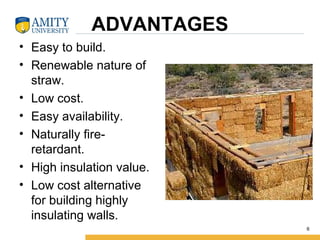
• Easy to build.
• Renewable nature of
straw.
• Low cost.
• Easy availability.
• Naturally fire-
retardant.
• High insulation value.
• Low cost alternative
for building highly
insulating walls.
6
FEATURES
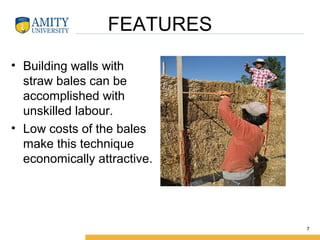
• Building walls with
straw bales can be
accomplished with
unskilled labour.
• Low costs of the bales
make this technique
economically attractive.
7
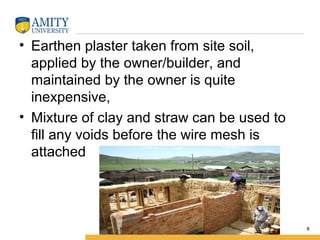
• Earthen plaster taken from site soil,
applied by the owner/builder, and
maintained by the owner is quite
inexpensive,
• Mixture of clay and straw can be used to
fill any voids before the wire mesh is
attached
8
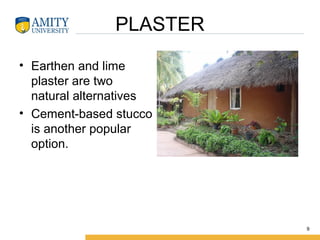
PLASTER
• Earthen and lime
plaster are two
natural alternatives
• Cement-based stucco
is another popular
option.
9
THANK YOU
10

Strawbale construction low cost housing

  • 1.
    CASE STUDY:HOME FOR CONSTRUCTIONWORKERS By:-SHOURYA PURI ARCHITECTURAL DESIGN  AMITY SCHOOL OF ARCHITECTURE AND PLANNING
  • 2.
  • 3.
  • 4.
    STRAWBALE CONSTRUCTION • Usesbales of straw commonly wheat, rice, rye and oats straw as structural elements, building insulation, or both. • Natural building. • Sustainable method construction. • Low cost. • Energy efficiency of thick, super-insulated walls. 4
  • 5.
    MATERIAL • Baled strawfrom wheat, oats, barley, rye, rice and others. • Walls covered by earthen or lime stucco. • Straw bale are traditionally a waste product which farmers do not till under the soil, but do sell as animal bedding or landscape supply due to their durable nature 5
  • 6.
    ADVANTAGES • Easy tobuild. • Renewable nature of straw. • Low cost. • Easy availability. • Naturally fire- retardant. • High insulation value. • Low cost alternative for building highly insulating walls. 6
  • 7.
    FEATURES • Building wallswith straw bales can be accomplished with unskilled labour. • Low costs of the bales make this technique economically attractive. 7
  • 8.
    • Earthen plastertaken from site soil, applied by the owner/builder, and maintained by the owner is quite inexpensive, • Mixture of clay and straw can be used to fill any voids before the wire mesh is attached 8
  • 9.
    PLASTER • Earthen andlime plaster are two natural alternatives • Cement-based stucco is another popular option. 9
  • 10.