GLASS IN
INTERIOR DESIGN
By HNG Floatglass
Uses For Glass In Interior
Design
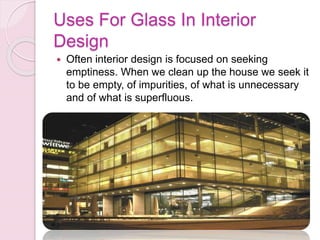
 Often interior design is focused on seeking
emptiness. When we clean up the house we seek it
to be empty, of impurities, of what is unnecessary
and of what is superfluous.
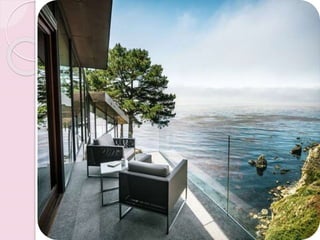
Glass And Light
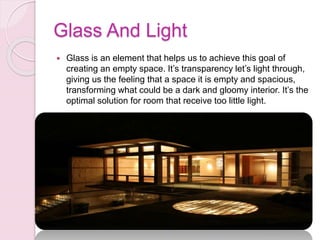
 Glass is an element that helps us to achieve this goal of
creating an empty space. It’s transparency let’s light through,
giving us the feeling that a space it is empty and spacious,
transforming what could be a dark and gloomy interior. It’s the
optimal solution for room that receive too little light.
When It Comes To Interior
Design, Glass Has Many Uses.
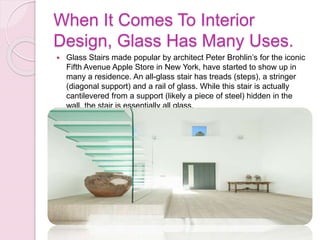
 Glass Stairs made popular by architect Peter Brohlin’s for the iconic
Fifth Avenue Apple Store in New York, have started to show up in
many a residence. An all-glass stair has treads (steps), a stringer
(diagonal support) and a rail of glass. While this stair is actually
cantilevered from a support (likely a piece of steel) hidden in the
wall, the stair is essentially all glass.
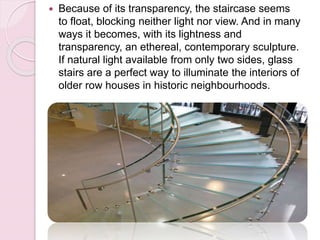
 Because of its transparency, the staircase seems
to float, blocking neither light nor view. And in many
ways it becomes, with its lightness and
transparency, an ethereal, contemporary sculpture.
If natural light available from only two sides, glass
stairs are a perfect way to illuminate the interiors of
older row houses in historic neighbourhoods.
Glass Floors
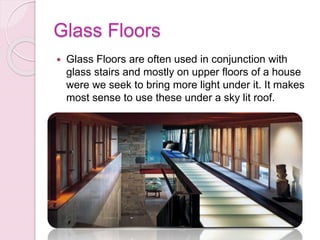
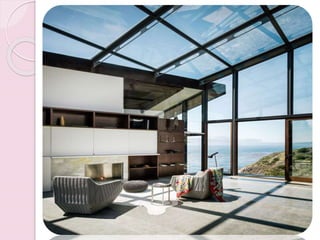
 Glass Floors are often used in conjunction with
glass stairs and mostly on upper floors of a house
were we seek to bring more light under it. It makes
most sense to use these under a sky lit roof.
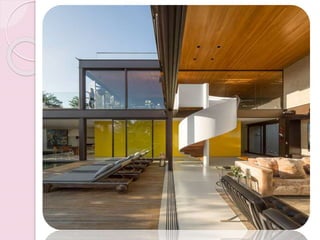
Glass Walkways
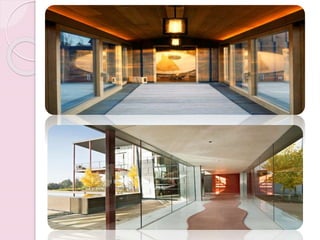
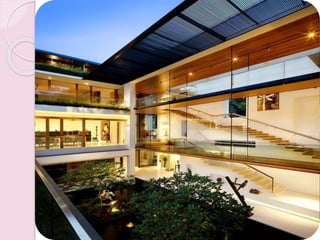
 Glass Walkways allows us to be enclosed yet open
to the view. When closed the walkway connects
two sides of the house, but it does so in dramatic
fashion. The cove lighting and subtle barrel-vaulted
wood ceiling are nice touches.
Glass Bathroom
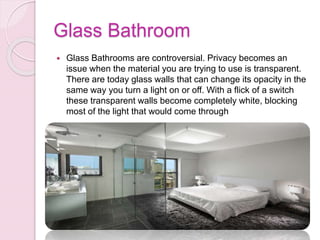
 Glass Bathrooms are controversial. Privacy becomes an
issue when the material you are trying to use is transparent.
There are today glass walls that can change its opacity in the
same way you turn a light on or off. With a flick of a switch
these transparent walls become completely white, blocking
most of the light that would come through
Glass Blocks
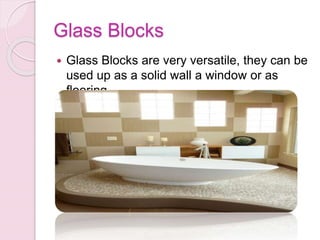
 Glass Blocks are very versatile, they can be
used up as a solid wall a window or as
flooring
THANK YOU 

Glass in interior design

  • 1.
  • 2.
    Uses For GlassIn Interior Design  Often interior design is focused on seeking emptiness. When we clean up the house we seek it to be empty, of impurities, of what is unnecessary and of what is superfluous.
  • 4.
    Glass And Light Glass is an element that helps us to achieve this goal of creating an empty space. It’s transparency let’s light through, giving us the feeling that a space it is empty and spacious, transforming what could be a dark and gloomy interior. It’s the optimal solution for room that receive too little light.
  • 6.
    When It ComesTo Interior Design, Glass Has Many Uses.  Glass Stairs made popular by architect Peter Brohlin’s for the iconic Fifth Avenue Apple Store in New York, have started to show up in many a residence. An all-glass stair has treads (steps), a stringer (diagonal support) and a rail of glass. While this stair is actually cantilevered from a support (likely a piece of steel) hidden in the wall, the stair is essentially all glass.
  • 8.
     Because ofits transparency, the staircase seems to float, blocking neither light nor view. And in many ways it becomes, with its lightness and transparency, an ethereal, contemporary sculpture. If natural light available from only two sides, glass stairs are a perfect way to illuminate the interiors of older row houses in historic neighbourhoods.
  • 10.
    Glass Floors  GlassFloors are often used in conjunction with glass stairs and mostly on upper floors of a house were we seek to bring more light under it. It makes most sense to use these under a sky lit roof.
  • 12.
    Glass Walkways  GlassWalkways allows us to be enclosed yet open to the view. When closed the walkway connects two sides of the house, but it does so in dramatic fashion. The cove lighting and subtle barrel-vaulted wood ceiling are nice touches.
  • 14.
    Glass Bathroom  GlassBathrooms are controversial. Privacy becomes an issue when the material you are trying to use is transparent. There are today glass walls that can change its opacity in the same way you turn a light on or off. With a flick of a switch these transparent walls become completely white, blocking most of the light that would come through
  • 16.
    Glass Blocks  GlassBlocks are very versatile, they can be used up as a solid wall a window or as flooring
  • 18.