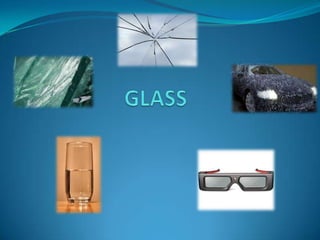
GLASS
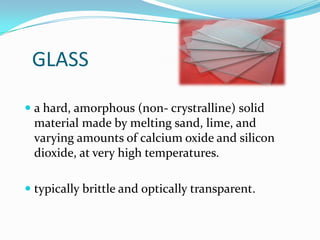
GLASS a hard, amorphous (non- crystralline) solid material made by melting sand, lime, and varying amounts of calcium oxide and silicon dioxide, at very high temperatures. typically brittle and optically transparent.
HISTORY OF GLASS MAKING
HistoryIt started on 3500 BCE in Mesopotamiain the Roman glass making center at Trier.Comes from a German word ‘glesum’ which means transparent or lustrous substance.
GLASS INGREDIENTSSILICA (SiO₂)Soda Ash (Na₂CO₃)Lime (CaO)Cullet (Recycled Glass)
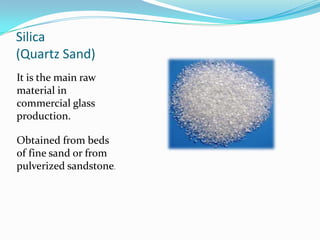
Silica(Quartz Sand)It is the main raw material in commercial glass production.Obtained from beds of fine sand or from pulverized sandstone.
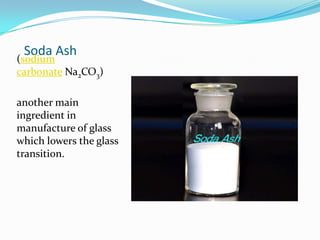
Soda Ash(sodium carbonate Na2CO3)another main ingredient in manufacture of glass which lowers the glass transition. 
Lime(calcium oxide(CaO)generally obtained from limestone, is added to provide for a better chemical durability. 
Cullet(Recycled glass)Another common glass ingredient coming from waste glass which saves on raw material and energy.
Additional Substances Lead – brilliance and weightBoron – thermal and electrical resistanceBarium – to increase refractive indexLanthanum oxide – for optical glassesIron and cerium – infrared rays and UV wavelengthsMetallic oxides – to impart colorManganese – decolorizing Sodium sulfate and sodium chloride – finishing agents
GLASS MAKING PROCESS
Glass Making Process	Modern glass factories are three-part operations:Batch HouseHot EndCold End
The Batch Househandles the raw materials from  the storage silosglass batching is used to determine the correct mix of raw materials (batch) for  to achieve the desired glass composition.
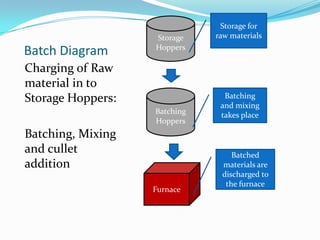
Batch DiagramCharging of Raw material in to Storage Hoppers:Batching, Mixing and cullet additionStorage for raw materialsStorage HoppersBatching HoppersBatching  and mixing takes placeBatched materials are discharged to the furnaceFurnace
The Hot Endhandles the main part of manufacture with the furnaces, annealing ovens, and forming machines.
Furnacea device used for heating. The name derives from Latin fornax, oven. The heat energy to fuel a furnace may be supplied directly by fuel combustion, by electricity such as the electric arc furnace.The furnaces operate at temperatures up to 1,575°C.
Glass Forming	Once glass has been melted, it can be shaped and used in various ways. The Blowing Pressing Drawing.
GlassblowingA glass forming technique that involves inflating molten glass into a bubble, or parison, with the aid of a blowpipe, or blow tube.Air can be blown in manually or by machine
PressingIn the pressing method of glass making, the liquid glass is poured into a mold and then pressed into shape by either a machine or a special tool. 
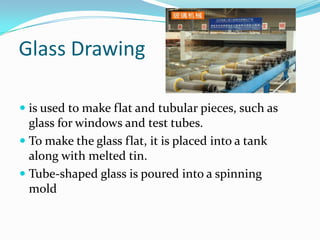
Glass Drawingis used to make flat and tubular pieces, such as glass for windows and test tubes. To make the glass flat, it is placed into a tank along with melted tin.Tube-shaped glass is poured into a spinning mold
AnnealingOnce the glass is finished, it goes through an annealing or tempering process to increase its strength.
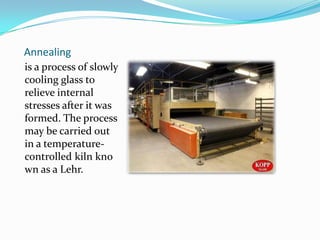
Annealing is a process of slowly cooling glass to relieve internal stresses after it was formed. The process may be carried out in a temperature-controlled kiln known as a Lehr.
The Cold Endits role is to inspect the products for defects, package the glass for shipment and label the glass.Automatic machines, or sometimes persons, inspect every container for a variety of faults.
TYPES  OF GLASS, ITS USES AND APPLICATIONS
1. Soda glassit is the cheapest & most common glass. it is prepared by fusing soda ash, sand , limestone. it is also called soft glasssoda glass is used for the manufacture of window glass, common glassware, bottles and jars, etc. it is easily attacked by chemcials.
2. Hard glassToughened glass are best choice for areas where safety is the highest consideration. Used for window panes of automobile, glass roofs, furniture and shelves, partitions etc.It is obtained by fusing potassium carbonate & limestone .
3. Lead crystal glasslead glass has high refractive index.Ordinary glass has a refractive index of n = 1.5, while the addition of lead produces a range up to 1.7it, therefore, sparkles & is used for making expensive glass ware.
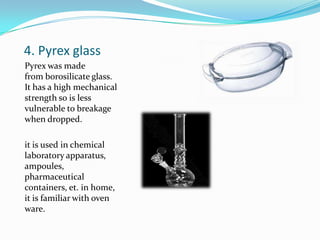
4. Pyrex glassPyrex was made from borosilicate glass. It has a high mechanical strength so is less vulnerable to breakage when dropped.it is used in chemical laboratory apparatus, ampoules, pharmaceutical containers, et. in home, it is familiar with oven ware.
5. Optical glassThis glass is formulated very precisely so that its properties are knownand specially made so as to be free of strains & defects.it is used for making lenses for spectacles, microscopes, cameras, telescopes & other optical instruments.
6. Laminated glassit is prepared by placing a layer of transparent plastic between the two layers of glass by means of suitable adhesive. The 3 layers are joined together by the action of heat & pressure. . It is used in making wind screens of airplanes, automobiles, bulletproof glass etc…
7. Glass fibres:Fiberglass, (also called fibreglass and glass fibre), is a material consisting of numerous extremely fine fibers of glass. Glass fibers are useful thermal insulators because of their high ratio of surface area to weight.Glass fibre has varied applications in most of the industries.
Glass woolGlass wool is a bundle of loose glass fibres, which is an excellent heat insulator. It is used as insulating material in refrigerators, ovens etc.
Other uses of fibreglasselectrical insulationpole vault polescrossbowshockey sticks surfboards boat hullspaper honeycombfor medical purposes in casts.
8. Energy efficient glassIs a high quality clear glass with a specially formulated, permanent, transparent Low E coating applied pyrolitically to one surface during glass manufacturethe Low E coating is to reflect the long wavelength energy (generated by heating systems, lighting and building occupants) back into the building
Low E glassThe radiation coming from your heating system and your furniture and furnishings is long wave radiation. This type of radiation should be contained in your room as best as possible, while the radiation from the sun should be shielded and reflected back outside. 
9. MirrorsMirrors are manufactured by applying a reflective coating such as tin(II) chloride or silver to the glass. The tin (II) chloride is applied because silver will not bond with the glass. The chemical activator causes the tin/silver to harden. Copper is added for long-term durability and paint to protect the coating on the back of the mirror from scratches and other accidental damage.
DEBATEThe status of glass as a liquid, versus a solid, has been hotly debated. The short story is that glass is a supercooled liquid, meaning that it is rigid and static but does not change molecularly between melting and solidification into a desired shape. Glass is one the most versatile substances on Earth, used in many applications and in a wide variety of forms, from plain clear glass to tempered and tinted varieties, and so forth.

Glass

  • 1.
  • 2.
    GLASS a hard,amorphous (non- crystralline) solid material made by melting sand, lime, and varying amounts of calcium oxide and silicon dioxide, at very high temperatures. typically brittle and optically transparent.
  • 3.
  • 4.
    HistoryIt started on3500 BCE in Mesopotamiain the Roman glass making center at Trier.Comes from a German word ‘glesum’ which means transparent or lustrous substance.
  • 5.
    GLASS INGREDIENTSSILICA (SiO₂)SodaAsh (Na₂CO₃)Lime (CaO)Cullet (Recycled Glass)
  • 6.
    Silica(Quartz Sand)It isthe main raw material in commercial glass production.Obtained from beds of fine sand or from pulverized sandstone.
  • 7.
    Soda Ash(sodium carbonate Na2CO3)anothermain ingredient in manufacture of glass which lowers the glass transition. 
  • 8.
    Lime(calcium oxide(CaO)generally obtainedfrom limestone, is added to provide for a better chemical durability. 
  • 9.
    Cullet(Recycled glass)Another commonglass ingredient coming from waste glass which saves on raw material and energy.
  • 10.
    Additional Substances Lead– brilliance and weightBoron – thermal and electrical resistanceBarium – to increase refractive indexLanthanum oxide – for optical glassesIron and cerium – infrared rays and UV wavelengthsMetallic oxides – to impart colorManganese – decolorizing Sodium sulfate and sodium chloride – finishing agents
  • 11.
  • 12.
    Glass Making Process Modernglass factories are three-part operations:Batch HouseHot EndCold End
  • 13.
    The Batch Househandlesthe raw materials from the storage silosglass batching is used to determine the correct mix of raw materials (batch) for to achieve the desired glass composition.
  • 14.
    Batch DiagramCharging ofRaw material in to Storage Hoppers:Batching, Mixing and cullet additionStorage for raw materialsStorage HoppersBatching HoppersBatching and mixing takes placeBatched materials are discharged to the furnaceFurnace
  • 15.
    The Hot Endhandlesthe main part of manufacture with the furnaces, annealing ovens, and forming machines.
  • 16.
    Furnacea device usedfor heating. The name derives from Latin fornax, oven. The heat energy to fuel a furnace may be supplied directly by fuel combustion, by electricity such as the electric arc furnace.The furnaces operate at temperatures up to 1,575°C.
  • 17.
    Glass Forming Once glasshas been melted, it can be shaped and used in various ways. The Blowing Pressing Drawing.
  • 18.
    GlassblowingA glass formingtechnique that involves inflating molten glass into a bubble, or parison, with the aid of a blowpipe, or blow tube.Air can be blown in manually or by machine
  • 19.
    PressingIn the pressingmethod of glass making, the liquid glass is poured into a mold and then pressed into shape by either a machine or a special tool. 
  • 20.
    Glass Drawingis usedto make flat and tubular pieces, such as glass for windows and test tubes. To make the glass flat, it is placed into a tank along with melted tin.Tube-shaped glass is poured into a spinning mold
  • 21.
    AnnealingOnce the glassis finished, it goes through an annealing or tempering process to increase its strength.
  • 22.
    Annealing is a processof slowly cooling glass to relieve internal stresses after it was formed. The process may be carried out in a temperature-controlled kiln known as a Lehr.
  • 23.
    The Cold Enditsrole is to inspect the products for defects, package the glass for shipment and label the glass.Automatic machines, or sometimes persons, inspect every container for a variety of faults.
  • 24.
    TYPES OFGLASS, ITS USES AND APPLICATIONS
  • 25.
    1. Soda glassitis the cheapest & most common glass. it is prepared by fusing soda ash, sand , limestone. it is also called soft glasssoda glass is used for the manufacture of window glass, common glassware, bottles and jars, etc. it is easily attacked by chemcials.
  • 26.
    2. Hard glassToughenedglass are best choice for areas where safety is the highest consideration. Used for window panes of automobile, glass roofs, furniture and shelves, partitions etc.It is obtained by fusing potassium carbonate & limestone .
  • 27.
    3. Lead crystalglasslead glass has high refractive index.Ordinary glass has a refractive index of n = 1.5, while the addition of lead produces a range up to 1.7it, therefore, sparkles & is used for making expensive glass ware.
  • 28.
    4. Pyrex glassPyrexwas made from borosilicate glass. It has a high mechanical strength so is less vulnerable to breakage when dropped.it is used in chemical laboratory apparatus, ampoules, pharmaceutical containers, et. in home, it is familiar with oven ware.
  • 29.
    5. Optical glassThisglass is formulated very precisely so that its properties are knownand specially made so as to be free of strains & defects.it is used for making lenses for spectacles, microscopes, cameras, telescopes & other optical instruments.
  • 30.
    6. Laminated glassitis prepared by placing a layer of transparent plastic between the two layers of glass by means of suitable adhesive. The 3 layers are joined together by the action of heat & pressure. . It is used in making wind screens of airplanes, automobiles, bulletproof glass etc…
  • 31.
    7. Glass fibres:Fiberglass,(also called fibreglass and glass fibre), is a material consisting of numerous extremely fine fibers of glass. Glass fibers are useful thermal insulators because of their high ratio of surface area to weight.Glass fibre has varied applications in most of the industries.
  • 32.
    Glass woolGlass woolis a bundle of loose glass fibres, which is an excellent heat insulator. It is used as insulating material in refrigerators, ovens etc.
  • 33.
    Other uses offibreglasselectrical insulationpole vault polescrossbowshockey sticks surfboards boat hullspaper honeycombfor medical purposes in casts.
  • 34.
    8. Energy efficientglassIs a high quality clear glass with a specially formulated, permanent, transparent Low E coating applied pyrolitically to one surface during glass manufacturethe Low E coating is to reflect the long wavelength energy (generated by heating systems, lighting and building occupants) back into the building
  • 35.
    Low E glassTheradiation coming from your heating system and your furniture and furnishings is long wave radiation. This type of radiation should be contained in your room as best as possible, while the radiation from the sun should be shielded and reflected back outside. 
  • 36.
    9. MirrorsMirrors aremanufactured by applying a reflective coating such as tin(II) chloride or silver to the glass. The tin (II) chloride is applied because silver will not bond with the glass. The chemical activator causes the tin/silver to harden. Copper is added for long-term durability and paint to protect the coating on the back of the mirror from scratches and other accidental damage.
  • 37.
    DEBATEThe status ofglass as a liquid, versus a solid, has been hotly debated. The short story is that glass is a supercooled liquid, meaning that it is rigid and static but does not change molecularly between melting and solidification into a desired shape. Glass is one the most versatile substances on Earth, used in many applications and in a wide variety of forms, from plain clear glass to tempered and tinted varieties, and so forth.