TYPES OF GLASS
Dr.Bincy Joseph
Assistant Professor
Dept. of chemistry
St. Mary's college,
Thrissur
GLASS
Glass is an amorphous (non crystalline)
solid material which is
often transparent and has
widespread practical,
technological, and decorative
usage in things like window
panes, tableware, and
optoelectronics.
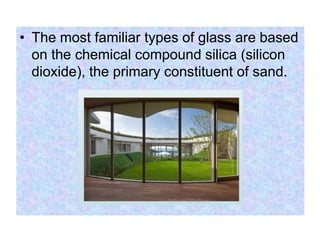
• The most familiar types of glass are based
on the chemical compound silica (silicon
dioxide), the primary constituent of sand.
Soda Glass
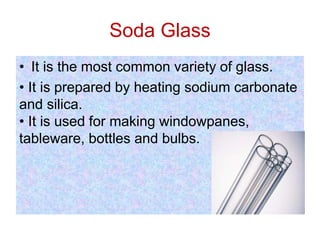
• It is the most common variety of glass.
• It is prepared by heating sodium carbonate
and silica.
• It is used for making windowpanes,
tableware, bottles and bulbs.
Potash Glass
• Potash lime glass is made with silica (sand),
Calcium carbonate and potassium carbonate.
• These glasses are costlier than soda lime glass
and are used for chemical apparatus,
combustion tubes and glassware which are
used for heating operations.
Flint Glass
• It is made up of lead oxide fluxed with silica and
K2CO3. Lead glasses has a lower softening temperature
higher refractive index and good electrical properties. It
is bright lustrous and possess high specific gravity.
• High quality table wares, optical lenses, neon sign
tubing, cathode ray tubes, electrical insulators, crystal
art objects or cut glass, Windows and Shields for
protection against X-rays and Gamma rays in medical
and atomic energy fields etc.
Pyrex glass
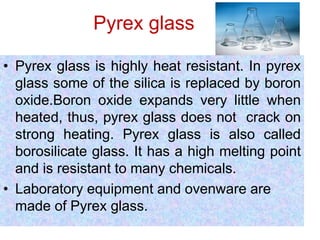
• Pyrex glass is highly heat resistant. In pyrex
glass some of the silica is replaced by boron
oxide.Boron oxide expands very little when
heated, thus, pyrex glass does not crack on
strong heating. Pyrex glass is also called
borosilicate glass. It has a high melting point
and is resistant to many chemicals.
• Laboratory equipment and ovenware are
made of Pyrex glass.
Jena Glass
• It is common hard glass containing silica and
boron with small amount of alumina and less
alkaline solids.
Uses: Industrially used for pipeline of corrosive
liquids, gauge glasses, superior laboratory
apparatus, kitchen wares, chemical plants,
television tubes, electrical insulators etc.
Crookes Glass
• It contains Phosphorus, PbCO3, silicates and Cerium
oxide which has the property to absorb harmful ultra-
violet light. This glass is given through homogeneity
by heating it for a prolonged period of time. These
glasses have low melting point and are relatively soft.
Uses: They are used for making optical lenses.
Ground Glass
• Ordinary glass whose surface has been
given a matt finish by rubbing with emery
& turpentine.
• Used for windowpane to ensure privacy,
• Also used for quick-fit joints in laboratory
apparatus, and in light bulbs for even
distribution of light.
Safety Glass
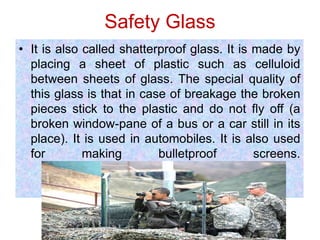
• It is also called shatterproof glass. It is made by
placing a sheet of plastic such as celluloid
between sheets of glass. The special quality of
this glass is that in case of breakage the broken
pieces stick to the plastic and do not fly off (a
broken window-pane of a bus or a car still in its
place). It is used in automobiles. It is also used
for making bulletproof screens.
Crown Glass
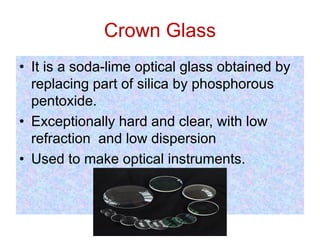
• It is a soda-lime optical glass obtained by
replacing part of silica by phosphorous
pentoxide.
• Exceptionally hard and clear, with low
refraction and low dispersion
• Used to make optical instruments.
Coloured Glass
• Small amounts of metallic oxides are mixed with
the hot molten mixture of sand, sodium carbonate
and limestone. The desired colour determines the
choice of the metallic oxide to be added, as
different metallic oxides give different colours to
the glass.
• It is used for decorating walls, making
sunglasses, and for making light signals for
automobiles, trains and aeroplanes. .
THANK YOU

Glass pdf

  • 1.
    TYPES OF GLASS Dr.BincyJoseph Assistant Professor Dept. of chemistry St. Mary's college, Thrissur
  • 2.
    GLASS Glass is anamorphous (non crystalline) solid material which is often transparent and has widespread practical, technological, and decorative usage in things like window panes, tableware, and optoelectronics.
  • 3.
    • The mostfamiliar types of glass are based on the chemical compound silica (silicon dioxide), the primary constituent of sand.
  • 4.
    Soda Glass • Itis the most common variety of glass. • It is prepared by heating sodium carbonate and silica. • It is used for making windowpanes, tableware, bottles and bulbs.
  • 5.
    Potash Glass • Potashlime glass is made with silica (sand), Calcium carbonate and potassium carbonate. • These glasses are costlier than soda lime glass and are used for chemical apparatus, combustion tubes and glassware which are used for heating operations.
  • 6.
    Flint Glass • Itis made up of lead oxide fluxed with silica and K2CO3. Lead glasses has a lower softening temperature higher refractive index and good electrical properties. It is bright lustrous and possess high specific gravity. • High quality table wares, optical lenses, neon sign tubing, cathode ray tubes, electrical insulators, crystal art objects or cut glass, Windows and Shields for protection against X-rays and Gamma rays in medical and atomic energy fields etc.
  • 7.
    Pyrex glass • Pyrexglass is highly heat resistant. In pyrex glass some of the silica is replaced by boron oxide.Boron oxide expands very little when heated, thus, pyrex glass does not crack on strong heating. Pyrex glass is also called borosilicate glass. It has a high melting point and is resistant to many chemicals. • Laboratory equipment and ovenware are made of Pyrex glass.
  • 8.
    Jena Glass • Itis common hard glass containing silica and boron with small amount of alumina and less alkaline solids. Uses: Industrially used for pipeline of corrosive liquids, gauge glasses, superior laboratory apparatus, kitchen wares, chemical plants, television tubes, electrical insulators etc.
  • 9.
    Crookes Glass • Itcontains Phosphorus, PbCO3, silicates and Cerium oxide which has the property to absorb harmful ultra- violet light. This glass is given through homogeneity by heating it for a prolonged period of time. These glasses have low melting point and are relatively soft. Uses: They are used for making optical lenses.
  • 10.
    Ground Glass • Ordinaryglass whose surface has been given a matt finish by rubbing with emery & turpentine. • Used for windowpane to ensure privacy, • Also used for quick-fit joints in laboratory apparatus, and in light bulbs for even distribution of light.
  • 11.
    Safety Glass • Itis also called shatterproof glass. It is made by placing a sheet of plastic such as celluloid between sheets of glass. The special quality of this glass is that in case of breakage the broken pieces stick to the plastic and do not fly off (a broken window-pane of a bus or a car still in its place). It is used in automobiles. It is also used for making bulletproof screens.
  • 12.
    Crown Glass • Itis a soda-lime optical glass obtained by replacing part of silica by phosphorous pentoxide. • Exceptionally hard and clear, with low refraction and low dispersion • Used to make optical instruments.
  • 13.
    Coloured Glass • Smallamounts of metallic oxides are mixed with the hot molten mixture of sand, sodium carbonate and limestone. The desired colour determines the choice of the metallic oxide to be added, as different metallic oxides give different colours to the glass. • It is used for decorating walls, making sunglasses, and for making light signals for automobiles, trains and aeroplanes. .
  • 14.