GLASS Lecture By: Ar. Shahrukh shah
SOAD
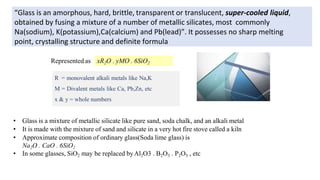
“Glass is an amorphous, hard, brittle, transparent or translucent, super-cooled liquid,
obtained by fusing a mixture of a number of metallic silicates, most commonly
Na(sodium), K(potassium),Ca(calcium) and Pb(lead)”. It possesses no sharp melting
point, crystalling structure and definite formula
xR2O . yMO . 6SiO2
Represented as
R = monovalent alkali metals like Na,K
M = Divalent metals like Ca, Pb,Zn, etc
x & y = whole numbers
• Glass is a mixture of metallic silicate like pure sand, soda chalk, and an alkali metal
• It is made with the mixture of sand and silicate in a very hot fire stove called a kiln
• Approximate composition of ordinary glass(Soda lime glass) is
Na2O . CaO . 6SiO2
• In some glasses, SiO2 may be replaced byAl2O3 . B2O3 . P2O5 , etc
General Properties of glass
 Amorphous Solid (atoms irregular fashion)
 No definite melting point
 Very brittle
 Softens on heating
 Can absorb, reflect and transmit light
 Good electrical insulator
 Affected by alkalis
 Not affected by air,water,acid or chemical reagents . But soluble in HF which
converts into SiF4
 Light in weight because it has homogeneous internal structure similar to liquids
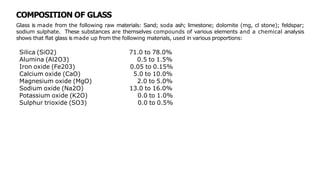
COMPOSITION OF GLASS
Glass is made from the following raw materials: Sand; soda ash; limestone; dolomite (mg, cl stone); feldspar;
sodium sulphate. These substances are themselves compounds of various elements and a chemical analysis
shows that flat glass is made up from the following materials, used in various proportions:
Silica (SiO2) 71.0 to 78.0%
Alumina (Al2O3) 0.5 to 1.5%
Iron oxide (Fe203) 0.05 to 0.15%
Calcium oxide (CaO) 5.0 to 10.0%
Magnesium oxide (MgO) 2.0 to 5.0%
Sodium oxide (Na2O) 13.0 to 16.0%
Potassium oxide (K2O) 0.0 to 1.0%
Sulphur trioxide (SO3) 0.0 to 0.5%
Raw materials of glass
Sodium
(Na), 14
Potassiu
m (K), 0.3
Calcium
(Ca), 9
Barium
(Ba), 4
Silica, 70
Others,
2.7
Sodium (Na)
Barium (Ba)
Potassium (K)
Silica
Calcium (Ca)
Others
Sl. No Name of the
element
Source of the element Name of the
glass produced
1 Sodium (Na) Na2CO3,Na2SO4 Soft glass
2 Potassium (K) Potash, K2CO3,KNO3 Hard glass
3 Calcium (Ca) Lime, limestone Glass with
high RI
4 Barium (Ba) BaCO3 Glass with
high RI
5 Lead Litharge, red lead Flint glass
6 Zinc Zinc Oxide Heat & Shock
proof glass
7 Borate Borax, boric acid Heat & shock
proof glass
8 Silica Sand, quartz
Colors
Yellow
Ferric Salt
Green Ferrous and chromium
Blue Cobalt salt
RI (Refractive index)
Glass Manufacturing
Manufacturing of glass consists of following high level steps
1. Melting
a. Pot furnace
b. Tank furnace
2. Forming and shaping
3. Annealing
4. Finishing
Melting
• Raw materials in proper proportions (sand, soda ash
and lime stone ) are mixed and finely powdered
• The homogenous mixture known as Batch is fused with
some broken glass , called “Cullet” in any of the two
types of furnaces
• The homogeneous mixture is melted either in
a. Pot furnace or
b. Tank furnace
• The batch melts and fuses at 1800oC
Melting: Pot furnace
Hot Gases
A B
D
C
Hot Air
Figure showing Pot furnace
 Two types of pots are used
a. Open crucible type pot
b. Closed covered type pot
 Generally closed covered type pot is used
 Pot is placed in a circle around a central
opening in its bottom
 Heated by burning producer gas and air
 Roof of the pot is constructed with refractory
material which also reflects the heat
 Also called as batch process
Melting: Tank Furnace
Molten glass
Burning fuel gas
A B C D
Air Fuel gas Fuel gases
Fuel gas and air being
heated by hot checker
work
 The “batch” is melted in the tank using
producer gas and air
 It follows “regenerative system of heat
economy”
 Air and fuel is passes throughA& B
 The burnt gases are deflected by the roof
and “batch” gets melted
 Hot waste gas escapes through firebricks
C & D
 The direction of the fuel gas & air is reversed through C & D , which absorbs the
heat of the waste gas and burns
 The waste gas now escapes throughA& B
Figure showing tank furnace
Melting : Chemical reactions
• Cullet melts at relatively low temperature and assists in melting of rest of
the charge
• During the melting process following reactions occur
• The molten mass is heated till its free from air bubbles
• For colored gases desired pigment is added
• The molten mass is then cooled at about 800oC at later point of time
CaCO3 + SiO2 CaSiO3 + CO2
Na2CO3 + SiO2 Na2SiO3 + CO2
Forming & Shaping, Annealing and Finishing
 Molten gas is converted to desired shape by blowing or molding or pressing
between rollers - “Forming and Shaping”
 Articles are then cooled gradually at room temperature. - “Annealing”
The longer the annealing period better the quality of glass
 After annealing, the articles are subjected to cleaning, polishing, cutting, sand
blasting etc., - “Finishing”
Types of Glass Used for Glazing
Glass plays an essential role in the facade. A facade is a special type of wall. It separates inside from outside. Glass is a
uniform material, a solidified liquid. By its property of transparency it opens up our buildings to the outside world.
In modern architecture there is tendency to open up our buildings by using very large facades that are as transparent
as possible.
• In the external wall, glass can be used as a curtain wall or structural glazing.
• Glass is not essentially transparent. They are available in several opacities and various textures and finishes.
•
•
•
•
 BASIC TYPES OF GLASS
floatglass
sheet glass
patterned glass
wired glass
 MODIFIED VARIETIES OF GLASS
• Reflective glass
• Insulating glass
• Safetyglass
• - Laminatedsafety glass
• -T
oughened safetyglass
• Glassbricks
• Tintedglass, etc…
FLOATGLASS
• Most widely used type of glass
• Monolithic and highly transparent
• Produced by flowing molten glass over a bath of molten tin and
slowly cooling .
• Has uniform thickness, flatness and excellent optical quality.
• Manufactured in two main varieties, i.e.;clear and tinted.
• Used in mirrors, windows, curtain walls and doors.
• float glass can be toughened, a process that creates safety glassout
of annealed glass.
• Available in thicknesses 2-19 mm
• Can be coloured during manufacturing.
SHEET GLASS
• There are three different kind of sheet glasses:
- Annealed flat glass
- Processed flat glass
- Misc.glass
• Actual color green (or sometimes blue).
Sizes available:
• 2mm, 3mm, 4mm, 5mm,
• 6mm, 8mm, 10mm, 12mm, 15mm and19mm.
Uses:
windows, shelves, large size doors and table tops
PRIZE:
Thickness Cost
4-6mm Rs 53/sqm
8-12mm Rs 63/sqm
PATTERNED GLASS
• Sometimes referred to as “figured” or “rolled” glass.
• Has a pattern or texture impressed on one or both sides in the process of rolling.
• This glass surface has a patterned decorative design which provide
translucency and some degrees ofobscurity.
• Patterns are classified as decorative or glazing i.e.,used primarily for their functional properties.
USES:
• Decorative glazing of windows, bathroom partitions, door.
• Isdifficult to clean as dust settles between the crevices
• Thickness: 4mm, 6mm,
• Sizes:2140 x 1280 mm, 2140 x 1320 mm respectively.
WIRED GLASS
• Fine twisted hexagonal wire netting or mesh inserted during the process of rolling.
• May be patterned, smooth rolled or ground and polished.
• Used primarily in fire rated windows, doors, skylights and applications
requiring a safety glazing material.
• When broken, loose pieces of glass are held by the wire netting.
• Georgian wire mesh, 13mm provided.
• Thickness: 5 to 7 mm.
• Size:3300 x 1830 mm.
REFLECTIVE GLASS
• Coating of a metal compound applied on one surface bychemical deposition.
• Reflects light and solar heat
• May be applied on any type of glass and thickness upto half an inch
• Uses: principally used in curtain wall glazing and structural glazing, train
windows(AC compartments), doors and windows of commercial buildings,
partitions and internal wall cladding.
• Disadvantages: Causes light pollution and is hazardous to traffic.
Thickness Cost
4-6mm Rs 53/sqm
8-12mm Rs 63/sqm
INSULATING GLASS
• Factory assembled unit consisting of two or more panes of
glass separated by air spaces.
• Moisture proof
• The periphery of the air spaces is hermetically sealed.
•
• There are two types of such sealed units:
• - Organic seal type: Two or more panes of glass separated by
air spaces sealed at their edges with an organic seal.
- Glass edge type: Two sheets of clear single strength or double
strength glass fused together at their edges enclosing a nominal
3/16 inches air space. This type of glass is not produced with
multiple air spaces.
SAFETY GLASS
• Developed basically for vehicular purposes where safety from fracture of glass is a major concern.
• Requirement of uninterrupted vision rules out the use ofwired glass.
• Is of two types-
 Laminated safety glass
 Toughened safety glass
LAMINATED SAFETY GLASS
• Made in the form of a sandwich consisting of an interlayer of transparent plastic material
such as celluloid between two sheets of plate or sheet glass.
• Celluloid placed between sheets already coated with gelatin and specially prepared
enamel.
• Adhesion achieved by applying considerable heat and pressure.
• When one or both sheets of this composite material are broken the glass adheres to the
inter layer so that there is no danger from the flying fragments
TOUGHENED SAFETY GLASS
• Pieces of sheet or plate glass suspended in electric furnace until soft
and suddenly cooled by blowing air on both sides.
• Fragments have no cutting edge.
• Toughened glass withstands a dead load more than four times that
of ordinary glass.
• Additional compressive stresses in the surfaces makes the glass stronger.
• Can safely accommodate high tensile forces due to the pre-stress.
• Fracture can occur once the pre-stress has beenexceeded.
GLASS BRICKS
• These are hollow glass units or blocks of glass shaped to work as bricks
• Joined with the help of silicon sealants to obtain seamless finish
• The two outer, exposed surfaces may be smooth or textured.
• Glass blocks can be coloured and have decorated surfaces.
• Walls of glass blocks meeting fire resistance are also possible.
• Found in Indonesian, Sri Lankan, Chinese, USA,Germanvarieties
• Srilankan and Indonesian varieties: Rs80
• European clear: Rs350/pc
• European coloured: Rs450/pc
• Chinese clear: Rs52/pc
• Chinese coloured: Rs152/pc
TINTED GLASS
• Manufactured by adding a dye at the molten glassstage
• Used to minimize solar heat gain and glare while it also absorbs heat.
• Available in grey, bronze, green, blue and blue/green
• Allows for increased control of comfort and energy usage
Sizes available:
Grey and Bronze -
Blue
Green
B
lue/Green
4mm, 5mm, 6mm,8mm,and 10mm
- 6mm
- 5mm, 6mm, and10mm
- 6mm and 10mm
Thickness Rate/sq ft (Rs.)
3mm 22
4mm 30
5mm 35
6mm 38
8mm 70
10mm 90
VIDEO LINKS
https://www.youtube.com/watch?v=S6hNFuaV7ro&feature=youtu.be
https://www.youtube.com/watch?v=UOwk2QIfDqY&feature=youtu.be
https://www.youtube.com/watch?v=bxW7pPKG0Mg

GLASS_LECTURE-1.pptx

  • 1.
    GLASS Lecture By:Ar. Shahrukh shah SOAD
  • 2.
    “Glass is anamorphous, hard, brittle, transparent or translucent, super-cooled liquid, obtained by fusing a mixture of a number of metallic silicates, most commonly Na(sodium), K(potassium),Ca(calcium) and Pb(lead)”. It possesses no sharp melting point, crystalling structure and definite formula xR2O . yMO . 6SiO2 Represented as R = monovalent alkali metals like Na,K M = Divalent metals like Ca, Pb,Zn, etc x & y = whole numbers • Glass is a mixture of metallic silicate like pure sand, soda chalk, and an alkali metal • It is made with the mixture of sand and silicate in a very hot fire stove called a kiln • Approximate composition of ordinary glass(Soda lime glass) is Na2O . CaO . 6SiO2 • In some glasses, SiO2 may be replaced byAl2O3 . B2O3 . P2O5 , etc
  • 3.
    General Properties ofglass  Amorphous Solid (atoms irregular fashion)  No definite melting point  Very brittle  Softens on heating  Can absorb, reflect and transmit light  Good electrical insulator  Affected by alkalis  Not affected by air,water,acid or chemical reagents . But soluble in HF which converts into SiF4  Light in weight because it has homogeneous internal structure similar to liquids
  • 4.
    COMPOSITION OF GLASS Glassis made from the following raw materials: Sand; soda ash; limestone; dolomite (mg, cl stone); feldspar; sodium sulphate. These substances are themselves compounds of various elements and a chemical analysis shows that flat glass is made up from the following materials, used in various proportions: Silica (SiO2) 71.0 to 78.0% Alumina (Al2O3) 0.5 to 1.5% Iron oxide (Fe203) 0.05 to 0.15% Calcium oxide (CaO) 5.0 to 10.0% Magnesium oxide (MgO) 2.0 to 5.0% Sodium oxide (Na2O) 13.0 to 16.0% Potassium oxide (K2O) 0.0 to 1.0% Sulphur trioxide (SO3) 0.0 to 0.5%
  • 5.
    Raw materials ofglass Sodium (Na), 14 Potassiu m (K), 0.3 Calcium (Ca), 9 Barium (Ba), 4 Silica, 70 Others, 2.7 Sodium (Na) Barium (Ba) Potassium (K) Silica Calcium (Ca) Others Sl. No Name of the element Source of the element Name of the glass produced 1 Sodium (Na) Na2CO3,Na2SO4 Soft glass 2 Potassium (K) Potash, K2CO3,KNO3 Hard glass 3 Calcium (Ca) Lime, limestone Glass with high RI 4 Barium (Ba) BaCO3 Glass with high RI 5 Lead Litharge, red lead Flint glass 6 Zinc Zinc Oxide Heat & Shock proof glass 7 Borate Borax, boric acid Heat & shock proof glass 8 Silica Sand, quartz Colors Yellow Ferric Salt Green Ferrous and chromium Blue Cobalt salt RI (Refractive index)
  • 6.
    Glass Manufacturing Manufacturing ofglass consists of following high level steps 1. Melting a. Pot furnace b. Tank furnace 2. Forming and shaping 3. Annealing 4. Finishing
  • 7.
    Melting • Raw materialsin proper proportions (sand, soda ash and lime stone ) are mixed and finely powdered • The homogenous mixture known as Batch is fused with some broken glass , called “Cullet” in any of the two types of furnaces • The homogeneous mixture is melted either in a. Pot furnace or b. Tank furnace • The batch melts and fuses at 1800oC
  • 8.
    Melting: Pot furnace HotGases A B D C Hot Air Figure showing Pot furnace  Two types of pots are used a. Open crucible type pot b. Closed covered type pot  Generally closed covered type pot is used  Pot is placed in a circle around a central opening in its bottom  Heated by burning producer gas and air  Roof of the pot is constructed with refractory material which also reflects the heat  Also called as batch process
  • 9.
    Melting: Tank Furnace Moltenglass Burning fuel gas A B C D Air Fuel gas Fuel gases Fuel gas and air being heated by hot checker work  The “batch” is melted in the tank using producer gas and air  It follows “regenerative system of heat economy”  Air and fuel is passes throughA& B  The burnt gases are deflected by the roof and “batch” gets melted  Hot waste gas escapes through firebricks C & D  The direction of the fuel gas & air is reversed through C & D , which absorbs the heat of the waste gas and burns  The waste gas now escapes throughA& B Figure showing tank furnace
  • 10.
    Melting : Chemicalreactions • Cullet melts at relatively low temperature and assists in melting of rest of the charge • During the melting process following reactions occur • The molten mass is heated till its free from air bubbles • For colored gases desired pigment is added • The molten mass is then cooled at about 800oC at later point of time CaCO3 + SiO2 CaSiO3 + CO2 Na2CO3 + SiO2 Na2SiO3 + CO2
  • 11.
    Forming & Shaping,Annealing and Finishing  Molten gas is converted to desired shape by blowing or molding or pressing between rollers - “Forming and Shaping”  Articles are then cooled gradually at room temperature. - “Annealing” The longer the annealing period better the quality of glass  After annealing, the articles are subjected to cleaning, polishing, cutting, sand blasting etc., - “Finishing”
  • 12.
    Types of GlassUsed for Glazing Glass plays an essential role in the facade. A facade is a special type of wall. It separates inside from outside. Glass is a uniform material, a solidified liquid. By its property of transparency it opens up our buildings to the outside world. In modern architecture there is tendency to open up our buildings by using very large facades that are as transparent as possible. • In the external wall, glass can be used as a curtain wall or structural glazing. • Glass is not essentially transparent. They are available in several opacities and various textures and finishes.
  • 13.
    • • • •  BASIC TYPESOF GLASS floatglass sheet glass patterned glass wired glass  MODIFIED VARIETIES OF GLASS • Reflective glass • Insulating glass • Safetyglass • - Laminatedsafety glass • -T oughened safetyglass • Glassbricks • Tintedglass, etc…
  • 14.
    FLOATGLASS • Most widelyused type of glass • Monolithic and highly transparent • Produced by flowing molten glass over a bath of molten tin and slowly cooling . • Has uniform thickness, flatness and excellent optical quality. • Manufactured in two main varieties, i.e.;clear and tinted. • Used in mirrors, windows, curtain walls and doors. • float glass can be toughened, a process that creates safety glassout of annealed glass. • Available in thicknesses 2-19 mm • Can be coloured during manufacturing.
  • 15.
    SHEET GLASS • Thereare three different kind of sheet glasses: - Annealed flat glass - Processed flat glass - Misc.glass • Actual color green (or sometimes blue). Sizes available: • 2mm, 3mm, 4mm, 5mm, • 6mm, 8mm, 10mm, 12mm, 15mm and19mm. Uses: windows, shelves, large size doors and table tops PRIZE: Thickness Cost 4-6mm Rs 53/sqm 8-12mm Rs 63/sqm
  • 16.
    PATTERNED GLASS • Sometimesreferred to as “figured” or “rolled” glass. • Has a pattern or texture impressed on one or both sides in the process of rolling. • This glass surface has a patterned decorative design which provide translucency and some degrees ofobscurity. • Patterns are classified as decorative or glazing i.e.,used primarily for their functional properties. USES: • Decorative glazing of windows, bathroom partitions, door. • Isdifficult to clean as dust settles between the crevices • Thickness: 4mm, 6mm, • Sizes:2140 x 1280 mm, 2140 x 1320 mm respectively.
  • 17.
    WIRED GLASS • Finetwisted hexagonal wire netting or mesh inserted during the process of rolling. • May be patterned, smooth rolled or ground and polished. • Used primarily in fire rated windows, doors, skylights and applications requiring a safety glazing material. • When broken, loose pieces of glass are held by the wire netting. • Georgian wire mesh, 13mm provided. • Thickness: 5 to 7 mm. • Size:3300 x 1830 mm.
  • 18.
    REFLECTIVE GLASS • Coatingof a metal compound applied on one surface bychemical deposition. • Reflects light and solar heat • May be applied on any type of glass and thickness upto half an inch • Uses: principally used in curtain wall glazing and structural glazing, train windows(AC compartments), doors and windows of commercial buildings, partitions and internal wall cladding. • Disadvantages: Causes light pollution and is hazardous to traffic. Thickness Cost 4-6mm Rs 53/sqm 8-12mm Rs 63/sqm
  • 19.
    INSULATING GLASS • Factoryassembled unit consisting of two or more panes of glass separated by air spaces. • Moisture proof • The periphery of the air spaces is hermetically sealed. • • There are two types of such sealed units: • - Organic seal type: Two or more panes of glass separated by air spaces sealed at their edges with an organic seal. - Glass edge type: Two sheets of clear single strength or double strength glass fused together at their edges enclosing a nominal 3/16 inches air space. This type of glass is not produced with multiple air spaces.
  • 20.
    SAFETY GLASS • Developedbasically for vehicular purposes where safety from fracture of glass is a major concern. • Requirement of uninterrupted vision rules out the use ofwired glass. • Is of two types-  Laminated safety glass  Toughened safety glass
  • 21.
    LAMINATED SAFETY GLASS •Made in the form of a sandwich consisting of an interlayer of transparent plastic material such as celluloid between two sheets of plate or sheet glass. • Celluloid placed between sheets already coated with gelatin and specially prepared enamel. • Adhesion achieved by applying considerable heat and pressure. • When one or both sheets of this composite material are broken the glass adheres to the inter layer so that there is no danger from the flying fragments
  • 22.
    TOUGHENED SAFETY GLASS •Pieces of sheet or plate glass suspended in electric furnace until soft and suddenly cooled by blowing air on both sides. • Fragments have no cutting edge. • Toughened glass withstands a dead load more than four times that of ordinary glass. • Additional compressive stresses in the surfaces makes the glass stronger. • Can safely accommodate high tensile forces due to the pre-stress. • Fracture can occur once the pre-stress has beenexceeded.
  • 23.
    GLASS BRICKS • Theseare hollow glass units or blocks of glass shaped to work as bricks • Joined with the help of silicon sealants to obtain seamless finish • The two outer, exposed surfaces may be smooth or textured. • Glass blocks can be coloured and have decorated surfaces. • Walls of glass blocks meeting fire resistance are also possible. • Found in Indonesian, Sri Lankan, Chinese, USA,Germanvarieties • Srilankan and Indonesian varieties: Rs80 • European clear: Rs350/pc • European coloured: Rs450/pc • Chinese clear: Rs52/pc • Chinese coloured: Rs152/pc
  • 24.
    TINTED GLASS • Manufacturedby adding a dye at the molten glassstage • Used to minimize solar heat gain and glare while it also absorbs heat. • Available in grey, bronze, green, blue and blue/green • Allows for increased control of comfort and energy usage Sizes available: Grey and Bronze - Blue Green B lue/Green 4mm, 5mm, 6mm,8mm,and 10mm - 6mm - 5mm, 6mm, and10mm - 6mm and 10mm Thickness Rate/sq ft (Rs.) 3mm 22 4mm 30 5mm 35 6mm 38 8mm 70 10mm 90
  • 25.