By:Nabaa yousif
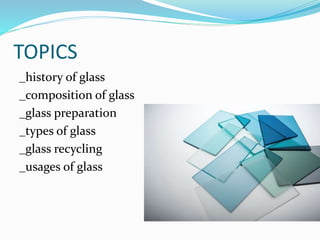
TOPICS
_history of glass
_composition of glass
_glass preparation
_types of glass
_glass recycling
_usages of glass
GLASS
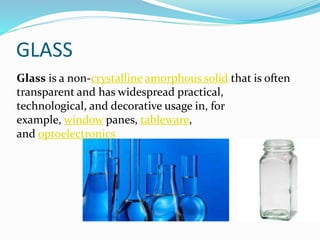
Glass is a non-crystalline amorphous solid that is often
transparent and has widespread practical,
technological, and decorative usage in, for
example, window panes, tableware,
and optoelectronics
HISTORY OF GLASS
._First true glass was made in coastal north Syria
_the story of glass dates back to ancient Egypt where glass-making
became popular during the late bronze age.
_Anglo-Saxon period glass was a luxury material across England.
_in 10th century stained glass came to usage.
_in 1330crwon glass was produced in rouen.
_in 14th and 19th centuries stained glass employed in building
purposes.
_in 1843 henry bessemer invented float glass.
_in 12th century reinfoorced glass and glass bricks came to usage.
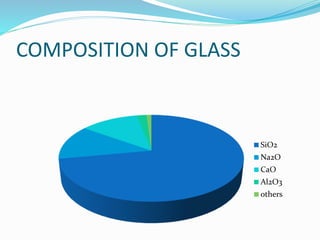
COMPOSITION OF GLASS
SiO2
Na2O
CaO
Al2O3
others
SILICA(sand)
_silica is another name for the chemical compound SILICON
SiO2))OXIDE
_each unit of silica includes one atom of silicon and two atom
of oxygen
_physical properties of silica are
1.Solid in room temperature
2.Pure silica is colorless but if contaminants are present in a
sample of quartz, it may be colored
3.Silica has very high melting and boiling
points(3,110F)(4,046F)
_silica reacts with hydrofluoric acid, it also reacts with metal
oxide like sodium oxide or lead oxide ,these reactions are
used to produce different types of glass
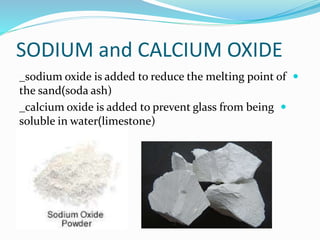
SODIUM and CALCIUM OXIDE
_sodium oxide is added to reduce the melting point of
soda ash))the sand
_calcium oxide is added to prevent glass from being
limestone))soluble in water
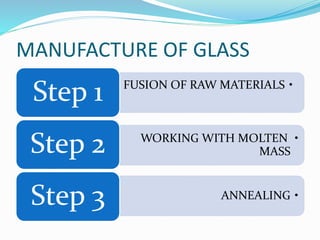
MANUFACTURE OF GLASS
•FUSION OF RAW MATERIALS
Step 1
•WORKING WITH MOLTEN
MASSStep 2
•ANNEALINGStep 3
AMOROHOUS GLASS
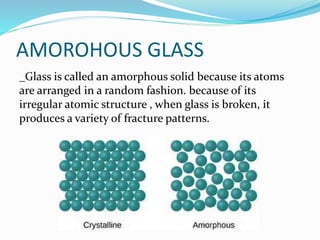
_Glass is called an amorphous solid because its atoms
are arranged in a random fashion. because of its
irregular atomic structure , when glass is broken, it
produces a variety of fracture patterns.
COLORED GLASS
_colored glasses are due to inclusion of ions of chemical
elements like:
_iron(Fe)
_cobalt(Co)
_nickel(Ni)
_copper(Cu)
_chromium(Cr)
_magnesium(Mg)
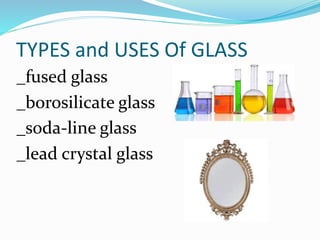
TYPES and USES Of GLASS
_fused glass
_borosilicate glass
_soda-line glass
_lead crystal glass
FUSED GLASS
_the simplest type of glass is fused glass . it consists
mainly of silica.
_fused glass is made by heating silica to a molten liquid .
the liquid is then cooled rapidly to form an amorphous
solid.
SODA-LIME GLASS
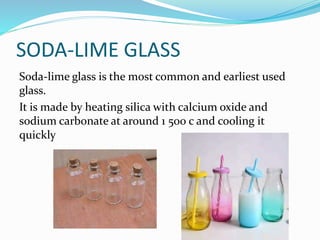
Soda-lime glass is the most common and earliest used
glass.
It is made by heating silica with calcium oxide and
sodium carbonate at around 1 500 c and cooling it
quickly
BOROSILICATE GLASS
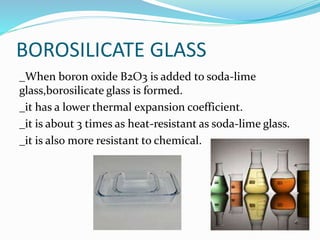
_When boron oxide B2O3 is added to soda-lime
glass,borosilicate glass is formed.
_it has a lower thermal expansion coefficient.
_it is about 3 times as heat-resistant as soda-lime glass.
_it is also more resistant to chemical.
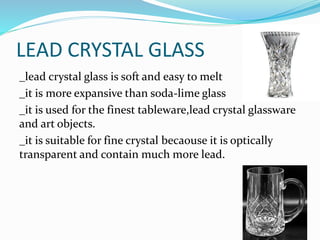
LEAD CRYSTAL GLASS
_lead crystal glass is soft and easy to melt
_it is more expansive than soda-lime glass
_it is used for the finest tableware,lead crystal glassware
and art objects.
_it is suitable for fine crystal becaouse it is optically
transparent and contain much more lead.
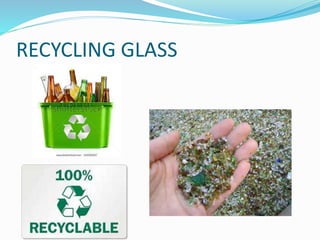
RECYCLING GLASS
THANK YOU
ARIGATO KOZAYMAS

GLASS

  • 1.
  • 2.
    TOPICS _history of glass _compositionof glass _glass preparation _types of glass _glass recycling _usages of glass
  • 3.
    GLASS Glass is anon-crystalline amorphous solid that is often transparent and has widespread practical, technological, and decorative usage in, for example, window panes, tableware, and optoelectronics
  • 4.
    HISTORY OF GLASS ._Firsttrue glass was made in coastal north Syria _the story of glass dates back to ancient Egypt where glass-making became popular during the late bronze age. _Anglo-Saxon period glass was a luxury material across England. _in 10th century stained glass came to usage. _in 1330crwon glass was produced in rouen. _in 14th and 19th centuries stained glass employed in building purposes. _in 1843 henry bessemer invented float glass. _in 12th century reinfoorced glass and glass bricks came to usage.
  • 5.
  • 6.
    SILICA(sand) _silica is anothername for the chemical compound SILICON SiO2))OXIDE _each unit of silica includes one atom of silicon and two atom of oxygen _physical properties of silica are 1.Solid in room temperature 2.Pure silica is colorless but if contaminants are present in a sample of quartz, it may be colored 3.Silica has very high melting and boiling points(3,110F)(4,046F) _silica reacts with hydrofluoric acid, it also reacts with metal oxide like sodium oxide or lead oxide ,these reactions are used to produce different types of glass
  • 7.
    SODIUM and CALCIUMOXIDE _sodium oxide is added to reduce the melting point of soda ash))the sand _calcium oxide is added to prevent glass from being limestone))soluble in water
  • 8.
    MANUFACTURE OF GLASS •FUSIONOF RAW MATERIALS Step 1 •WORKING WITH MOLTEN MASSStep 2 •ANNEALINGStep 3
  • 9.
    AMOROHOUS GLASS _Glass iscalled an amorphous solid because its atoms are arranged in a random fashion. because of its irregular atomic structure , when glass is broken, it produces a variety of fracture patterns.
  • 10.
    COLORED GLASS _colored glassesare due to inclusion of ions of chemical elements like: _iron(Fe) _cobalt(Co) _nickel(Ni) _copper(Cu) _chromium(Cr) _magnesium(Mg)
  • 11.
    TYPES and USESOf GLASS _fused glass _borosilicate glass _soda-line glass _lead crystal glass
  • 12.
    FUSED GLASS _the simplesttype of glass is fused glass . it consists mainly of silica. _fused glass is made by heating silica to a molten liquid . the liquid is then cooled rapidly to form an amorphous solid.
  • 13.
    SODA-LIME GLASS Soda-lime glassis the most common and earliest used glass. It is made by heating silica with calcium oxide and sodium carbonate at around 1 500 c and cooling it quickly
  • 14.
    BOROSILICATE GLASS _When boronoxide B2O3 is added to soda-lime glass,borosilicate glass is formed. _it has a lower thermal expansion coefficient. _it is about 3 times as heat-resistant as soda-lime glass. _it is also more resistant to chemical.
  • 15.
    LEAD CRYSTAL GLASS _leadcrystal glass is soft and easy to melt _it is more expansive than soda-lime glass _it is used for the finest tableware,lead crystal glassware and art objects. _it is suitable for fine crystal becaouse it is optically transparent and contain much more lead.
  • 16.
  • 17.