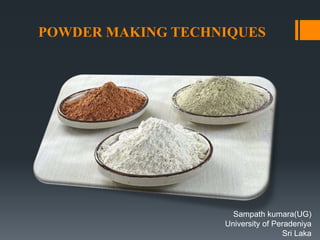
POWDER MAKING TECHNIQUES
Sampath kumara(UG)
University of Peradeniya
Sri Laka
Outline
• Introduction of Ceramics
• Properties
• classification
• Powder production methods
• Mechanical
• Chemical
• Physical
• Freeze drying
• Spray drying
• Sol-Gel technique
• Advanced ceramics
What is Ceramic ?
• Ceramic materials are inorganic , non-metallic
materials and things made from them.
• They formed by the action of heat and
subsequent cooling.
• Clay was the earliest material used to produce
ceramics.
• Ceramics now include domestic , industrial
and building products and etc..
Properties of Ceramics
• Extreme hardness
 High wear resistance
• Corrosion resistance
• Heat resistance
 Low electrical conductivity
 Low thermal conductivity
 Low thermal expansion
 Poor thermal shock resistance
• Low ductility
• Low toughness
• Low density
• High strength at elevated temperatures
 Very brittle
 High elastic modulus
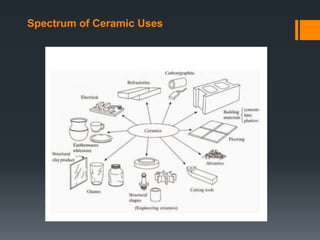
Spectrum of Ceramic Uses
Classification of Ceramic
Ceramic materials
Generally the ceramic materials may be divided into 3 classes according
to their common characteristics features.
a) Clay products
b) Refractories
c) Glasses
• Silicon & Aluminium as silicates
• Potassium compounds
• Magnesium compounds
• Calcium compounds
• Soda-lime glasses
• Lead glasses
• Borosilicate
Raw materials
 The traditional ceramics industry is largely based
on combinations of clay minerals , feldspar and
silica.
Talc
silica
Advance ceramics
Si3N4 -
ZrO2
Al2O3
SiC
There are numerous ways for powder production which
can be categorized as follows.
1) Mechanical methods
-chopping & cutting
-abrasion methods
-machining methods
-milling
-cold-stream process
2) Chemical Methods
-reduction of oxides
-precipitation from solutions
-thermal decomposition of compounds
-hydride decomposition
-thermal reaction
-electro-chemical methods
3) Physical Methods
-water atomization
-gas atomization
-special atomization methods
Ceramic process
COMMERCIAL METHODS
These are the methods used for high production rate. Best examples
of mechanical production methods are the Milling Process and Cold
Stream Process.
Milling:
Two types of milling are;
i) Ball Milling
ii) Attrition Milling.
• Particle size reduction (grinding)
• Shape change (flaking
• Solid-state alloying (mechanical alloying)
• Solid-state blending (incomplete alloying)
• Modifying, changing, or altering properties of a
material (density, flowability , or work hardening)
• Mixing or blending of two or more materials or mixed
phases
Objectives of milling include:
1) Ball Milling
Ball milling is an old and relatively simple method
for grinding large lumps of materials into smaller
pieces and powder form.
The principle is simple and is based on the
impact and shear forces.
Hard balls are used for mechanical comminution
of brittle materials and producing powders
Critical speed is the speed above which the
ball will centrifuge.
Attrition is the term which means to wear or rub away. It
is a process of grinding down by friction.
2) Attrition Milling
Figure: Ball mill
Ball Milling video
Figure: Attrition mill
Attrition milling video
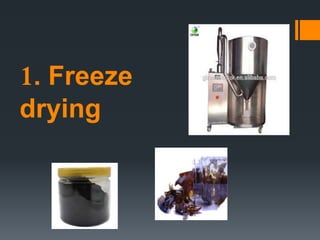
1. Freeze
drying
Freeze dying
A dehydration process typically used
to preserve a perishable material or
make the material more convenient
for transport.
Freeze drying
A slow batch process
Mainly two techniques
Freeze
Evaporation
A vaccume systerm is used
 4 main stages
4 stages of freeze drying
1. Pretreatment
2. Freezing
3. Primary drying
4. Secondary drying
1. Pretreatment
 A method of treating the product prior to freezing
This may includes,
 Concentrating the product
 Freeze concentration
 Solution phace concentration
 Formulation revision (addition of components )
 increase stability and processing
 Decrease a high-vapor-pressure solvent or increasing
the surface area.
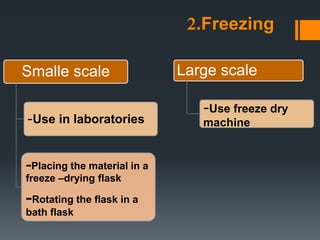
2.Freezing
Smalle scale
-Use in laboratories
-Placing the material in a
freeze –drying flask
-Rotating the flask in a
bath flask
Large scale
-Use freeze dry
machine
Batch freeze
dryer
Continous freeze
dryer
Tunnel freeze
dryer
Freezing
It is important to cool the material
below its eutectic point (the lowest
temperature at which the solid and
liquid phases of the material can
coexist)
3. Primary drying
The pressure is lowered
Enough heat is supplied to the material
About 95 percent of the water in the
material is sublimated
Process is slow.
In this phase, pressure is controlled
through the application of partial vacuum.
4. Secondary drying
Remove unfrozen water molecules.
 The temperature is raised higher than
in the primary drying phase.
Usually the pressure is also lowered.
After the freeze-drying process is
complete, the vacuum is usually
broken with an inert gas, such as
nitrogen, before the material is sealed.
Applications of freeze drying
Industry Application
1.Ceramics To create formable powder
2.Food processing For instant meals and soups.
For breakfast cereals, jices.
For flavorings
3.Dairy industry High value protiens
4.Phamaceuticals Protiens,enzymes,hormones,
vaccines and other biological
products.
5.Nutraceuticals Aloe vera,mussels,shark cartilage
6.Research Stabilization and storage of
biological materials.
7.Document recovery Water logged artifacts
Water damaged books and
documents.
8.Starters and cultures For used in cheese, yoghurts,meats
and probiotics
9.Floral Preserved petals and whole flowers.
Preserving wedding bouquets and
memorial flowers.
10.Taxdermy Animal preservation.
11.Technological industry Chemical synthesized roducts.
Late stage purification procedure.
Application of freeze drying in
ceramic industry
To make ceramic power
To produce porous ceramics
To make ceramic plates
To create superconductors
Freeze drying to make porous
ceramics
A water
based
ceramic slurry
Freeze while the
growth direction
of ice is
controlled
Sublimation
of ice
Greenbody Porous ceramic
Freeze drying to make ceramic
powder
From a sprayed slurry mist.
Creates softer particles with a more
homogeneous chemical composition.
More expensive.
Advantages of freeze drying
Less damages to their physical structure.
No need to refrigerate
No need to use chemicals for preservation
Easy to transport
Can increase the shelf life.
Can reconstitute quickly and easily.
No risk of contamination.
Disadvantages of freeze drying
Expensive
Long process time
Can cause structural deformation
Storage problems
Effective for selected items
Freeze drying video
Applications
2.
SPRAY
drying
What is ‘SPRAY DRYING’ ?
• An efficient way to convert ceramic
slurries into powder.
o i.e. Liquid form Powder form
• Preferred method of drying of many
thermally-sensitive materials.
• Air is the heated drying
medium; if the liquid is a
flammable solvent or the
product is oxygen
sensitive then Nitrogen is
used.
 Spray Dryer is
used.
• Co-current
spray dryer
• Counter
current spray
dryer
• Co-counter
spray dryer,
etc.
GENERAL
PROCESS
Process of Spray Drying..
 One-step continuous unit
operation.
 Five main steps:
1. Concentration
2. Atomization
3. Droplet-Air Contact
4. Droplet Drying
5. Separation
Concentration
• Increases the solids content
• Reducing the amount of
liquid that must be
evaporated in the spray dryer
Atomization
 Process of breaking
up bulk liquids into
droplets
 Nozzles (1-100)and
rotary atomizers are
used to form sprays
 The purpose of the atomizer:
 To meter flow into the
chamber
 Produce populations of
liquid particles of the desired
size
 Distribute those particles
uniformly in the drying
chamber
The selection of a specific
atomizer is made based on
the
• Feedstock
• Required powder
properties
• Dryer type capacity
• Atomizer capacity
Droplet-Air Contact
• The way in which the spray
makes contact with the air in
the dryer influences the
behavior of the droplet during
the drying phase and has a
direct bearing on the properties
of the dried product.
Droplet Drying
• Moisture evaporation takes place
in two stages
Separation
• Atomized droplets flow
through the spray drying
chamber
• Exit with a gas stream
through the product outlet
o All gases from drying
pass through product
recovery equipment
before being released
to the atmosphere.
o Cyclonic separators,
followed by dry fabric
filters or wet scrubbers
are used to separate
the particles from the
gases.
Spray drying Video
APPLICATIONS
• Milk products
• Egg products
• Food and Plant products
• Fruits and Vegetables product
• Carbohydrates and similar
products
• Yeast products
• Tannin products
• Cellulose products
• Slaughterhouse products
• Fish products
• Pharmaceutical Products
• In Ceramic Industry:
Spray Dried Bodies for Specific
Industries:
Electrical Porcelain Bodies
Sanitary ware Bodies
Catalyst Support Bodies
Potter
Refractories
Spray Dried Bodies successfully produced contain:
Ceramic Fluxes (e.g. Feldspar, Petalite)
Flints and Silica
Molochite
Talc
Olivine
Alumina
Zirconia
Titanates
ADVANTAGES AND DISADVANTAGES OF
SPRAY DRYING
ADVANTAGES
1. Able to operate in applications that range
from pharmaceutical processing to ceramic
powder production.
2. Can be designed to virtually any capacity
required.
3. Feed rates range from a few pounds per
hour to over 100 tons per hour.
4. Powder quality remains constant
during the entire run of the dryer.
5. Operation is continuous and
adoptable to full automatic control.
6. Can be used with both heat-
resistant and heat sensitive
products.
7. Feedstock can be in solution ,
slurry, paste, gel, suspension or
melt form.
8. Product density can be controlled and
nearly spherical particles can be
produced.
9. Material does not contact metal surface
until dried, reducing corrosion
problems.
10. A great variety of spray dryer designs
are available to meet various product
specifications.
DISADVANTAGES
1. Solid materials cannot be dried.
2. The equipment is very costly
and bulky.
3. Cleaning is time consuming.
4. There is a lot of heat wasted.
3)SOL-GEL
-
Why Sol-Gel..?
Applications Conventional methods
Glass preparation
and ceramics
High temparature, thermal
decomposition, limited materials
DSSC(thin TiO2
films)
Cumbersome, non-uniform and
high temp.
Coatings and thin
film applications
Accessibility limitations, scaling,
costly and energy intensives
- Process in which solid nano particles are
dispersed in a liquid (a sol) and agglomerate
together to form a continuous three-
dimensional network extending throughout the
liquid (a gel)
- Involves hydrolysis and poly-condensation
What’s Sol-Gel..
- Solid particles (up to few 100 nm) suspended in liquid phase
i.e. Sol
- Solid macromolecule (polymer chains) immersed in liquid
phase i.e. Gel
- Particles in Sol condense in new phase Gel
Sol-Gel..
…consists of hydrolysis and condensation.
Hydrolysis:
M(OR)x + H2O → HO-M(OR)x-1 + R-OH
R: -CH3, -C2H5 etc.
M:Si, Al, Ti etc.
Sol Gel synthesis:
1. Alcohol condensation:
(OR)x-1-MOH + ROM-(OR)x-1 →
(RO)x-1-MOM-(OR)x-1 + ROH
2. Water condensation:
(OR)x-1-MOH + HOM-(OR)x-1 →
(RO)x-1-MOM-(OR)x-1 + HOH
Condensation:
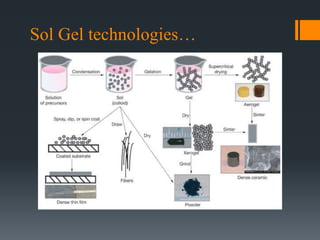
1) The desired colloidal particles once dispersed in a
liquid to form a sol.
(2) The deposition of sol solution produces the
coatings on the substrates by spraying, dipping or
spinning.
(3) The particles in sol are polymerized through the
removal of the stabilizing components and produce a
gel in a state of a continuous network.
(4) The final heat treatments pyrolyze the remaining
organic or inorganic components and form an
amorphous or crystalline coating.
The sol-gel process usually
consists of 4 steps:
Sol-gel video
Sol- Gel
Processing
RO Me or Me salt
+H2O Stabilizer
Nanodisperse Oxide Sol
(Particulate or Polymeric)
-H2O
Gel
Xerogel
Porous Oxide
-H2O
T > 400 C
-H2O
-Stabilizer
Sol Gel technologies…
 Variation of gelation time with PH
Factors affecting sol-gel chemistry
As the temperature increases the gelation time decreases.
 Synthesis of ceramics, glass, fibres
 Thin films on substrate
 Nuclear fuels (UO2 and ThO2 )
 Aerogels and xerogels
 Optical and refractory ceramic fibers
 Zeolite synthesis
 Powder abrasives
 Optical coating, protective coating on plastic, glass, metals
- BaTiO3 electronic material for capacitors
Applications…
- Cheap and low temp. operation
- Very thin films of metal oxides can be obtained
- Uniform distribution of components and porosity
- Better alternative approach to conventional production of glasses
- Easy dopant addition in ceramics processing
- Sol gel material can be obtained as bulks, thin films, (nano)
powders
Advantages:
“Sol-gel processing is a billion-dollar market”(Source: Laser
Focus World) According to a technical ’’
The total global market for sol-gel products was
valued at $1.6 billion in 2013.This market is expected
to grow to $1.7 billion in 2014 and $2.5 billion in
2019,a compound annul growth rate(CAGR)of 7.8%
from 2014 to 2019
Market
Advanced ceramics
Advanced ceramic video
Summery
• Introduction of Ceramics
• Properties
• classification
• Powder production methods
• Mechanical
• Chemical
• Physical
• Freeze drying
• Spray drying
• Sol-Gel technique
• Advanced ceramics
THANK
YOU

Powder Making Techniques in Ceramics

  • 1.
    POWDER MAKING TECHNIQUES Sampathkumara(UG) University of Peradeniya Sri Laka
  • 2.
    Outline • Introduction ofCeramics • Properties • classification • Powder production methods • Mechanical • Chemical • Physical • Freeze drying • Spray drying • Sol-Gel technique • Advanced ceramics
  • 3.
    What is Ceramic? • Ceramic materials are inorganic , non-metallic materials and things made from them. • They formed by the action of heat and subsequent cooling. • Clay was the earliest material used to produce ceramics. • Ceramics now include domestic , industrial and building products and etc..
  • 4.
    Properties of Ceramics •Extreme hardness  High wear resistance • Corrosion resistance • Heat resistance  Low electrical conductivity  Low thermal conductivity  Low thermal expansion  Poor thermal shock resistance • Low ductility • Low toughness • Low density • High strength at elevated temperatures  Very brittle  High elastic modulus
  • 5.
  • 6.
  • 8.
    Ceramic materials Generally theceramic materials may be divided into 3 classes according to their common characteristics features. a) Clay products b) Refractories c) Glasses • Silicon & Aluminium as silicates • Potassium compounds • Magnesium compounds • Calcium compounds • Soda-lime glasses • Lead glasses • Borosilicate
  • 9.
    Raw materials  Thetraditional ceramics industry is largely based on combinations of clay minerals , feldspar and silica. Talc silica Advance ceramics Si3N4 - ZrO2 Al2O3 SiC
  • 10.
    There are numerousways for powder production which can be categorized as follows. 1) Mechanical methods -chopping & cutting -abrasion methods -machining methods -milling -cold-stream process
  • 11.
    2) Chemical Methods -reductionof oxides -precipitation from solutions -thermal decomposition of compounds -hydride decomposition -thermal reaction -electro-chemical methods 3) Physical Methods -water atomization -gas atomization -special atomization methods
  • 12.
  • 13.
    COMMERCIAL METHODS These arethe methods used for high production rate. Best examples of mechanical production methods are the Milling Process and Cold Stream Process. Milling: Two types of milling are; i) Ball Milling ii) Attrition Milling.
  • 14.
    • Particle sizereduction (grinding) • Shape change (flaking • Solid-state alloying (mechanical alloying) • Solid-state blending (incomplete alloying) • Modifying, changing, or altering properties of a material (density, flowability , or work hardening) • Mixing or blending of two or more materials or mixed phases Objectives of milling include:
  • 15.
    1) Ball Milling Ballmilling is an old and relatively simple method for grinding large lumps of materials into smaller pieces and powder form. The principle is simple and is based on the impact and shear forces. Hard balls are used for mechanical comminution of brittle materials and producing powders Critical speed is the speed above which the ball will centrifuge.
  • 16.
    Attrition is theterm which means to wear or rub away. It is a process of grinding down by friction. 2) Attrition Milling
  • 17.
  • 18.
  • 19.
  • 20.
    Freeze dying A dehydrationprocess typically used to preserve a perishable material or make the material more convenient for transport.
  • 21.
    Freeze drying A slowbatch process Mainly two techniques Freeze Evaporation A vaccume systerm is used  4 main stages
  • 22.
    4 stages offreeze drying 1. Pretreatment 2. Freezing 3. Primary drying 4. Secondary drying
  • 23.
    1. Pretreatment  Amethod of treating the product prior to freezing This may includes,  Concentrating the product  Freeze concentration  Solution phace concentration  Formulation revision (addition of components )  increase stability and processing  Decrease a high-vapor-pressure solvent or increasing the surface area.
  • 24.
    2.Freezing Smalle scale -Use inlaboratories -Placing the material in a freeze –drying flask -Rotating the flask in a bath flask Large scale -Use freeze dry machine
  • 25.
  • 26.
    Freezing It is importantto cool the material below its eutectic point (the lowest temperature at which the solid and liquid phases of the material can coexist)
  • 27.
    3. Primary drying Thepressure is lowered Enough heat is supplied to the material About 95 percent of the water in the material is sublimated Process is slow. In this phase, pressure is controlled through the application of partial vacuum.
  • 28.
    4. Secondary drying Removeunfrozen water molecules.  The temperature is raised higher than in the primary drying phase. Usually the pressure is also lowered.
  • 29.
    After the freeze-dryingprocess is complete, the vacuum is usually broken with an inert gas, such as nitrogen, before the material is sealed.
  • 30.
    Applications of freezedrying Industry Application 1.Ceramics To create formable powder 2.Food processing For instant meals and soups. For breakfast cereals, jices. For flavorings 3.Dairy industry High value protiens 4.Phamaceuticals Protiens,enzymes,hormones, vaccines and other biological products. 5.Nutraceuticals Aloe vera,mussels,shark cartilage 6.Research Stabilization and storage of biological materials. 7.Document recovery Water logged artifacts Water damaged books and documents.
  • 31.
    8.Starters and culturesFor used in cheese, yoghurts,meats and probiotics 9.Floral Preserved petals and whole flowers. Preserving wedding bouquets and memorial flowers. 10.Taxdermy Animal preservation. 11.Technological industry Chemical synthesized roducts. Late stage purification procedure.
  • 32.
    Application of freezedrying in ceramic industry To make ceramic power To produce porous ceramics To make ceramic plates To create superconductors
  • 33.
    Freeze drying tomake porous ceramics A water based ceramic slurry Freeze while the growth direction of ice is controlled Sublimation of ice Greenbody Porous ceramic
  • 34.
    Freeze drying tomake ceramic powder From a sprayed slurry mist. Creates softer particles with a more homogeneous chemical composition. More expensive.
  • 35.
    Advantages of freezedrying Less damages to their physical structure. No need to refrigerate No need to use chemicals for preservation Easy to transport Can increase the shelf life. Can reconstitute quickly and easily. No risk of contamination.
  • 36.
    Disadvantages of freezedrying Expensive Long process time Can cause structural deformation Storage problems Effective for selected items
  • 37.
  • 39.
  • 40.
  • 41.
    What is ‘SPRAYDRYING’ ? • An efficient way to convert ceramic slurries into powder. o i.e. Liquid form Powder form • Preferred method of drying of many thermally-sensitive materials.
  • 42.
    • Air isthe heated drying medium; if the liquid is a flammable solvent or the product is oxygen sensitive then Nitrogen is used.
  • 43.
     Spray Dryeris used. • Co-current spray dryer • Counter current spray dryer • Co-counter spray dryer, etc.
  • 45.
  • 46.
    Process of SprayDrying..  One-step continuous unit operation.  Five main steps: 1. Concentration 2. Atomization 3. Droplet-Air Contact 4. Droplet Drying 5. Separation
  • 47.
    Concentration • Increases thesolids content • Reducing the amount of liquid that must be evaporated in the spray dryer
  • 48.
    Atomization  Process ofbreaking up bulk liquids into droplets  Nozzles (1-100)and rotary atomizers are used to form sprays
  • 49.
     The purposeof the atomizer:  To meter flow into the chamber  Produce populations of liquid particles of the desired size  Distribute those particles uniformly in the drying chamber
  • 50.
    The selection ofa specific atomizer is made based on the • Feedstock • Required powder properties • Dryer type capacity • Atomizer capacity
  • 51.
    Droplet-Air Contact • Theway in which the spray makes contact with the air in the dryer influences the behavior of the droplet during the drying phase and has a direct bearing on the properties of the dried product.
  • 52.
    Droplet Drying • Moistureevaporation takes place in two stages
  • 53.
    Separation • Atomized dropletsflow through the spray drying chamber • Exit with a gas stream through the product outlet
  • 54.
    o All gasesfrom drying pass through product recovery equipment before being released to the atmosphere. o Cyclonic separators, followed by dry fabric filters or wet scrubbers are used to separate the particles from the gases.
  • 55.
  • 56.
    APPLICATIONS • Milk products •Egg products • Food and Plant products • Fruits and Vegetables product • Carbohydrates and similar products • Yeast products • Tannin products • Cellulose products • Slaughterhouse products • Fish products • Pharmaceutical Products
  • 57.
    • In CeramicIndustry: Spray Dried Bodies for Specific Industries: Electrical Porcelain Bodies Sanitary ware Bodies Catalyst Support Bodies Potter Refractories
  • 58.
    Spray Dried Bodiessuccessfully produced contain: Ceramic Fluxes (e.g. Feldspar, Petalite) Flints and Silica Molochite Talc Olivine Alumina Zirconia Titanates
  • 59.
    ADVANTAGES AND DISADVANTAGESOF SPRAY DRYING ADVANTAGES 1. Able to operate in applications that range from pharmaceutical processing to ceramic powder production. 2. Can be designed to virtually any capacity required. 3. Feed rates range from a few pounds per hour to over 100 tons per hour.
  • 60.
    4. Powder qualityremains constant during the entire run of the dryer. 5. Operation is continuous and adoptable to full automatic control. 6. Can be used with both heat- resistant and heat sensitive products. 7. Feedstock can be in solution , slurry, paste, gel, suspension or melt form.
  • 61.
    8. Product densitycan be controlled and nearly spherical particles can be produced. 9. Material does not contact metal surface until dried, reducing corrosion problems. 10. A great variety of spray dryer designs are available to meet various product specifications.
  • 62.
    DISADVANTAGES 1. Solid materialscannot be dried. 2. The equipment is very costly and bulky. 3. Cleaning is time consuming. 4. There is a lot of heat wasted.
  • 63.
  • 64.
    - Why Sol-Gel..? Applications Conventionalmethods Glass preparation and ceramics High temparature, thermal decomposition, limited materials DSSC(thin TiO2 films) Cumbersome, non-uniform and high temp. Coatings and thin film applications Accessibility limitations, scaling, costly and energy intensives
  • 65.
    - Process inwhich solid nano particles are dispersed in a liquid (a sol) and agglomerate together to form a continuous three- dimensional network extending throughout the liquid (a gel) - Involves hydrolysis and poly-condensation What’s Sol-Gel..
  • 66.
    - Solid particles(up to few 100 nm) suspended in liquid phase i.e. Sol - Solid macromolecule (polymer chains) immersed in liquid phase i.e. Gel - Particles in Sol condense in new phase Gel Sol-Gel..
  • 67.
    …consists of hydrolysisand condensation. Hydrolysis: M(OR)x + H2O → HO-M(OR)x-1 + R-OH R: -CH3, -C2H5 etc. M:Si, Al, Ti etc. Sol Gel synthesis:
  • 68.
    1. Alcohol condensation: (OR)x-1-MOH+ ROM-(OR)x-1 → (RO)x-1-MOM-(OR)x-1 + ROH 2. Water condensation: (OR)x-1-MOH + HOM-(OR)x-1 → (RO)x-1-MOM-(OR)x-1 + HOH Condensation:
  • 69.
    1) The desiredcolloidal particles once dispersed in a liquid to form a sol. (2) The deposition of sol solution produces the coatings on the substrates by spraying, dipping or spinning. (3) The particles in sol are polymerized through the removal of the stabilizing components and produce a gel in a state of a continuous network. (4) The final heat treatments pyrolyze the remaining organic or inorganic components and form an amorphous or crystalline coating. The sol-gel process usually consists of 4 steps:
  • 70.
  • 71.
    Sol- Gel Processing RO Meor Me salt +H2O Stabilizer Nanodisperse Oxide Sol (Particulate or Polymeric) -H2O Gel Xerogel Porous Oxide -H2O T > 400 C -H2O -Stabilizer
  • 72.
  • 73.
     Variation ofgelation time with PH Factors affecting sol-gel chemistry
  • 74.
    As the temperatureincreases the gelation time decreases.
  • 75.
     Synthesis ofceramics, glass, fibres  Thin films on substrate  Nuclear fuels (UO2 and ThO2 )  Aerogels and xerogels  Optical and refractory ceramic fibers  Zeolite synthesis  Powder abrasives  Optical coating, protective coating on plastic, glass, metals - BaTiO3 electronic material for capacitors Applications…
  • 77.
    - Cheap andlow temp. operation - Very thin films of metal oxides can be obtained - Uniform distribution of components and porosity - Better alternative approach to conventional production of glasses - Easy dopant addition in ceramics processing - Sol gel material can be obtained as bulks, thin films, (nano) powders Advantages:
  • 78.
    “Sol-gel processing isa billion-dollar market”(Source: Laser Focus World) According to a technical ’’ The total global market for sol-gel products was valued at $1.6 billion in 2013.This market is expected to grow to $1.7 billion in 2014 and $2.5 billion in 2019,a compound annul growth rate(CAGR)of 7.8% from 2014 to 2019 Market
  • 79.
  • 80.
  • 81.
    Summery • Introduction ofCeramics • Properties • classification • Powder production methods • Mechanical • Chemical • Physical • Freeze drying • Spray drying • Sol-Gel technique • Advanced ceramics
  • 82.