CEMENT
Dr.Bincy Joseph
Assistant Professor
Dept.of chemistry
St. Mary's college Thrissur
CEMENT
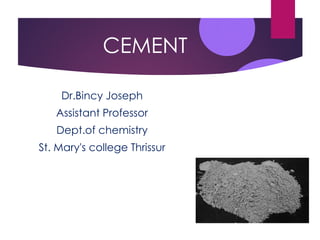
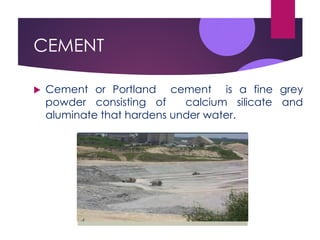
 Cement or Portland cement is a fine grey
powder consisting of calcium silicate and
aluminate that hardens under water.
Manufacture of cement
Raw materials
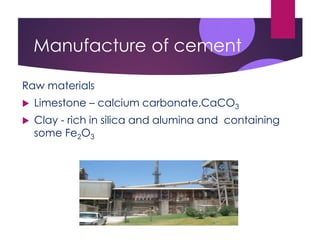
 Limestone – calcium carbonate,CaCO3
 Clay - rich in silica and alumina and containing
some Fe2O3
Manufacture of cement
 Finely powdered limestone mixed with finely
powdered clay
 Made into a slurry in water
 Raw slurry heated at 1400-1500oC in steel rotary kiln
 Dehydration occurs
High temperature form CaO, decomposition of
CaCO3
Manufacture of cement
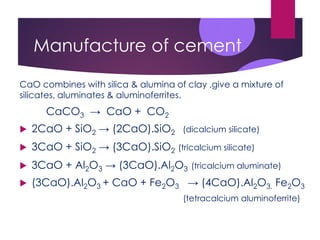
CaO combines with silica & alumina of clay ,give a mixture of
silicates, aluminates & aluminoferrites.
CaCO3 → CaO + CO2
 2CaO + SiO2 → (2CaO).SiO2 (dicalcium silicate)
 3CaO + SiO2 → (3CaO).SiO2 (tricalcium silicate)
 3CaO + Al2O3 → (3CaO).Al2O3 (tricalcium aluminate)
 (3CaO).Al2O3 + CaO + Fe2O3 → (4CaO).Al2O3. Fe2O3
(tetracalcium aluminoferrite)
Manufacture of cement
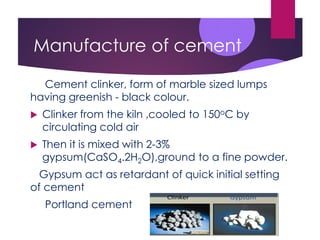
Cement clinker, form of marble sized lumps
having greenish - black colour.
 Clinker from the kiln ,cooled to 150oC by
circulating cold air
 Then it is mixed with 2-3%
gypsum(CaSO4.2H2O),ground to a fine powder.
Gypsum act as retardant of quick initial setting
of cement
Portland cement
Composition of Portland
cement
 10-20 % dicalcium silicate (2CaO).SiO2
 50-70% tricalcium silicate (3CaO).SiO2
 5-10% tricalcium aluminate (3CaO).Al2O3
 3-8 % tetracalcium aluminoferrite
(4CaO).Al2O3. Fe2O3
Composition of Portland cement
 CaO = 50 - 60%
 SiO2 = 20-25%
 Al2O3 = 5-10%
 MgO = 2-3%
 Fe2O3 = 1-2%
 SO3 = 1-2 %
Setting of cement
 The plastic mass obtained when cement is
mixed with water becomes stiff and hard due to
the precipitation of colloid gels formed by the
hydration and hydrolysis of cement
constituents, the process is called setting.
 The constituents lose water and change into
interlocking crystalline products by the rupture
of the gel coatings ,the process is called
hardening.
Setting of cement-Reactions
 Hydration of tricalcium aluminate -
3CaO .Al2O3 + 6H2O → 3CaO .Al2O3 .6H2O
Hydrated gel of tricalcium aluminate
 Hydrolysis of tricalcium silicate –
3CaO.SiO2 + H2O → Ca(OH)2 + 2CaO .SiO2
Dicalcium silicate
Ca(OH)2 binds the calcium silicate particles together
Setting of cement-Reactions
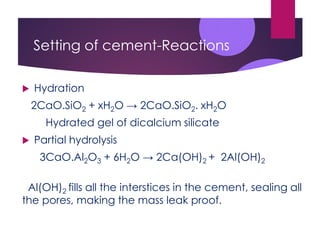
 Hydration
2CaO.SiO2 + xH2O → 2CaO.SiO2. xH2O
Hydrated gel of dicalcium silicate
 Partial hydrolysis
3CaO.Al2O3 + 6H2O → 2Ca(OH)2 + 2Al(OH)2
Al(OH)2 fills all the interstices in the cement, sealing all
the pores, making the mass leak proof.
Setting of cement-Reactions
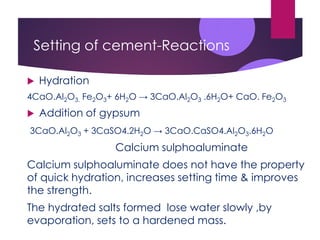
 Hydration
4CaO.Al2O3. Fe2O3+ 6H2O → 3CaO.Al2O3 .6H2O+ CaO. Fe2O3
 Addition of gypsum
3CaO.Al2O3 + 3CaSO4.2H2O → 3CaO.CaSO4.Al2O3.6H2O
Calcium sulphoaluminate
Calcium sulphoaluminate does not have the property
of quick hydration, increases setting time & improves
the strength.
The hydrated salts formed lose water slowly ,by
evaporation, sets to a hardened mass.
Uses of cement
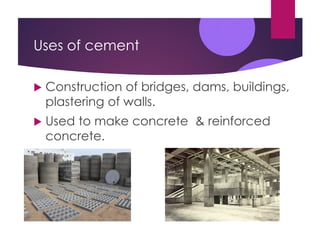
 Construction of bridges, dams, buildings,
plastering of walls.
 Used to make concrete & reinforced
concrete.
THANK YOU

Cement

  • 1.
    CEMENT Dr.Bincy Joseph Assistant Professor Dept.ofchemistry St. Mary's college Thrissur
  • 2.
    CEMENT  Cement orPortland cement is a fine grey powder consisting of calcium silicate and aluminate that hardens under water.
  • 3.
    Manufacture of cement Rawmaterials  Limestone – calcium carbonate,CaCO3  Clay - rich in silica and alumina and containing some Fe2O3
  • 4.
    Manufacture of cement Finely powdered limestone mixed with finely powdered clay  Made into a slurry in water  Raw slurry heated at 1400-1500oC in steel rotary kiln  Dehydration occurs High temperature form CaO, decomposition of CaCO3
  • 5.
    Manufacture of cement CaOcombines with silica & alumina of clay ,give a mixture of silicates, aluminates & aluminoferrites. CaCO3 → CaO + CO2  2CaO + SiO2 → (2CaO).SiO2 (dicalcium silicate)  3CaO + SiO2 → (3CaO).SiO2 (tricalcium silicate)  3CaO + Al2O3 → (3CaO).Al2O3 (tricalcium aluminate)  (3CaO).Al2O3 + CaO + Fe2O3 → (4CaO).Al2O3. Fe2O3 (tetracalcium aluminoferrite)
  • 6.
    Manufacture of cement Cementclinker, form of marble sized lumps having greenish - black colour.  Clinker from the kiln ,cooled to 150oC by circulating cold air  Then it is mixed with 2-3% gypsum(CaSO4.2H2O),ground to a fine powder. Gypsum act as retardant of quick initial setting of cement Portland cement
  • 7.
    Composition of Portland cement 10-20 % dicalcium silicate (2CaO).SiO2  50-70% tricalcium silicate (3CaO).SiO2  5-10% tricalcium aluminate (3CaO).Al2O3  3-8 % tetracalcium aluminoferrite (4CaO).Al2O3. Fe2O3
  • 8.
    Composition of Portlandcement  CaO = 50 - 60%  SiO2 = 20-25%  Al2O3 = 5-10%  MgO = 2-3%  Fe2O3 = 1-2%  SO3 = 1-2 %
  • 9.
    Setting of cement The plastic mass obtained when cement is mixed with water becomes stiff and hard due to the precipitation of colloid gels formed by the hydration and hydrolysis of cement constituents, the process is called setting.  The constituents lose water and change into interlocking crystalline products by the rupture of the gel coatings ,the process is called hardening.
  • 10.
    Setting of cement-Reactions Hydration of tricalcium aluminate - 3CaO .Al2O3 + 6H2O → 3CaO .Al2O3 .6H2O Hydrated gel of tricalcium aluminate  Hydrolysis of tricalcium silicate – 3CaO.SiO2 + H2O → Ca(OH)2 + 2CaO .SiO2 Dicalcium silicate Ca(OH)2 binds the calcium silicate particles together
  • 11.
    Setting of cement-Reactions Hydration 2CaO.SiO2 + xH2O → 2CaO.SiO2. xH2O Hydrated gel of dicalcium silicate  Partial hydrolysis 3CaO.Al2O3 + 6H2O → 2Ca(OH)2 + 2Al(OH)2 Al(OH)2 fills all the interstices in the cement, sealing all the pores, making the mass leak proof.
  • 12.
    Setting of cement-Reactions Hydration 4CaO.Al2O3. Fe2O3+ 6H2O → 3CaO.Al2O3 .6H2O+ CaO. Fe2O3  Addition of gypsum 3CaO.Al2O3 + 3CaSO4.2H2O → 3CaO.CaSO4.Al2O3.6H2O Calcium sulphoaluminate Calcium sulphoaluminate does not have the property of quick hydration, increases setting time & improves the strength. The hydrated salts formed lose water slowly ,by evaporation, sets to a hardened mass.
  • 13.
    Uses of cement Construction of bridges, dams, buildings, plastering of walls.  Used to make concrete & reinforced concrete.
  • 14.