CHEMICALS IN FOOD
Dr.Bincy Joseph
Assistant Professor
Dept.of chemistry
St. Mary's college Thrissur
FOOD
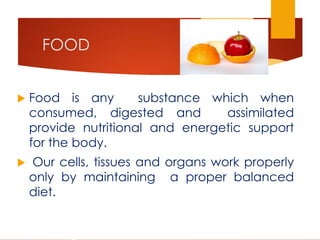
 Food is any substance which when
consumed, digested and assimilated
provide nutritional and energetic support
for the body.
 Our cells, tissues and organs work properly
only by maintaining a proper balanced
diet.
FOOD ADDITIVES
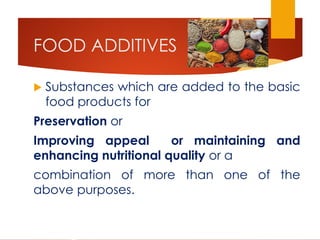
 Substances which are added to the basic
food products for
Preservation or
Improving appeal or maintaining and
enhancing nutritional quality or a
combination of more than one of the
above purposes.
FOOD ADDITIVES
 Some additives enhance flavour or colour, and
some control pH , while others stabilize ,thicken
,emulsify ,sweeten or tenderize the food.
 Some of them serve to protect the food from being
spoiled by oxidation, bacterial attack, or ageing and
thereby increase shelf-life.
A. Food Preservatives
 Chemicals intentionally added to food, generally in
small quantities to prevent it microbial and /or
catalytic decomposition and deterioration -food
preservatives.
 Food preservatives function by inhibiting the growth
and activity of microorganisms(bacteria, fungi and
others) or by preventing undesirable enzymatic and
catalytic chemical reactions.
Food Preservatives
The most commonly used
 Sugar (sucrose)
 Table salt (sodium chloride)
 Vinegar (dil.acetic acid solution)
 Vegetable oils
Food Preservatives
Other food preservatives commonly used are
 Sodium benzoate - used in jams, jellies, fruit juices,
pickles etc as an antimicrobial agent.
 Citric acid - used in jams, jellies, drinks, syrups etc as
a sequestrant for trace metals.
 Potassium metabisulphate - used for preserving mango
chutney, lemon squashes, juices of colourless fruits
like apples.
B. Artificial sweeteners
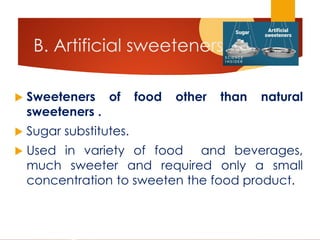
 Sweeteners of food other than natural
sweeteners .
 Sugar substitutes.
 Used in variety of food and beverages,
much sweeter and required only a small
concentration to sweeten the food product.
Artificial sweeteners
 Saccharin
 Aspartame
 Sucralose
 Alitame
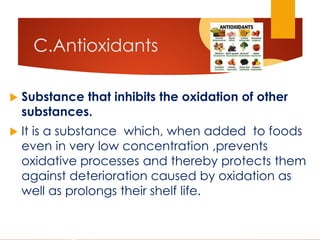
C.Antioxidants
 Substance that inhibits the oxidation of other
substances.
 It is a substance which, when added to foods
even in very low concentration ,prevents
oxidative processes and thereby protects them
against deterioration caused by oxidation as
well as prolongs their shelf life.
Antioxidants
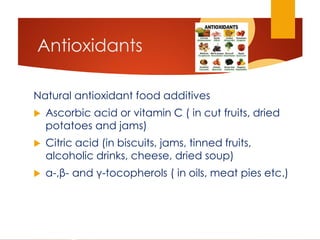
Natural antioxidant food additives
 Ascorbic acid or vitamin C ( in cut fruits, dried
potatoes and jams)
 Citric acid (in biscuits, jams, tinned fruits,
alcoholic drinks, cheese, dried soup)
 α-,β- and γ-tocopherols ( in oils, meat pies etc.)
Antioxidants
Most common synthetic antioxidants food additives
 Butylated hydroxyanisole(BHA)
 Butylated hydroxytoluene(BHT)
Both are used to preserve fats and oils, margarine,
bread, cheese, butter, cereal-based snack foods,
cake mixes, chewing gum, dehydrated soups and
broths, dehydrated potatoes and meat, etc.
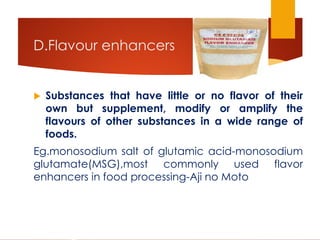
D.Flavour enhancers
 Substances that have little or no flavor of their
own but supplement, modify or amplify the
flavours of other substances in a wide range of
foods.
Eg.monosodium salt of glutamic acid-monosodium
glutamate(MSG),most commonly used flavor
enhancers in food processing-Aji no Moto
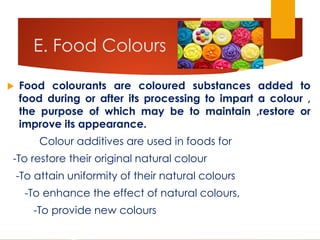
E. Food Colours
 Food colourants are coloured substances added to
food during or after its processing to impart a colour ,
the purpose of which may be to maintain ,restore or
improve its appearance.
Colour additives are used in foods for
-To restore their original natural colour
-To attain uniformity of their natural colours
-To enhance the effect of natural colours,
-To provide new colours
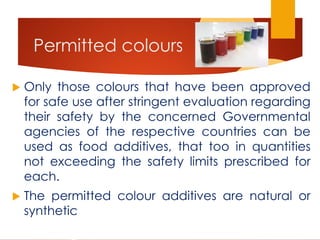
Permitted colours
 Only those colours that have been approved
for safe use after stringent evaluation regarding
their safety by the concerned Governmental
agencies of the respective countries can be
used as food additives, that too in quantities
not exceeding the safety limits prescribed for
each.
 The permitted colour additives are natural or
synthetic
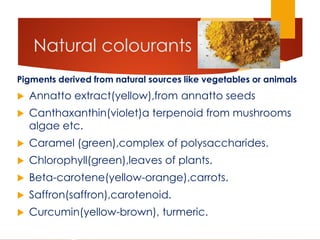
Natural colourants
Pigments derived from natural sources like vegetables or animals
 Annatto extract(yellow),from annatto seeds
 Canthaxanthin(violet)a terpenoid from mushrooms
algae etc.
 Caramel (green),complex of polysaccharides.
 Chlorophyll(green),leaves of plants.
 Beta-carotene(yellow-orange),carrots.
 Saffron(saffron),carotenoid.
 Curcumin(yellow-brown), turmeric.
Artificial or synthetic colourants
Man –made colours .
 Fast green FCF, green triarylmethane dye.
 Indigo Carmine, blue indigoid dye
 Brilliant blue FCF, blue triarylmethane dye.
 Tartrazine, yellow pyrazolone dye.
 Sunset yellow FCF,yellow azo dye.
 Erythrosine, red xanthene dye.
 Carmoisine, red azo dye
Non-permitted food colours
The colours that are banned from use as food
additives on account of their toxic characters
 Rhodamine B: red dye, may cause
degenerative changes in the liver & kidney.
 Orange II :orange dye, cause haematological
changes and retardation of growth
 Metanil yellow: yellow dye, cause
degenerative changes in the stomach, kidneys
and liver as well as in the reproductive system
Non-permitted food colours
 Malachite green: green dye, capable of
damaging liver, kidney, heart and spleen as
well as causing lesions of skin, eyes ,lungs and
bones.
 Auramine: yellow dye, may damage the kidney
and liver as well as cause retardation of growth.
 Sudan dyes: red dyes, may cause kidney lesions
as well as damage of liver.
THANK YOU

Food additives pdf

  • 1.
    CHEMICALS IN FOOD Dr.BincyJoseph Assistant Professor Dept.of chemistry St. Mary's college Thrissur
  • 2.
    FOOD  Food isany substance which when consumed, digested and assimilated provide nutritional and energetic support for the body.  Our cells, tissues and organs work properly only by maintaining a proper balanced diet.
  • 3.
    FOOD ADDITIVES  Substanceswhich are added to the basic food products for Preservation or Improving appeal or maintaining and enhancing nutritional quality or a combination of more than one of the above purposes.
  • 4.
    FOOD ADDITIVES  Someadditives enhance flavour or colour, and some control pH , while others stabilize ,thicken ,emulsify ,sweeten or tenderize the food.  Some of them serve to protect the food from being spoiled by oxidation, bacterial attack, or ageing and thereby increase shelf-life.
  • 5.
    A. Food Preservatives Chemicals intentionally added to food, generally in small quantities to prevent it microbial and /or catalytic decomposition and deterioration -food preservatives.  Food preservatives function by inhibiting the growth and activity of microorganisms(bacteria, fungi and others) or by preventing undesirable enzymatic and catalytic chemical reactions.
  • 6.
    Food Preservatives The mostcommonly used  Sugar (sucrose)  Table salt (sodium chloride)  Vinegar (dil.acetic acid solution)  Vegetable oils
  • 7.
    Food Preservatives Other foodpreservatives commonly used are  Sodium benzoate - used in jams, jellies, fruit juices, pickles etc as an antimicrobial agent.  Citric acid - used in jams, jellies, drinks, syrups etc as a sequestrant for trace metals.  Potassium metabisulphate - used for preserving mango chutney, lemon squashes, juices of colourless fruits like apples.
  • 8.
    B. Artificial sweeteners Sweeteners of food other than natural sweeteners .  Sugar substitutes.  Used in variety of food and beverages, much sweeter and required only a small concentration to sweeten the food product.
  • 9.
    Artificial sweeteners  Saccharin Aspartame  Sucralose  Alitame
  • 10.
    C.Antioxidants  Substance thatinhibits the oxidation of other substances.  It is a substance which, when added to foods even in very low concentration ,prevents oxidative processes and thereby protects them against deterioration caused by oxidation as well as prolongs their shelf life.
  • 11.
    Antioxidants Natural antioxidant foodadditives  Ascorbic acid or vitamin C ( in cut fruits, dried potatoes and jams)  Citric acid (in biscuits, jams, tinned fruits, alcoholic drinks, cheese, dried soup)  α-,β- and γ-tocopherols ( in oils, meat pies etc.)
  • 12.
    Antioxidants Most common syntheticantioxidants food additives  Butylated hydroxyanisole(BHA)  Butylated hydroxytoluene(BHT) Both are used to preserve fats and oils, margarine, bread, cheese, butter, cereal-based snack foods, cake mixes, chewing gum, dehydrated soups and broths, dehydrated potatoes and meat, etc.
  • 13.
    D.Flavour enhancers  Substancesthat have little or no flavor of their own but supplement, modify or amplify the flavours of other substances in a wide range of foods. Eg.monosodium salt of glutamic acid-monosodium glutamate(MSG),most commonly used flavor enhancers in food processing-Aji no Moto
  • 14.
    E. Food Colours Food colourants are coloured substances added to food during or after its processing to impart a colour , the purpose of which may be to maintain ,restore or improve its appearance. Colour additives are used in foods for -To restore their original natural colour -To attain uniformity of their natural colours -To enhance the effect of natural colours, -To provide new colours
  • 15.
    Permitted colours  Onlythose colours that have been approved for safe use after stringent evaluation regarding their safety by the concerned Governmental agencies of the respective countries can be used as food additives, that too in quantities not exceeding the safety limits prescribed for each.  The permitted colour additives are natural or synthetic
  • 16.
    Natural colourants Pigments derivedfrom natural sources like vegetables or animals  Annatto extract(yellow),from annatto seeds  Canthaxanthin(violet)a terpenoid from mushrooms algae etc.  Caramel (green),complex of polysaccharides.  Chlorophyll(green),leaves of plants.  Beta-carotene(yellow-orange),carrots.  Saffron(saffron),carotenoid.  Curcumin(yellow-brown), turmeric.
  • 17.
    Artificial or syntheticcolourants Man –made colours .  Fast green FCF, green triarylmethane dye.  Indigo Carmine, blue indigoid dye  Brilliant blue FCF, blue triarylmethane dye.  Tartrazine, yellow pyrazolone dye.  Sunset yellow FCF,yellow azo dye.  Erythrosine, red xanthene dye.  Carmoisine, red azo dye
  • 18.
    Non-permitted food colours Thecolours that are banned from use as food additives on account of their toxic characters  Rhodamine B: red dye, may cause degenerative changes in the liver & kidney.  Orange II :orange dye, cause haematological changes and retardation of growth  Metanil yellow: yellow dye, cause degenerative changes in the stomach, kidneys and liver as well as in the reproductive system
  • 19.
    Non-permitted food colours Malachite green: green dye, capable of damaging liver, kidney, heart and spleen as well as causing lesions of skin, eyes ,lungs and bones.  Auramine: yellow dye, may damage the kidney and liver as well as cause retardation of growth.  Sudan dyes: red dyes, may cause kidney lesions as well as damage of liver.
  • 20.