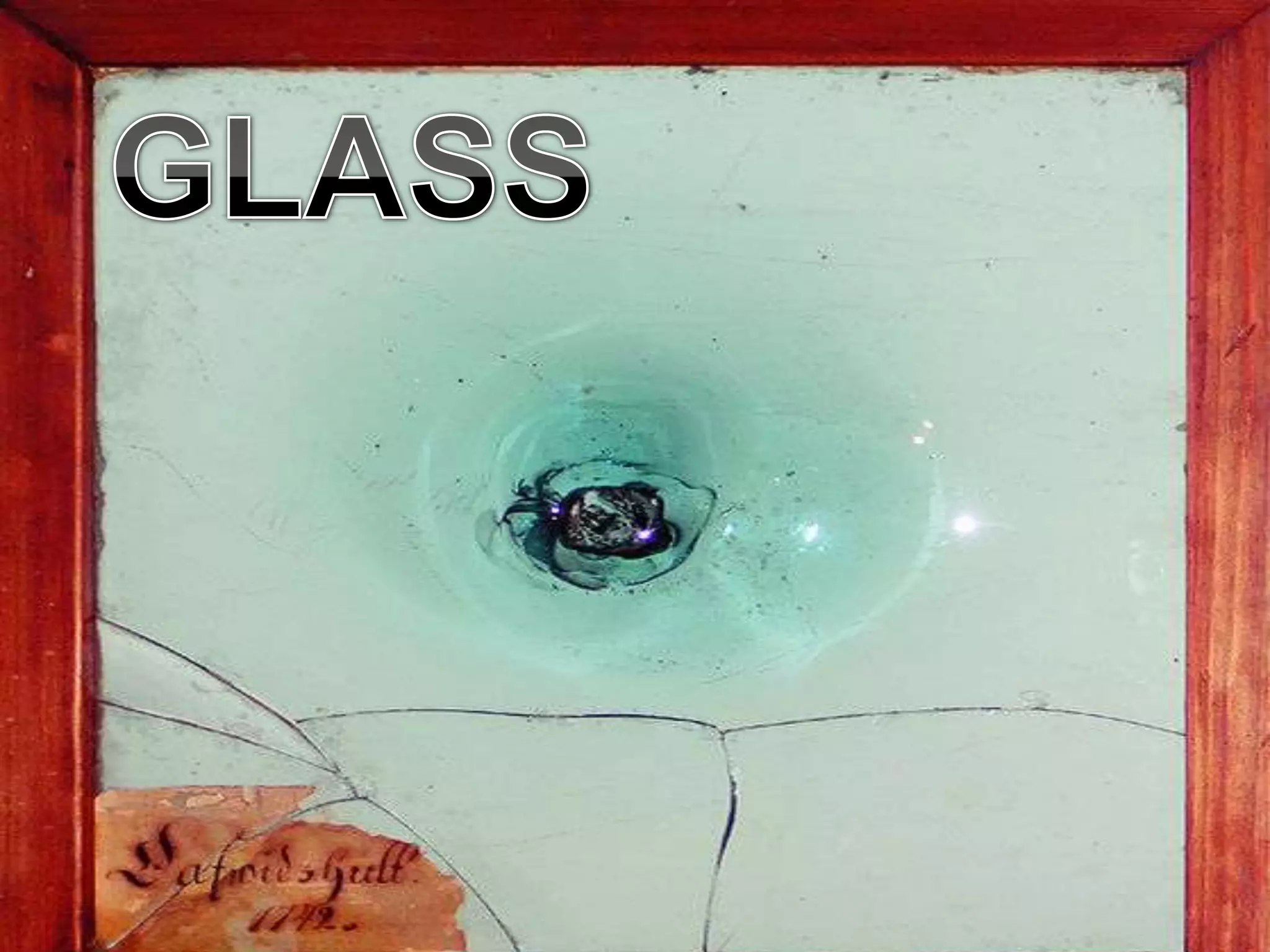
GLASS
 Definition
 Preparation

 Composition

 VARIETY

 Uses
DEFINITION
  Glass is an amorphous, hard, brittle,        transparent or
  translucent super cooled liquid of infinite viscosity,
  having no definite melting point obtained by fusing a
  mixture of a number of metallic silicates or borates of
  Sodium, Potassium, Calcium, and Lead.

It possess no definite formula or crystalline structure:
     “An inorganic product of fusion which has cooled to a
                        rigid condition without crystallizing”
      Does not have a specific melting point
 Softens over a temperature range
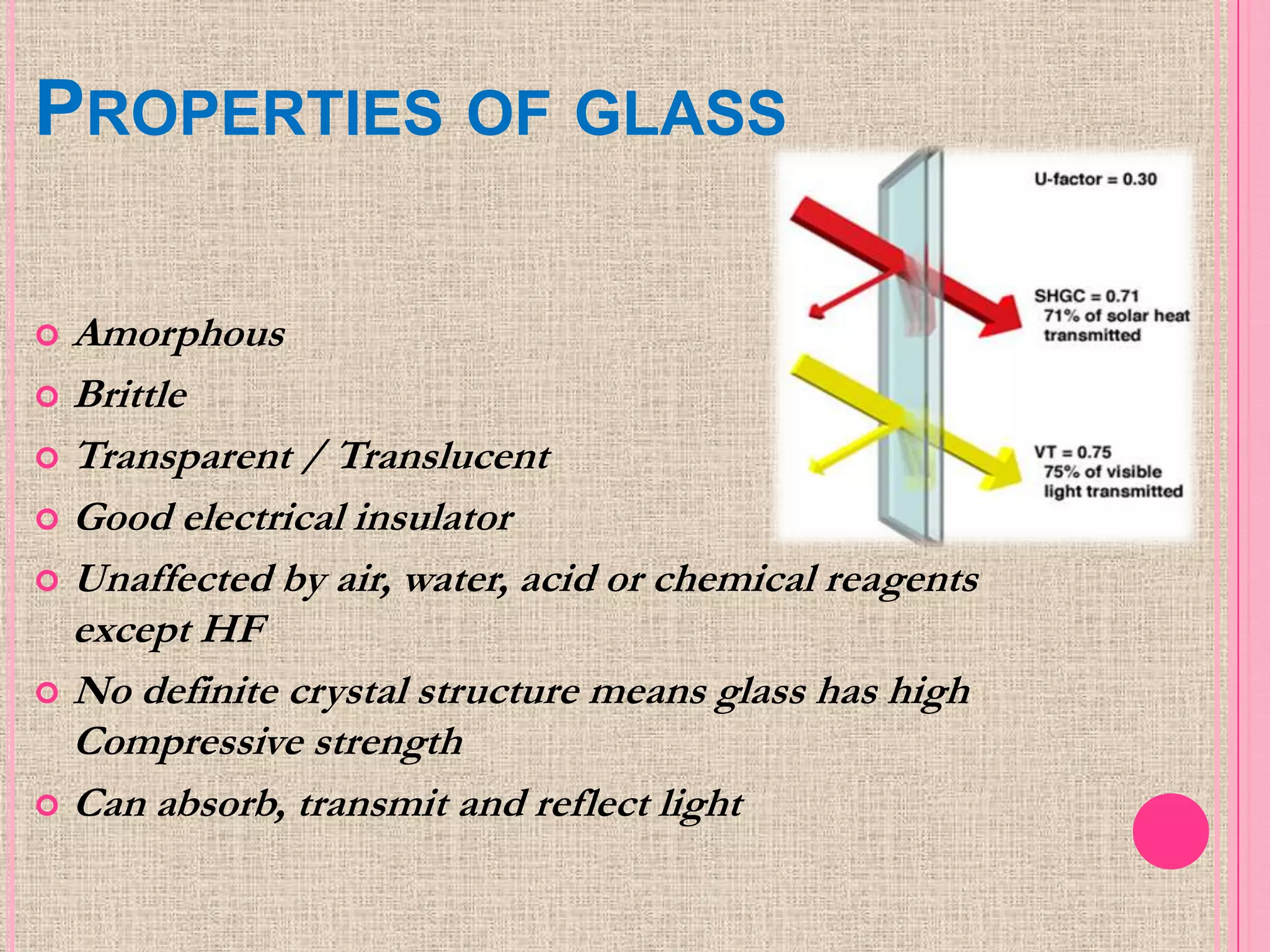
PROPERTIES OF GLASS

 Amorphous
 Brittle

 Transparent / Translucent

 Good electrical insulator

 Unaffected by air, water, acid or chemical reagents
  except HF
 No definite crystal structure means glass has high
  Compressive strength
 Can absorb, transmit and reflect light
RAW MATERIALS USED IN MANUFACTURING GLASS


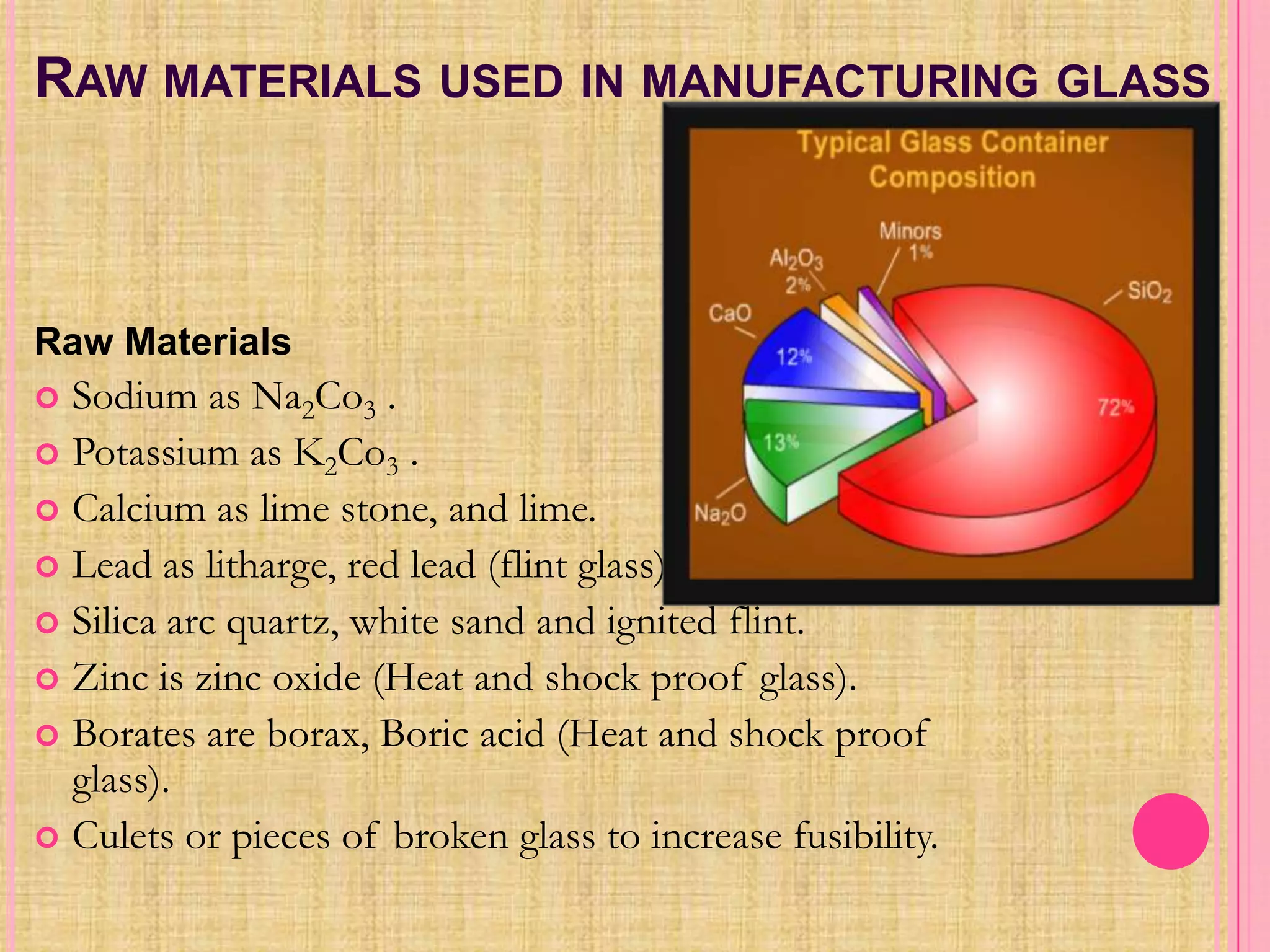
Raw Materials
 Sodium as Na2Co3 .
 Potassium as K2Co3 .
 Calcium as lime stone, and lime.
 Lead as litharge, red lead (flint glass).
 Silica arc quartz, white sand and ignited flint.
 Zinc is zinc oxide (Heat and shock proof glass).
 Borates are borax, Boric acid (Heat and shock proof
  glass).
 Culets or pieces of broken glass to increase fusibility.
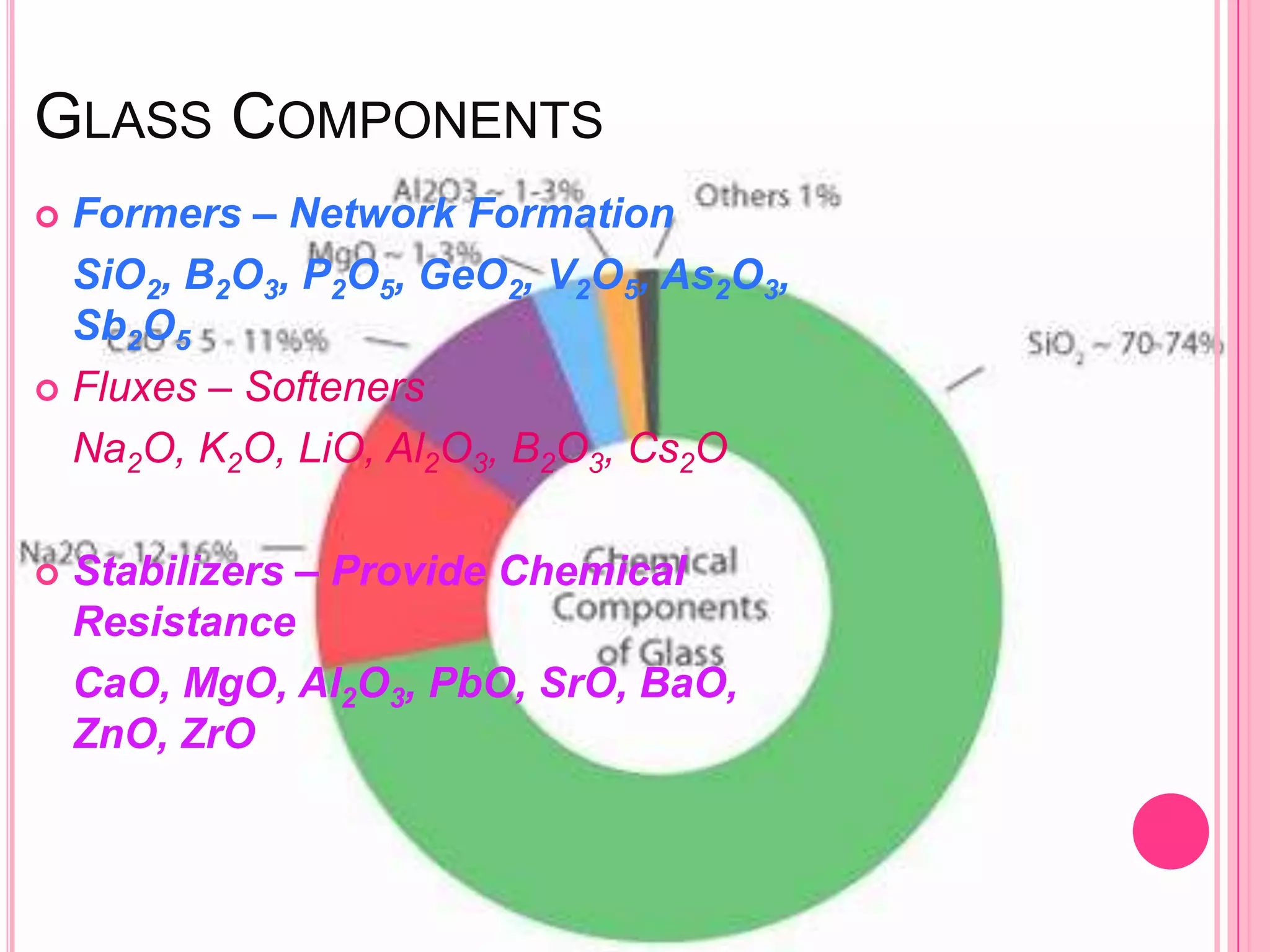
GLASS COMPONENTS
 Formers – Network Formation
  SiO2, B2O3, P2O5, GeO2, V2O5, As2O3,
  Sb2O5
 Fluxes – Softeners

  Na2O, K2O, LiO, Al2O3, B2O3, Cs2O

   Stabilizers – Provide Chemical
    Resistance
    CaO, MgO, Al2O3, PbO, SrO, BaO,
    ZnO, ZrO
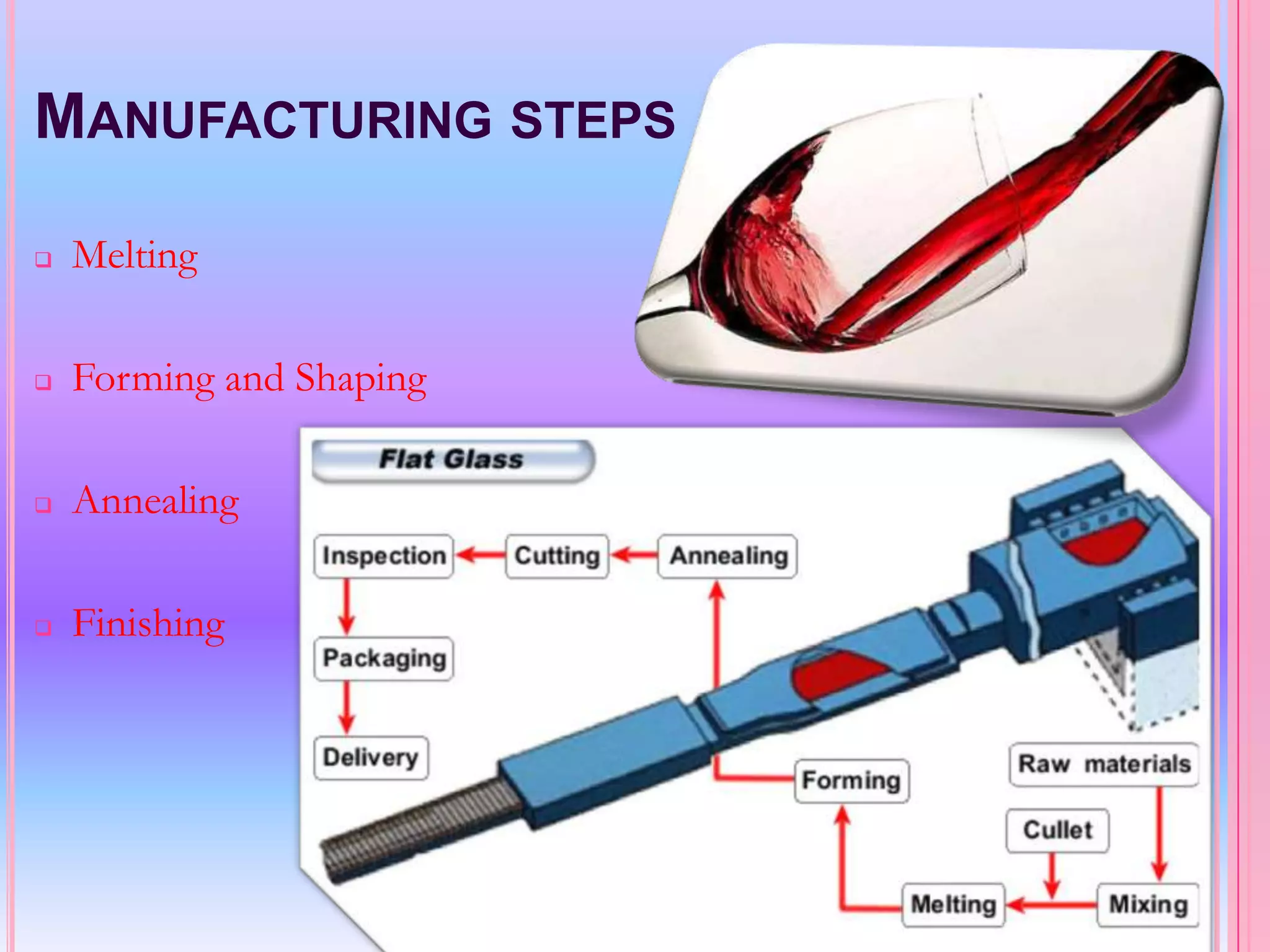
MANUFACTURING STEPS

   Melting

   Forming and Shaping

   Annealing

   Finishing
MELTING PROCESS
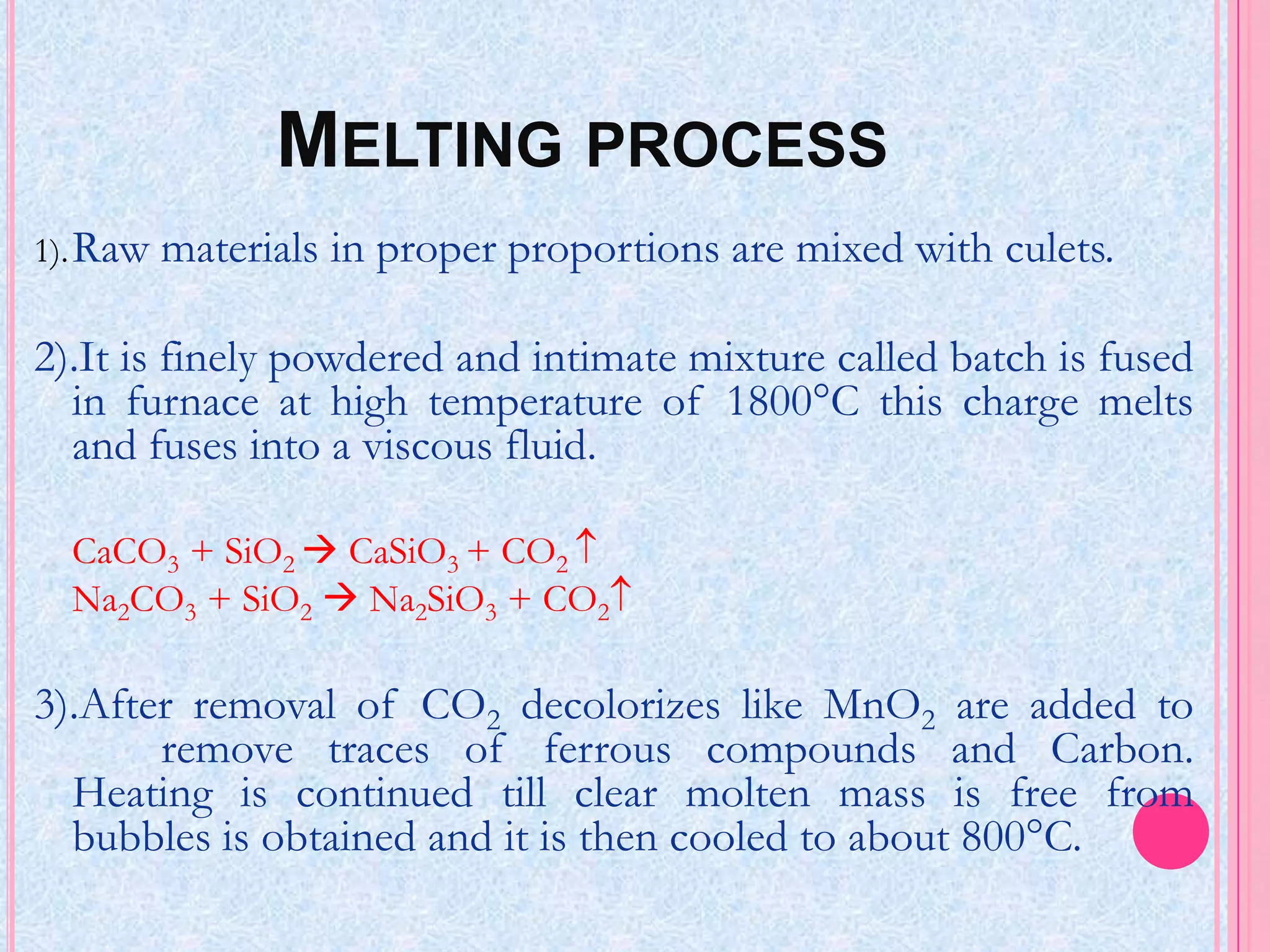
1). Raw   materials in proper proportions are mixed with culets.

2).It is finely powdered and intimate mixture called batch is fused
  in furnace at high temperature of 1800°C this charge melts
  and fuses into a viscous fluid.

  CaCO3 + SiO2  CaSiO3 + CO2
  Na2CO3 + SiO2  Na2SiO3 + CO2

3).After removal of CO2 decolorizes like MnO2 are added to
       remove traces of ferrous compounds and Carbon.
  Heating is continued till clear molten mass is free from
  bubbles is obtained and it is then cooled to about 800°C.
FORMING,            SHAPING, AND ANNEALING

 Forming    and Shaping.

    The viscous mass obtained from melting is poured into
    moulds to get different types of articles of desired shape by
    either blowing or pressing between the rollers.

 Annealing.


    Glass articles are then allowed to cool gradually at room
    temperature by passing through different chambers with
    descending temperatures. This reduces the internal Strain
    in the glass.
FINISHING
Finishing is the last step in glass manufacturing.
It involves following steps.

   Cleaning.

   Grinding.

   Polishing.

   Cutting.

   Sand Blasting.
SODA LIME OR SOFT GLASS
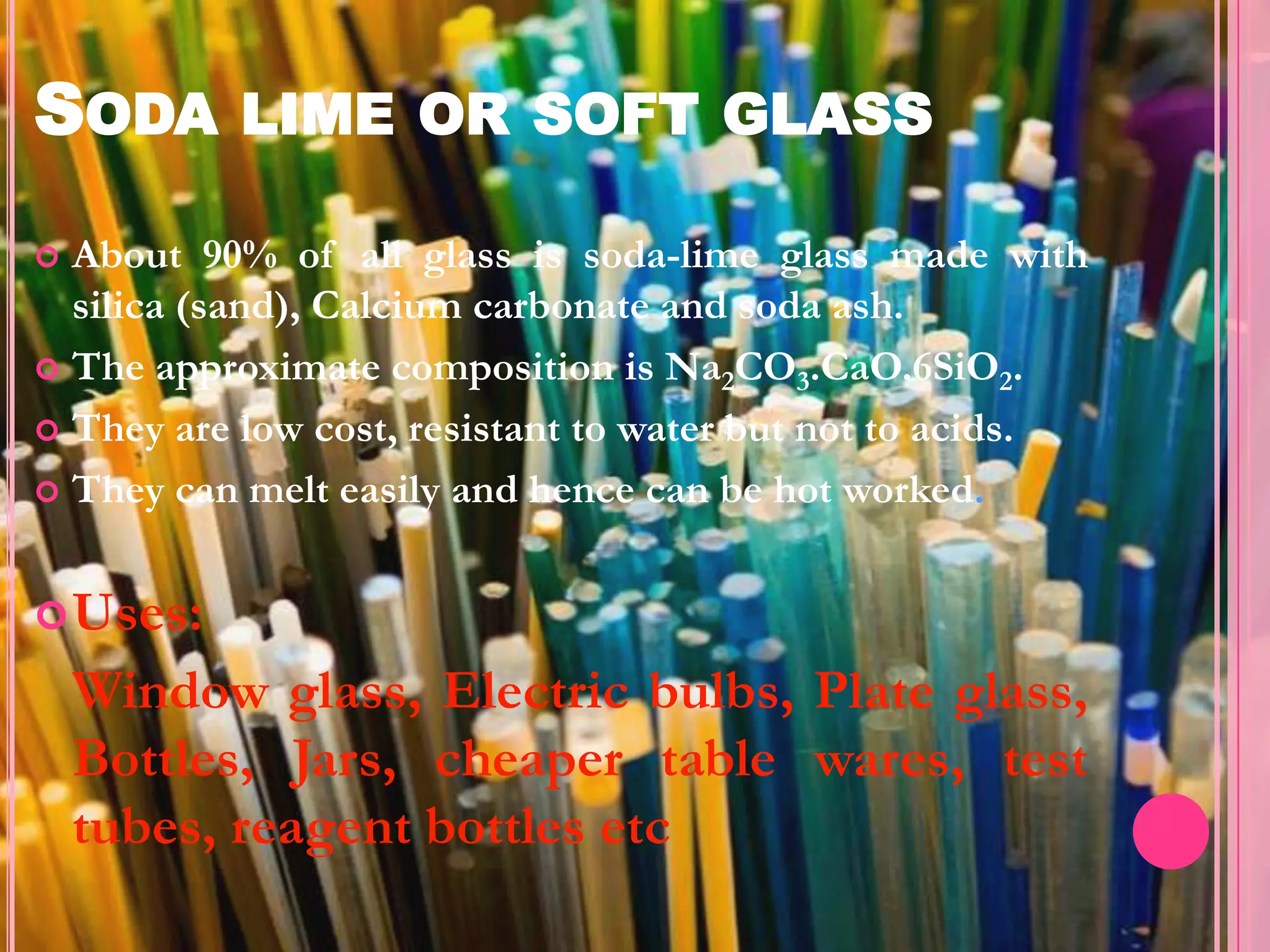
 About 90% of all glass is soda-lime glass made with
  silica (sand), Calcium carbonate and soda ash.
 The approximate composition is Na2CO3.CaO.6SiO2.

 They are low cost, resistant to water but not to acids.

 They can melt easily and hence can be hot worked.


 Uses:
    Window glass, Electric bulbs, Plate glass,
    Bottles, Jars, cheaper table wares, test
    tubes, reagent bottles etc
POTASH LIME OR HARD GLASS

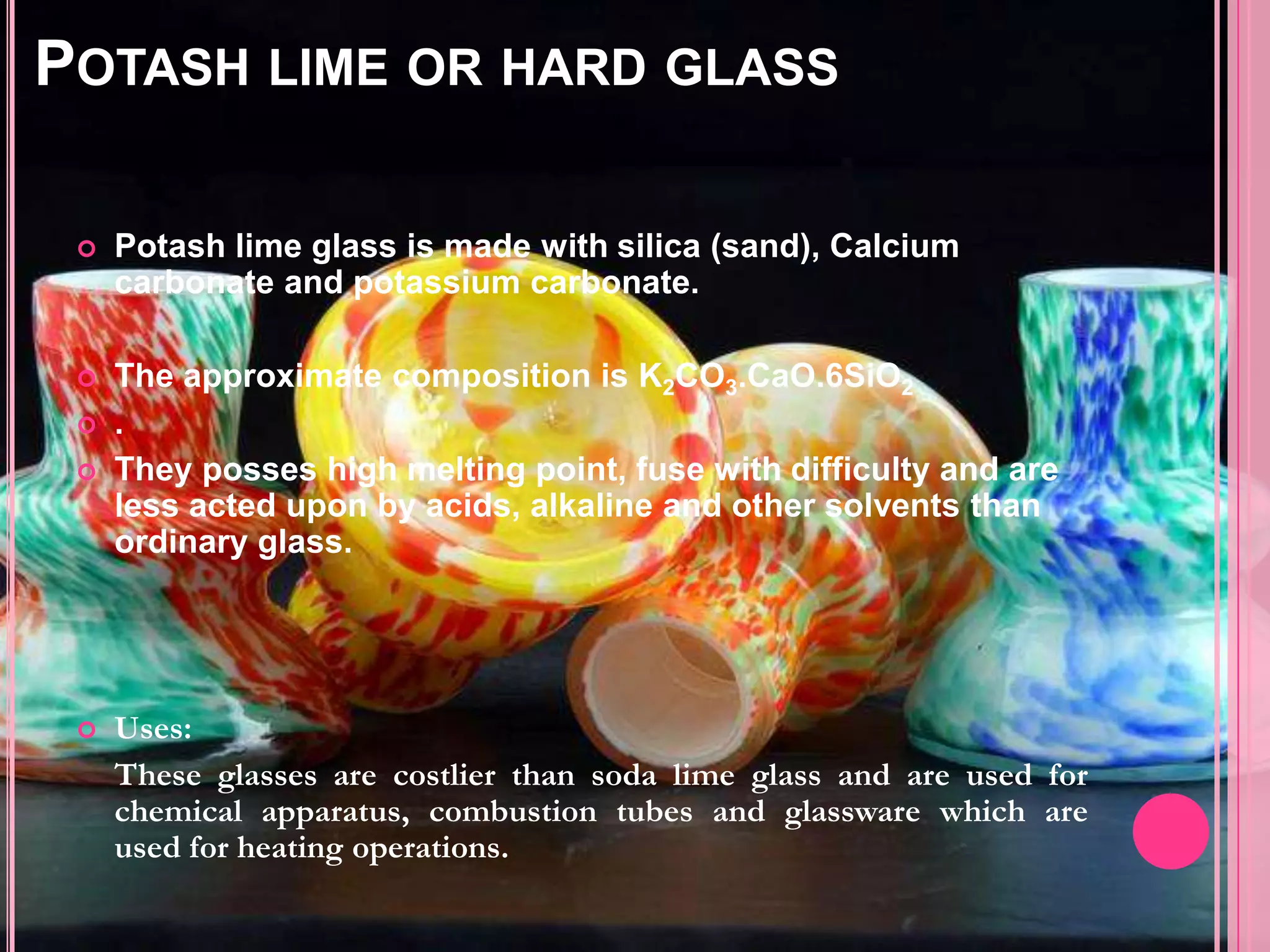
    Potash lime glass is made with silica (sand), Calcium
     carbonate and potassium carbonate.

    The approximate composition is K2CO3.CaO.6SiO2
    .
    They posses high melting point, fuse with difficulty and are
     less acted upon by acids, alkaline and other solvents than
     ordinary glass.


    Uses:
     These glasses are costlier than soda lime glass and are used for
     chemical apparatus, combustion tubes and glassware which are
     used for heating operations.
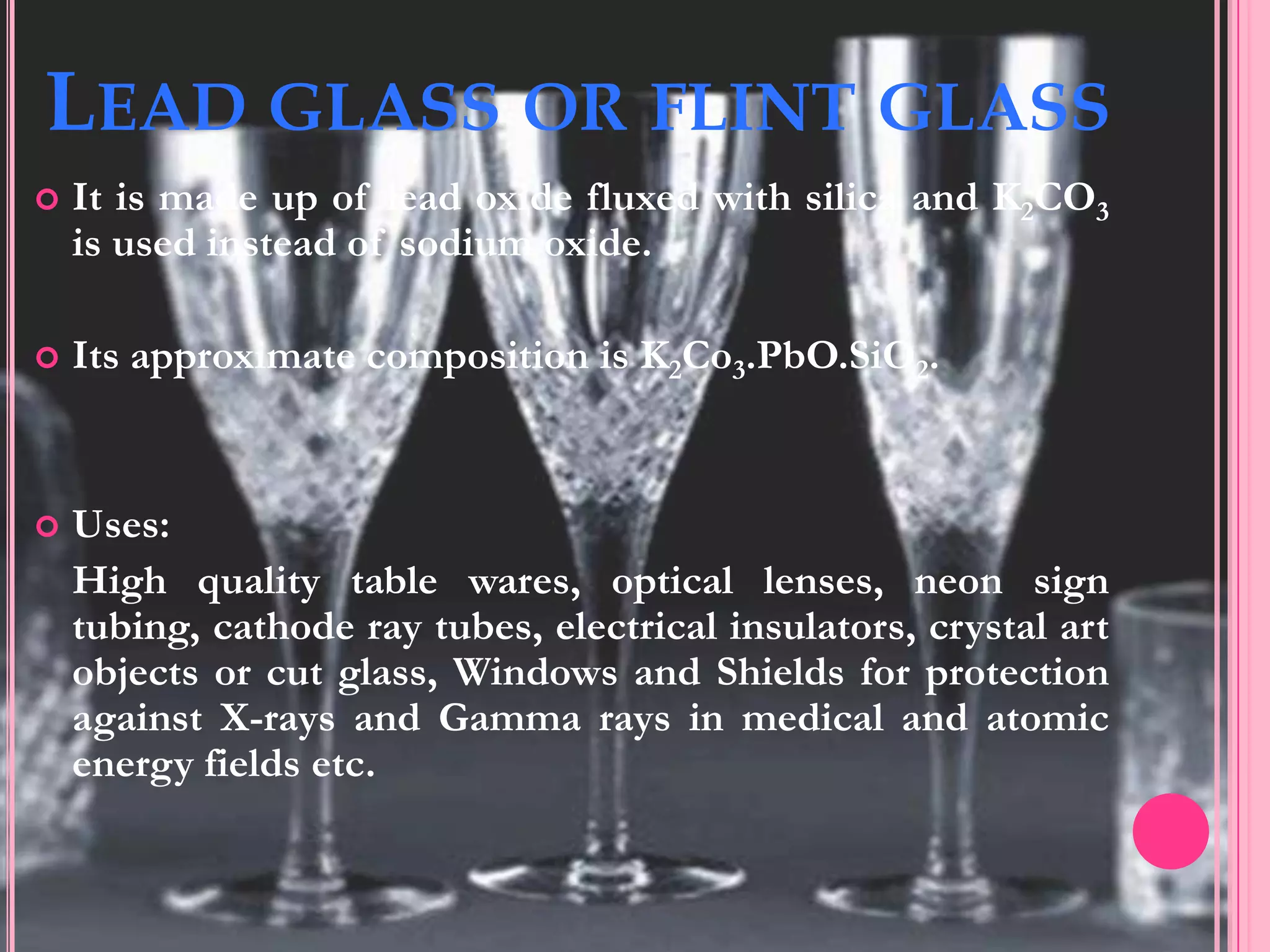
LEAD GLASS OR FLINT GLASS
   It is made up of lead oxide fluxed with silica and K2CO3
    is used instead of sodium oxide.

   Its approximate composition is K2Co3.PbO.SiO2.


   Uses:
    High quality table wares, optical lenses, neon sign
    tubing, cathode ray tubes, electrical insulators, crystal art
    objects or cut glass, Windows and Shields for protection
    against X-rays and Gamma rays in medical and atomic
    energy fields etc.
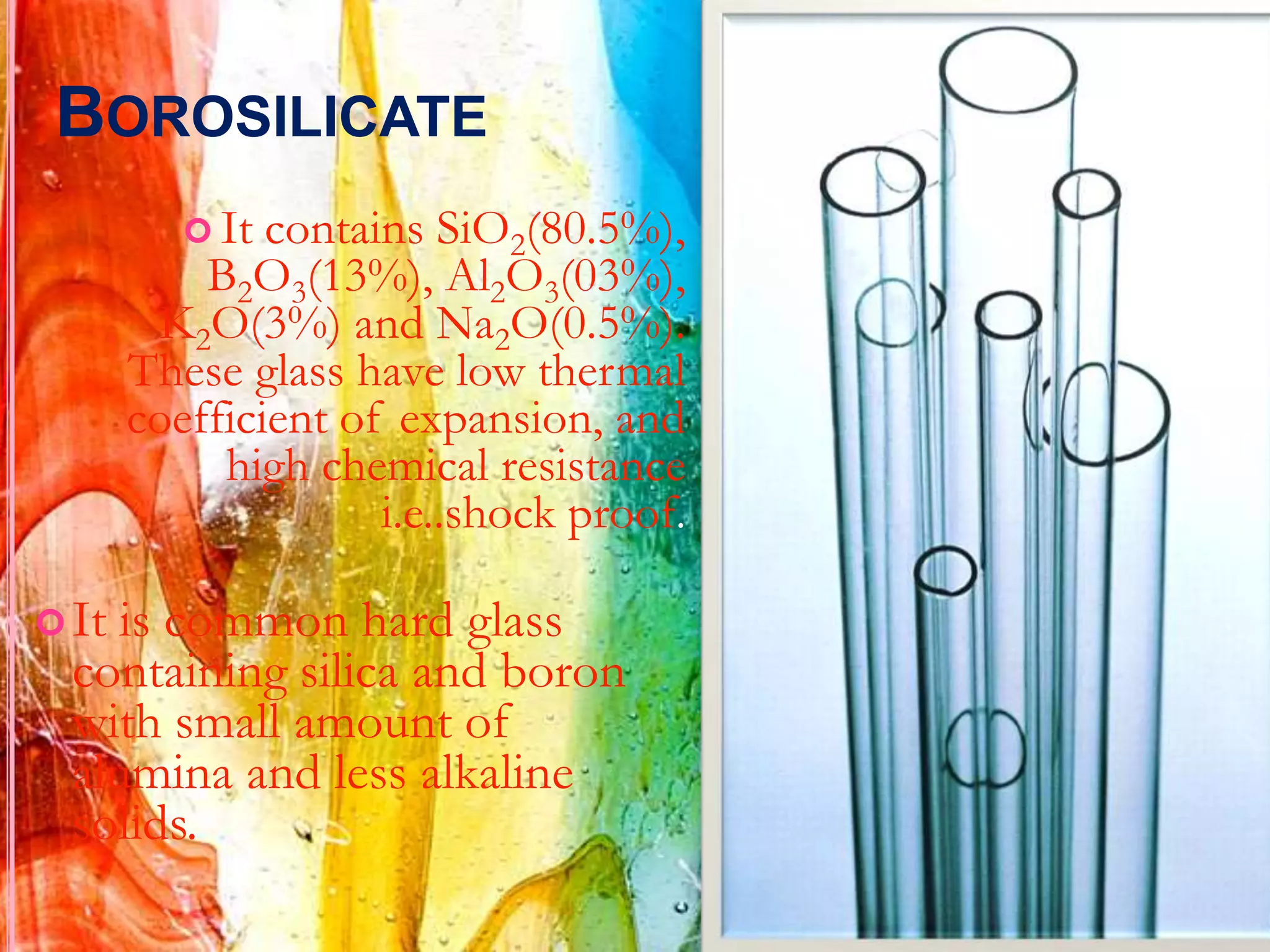
BOROSILICATE
           It contains SiO2(80.5%),
           B2O3(13%), Al2O3(03%),
        K2O(3%) and Na2O(0.5%).
       These glass have low thermal
       coefficient of expansion, and
            high chemical resistance
                     i.e..shock proof.

 It is common hard glass
  containing silica and boron
  with small amount of
  alumina and less alkaline
  solids.
ALUMINO-SILICATE GLASS
   The typical approximate composition
    of this type of glass SiO2(55%),
    Al2O3(23%), MgO(090, B2O3(07%),
    CaO(05%) and Na2O, K2O(01%).
   This type of glass possess
    exceptionally high softening
    temperature.

   Uses:
    It is used for high pressure
    mercury discharge tubes,
    chemical combustion tube and
    certain domestic equipments.
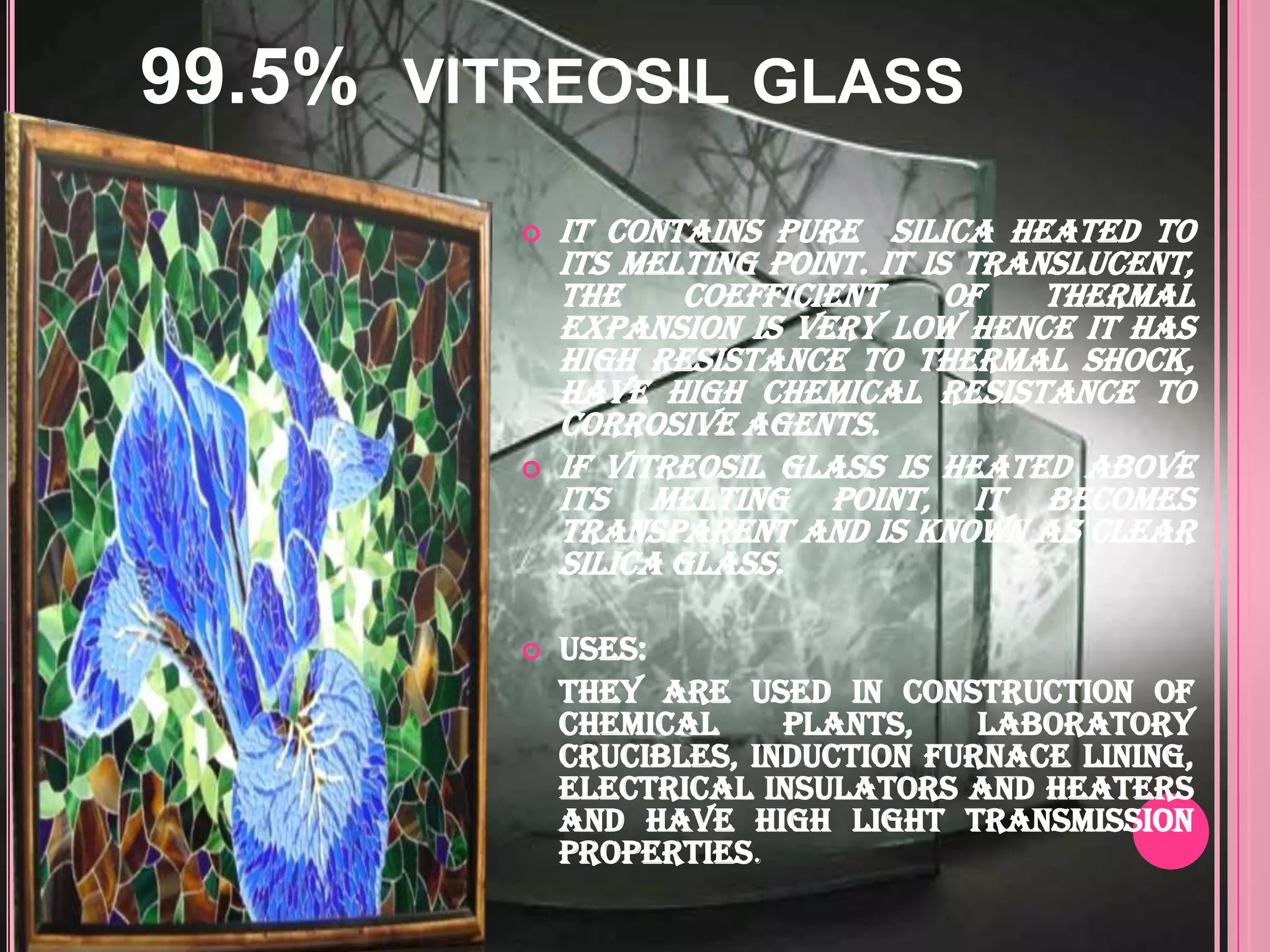
99.5%   VITREOSIL GLASS

              It contains pure silica heated to
               its melting point. It is translucent,
               the     coefficient     of   thermal
               expansion is very low hence it has
               high resistance to thermal shock,
               have high chemical resistance to
               corrosive agents.
              If Vitreosil glass is heated above
               its melting point, it becomes
               transparent and is known as clear
               silica glass.

              Uses:
               They are used in construction of
               chemical     plants,    laboratory
               crucibles, induction furnace lining,
               electrical insulators and heaters
               and have high light transmission
               properties.
SAFETY GLASS
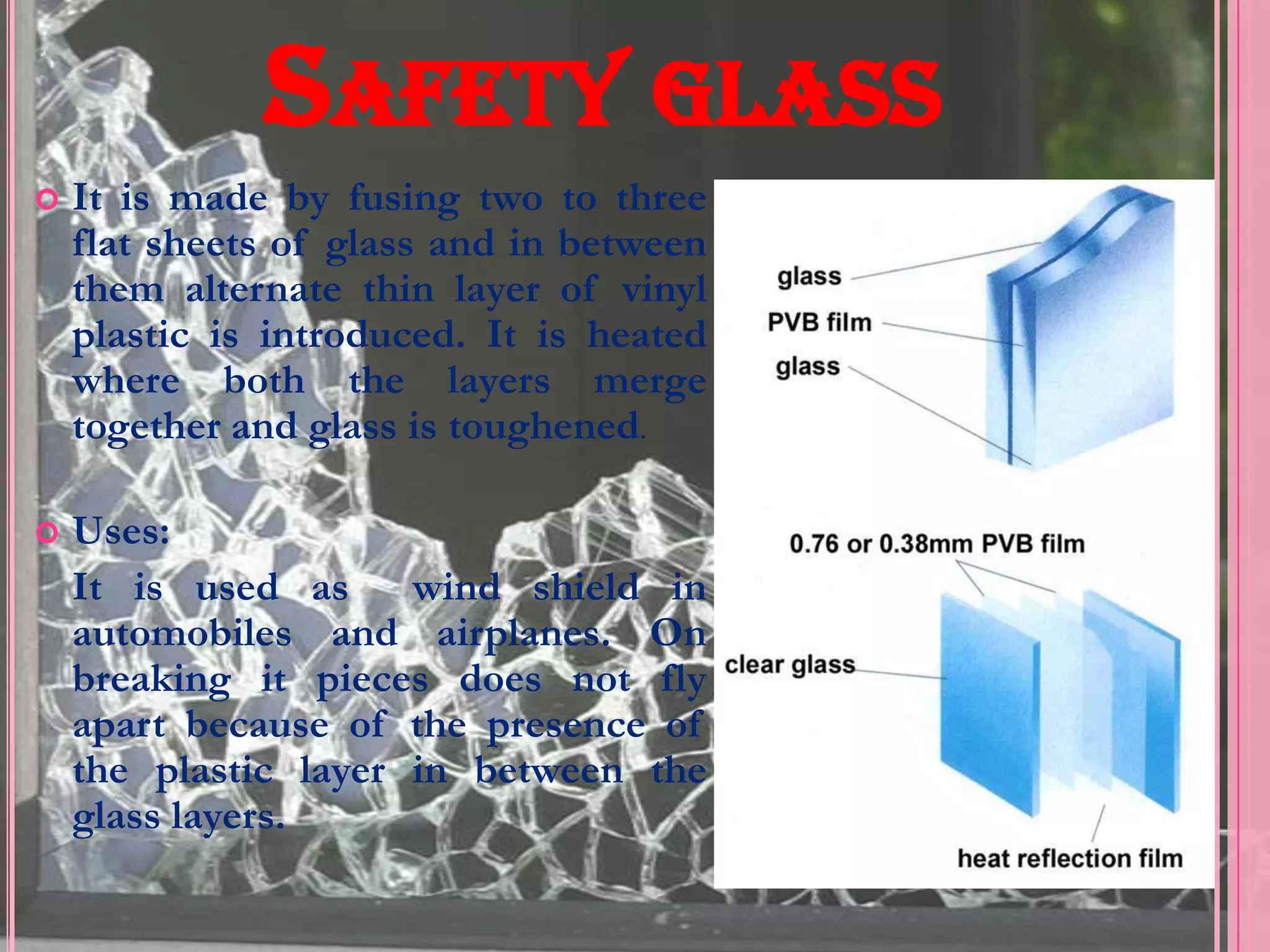
   It is made by fusing two to three
    flat sheets of glass and in between
    them alternate thin layer of vinyl
    plastic is introduced. It is heated
    where both the layers merge
    together and glass is toughened.

   Uses:
    It is used as wind shield in
    automobiles and airplanes. On
    breaking it pieces does not fly
    apart because of the presence of
    the plastic layer in between the
    glass layers.
OPTICAL OR CROOK’S GLASS

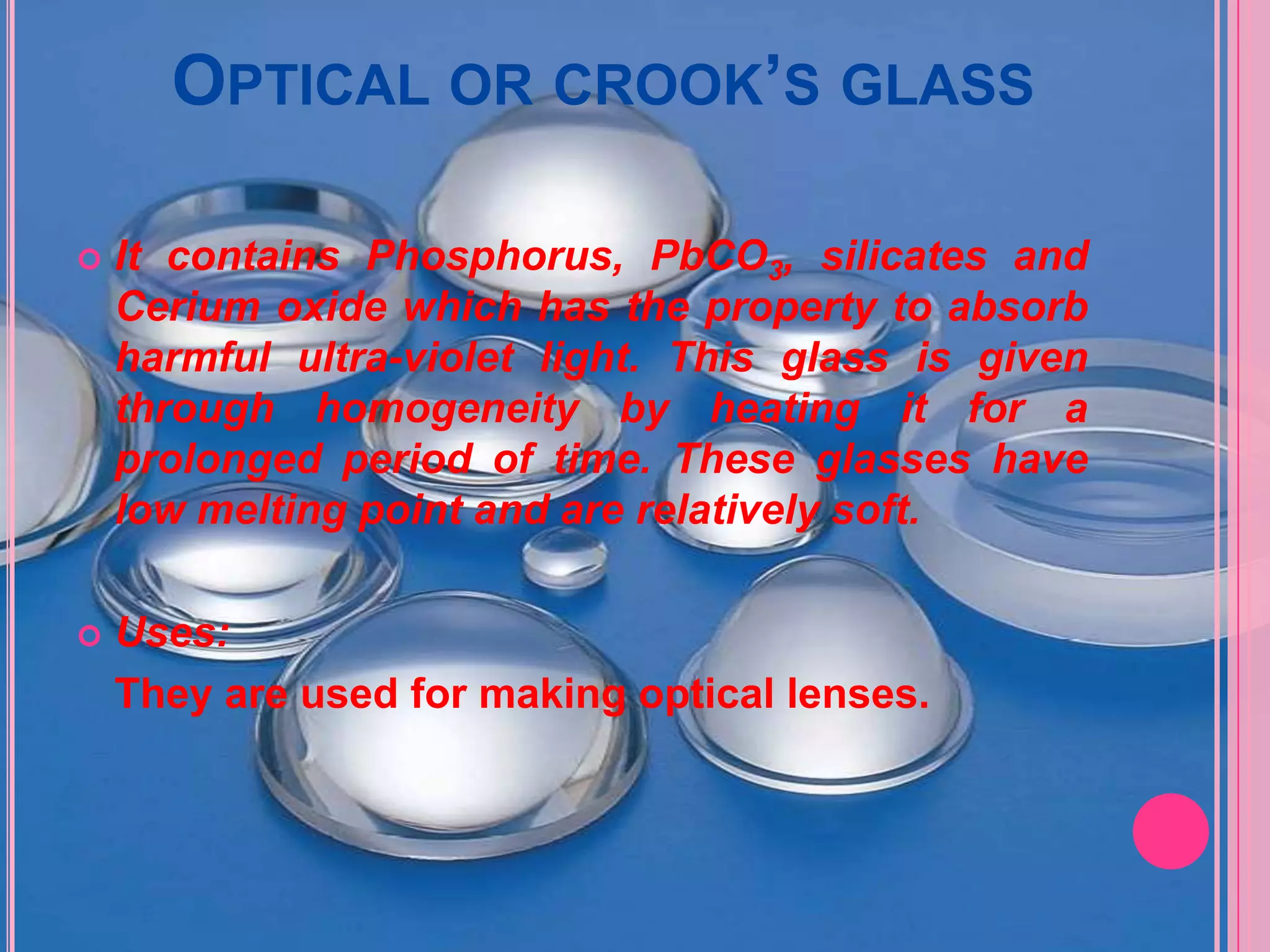
   It contains Phosphorus, PbCO3, silicates and
    Cerium oxide which has the property to absorb
    harmful ultra-violet light. This glass is given
    through homogeneity by heating it for a
    prolonged period of time. These glasses have
    low melting point and are relatively soft.

   Uses:
    They are used for making optical lenses.
COLOURED GLASS
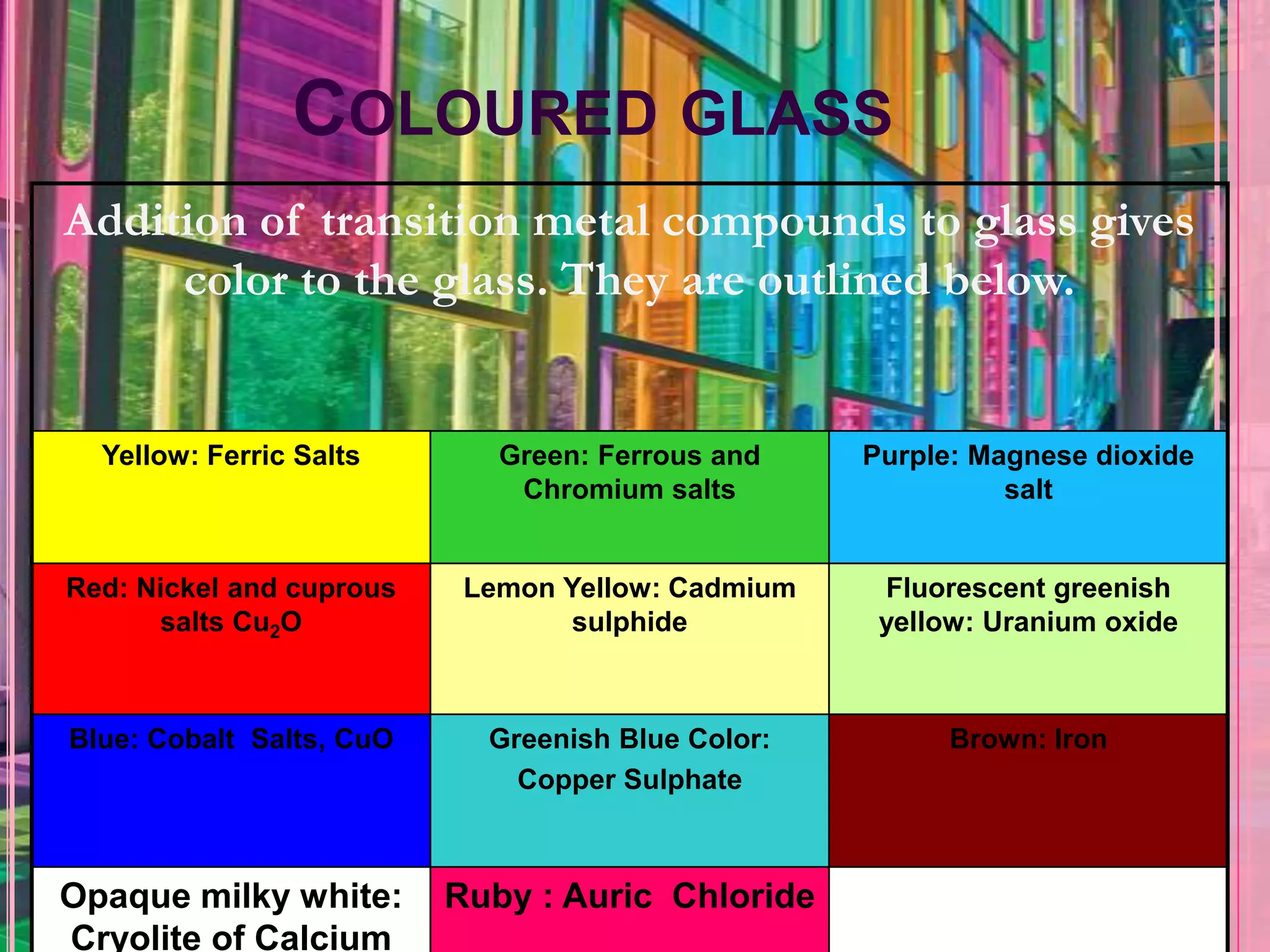
Addition of transition metal compounds to glass gives
     color to the glass. They are outlined below.


  Yellow: Ferric Salts       Green: Ferrous and    Purple: Magnese dioxide
                              Chromium salts                 salt


Red: Nickel and cuprous    Lemon Yellow: Cadmium    Fluorescent greenish
      salts Cu2O                  sulphide          yellow: Uranium oxide


Blue: Cobalt Salts, CuO     Greenish Blue Color:         Brown: Iron
                              Copper Sulphate


Opaque milky white:       Ruby : Auric Chloride
Cryolite of Calcium
WIRED GLASS
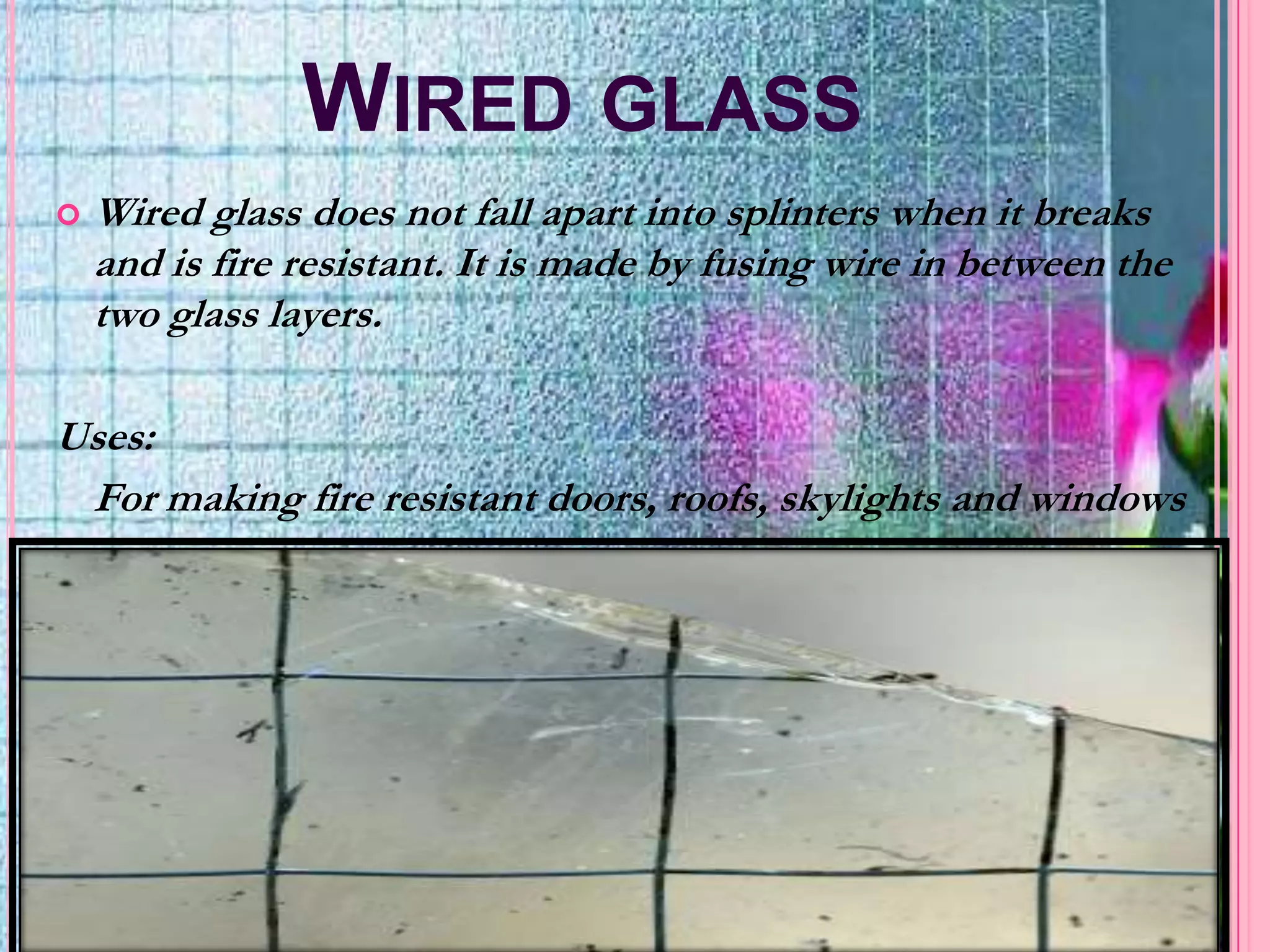
   Wired glass does not fall apart into splinters when it breaks
    and is fire resistant. It is made by fusing wire in between the
    two glass layers.

Uses:
 For making fire resistant doors, roofs, skylights and windows
FIBER GLASS
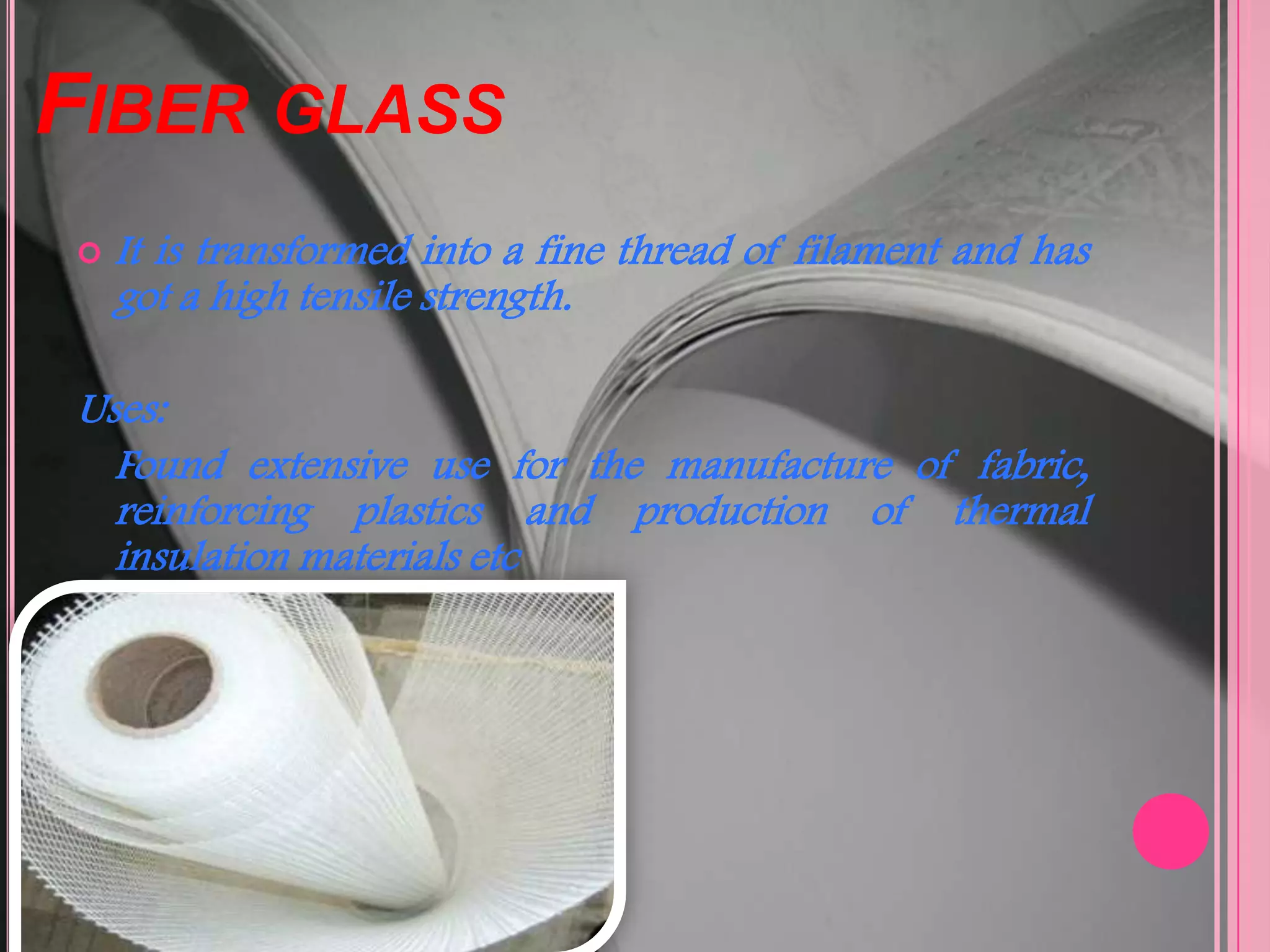
   It is transformed into a fine thread of filament and has
    got a high tensile strength.

Uses:
  Found extensive use for the manufacture of fabric,
  reinforcing plastics and production of thermal
  insulation materials etc
NEUTRAL GLASS
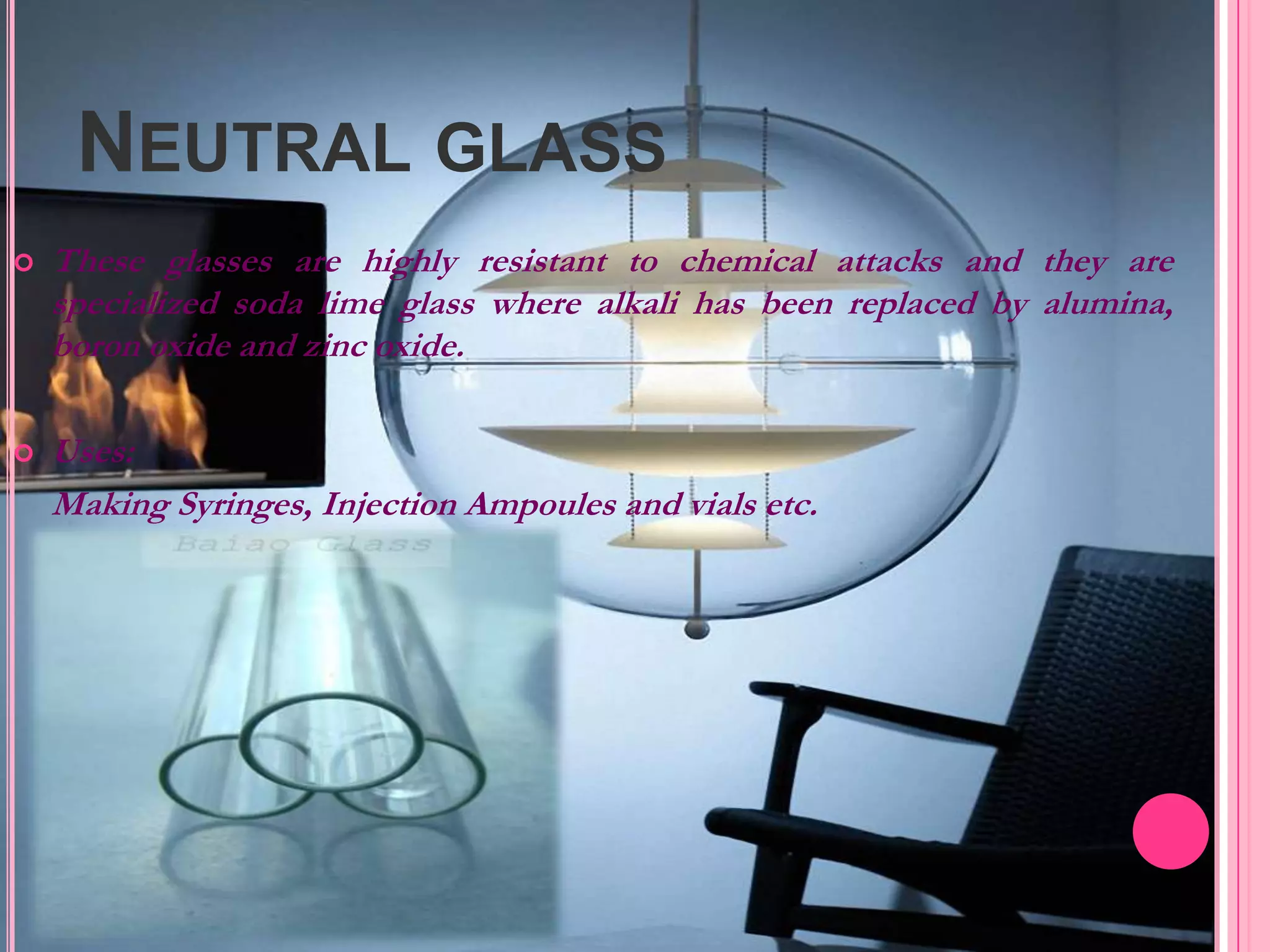
   These glasses are highly resistant to chemical attacks and they are
    specialized soda lime glass where alkali has been replaced by alumina,
    boron oxide and zinc oxide.

   Uses:
    Making Syringes, Injection Ampoules and vials etc.
LAMINATED GLASS
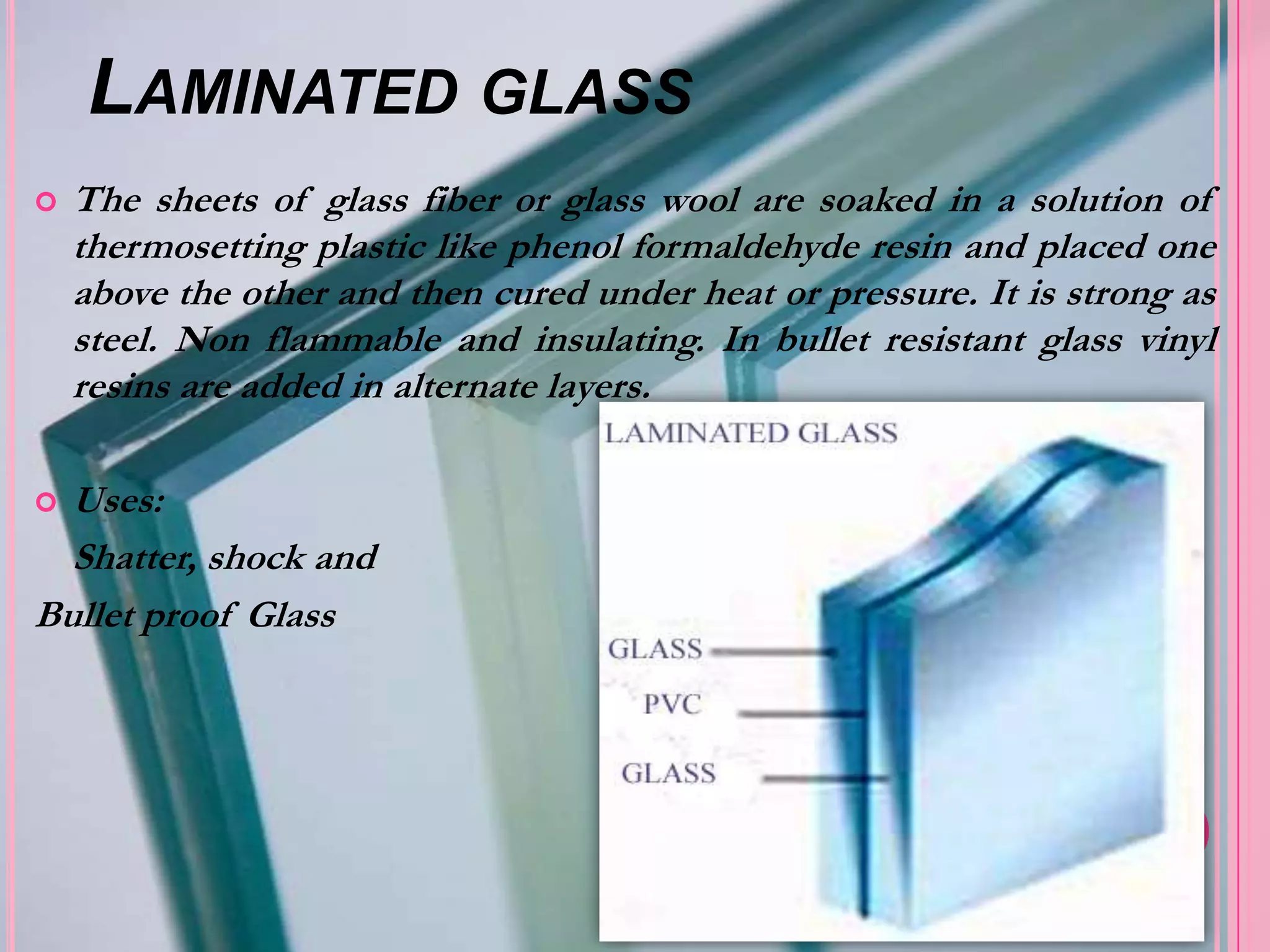
   The sheets of glass fiber or glass wool are soaked in a solution of
    thermosetting plastic like phenol formaldehyde resin and placed one
    above the other and then cured under heat or pressure. It is strong as
    steel. Non flammable and insulating. In bullet resistant glass vinyl
    resins are added in alternate layers.

 Uses:
  Shatter, shock and
Bullet proof Glass
INSULATING GLASS

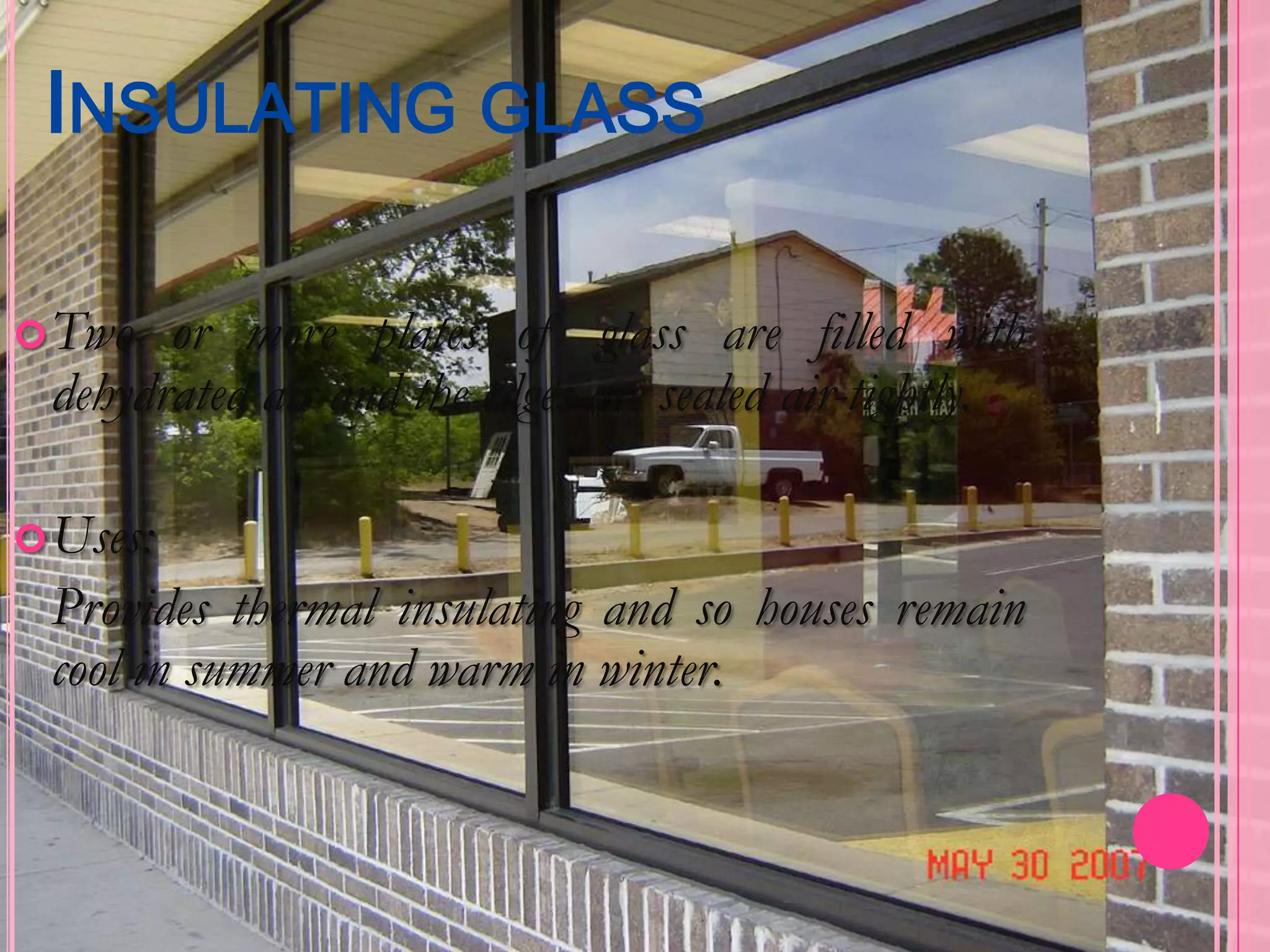
 Two  or more plates of glass are filled with
 dehydrated air and the edges are sealed air-tightly.

 Uses:
 Provides thermal insulating and so houses remain
 cool in summer and warm in winter.
FRACTURE / FAILURE OF
GLASS


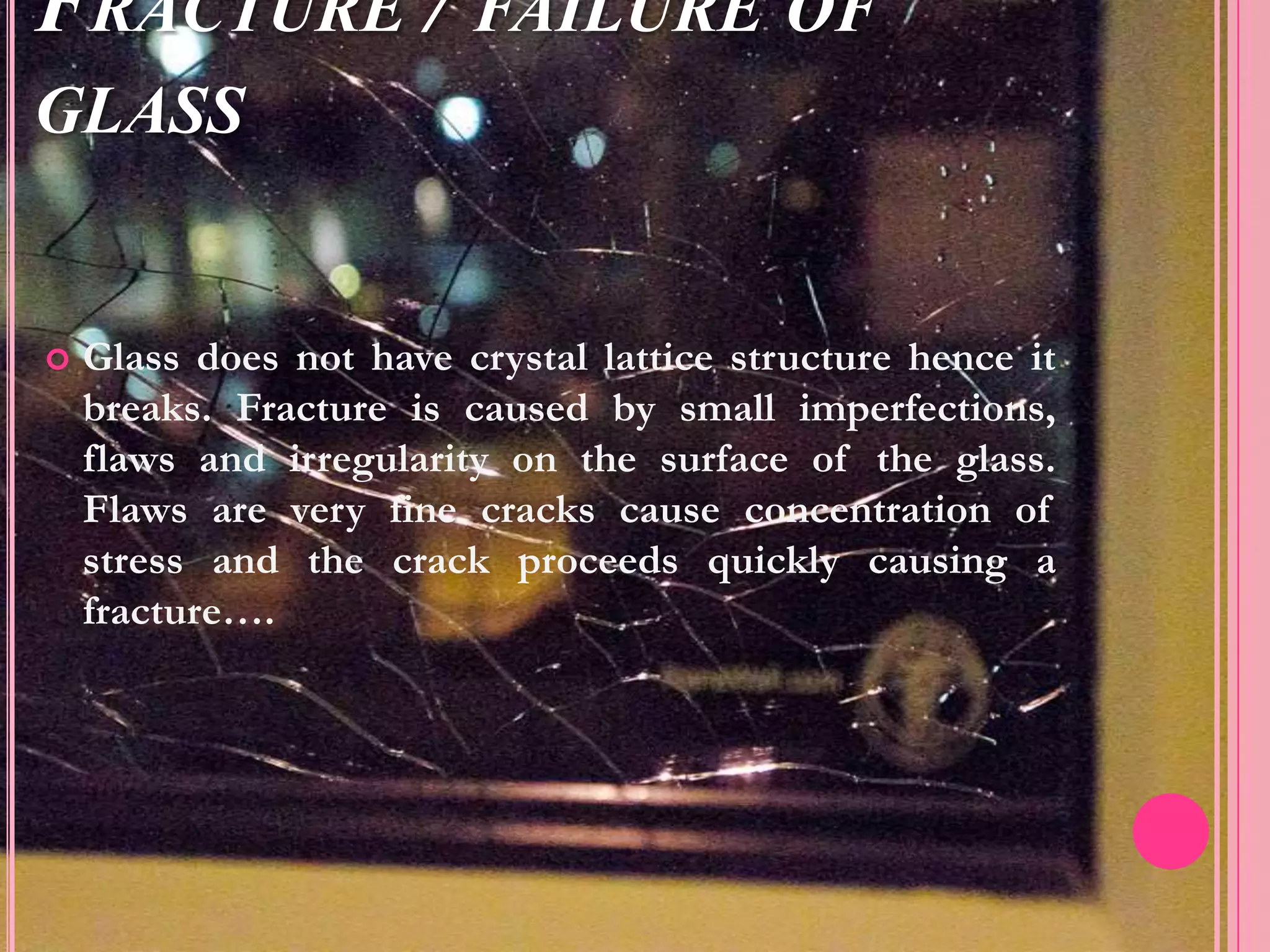
   Glass does not have crystal lattice structure hence it
    breaks. Fracture is caused by small imperfections,
    flaws and irregularity on the surface of the glass.
    Flaws are very fine cracks cause concentration of
    stress and the crack proceeds quickly causing a
    fracture….
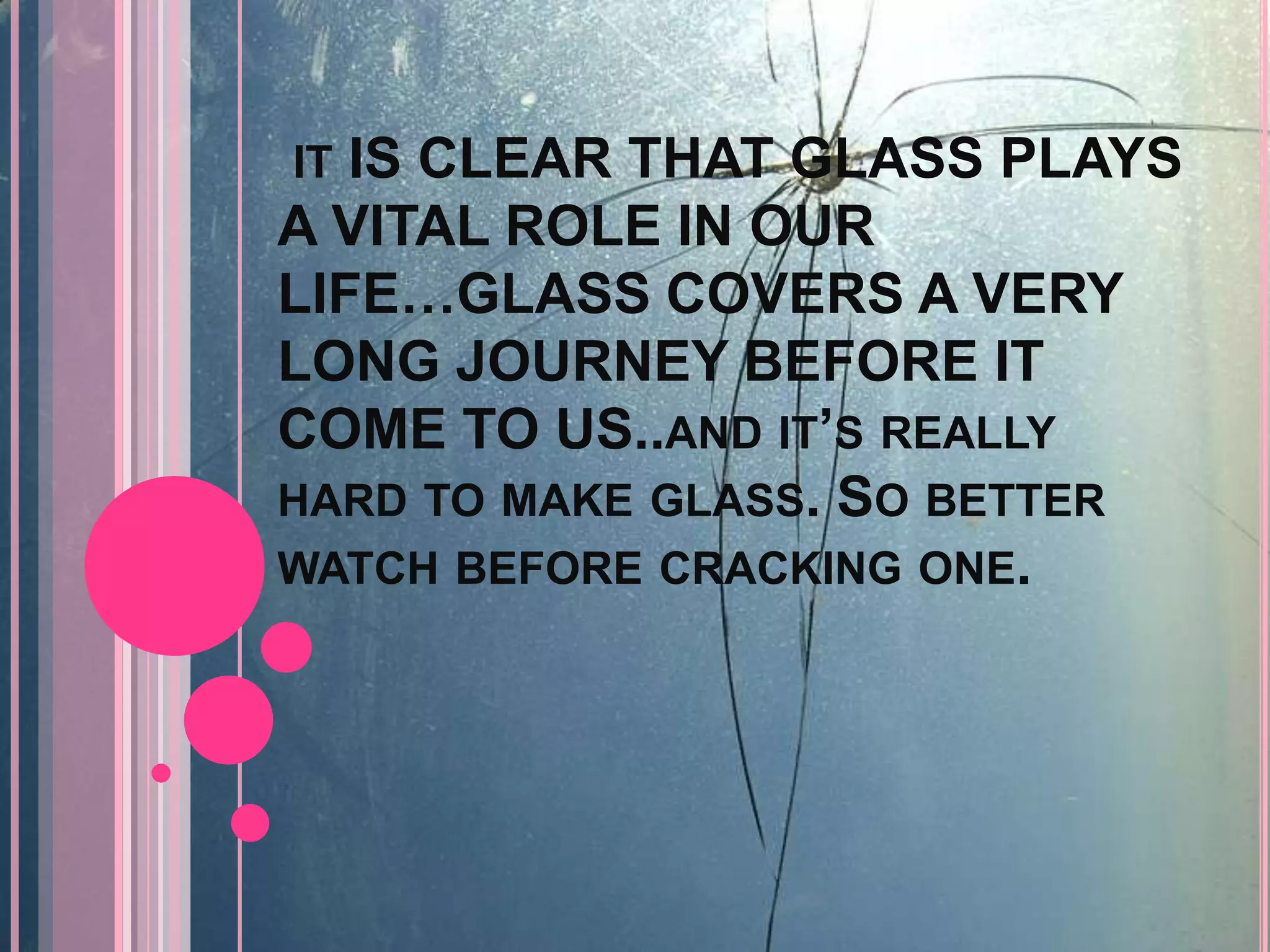
IT IS CLEAR THAT GLASS PLAYS
A VITAL ROLE IN OUR
LIFE…GLASS COVERS A VERY
LONG JOURNEY BEFORE IT
COME TO US..AND IT’S REALLY
HARD TO MAKE GLASS. SO BETTER
WATCH BEFORE CRACKING ONE.
Jaideep grp...

Jaideep grp...

  • 2.
    GLASS  Definition  Preparation Composition  VARIETY  Uses
  • 3.
    DEFINITION Glassis an amorphous, hard, brittle, transparent or translucent super cooled liquid of infinite viscosity, having no definite melting point obtained by fusing a mixture of a number of metallic silicates or borates of Sodium, Potassium, Calcium, and Lead. It possess no definite formula or crystalline structure:  “An inorganic product of fusion which has cooled to a rigid condition without crystallizing”  Does not have a specific melting point  Softens over a temperature range
  • 4.
    PROPERTIES OF GLASS Amorphous  Brittle  Transparent / Translucent  Good electrical insulator  Unaffected by air, water, acid or chemical reagents except HF  No definite crystal structure means glass has high Compressive strength  Can absorb, transmit and reflect light
  • 5.
    RAW MATERIALS USEDIN MANUFACTURING GLASS Raw Materials  Sodium as Na2Co3 .  Potassium as K2Co3 .  Calcium as lime stone, and lime.  Lead as litharge, red lead (flint glass).  Silica arc quartz, white sand and ignited flint.  Zinc is zinc oxide (Heat and shock proof glass).  Borates are borax, Boric acid (Heat and shock proof glass).  Culets or pieces of broken glass to increase fusibility.
  • 6.
    GLASS COMPONENTS  Formers– Network Formation SiO2, B2O3, P2O5, GeO2, V2O5, As2O3, Sb2O5  Fluxes – Softeners Na2O, K2O, LiO, Al2O3, B2O3, Cs2O  Stabilizers – Provide Chemical Resistance CaO, MgO, Al2O3, PbO, SrO, BaO, ZnO, ZrO
  • 7.
    MANUFACTURING STEPS  Melting  Forming and Shaping  Annealing  Finishing
  • 8.
    MELTING PROCESS 1). Raw materials in proper proportions are mixed with culets. 2).It is finely powdered and intimate mixture called batch is fused in furnace at high temperature of 1800°C this charge melts and fuses into a viscous fluid. CaCO3 + SiO2  CaSiO3 + CO2 Na2CO3 + SiO2  Na2SiO3 + CO2 3).After removal of CO2 decolorizes like MnO2 are added to remove traces of ferrous compounds and Carbon. Heating is continued till clear molten mass is free from bubbles is obtained and it is then cooled to about 800°C.
  • 9.
    FORMING, SHAPING, AND ANNEALING  Forming and Shaping. The viscous mass obtained from melting is poured into moulds to get different types of articles of desired shape by either blowing or pressing between the rollers.  Annealing.  Glass articles are then allowed to cool gradually at room temperature by passing through different chambers with descending temperatures. This reduces the internal Strain in the glass.
  • 10.
    FINISHING Finishing is thelast step in glass manufacturing. It involves following steps.  Cleaning.  Grinding.  Polishing.  Cutting.  Sand Blasting.
  • 11.
    SODA LIME ORSOFT GLASS  About 90% of all glass is soda-lime glass made with silica (sand), Calcium carbonate and soda ash.  The approximate composition is Na2CO3.CaO.6SiO2.  They are low cost, resistant to water but not to acids.  They can melt easily and hence can be hot worked.  Uses: Window glass, Electric bulbs, Plate glass, Bottles, Jars, cheaper table wares, test tubes, reagent bottles etc
  • 12.
    POTASH LIME ORHARD GLASS  Potash lime glass is made with silica (sand), Calcium carbonate and potassium carbonate.  The approximate composition is K2CO3.CaO.6SiO2  .  They posses high melting point, fuse with difficulty and are less acted upon by acids, alkaline and other solvents than ordinary glass.  Uses: These glasses are costlier than soda lime glass and are used for chemical apparatus, combustion tubes and glassware which are used for heating operations.
  • 13.
    LEAD GLASS ORFLINT GLASS  It is made up of lead oxide fluxed with silica and K2CO3 is used instead of sodium oxide.  Its approximate composition is K2Co3.PbO.SiO2.  Uses: High quality table wares, optical lenses, neon sign tubing, cathode ray tubes, electrical insulators, crystal art objects or cut glass, Windows and Shields for protection against X-rays and Gamma rays in medical and atomic energy fields etc.
  • 14.
    BOROSILICATE  It contains SiO2(80.5%), B2O3(13%), Al2O3(03%), K2O(3%) and Na2O(0.5%). These glass have low thermal coefficient of expansion, and high chemical resistance i.e..shock proof.  It is common hard glass containing silica and boron with small amount of alumina and less alkaline solids.
  • 15.
    ALUMINO-SILICATE GLASS  The typical approximate composition of this type of glass SiO2(55%), Al2O3(23%), MgO(090, B2O3(07%), CaO(05%) and Na2O, K2O(01%).  This type of glass possess exceptionally high softening temperature.  Uses: It is used for high pressure mercury discharge tubes, chemical combustion tube and certain domestic equipments.
  • 16.
    99.5% VITREOSIL GLASS  It contains pure silica heated to its melting point. It is translucent, the coefficient of thermal expansion is very low hence it has high resistance to thermal shock, have high chemical resistance to corrosive agents.  If Vitreosil glass is heated above its melting point, it becomes transparent and is known as clear silica glass.  Uses: They are used in construction of chemical plants, laboratory crucibles, induction furnace lining, electrical insulators and heaters and have high light transmission properties.
  • 17.
    SAFETY GLASS  It is made by fusing two to three flat sheets of glass and in between them alternate thin layer of vinyl plastic is introduced. It is heated where both the layers merge together and glass is toughened.  Uses: It is used as wind shield in automobiles and airplanes. On breaking it pieces does not fly apart because of the presence of the plastic layer in between the glass layers.
  • 18.
    OPTICAL OR CROOK’SGLASS  It contains Phosphorus, PbCO3, silicates and Cerium oxide which has the property to absorb harmful ultra-violet light. This glass is given through homogeneity by heating it for a prolonged period of time. These glasses have low melting point and are relatively soft.  Uses: They are used for making optical lenses.
  • 19.
    COLOURED GLASS Addition oftransition metal compounds to glass gives color to the glass. They are outlined below. Yellow: Ferric Salts Green: Ferrous and Purple: Magnese dioxide Chromium salts salt Red: Nickel and cuprous Lemon Yellow: Cadmium Fluorescent greenish salts Cu2O sulphide yellow: Uranium oxide Blue: Cobalt Salts, CuO Greenish Blue Color: Brown: Iron Copper Sulphate Opaque milky white: Ruby : Auric Chloride Cryolite of Calcium
  • 20.
    WIRED GLASS  Wired glass does not fall apart into splinters when it breaks and is fire resistant. It is made by fusing wire in between the two glass layers. Uses: For making fire resistant doors, roofs, skylights and windows
  • 21.
    FIBER GLASS  It is transformed into a fine thread of filament and has got a high tensile strength. Uses: Found extensive use for the manufacture of fabric, reinforcing plastics and production of thermal insulation materials etc
  • 22.
    NEUTRAL GLASS  These glasses are highly resistant to chemical attacks and they are specialized soda lime glass where alkali has been replaced by alumina, boron oxide and zinc oxide.  Uses: Making Syringes, Injection Ampoules and vials etc.
  • 23.
    LAMINATED GLASS  The sheets of glass fiber or glass wool are soaked in a solution of thermosetting plastic like phenol formaldehyde resin and placed one above the other and then cured under heat or pressure. It is strong as steel. Non flammable and insulating. In bullet resistant glass vinyl resins are added in alternate layers.  Uses: Shatter, shock and Bullet proof Glass
  • 24.
    INSULATING GLASS  Two or more plates of glass are filled with dehydrated air and the edges are sealed air-tightly.  Uses: Provides thermal insulating and so houses remain cool in summer and warm in winter.
  • 25.
    FRACTURE / FAILUREOF GLASS  Glass does not have crystal lattice structure hence it breaks. Fracture is caused by small imperfections, flaws and irregularity on the surface of the glass. Flaws are very fine cracks cause concentration of stress and the crack proceeds quickly causing a fracture….
  • 27.
    IT IS CLEARTHAT GLASS PLAYS A VITAL ROLE IN OUR LIFE…GLASS COVERS A VERY LONG JOURNEY BEFORE IT COME TO US..AND IT’S REALLY HARD TO MAKE GLASS. SO BETTER WATCH BEFORE CRACKING ONE.