MOIZ ULLAH BAIG (MM-036)
SAAD ARIF (MM-026)
HARIS IQBAL KHAN (MM-020)
OMAR SIDDIQI (MM-004)
Department of Materials Engineering
GLASS
INTRODUCTION
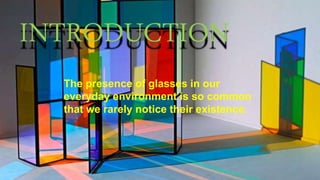
The presence of glasses in our
everyday environment is so common
that we rarely notice their existence.
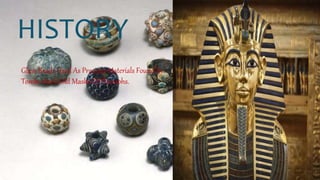
Glass Beads Used As Precious Materials Found In
Tombs And Gold Masks Of Pharaohs.
HISTORY
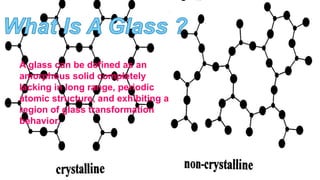
A glass can be defined as an
amorphous solid completely
lacking in long range, periodic
atomic structure, and exhibiting a
region of glass transformation
behavior.
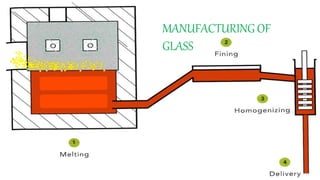
MANUFACTURING OF
GLASS
P
R
O
P
E
R
T
I
E
S
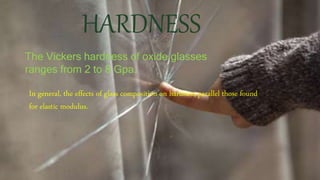
HARDNESS
The Vickers hardness of oxide glasses
ranges from 2 to 8 Gpa.
In general, the effects of glass composition on hardness parallel those found
for elastic modulus.
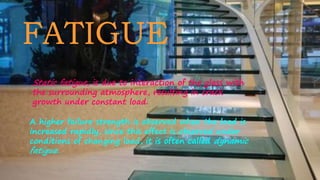
FATIGUE
Static fatigue, is due to interaction of the glass with
the surrounding atmosphere, resulting in crack
growth under constant load.
A higher failure strength is observed when the load is
increased rapidly, since this effect is observed under
conditions of changing load, it is often called dynamic
fatigue.
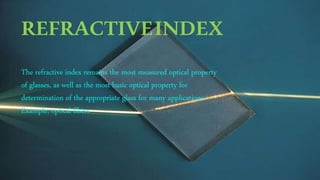
REFRACTIVEINDEX
The refractive index remains the most measured optical property
of glasses, as well as the most basic optical property for
determination of the appropriate glass for many applications.
Example; optical fibers
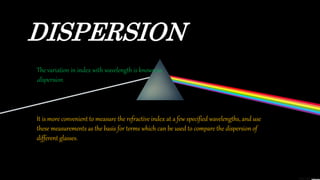
DISPERSION
The variation in index with wavelength is known as
dispersion.
It is more convenient to measure the refractive index at a few specified wavelengths, and use
these measurements as the basis for terms which can be used to compare the dispersion of
different glasses.
ADVANCE
TECHNIQUES
The advent of the age of technology
created many new opportunities for the
application of glasses.
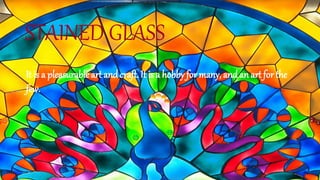
STAINED GLASS
It is a pleasurable art andcraft. It is a hobby for many, andan art for the
few.
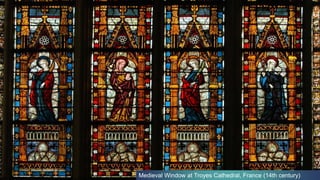
Medieval Window at Troyes Cathedral, France (14th century)
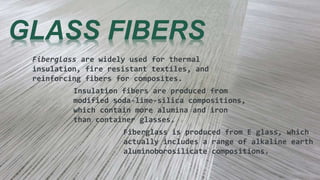
GLASS FIBERS
Fiberglass are widely used for thermal
insulation, fire resistant textiles, and
reinforcing fibers for composites.
Insulation fibers are produced from
modified soda-lime-silica compositions,
which contain more alumina and iron
than container glasses.
Fiberglass is produced from E glass, which
actually includes a range of alkaline earth
aluminoborosilicate compositions.
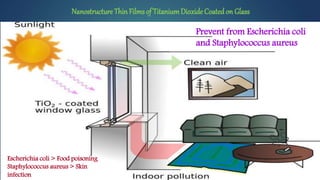
Nanostructure ThinFilms of TitaniumDioxide Coatedon Glass
Prevent from Escherichia coli
and Staphylococcus aureus
Escherichia coli > Food poisoning
Staphylococcus aureus > Skin
infection
SMART
GLASSSmart Glass or Switchable Glass is a product
of cutting-edge technology that allows users
to block either all light or just some by simply
turning a knob or pressing a button.
This type of light control could potentially
save tremendously on heating, cooling and
lighting costs.
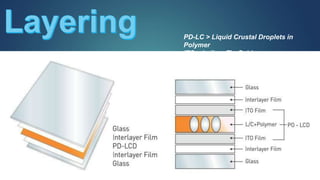
PD-LC > Liquid Crustal Droplets in
Polymer
ITO > Indium Tin Oxide
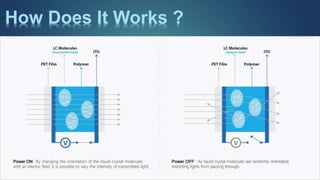
How Does It Works ?
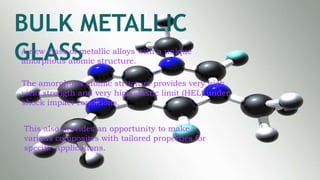
BULK METALLIC
GLASSA new class of metallic alloys with a unique
amorphous atomic structure.
The amorphous atomic structure provides very high
yield strength and very high elastic limit (HEL) under
shock impact conditions.
This also provides an opportunity to make
various composites with tailored properties for
specific applications.
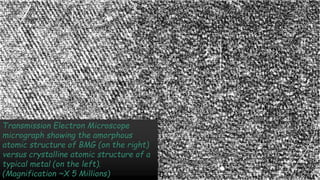
Transmission Electron Microscope
micrograph showing the amorphous
atomic structure of BMG (on the right)
versus crystalline atomic structure of a
typical metal (on the left).
(Magnification ~X 5 Millions)
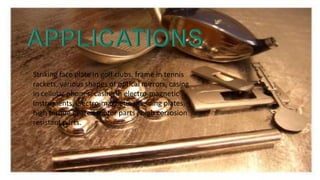
Striking face plate in golf clubs, frame in tennis
rackets, various shapes of optical mirrors, casing
in cellular phones, casing in electro-magnetic
instruments, electro-magnetic shielding plates,
high torque geared motor parts , high corrosion
resistant parts.
CONCLUSION

Glass, properties, manufacturing, applications, advance techniques

  • 1.
    MOIZ ULLAH BAIG(MM-036) SAAD ARIF (MM-026) HARIS IQBAL KHAN (MM-020) OMAR SIDDIQI (MM-004) Department of Materials Engineering GLASS
  • 2.
    INTRODUCTION The presence ofglasses in our everyday environment is so common that we rarely notice their existence.
  • 3.
    Glass Beads UsedAs Precious Materials Found In Tombs And Gold Masks Of Pharaohs. HISTORY
  • 4.
    A glass canbe defined as an amorphous solid completely lacking in long range, periodic atomic structure, and exhibiting a region of glass transformation behavior.
  • 6.
  • 7.
  • 8.
    HARDNESS The Vickers hardnessof oxide glasses ranges from 2 to 8 Gpa. In general, the effects of glass composition on hardness parallel those found for elastic modulus.
  • 9.
    FATIGUE Static fatigue, isdue to interaction of the glass with the surrounding atmosphere, resulting in crack growth under constant load. A higher failure strength is observed when the load is increased rapidly, since this effect is observed under conditions of changing load, it is often called dynamic fatigue.
  • 10.
    REFRACTIVEINDEX The refractive indexremains the most measured optical property of glasses, as well as the most basic optical property for determination of the appropriate glass for many applications. Example; optical fibers
  • 11.
    DISPERSION The variation inindex with wavelength is known as dispersion. It is more convenient to measure the refractive index at a few specified wavelengths, and use these measurements as the basis for terms which can be used to compare the dispersion of different glasses.
  • 12.
    ADVANCE TECHNIQUES The advent ofthe age of technology created many new opportunities for the application of glasses.
  • 13.
    STAINED GLASS It isa pleasurable art andcraft. It is a hobby for many, andan art for the few.
  • 15.
    Medieval Window atTroyes Cathedral, France (14th century)
  • 16.
    GLASS FIBERS Fiberglass arewidely used for thermal insulation, fire resistant textiles, and reinforcing fibers for composites. Insulation fibers are produced from modified soda-lime-silica compositions, which contain more alumina and iron than container glasses. Fiberglass is produced from E glass, which actually includes a range of alkaline earth aluminoborosilicate compositions.
  • 18.
    Nanostructure ThinFilms ofTitaniumDioxide Coatedon Glass Prevent from Escherichia coli and Staphylococcus aureus Escherichia coli > Food poisoning Staphylococcus aureus > Skin infection
  • 19.
    SMART GLASSSmart Glass orSwitchable Glass is a product of cutting-edge technology that allows users to block either all light or just some by simply turning a knob or pressing a button. This type of light control could potentially save tremendously on heating, cooling and lighting costs.
  • 20.
    PD-LC > LiquidCrustal Droplets in Polymer ITO > Indium Tin Oxide
  • 21.
    How Does ItWorks ?
  • 22.
    BULK METALLIC GLASSA newclass of metallic alloys with a unique amorphous atomic structure. The amorphous atomic structure provides very high yield strength and very high elastic limit (HEL) under shock impact conditions. This also provides an opportunity to make various composites with tailored properties for specific applications.
  • 23.
    Transmission Electron Microscope micrographshowing the amorphous atomic structure of BMG (on the right) versus crystalline atomic structure of a typical metal (on the left). (Magnification ~X 5 Millions)
  • 24.
    Striking face platein golf clubs, frame in tennis rackets, various shapes of optical mirrors, casing in cellular phones, casing in electro-magnetic instruments, electro-magnetic shielding plates, high torque geared motor parts , high corrosion resistant parts.
  • 25.