
FIBRE GLASS
FIBRE GLASS
 Composite material using resin as matrix
and glass fiber as reinforcement
 Fiberglass is a lightweight, extremely
strong, and robust material. Fiberglass
combines its light weight with an inherent
strength to provide a weather resistant
finish with a variety of surface textures.
 There are 4 methods by which
fiberglass can be made. They are:
Fiberglass hand lay-up operation
Fiberglass spray lay-up operation
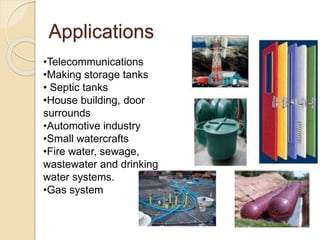
Applications
•Telecommunications
•Making storage tanks
• Septic tanks
•House building, door
surrounds
•Automotive industry
•Small watercrafts
•Fire water, sewage,
wastewater and drinking
water systems.
•Gas system
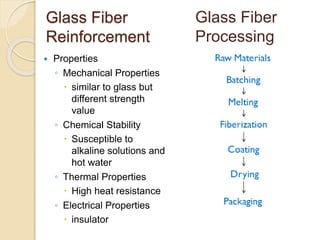
Glass Fiber
Reinforcement
 Properties
◦ Mechanical Properties
 similar to glass but
different strength
value
◦ Chemical Stability
 Susceptible to
alkaline solutions and
hot water
◦ Thermal Properties
 High heat resistance
◦ Electrical Properties
 insulator
Glass Fiber
Processing
Glass Fiber Processing
Raw Materials
 Major
◦ Silica
◦ Limestone
◦ Soda Ash
◦ Waste glass
 Others
◦ Calcined Alumina
◦ Borax
◦ Magnesite
Glass Fiber Processing
Batching
 Batching - exact quantities of raw
materials are mixed together before
being melted.
 Materials are added to lower the
working temperature and add
additional properties like
strength,increase melting temperature
and are alkali resistant.
Glass Fiber Processing
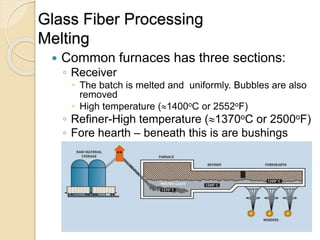
Melting
 Common furnaces has three sections:
◦ Receiver
 The batch is melted and uniformly. Bubbles are also
removed
 High temperature (1400oC or 2552oF)
◦ Refiner-High temperature (1370oC or 2500oF)
◦ Fore hearth – beneath this is are bushings
Glass Fiber Processing
Fiberization
 Extrusion
◦ Extruded through
200-8000 bushings
made of alloys.
◦ Bushings are heated
electronically to
maintain
temperature and
consequently, glass
viscosity and
thickness
 Attenuation
◦ Drawing extruded
molten glass into
filaments using high-
speed winder
◦ High-speed winding
applies tension.
Glass Fiber Processing
Coating
3 common types:
◦ Lubricants – Protect filaments from
abrading and breaking
◦ Binders – binds resin to glass fiber
◦ Coupling agents – increase affinity for
specific resins
Glass Fiber Processing
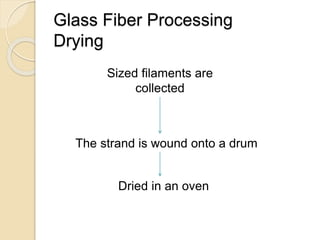
Drying
Sized filaments are
collected
The strand is wound onto a drum
Dried in an oven
Glass Fiber Processing
Packaging
 Continuous-filament
◦ Rolled in drums and formed into yarns
 Staple-fiber
◦ while cooling, jets of air break filaments into
lengths of 8-15 inches
 Chopped fiber
◦ Yarns are chopped into short, uniform
lengths
 Glass wool
◦ Cooling involves a downward jet of (hot) air,
making the fibers fall randomly onto a
conveyor belt, forming a fleecy mass
Resins
Matrix
 Three major types of resin: Polyester,
Epoxy, and Vinyl, all of which are
thermosets.
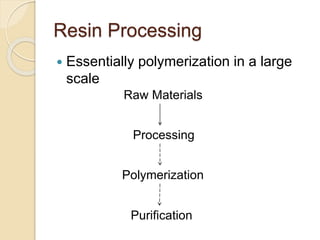
Resin Processing
 Essentially polymerization in a large
scale
Raw Materials
Polymerization
Processing
Purification
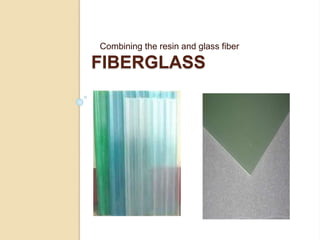
FIBERGLASS
Combining the resin and glass fiber
Fiberglass
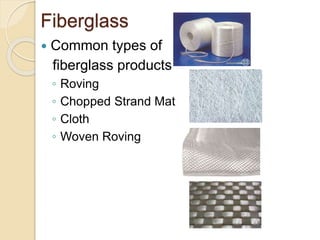
 Common types of
fiberglass products
◦ Roving
◦ Chopped Strand Mat
◦ Cloth
◦ Woven Roving
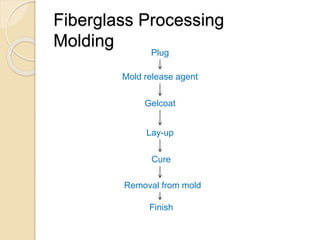
Fiberglass Processing
Molding
Plug
Mold release agent
Gelcoat
Lay-up
Cure
Removal from mold
Finish
Fiberglass Processing
Molding
 Plug
◦ Object with desired shape
◦ Can be formed with foams, wood, plaster,
etc.
 Mold
◦ Supports glass fibers during resin curing
 Mold release agent
◦ E.g. Polyvinyl alcohol
 Gelcoat
◦ Pigmented resin, harder, more durable finish
◦ Followed by a coating of a fiberglass
Fiberglass Processing
Molding
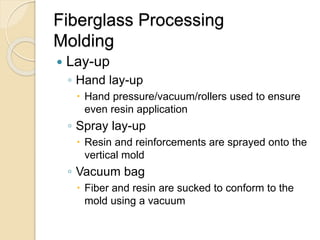
 Lay-up
◦ Hand lay-up
 Hand pressure/vacuum/rollers used to ensure
even resin application
◦ Spray lay-up
 Resin and reinforcements are sprayed onto the
vertical mold
◦ Vacuum bag
 Fiber and resin are sucked to conform to the
mold using a vacuum
Fiberglass Processing
Molding
 Cure
◦ Longer curing time = greater shrinkage
 Removal from mold
 Finish

Fiberglass

  • 1.
  • 2.
    FIBRE GLASS  Compositematerial using resin as matrix and glass fiber as reinforcement  Fiberglass is a lightweight, extremely strong, and robust material. Fiberglass combines its light weight with an inherent strength to provide a weather resistant finish with a variety of surface textures.  There are 4 methods by which fiberglass can be made. They are: Fiberglass hand lay-up operation Fiberglass spray lay-up operation
  • 3.
    Applications •Telecommunications •Making storage tanks •Septic tanks •House building, door surrounds •Automotive industry •Small watercrafts •Fire water, sewage, wastewater and drinking water systems. •Gas system
  • 4.
    Glass Fiber Reinforcement  Properties ◦Mechanical Properties  similar to glass but different strength value ◦ Chemical Stability  Susceptible to alkaline solutions and hot water ◦ Thermal Properties  High heat resistance ◦ Electrical Properties  insulator Glass Fiber Processing
  • 5.
    Glass Fiber Processing RawMaterials  Major ◦ Silica ◦ Limestone ◦ Soda Ash ◦ Waste glass  Others ◦ Calcined Alumina ◦ Borax ◦ Magnesite
  • 6.
    Glass Fiber Processing Batching Batching - exact quantities of raw materials are mixed together before being melted.  Materials are added to lower the working temperature and add additional properties like strength,increase melting temperature and are alkali resistant.
  • 7.
    Glass Fiber Processing Melting Common furnaces has three sections: ◦ Receiver  The batch is melted and uniformly. Bubbles are also removed  High temperature (1400oC or 2552oF) ◦ Refiner-High temperature (1370oC or 2500oF) ◦ Fore hearth – beneath this is are bushings
  • 8.
    Glass Fiber Processing Fiberization Extrusion ◦ Extruded through 200-8000 bushings made of alloys. ◦ Bushings are heated electronically to maintain temperature and consequently, glass viscosity and thickness  Attenuation ◦ Drawing extruded molten glass into filaments using high- speed winder ◦ High-speed winding applies tension.
  • 9.
    Glass Fiber Processing Coating 3common types: ◦ Lubricants – Protect filaments from abrading and breaking ◦ Binders – binds resin to glass fiber ◦ Coupling agents – increase affinity for specific resins
  • 10.
    Glass Fiber Processing Drying Sizedfilaments are collected The strand is wound onto a drum Dried in an oven
  • 11.
    Glass Fiber Processing Packaging Continuous-filament ◦ Rolled in drums and formed into yarns  Staple-fiber ◦ while cooling, jets of air break filaments into lengths of 8-15 inches  Chopped fiber ◦ Yarns are chopped into short, uniform lengths  Glass wool ◦ Cooling involves a downward jet of (hot) air, making the fibers fall randomly onto a conveyor belt, forming a fleecy mass
  • 12.
    Resins Matrix  Three majortypes of resin: Polyester, Epoxy, and Vinyl, all of which are thermosets.
  • 13.
    Resin Processing  Essentiallypolymerization in a large scale Raw Materials Polymerization Processing Purification
  • 14.
  • 15.
    Fiberglass  Common typesof fiberglass products ◦ Roving ◦ Chopped Strand Mat ◦ Cloth ◦ Woven Roving
  • 16.
    Fiberglass Processing Molding Plug Mold releaseagent Gelcoat Lay-up Cure Removal from mold Finish
  • 17.
    Fiberglass Processing Molding  Plug ◦Object with desired shape ◦ Can be formed with foams, wood, plaster, etc.  Mold ◦ Supports glass fibers during resin curing  Mold release agent ◦ E.g. Polyvinyl alcohol  Gelcoat ◦ Pigmented resin, harder, more durable finish ◦ Followed by a coating of a fiberglass
  • 18.
    Fiberglass Processing Molding  Lay-up ◦Hand lay-up  Hand pressure/vacuum/rollers used to ensure even resin application ◦ Spray lay-up  Resin and reinforcements are sprayed onto the vertical mold ◦ Vacuum bag  Fiber and resin are sucked to conform to the mold using a vacuum
  • 19.
    Fiberglass Processing Molding  Cure ◦Longer curing time = greater shrinkage  Removal from mold  Finish