
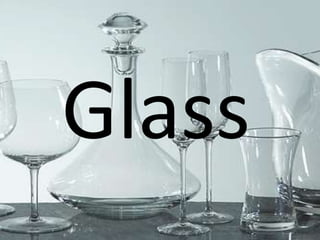

Glass
Contents
* What is glass
* Structure of glass
* History
* Types of glass
* Properties of glass
* Manufacturing of glass
* Uses of glass
* Advantages of glass
* Disadvantages of glass
What is glass
“Glass is a an inorganic product of fusion which
has cooled to a rigid condition without
crystallization”
or
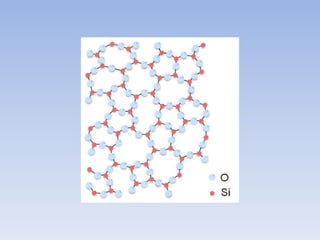
A brittle transparent solid with irregular atomic
structure
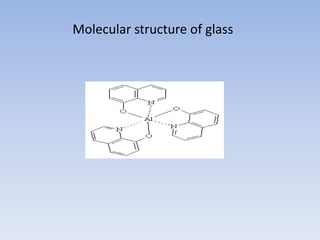
Molecular structure of glass
Glass is an inorganic solid material that is usually clear
or translucent with different colors. It is hard, brittle,
and stands up to the effects of wind, rain or sun. Glass
has been used for various kinds of bottles and
utensils, mirrors, windows and more. It is thought to
have been first created around 3000 BC, during the
bronze age. Egyptian glass beads date back to about
2500 BC.
History
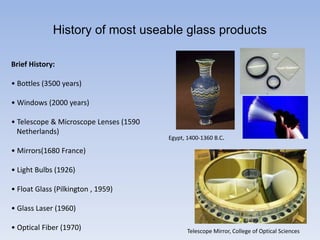
History of most useable glass products
Brief History:
• Bottles (3500 years)
• Windows (2000 years)
• Telescope & Microscope Lenses (1590
Netherlands)
• Mirrors(1680 France)
• Light Bulbs (1926)
• Float Glass (Pilkington , 1959)
• Glass Laser (1960)
• Optical Fiber (1970)
Egypt, 1400-1360 B.C.
Telescope Mirror, College of Optical Sciences
These are the main characteristics of glass:
- Solid and hard material
- Disordered and amorphous structure
- Fragile and easily breakable into sharp pieces
- Transparent to visible light
- Inert and biologically inactive material.
-Glass is 100% recyclable and one of the safest
packaging materials due to its composition and
properties
-
Properties of Glass
MANUFACTURING OF
GLASS
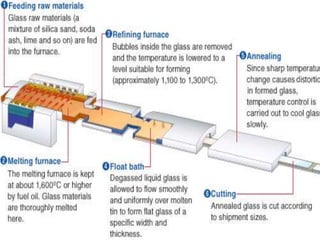
THE FLOAT PROCESS
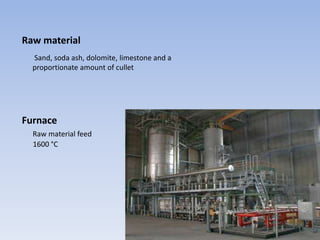
Sand, soda ash, dolomite, limestone and a
proportionate amount of cullet
Raw material
Furnace
Raw material feed
1600 °C
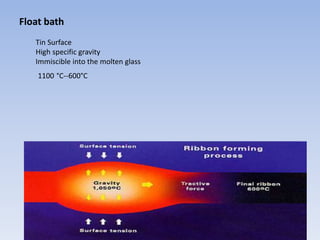
Float bath
Tin Surface
High specific gravity
Immiscible into the molten glass
1100 °C--600°C
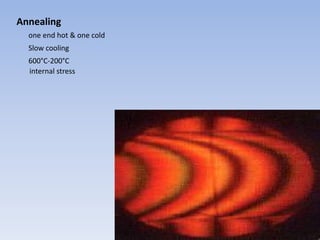
Annealing
one end hot & one cold
Slow cooling
600°C-200°C
internal stress
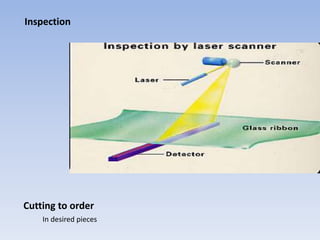
Inspection
Cutting to order
In desired pieces
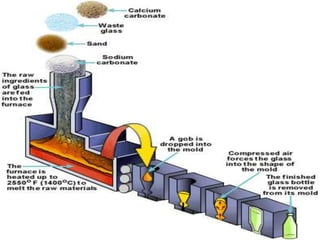
Production of glass bottles
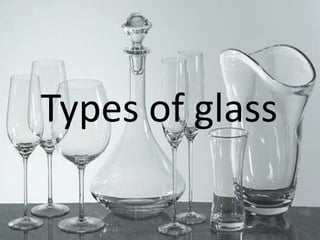
Types of glass
1. Commercial glass or Soda-lime glass:
This is the most common commercial glass and less
expensive. The composition of soda-lime glass is
normally 60-75% silica, 12-18% soda, and 5-12%
lime. A low percentage of other materials can be
added for specific properties such as coloring.
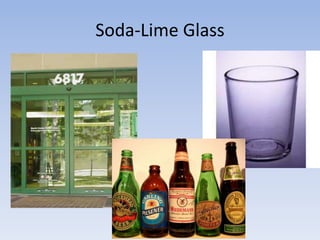
Soda-Lime Glass
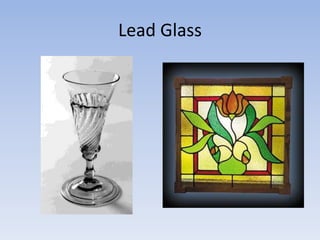
2. Lead glass:
This type of glass is composed of 54-65% SiO2, 18-38%
lead oxide (PbO), 13-15% soda (Na2O) or potash (K2), and
various other oxides. When the content of PbO is less than
18% is known as crystal glass.
Lead Glass
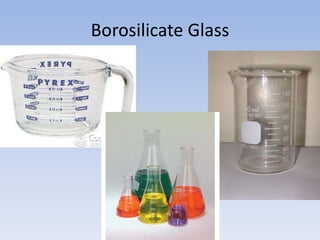
3. Borosilicate glass:
This is glass mainly composed of silica (70-80%), boric oxide B2O3
(7-13%) and smaller amounts of the alkalis (sodium and potassium
oxides) such as 4-8% of Na2O and K2O, and 2-7% aluminum oxide
(Al2O3). Boron gives greater resistance to thermal changes and
chemical corrosion.
Borosilicate Glass
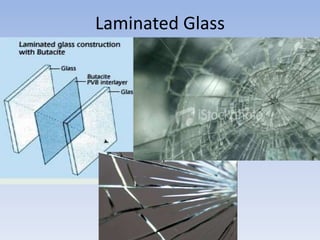
4. Laminated glass (Safety Glass):
This is a type of safety glass that holds together when
shattered. It typically has 2 layers of thick commercial glass
with a layer of resin called PVB (Polyvinyl Butaryl), between
them. In the event of breaking, the interlayer keeps the
layers of glass bonded even when broken, and its high
strength prevents the glass from breaking up into large sharp
pieces. This produces a characteristic "spider web" cracking
pattern when the impact is not enough to completely pierce
the glass.
Laminated Glass
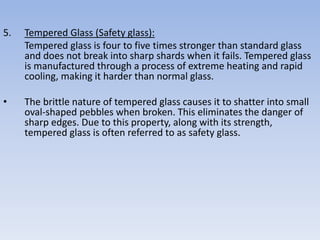
5. Tempered Glass (Safety glass):
Tempered glass is four to five times stronger than standard glass
and does not break into sharp shards when it fails. Tempered glass
is manufactured through a process of extreme heating and rapid
cooling, making it harder than normal glass.
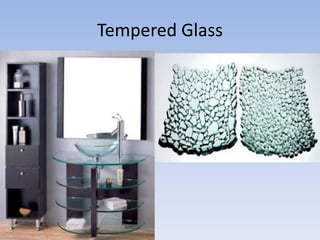
• The brittle nature of tempered glass causes it to shatter into small
oval-shaped pebbles when broken. This eliminates the danger of
sharp edges. Due to this property, along with its strength,
tempered glass is often referred to as safety glass.
Tempered Glass
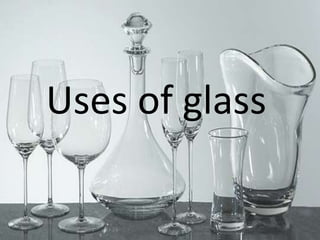
Uses of glass
•Soda-lime glass is primarily used for bottles, jars, everyday drinking
glasses, and window glass.
•Lead glass is usually used for art glass, wine and champagne glass, etc.
Glass with high lead oxide contents (i.e. 65%) may be used as radiation
shielding glass because lead absorb gamma rays and other forms of
harmful radiation, for example, for nuclear industry.
• It is suitable for industrial chemical process plants, in laboratories, in
the pharmaceutical industry, in bulbs for high-powered lamps, etc.
Borosilicate glass is also used in the home for cooking plates and other
heat-resistant products. It is used for domestic kitchens and chemistry
laboratories, this is because it has greater resistance to thermal shock
and allows for greater accuracy in laboratory measurements when
heating and cooling experiments
•Laminated glass is normally used when there is a possibility of
human impact or where the glass could fall if shattered. Shop-front
glazing and windshields are typically laminated glasses. The PVB
interlayer also gives the glass a much higher sound insulation rating,
due to the damping effect, and also blocks 99% of transmitted UV
light.
•The thermal process that cures tempered glass also makes it heat
resistant. Tempered glass is used to make the carafes in automatic
coffee makers and the windows in ovens. Computer screens,
skylights, door windows, tub enclosures and shower doors are more
examples of places you will find tempered glass. Building codes also
require the windows of many public structures to be made of
tempered glass.
Advantages
1. glass in construction work adds beauty to the building.
2. Its use fulfills the architectural view for external decoration.
3. By using glass in interior, it saves the space inside the building.
4. Glass cladding in building fulfill functional requirement of
lighting, heat retention and energy saving.
5. Its use appear a sense of openness and harmonious.
6. As toughened glass is available, one can have good interior
design with the use of glass in transparent staircase, colored
shelves, ceiling etc.
7. Glass is an excellent material for thermal insulation, water
proofing and energy conservation.
8. Glass is bad conductor of heat; it saves energy in air
conditioning of building.
9. For making glass partition on upper floors, no extra design is
required for slab as glass is light in weight.
• Difficult to work with if irregular shapes are needed.
Glass is malleable only when heated and treated in
special kilns and by special tools. By comparison, some
metal can be bent while cold and retain their strength
and new shape. [Glass bricks, however, can be used to
create irregular shapes in much the same way clayey
bricks are used.
• Glass in high buildings is a constant threat to people
below who might be underneath a falling glass pane or
its shards. This is a not infrequent happening during
earthquakes in a city with high rises. But, to a point,
sloughing brick facades have the same effect...they,
too, are a threat during earthquakes.
Disadvantages
• Of the above, the lack of load bearing capability and the
difficulty in working irregular shapes are probably the
biggest disadvantages of using glass in buildings
• Transmits radiant heat; so interiors can gain heat from
outside sources (like the Sun) or lose heat when the
outside is dark. Thus, a steady interior temperature is
harder to maintain unless special technologies are invoked
(like window blinds).
• Privacy from outside viewers would be an issue without
special technologies, like opaque glass.
Presented by:
HAFIZ ADIL 2010-IM-17
FAHEEM NAEEM 2010-IM-21
M.UMAIT AKHTAR 2010-IM-18
SUMAIR TARIQ 2010-IM-14
Glass 1

Glass 1

  • 2.
  • 3.
    Contents * What isglass * Structure of glass * History * Types of glass * Properties of glass * Manufacturing of glass * Uses of glass * Advantages of glass * Disadvantages of glass
  • 4.
    What is glass “Glassis a an inorganic product of fusion which has cooled to a rigid condition without crystallization” or A brittle transparent solid with irregular atomic structure
  • 5.
  • 7.
    Glass is aninorganic solid material that is usually clear or translucent with different colors. It is hard, brittle, and stands up to the effects of wind, rain or sun. Glass has been used for various kinds of bottles and utensils, mirrors, windows and more. It is thought to have been first created around 3000 BC, during the bronze age. Egyptian glass beads date back to about 2500 BC. History
  • 8.
    History of mostuseable glass products Brief History: • Bottles (3500 years) • Windows (2000 years) • Telescope & Microscope Lenses (1590 Netherlands) • Mirrors(1680 France) • Light Bulbs (1926) • Float Glass (Pilkington , 1959) • Glass Laser (1960) • Optical Fiber (1970) Egypt, 1400-1360 B.C. Telescope Mirror, College of Optical Sciences
  • 9.
    These are themain characteristics of glass: - Solid and hard material - Disordered and amorphous structure - Fragile and easily breakable into sharp pieces - Transparent to visible light - Inert and biologically inactive material. -Glass is 100% recyclable and one of the safest packaging materials due to its composition and properties - Properties of Glass
  • 10.
  • 11.
  • 12.
    Sand, soda ash,dolomite, limestone and a proportionate amount of cullet Raw material Furnace Raw material feed 1600 °C
  • 13.
    Float bath Tin Surface Highspecific gravity Immiscible into the molten glass 1100 °C--600°C
  • 14.
    Annealing one end hot& one cold Slow cooling 600°C-200°C internal stress
  • 15.
  • 17.
  • 19.
  • 20.
    1. Commercial glassor Soda-lime glass: This is the most common commercial glass and less expensive. The composition of soda-lime glass is normally 60-75% silica, 12-18% soda, and 5-12% lime. A low percentage of other materials can be added for specific properties such as coloring.
  • 21.
  • 22.
    2. Lead glass: Thistype of glass is composed of 54-65% SiO2, 18-38% lead oxide (PbO), 13-15% soda (Na2O) or potash (K2), and various other oxides. When the content of PbO is less than 18% is known as crystal glass.
  • 23.
  • 24.
    3. Borosilicate glass: Thisis glass mainly composed of silica (70-80%), boric oxide B2O3 (7-13%) and smaller amounts of the alkalis (sodium and potassium oxides) such as 4-8% of Na2O and K2O, and 2-7% aluminum oxide (Al2O3). Boron gives greater resistance to thermal changes and chemical corrosion.
  • 25.
  • 26.
    4. Laminated glass(Safety Glass): This is a type of safety glass that holds together when shattered. It typically has 2 layers of thick commercial glass with a layer of resin called PVB (Polyvinyl Butaryl), between them. In the event of breaking, the interlayer keeps the layers of glass bonded even when broken, and its high strength prevents the glass from breaking up into large sharp pieces. This produces a characteristic "spider web" cracking pattern when the impact is not enough to completely pierce the glass.
  • 27.
  • 28.
    5. Tempered Glass(Safety glass): Tempered glass is four to five times stronger than standard glass and does not break into sharp shards when it fails. Tempered glass is manufactured through a process of extreme heating and rapid cooling, making it harder than normal glass. • The brittle nature of tempered glass causes it to shatter into small oval-shaped pebbles when broken. This eliminates the danger of sharp edges. Due to this property, along with its strength, tempered glass is often referred to as safety glass.
  • 29.
  • 30.
  • 31.
    •Soda-lime glass isprimarily used for bottles, jars, everyday drinking glasses, and window glass. •Lead glass is usually used for art glass, wine and champagne glass, etc. Glass with high lead oxide contents (i.e. 65%) may be used as radiation shielding glass because lead absorb gamma rays and other forms of harmful radiation, for example, for nuclear industry. • It is suitable for industrial chemical process plants, in laboratories, in the pharmaceutical industry, in bulbs for high-powered lamps, etc. Borosilicate glass is also used in the home for cooking plates and other heat-resistant products. It is used for domestic kitchens and chemistry laboratories, this is because it has greater resistance to thermal shock and allows for greater accuracy in laboratory measurements when heating and cooling experiments
  • 32.
    •Laminated glass isnormally used when there is a possibility of human impact or where the glass could fall if shattered. Shop-front glazing and windshields are typically laminated glasses. The PVB interlayer also gives the glass a much higher sound insulation rating, due to the damping effect, and also blocks 99% of transmitted UV light. •The thermal process that cures tempered glass also makes it heat resistant. Tempered glass is used to make the carafes in automatic coffee makers and the windows in ovens. Computer screens, skylights, door windows, tub enclosures and shower doors are more examples of places you will find tempered glass. Building codes also require the windows of many public structures to be made of tempered glass.
  • 33.
    Advantages 1. glass inconstruction work adds beauty to the building. 2. Its use fulfills the architectural view for external decoration. 3. By using glass in interior, it saves the space inside the building. 4. Glass cladding in building fulfill functional requirement of lighting, heat retention and energy saving. 5. Its use appear a sense of openness and harmonious. 6. As toughened glass is available, one can have good interior design with the use of glass in transparent staircase, colored shelves, ceiling etc. 7. Glass is an excellent material for thermal insulation, water proofing and energy conservation. 8. Glass is bad conductor of heat; it saves energy in air conditioning of building. 9. For making glass partition on upper floors, no extra design is required for slab as glass is light in weight.
  • 34.
    • Difficult towork with if irregular shapes are needed. Glass is malleable only when heated and treated in special kilns and by special tools. By comparison, some metal can be bent while cold and retain their strength and new shape. [Glass bricks, however, can be used to create irregular shapes in much the same way clayey bricks are used. • Glass in high buildings is a constant threat to people below who might be underneath a falling glass pane or its shards. This is a not infrequent happening during earthquakes in a city with high rises. But, to a point, sloughing brick facades have the same effect...they, too, are a threat during earthquakes. Disadvantages
  • 35.
    • Of theabove, the lack of load bearing capability and the difficulty in working irregular shapes are probably the biggest disadvantages of using glass in buildings • Transmits radiant heat; so interiors can gain heat from outside sources (like the Sun) or lose heat when the outside is dark. Thus, a steady interior temperature is harder to maintain unless special technologies are invoked (like window blinds). • Privacy from outside viewers would be an issue without special technologies, like opaque glass.
  • 36.
    Presented by: HAFIZ ADIL2010-IM-17 FAHEEM NAEEM 2010-IM-21 M.UMAIT AKHTAR 2010-IM-18 SUMAIR TARIQ 2010-IM-14

Editor's Notes

  • #3 Glass
  • #5 “Glass is a an inorganic product of fusion which has cooled to a rigid condition without crystallization”
  • #6 Molecular structure of glass
  • #8 history
  • #10 Properties of Glass
  • #12 Manufacturing of glass
  • #20 Types of glass
  • #32 Uses of glass
  • #34 Advantages