CORROSION RESISTANTMATERIALS FOR
EXTREME ENVIRONMENTS
By
K.Koushik
USN NO – 1RV15ME052
R.V. College of Engineering
Department Of Mechanical Engineering
CONTENTS
• INTRODUCTION
• LITERATURE REVIEW
• MATERIALS REVIEW
• RECENT DEVELOPMENTS
• CASE STUDIES
• REFERENCES
Introduction
• Corrosion is termed as the ‘chemical or electrochemical reaction between a material and its
environment that leads to deterioration of the material and/or its properties.
• Extreme environments could be the high temperature, corrosive environments radiation and/or
operating/residual stress.
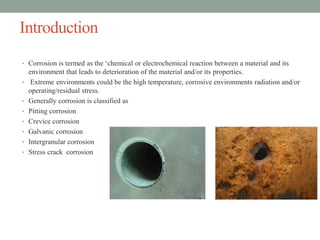
• Generally corrosion is classified as
• Pitting corrosion
• Crevice corrosion
• Galvanic corrosion
• Intergranular corrosion
• Stress crack corrosion
Literature review
 C.J.Liu et.al [1] used 4 different nickel alloys for IGT blades and studied their different
properties like hot corrosion, long term structural stability and other microstructural properties.
 Pin Lu et.al [2] used integrated computational materials approach to find the chemical
composition and microstructure of the high entropy alloys to exhibit high corrosion properties.
 Yao Qiu et.al [3] noticed that generally, in spite of complex compositions and in many cases
complicated microstructural heterogeneity, compositionally complex alloys are nominally
corrosion-resistant. This is discussed and aspects of the status and needs are presented.
 H. Nickel et.al [4] studied that the demand for improved efficiency and power output of energy
conversion systems has lead to an increase of gas inlet temperatures in modern land-based gas
turbines. Isothermal and cyclic oxidation tests were carried out in the temperature range 950°C-
1100°C on MCrAlY coatings. The effect of systematic variation of titanium and silicon
contents on oxidation and micro structural stability was studied by characterization of the
coating and the corrosion products using light and electron optical microscopy and by
secondary neutrals mass spectrometry (SNMS).
 Kirsten Bobzin [5] et.al described the wear and corrosion resistant properties of FeCrMnBC
coatings and its economical advantage and superior properties over stainless steel 316L.
 Vivekanand Kain[6] discussed the type of corrosions and types of materials which resists the
corrosion phenomena , its advantages and disadvantages.
Corrosion Resistant Metals
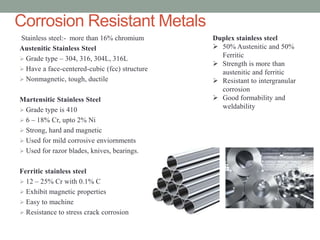
Stainless steel:- more than 16% chromium
Austenitic Stainless Steel
 Grade type – 304, 316, 304L, 316L
 Have a face-centered-cubic (fcc) structure
 Nonmagnetic, tough, ductile
Martensitic Stainless Steel
 Grade type is 410
 6 – 18% Cr, upto 2% Ni
 Strong, hard and magnetic
 Used for mild corrosive enviornments
 Used for razor blades, knives, bearings.
Ferritic stainless steel
 12 – 25% Cr with 0.1% C
 Exhibit magnetic properties
 Easy to machine
 Resistance to stress crack corrosion
Duplex stainless steel
 50% Austenitic and 50%
Ferritic
 Strength is more than
austenitic and ferritic
 Resistant to intergranular
corrosion
 Good formability and
weldability
Nickel andAluminium alloys
 Properties:
 Low density
 Higher thermal & electrical conductivities, magnetic properties
 Softness & facility of cold working
 Corrosion resistance
 Fusibility & ease of casting and fabrication
 Applications:
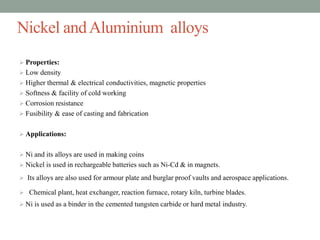
 Ni and its alloys are used in making coins
 Nickel is used in rechargeable batteries such as Ni-Cd & in magnets.
 Its alloys are also used for armour plate and burglar proof vaults and aerospace applications.
 Chemical plant, heat exchanger, reaction furnace, rotary kiln, turbine blades.
 Ni is used as a binder in the cemented tungsten carbide or hard metal industry.
Recent developments
High entropy alloys
High entropy alloys (HEAs) are systems that comprise five (but possibly more) principal metallic
elements in near equiatomic ratios, forming one or more solid solution phases.1 These alloys are
termed HEAs because they have a high entropy of mixing compared to conventional alloys, thus
notionally favoring the formation of solid solution phases.
 CALPHAD approach gives a fare chance of selecting
 The composition and structure of the materials.
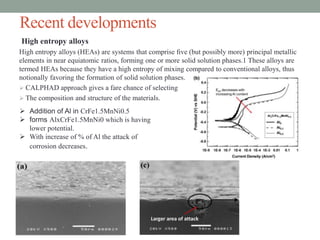
 Addition of Al in CrFe1.5MnNi0.5
 forms AlxCrFe1.5MnNi0 which is having
lower potential.
 With increase of % of Al the attack of
corrosion decreases.
Recent developments
Metal Coatings
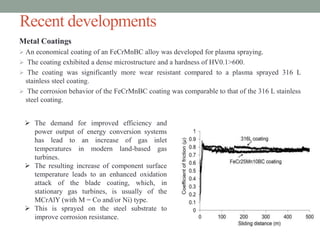
 An economical coating of an FeCrMnBC alloy was developed for plasma spraying.
 The coating exhibited a dense microstructure and a hardness of HV0.1>600.
 The coating was significantly more wear resistant compared to a plasma sprayed 316 L
stainless steel coating.
 The corrosion behavior of the FeCrMnBC coating was comparable to that of the 316 L stainless
steel coating.
 The demand for improved efficiency and
power output of energy conversion systems
has lead to an increase of gas inlet
temperatures in modern land-based gas
turbines.
 The resulting increase of component surface
temperature leads to an enhanced oxidation
attack of the blade coating, which, in
stationary gas turbines, is usually of the
MCrAlY (with M = Co and/or Ni) type.
 This is sprayed on the steel substrate to
improve corrosion resistance.
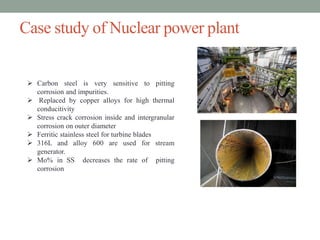
Case study of Nuclear power plant
 Carbon steel is very sensitive to pitting
corrosion and impurities.
 Replaced by copper alloys for high thermal
conducitivity
 Stress crack corrosion inside and intergranular
corrosion on outer diameter
 Ferritic stainless steel for turbine blades
 316L and alloy 600 are used for stream
generator.
 Mo% in SS decreases the rate of pitting
corrosion
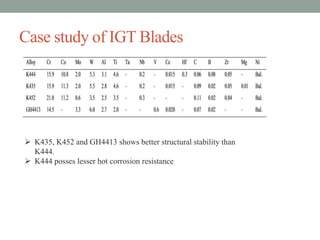
Case study of IGT Blades
 K435, K452 and GH4413 shows better structural stability than
K444.
 K444 posses lesser hot corrosion resistance
References
1. C J Liu et al., Four hot corrosion resistant materials for IGT Blades,
Elsevier, 2015
2. H Nickel et al., Development of NiCrAIY Alloys for corrosion
resistant coatings and thermal barrier coatings of gas turbine c
3. omponents, ASME November vol 121, 2009
4. Yao qiu et al, Corrosion of high entropy alloys, Materials degradation
2017
5. Pin Lu et al., Computational materials design of a corrosion resistant
high entropy alloy for harsh environments, Elsevier vol 153, pp 19-
22, 2018
6. J.R. Scully et al., Corrosion resistant metallic coatings, Materials
Today, 2008
THANK YOU

Corrosion resistant materials

  • 1.
    CORROSION RESISTANTMATERIALS FOR EXTREMEENVIRONMENTS By K.Koushik USN NO – 1RV15ME052 R.V. College of Engineering Department Of Mechanical Engineering
  • 2.
    CONTENTS • INTRODUCTION • LITERATUREREVIEW • MATERIALS REVIEW • RECENT DEVELOPMENTS • CASE STUDIES • REFERENCES
  • 3.
    Introduction • Corrosion istermed as the ‘chemical or electrochemical reaction between a material and its environment that leads to deterioration of the material and/or its properties. • Extreme environments could be the high temperature, corrosive environments radiation and/or operating/residual stress. • Generally corrosion is classified as • Pitting corrosion • Crevice corrosion • Galvanic corrosion • Intergranular corrosion • Stress crack corrosion
  • 4.
    Literature review  C.J.Liuet.al [1] used 4 different nickel alloys for IGT blades and studied their different properties like hot corrosion, long term structural stability and other microstructural properties.  Pin Lu et.al [2] used integrated computational materials approach to find the chemical composition and microstructure of the high entropy alloys to exhibit high corrosion properties.  Yao Qiu et.al [3] noticed that generally, in spite of complex compositions and in many cases complicated microstructural heterogeneity, compositionally complex alloys are nominally corrosion-resistant. This is discussed and aspects of the status and needs are presented.  H. Nickel et.al [4] studied that the demand for improved efficiency and power output of energy conversion systems has lead to an increase of gas inlet temperatures in modern land-based gas turbines. Isothermal and cyclic oxidation tests were carried out in the temperature range 950°C- 1100°C on MCrAlY coatings. The effect of systematic variation of titanium and silicon contents on oxidation and micro structural stability was studied by characterization of the coating and the corrosion products using light and electron optical microscopy and by secondary neutrals mass spectrometry (SNMS).  Kirsten Bobzin [5] et.al described the wear and corrosion resistant properties of FeCrMnBC coatings and its economical advantage and superior properties over stainless steel 316L.  Vivekanand Kain[6] discussed the type of corrosions and types of materials which resists the corrosion phenomena , its advantages and disadvantages.
  • 5.
    Corrosion Resistant Metals Stainlesssteel:- more than 16% chromium Austenitic Stainless Steel  Grade type – 304, 316, 304L, 316L  Have a face-centered-cubic (fcc) structure  Nonmagnetic, tough, ductile Martensitic Stainless Steel  Grade type is 410  6 – 18% Cr, upto 2% Ni  Strong, hard and magnetic  Used for mild corrosive enviornments  Used for razor blades, knives, bearings. Ferritic stainless steel  12 – 25% Cr with 0.1% C  Exhibit magnetic properties  Easy to machine  Resistance to stress crack corrosion Duplex stainless steel  50% Austenitic and 50% Ferritic  Strength is more than austenitic and ferritic  Resistant to intergranular corrosion  Good formability and weldability
  • 6.
    Nickel andAluminium alloys Properties:  Low density  Higher thermal & electrical conductivities, magnetic properties  Softness & facility of cold working  Corrosion resistance  Fusibility & ease of casting and fabrication  Applications:  Ni and its alloys are used in making coins  Nickel is used in rechargeable batteries such as Ni-Cd & in magnets.  Its alloys are also used for armour plate and burglar proof vaults and aerospace applications.  Chemical plant, heat exchanger, reaction furnace, rotary kiln, turbine blades.  Ni is used as a binder in the cemented tungsten carbide or hard metal industry.
  • 7.
    Recent developments High entropyalloys High entropy alloys (HEAs) are systems that comprise five (but possibly more) principal metallic elements in near equiatomic ratios, forming one or more solid solution phases.1 These alloys are termed HEAs because they have a high entropy of mixing compared to conventional alloys, thus notionally favoring the formation of solid solution phases.  CALPHAD approach gives a fare chance of selecting  The composition and structure of the materials.  Addition of Al in CrFe1.5MnNi0.5  forms AlxCrFe1.5MnNi0 which is having lower potential.  With increase of % of Al the attack of corrosion decreases.
  • 8.
    Recent developments Metal Coatings An economical coating of an FeCrMnBC alloy was developed for plasma spraying.  The coating exhibited a dense microstructure and a hardness of HV0.1>600.  The coating was significantly more wear resistant compared to a plasma sprayed 316 L stainless steel coating.  The corrosion behavior of the FeCrMnBC coating was comparable to that of the 316 L stainless steel coating.  The demand for improved efficiency and power output of energy conversion systems has lead to an increase of gas inlet temperatures in modern land-based gas turbines.  The resulting increase of component surface temperature leads to an enhanced oxidation attack of the blade coating, which, in stationary gas turbines, is usually of the MCrAlY (with M = Co and/or Ni) type.  This is sprayed on the steel substrate to improve corrosion resistance.
  • 9.
    Case study ofNuclear power plant  Carbon steel is very sensitive to pitting corrosion and impurities.  Replaced by copper alloys for high thermal conducitivity  Stress crack corrosion inside and intergranular corrosion on outer diameter  Ferritic stainless steel for turbine blades  316L and alloy 600 are used for stream generator.  Mo% in SS decreases the rate of pitting corrosion
  • 10.
    Case study ofIGT Blades  K435, K452 and GH4413 shows better structural stability than K444.  K444 posses lesser hot corrosion resistance
  • 11.
    References 1. C JLiu et al., Four hot corrosion resistant materials for IGT Blades, Elsevier, 2015 2. H Nickel et al., Development of NiCrAIY Alloys for corrosion resistant coatings and thermal barrier coatings of gas turbine c 3. omponents, ASME November vol 121, 2009 4. Yao qiu et al, Corrosion of high entropy alloys, Materials degradation 2017 5. Pin Lu et al., Computational materials design of a corrosion resistant high entropy alloy for harsh environments, Elsevier vol 153, pp 19- 22, 2018 6. J.R. Scully et al., Corrosion resistant metallic coatings, Materials Today, 2008
  • 12.