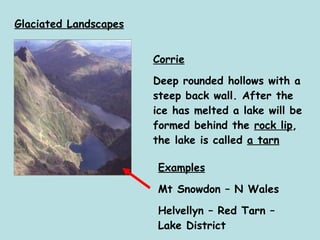
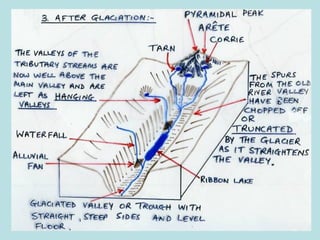
Glaciated Landscapes Corrie Deep rounded hollows with a steep back wall. After the ice has melted a lake will be formed behind the  rock lip , the lake is called  a tarn Examples Mt Snowdon – N Wales Helvellyn – Red Tarn – Lake District
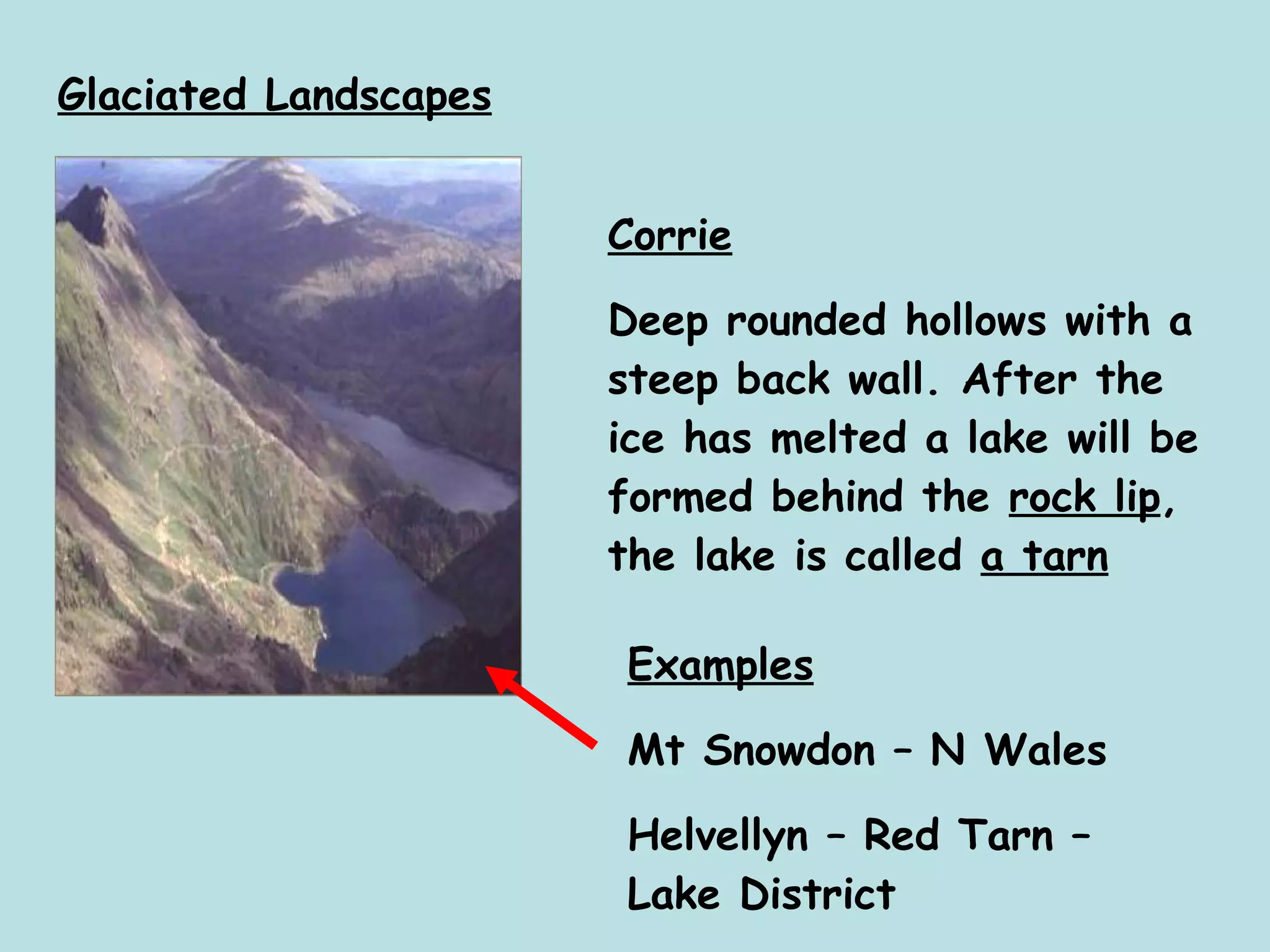
Corrie - Helvelyn - Red Tarn (Lake D) Steep back wall Tarn Rock lip
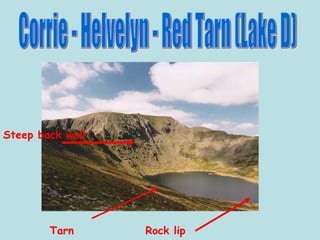
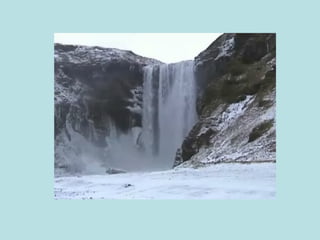
Hanging Valley During ice age smaller tributary glaciers joined with larger ones in the main valley. Glaciers in the main valley eroded more deeply When ice melts smaller valleys left at a higher level. Tributary streams descend to the main valley via a waterfall.
 
 
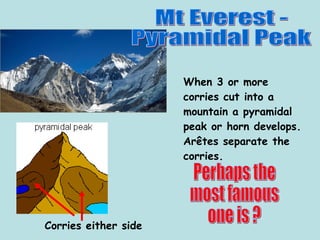
Mt Everest -  Pyramidal Peak Corries either side When 3 or more corries cut into a mountain a pyramidal peak or horn develops. Arêtes separate the corries. Perhaps the  most famous  one is ?
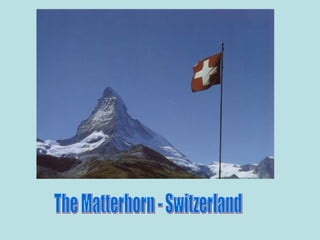
The Matterhorn - Switzerland
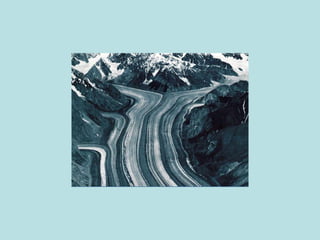
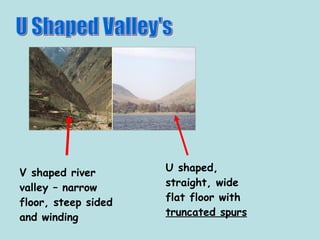
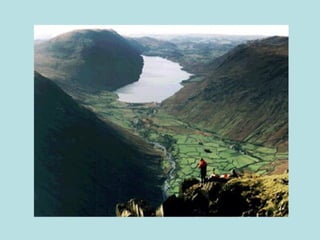
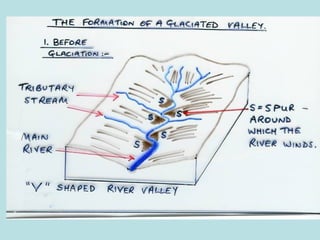
U Shaped Valley's V shaped river valley – narrow floor, steep sided and winding U shaped, straight, wide flat floor with  truncated spurs
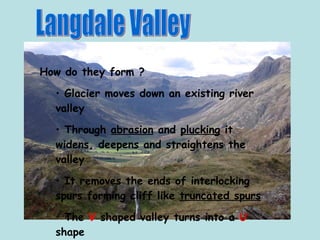
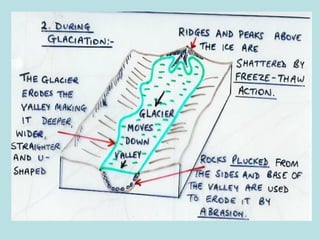
Langdale Valley How do they form ? Glacier moves down an existing river valley Through  abrasion  and  plucking  it widens, deepens and straightens the valley It removes the ends of interlocking spurs forming cliff like  truncated spurs The  V  shaped valley turns into a  U  shape
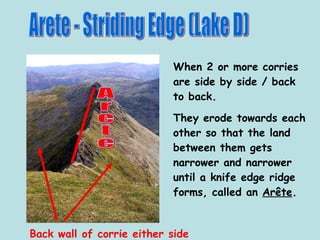
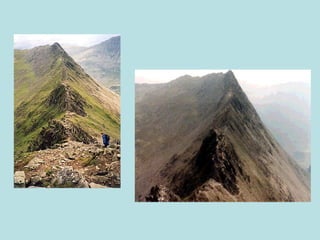
Arete - Striding Edge (Lake D) When 2 or more corries are side by side / back to back. They erode towards each other so that the land between them gets narrower and narrower until a knife edge ridge forms, called an  Arête .  Back wall of corrie either side Arete
 
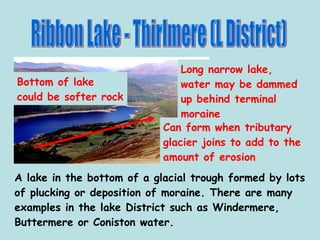
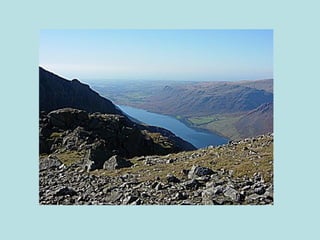
Ribbon Lake - Thirlmere (L District) A lake in the bottom of a glacial trough formed by lots of plucking or deposition of moraine. There are many examples in the lake District such as Windermere, Buttermere or Coniston water. Long narrow lake, water may be dammed up behind terminal moraine Bottom of lake could be softer rock Can form when tributary glacier joins to add to the amount of erosion


Glaciated Landforms

  • 1.
    Glaciated Landscapes CorrieDeep rounded hollows with a steep back wall. After the ice has melted a lake will be formed behind the rock lip , the lake is called a tarn Examples Mt Snowdon – N Wales Helvellyn – Red Tarn – Lake District
  • 2.
    Corrie - Helvelyn- Red Tarn (Lake D) Steep back wall Tarn Rock lip
  • 3.
    Hanging Valley Duringice age smaller tributary glaciers joined with larger ones in the main valley. Glaciers in the main valley eroded more deeply When ice melts smaller valleys left at a higher level. Tributary streams descend to the main valley via a waterfall.
  • 4.
  • 5.
  • 6.
    Mt Everest - Pyramidal Peak Corries either side When 3 or more corries cut into a mountain a pyramidal peak or horn develops. Arêtes separate the corries. Perhaps the most famous one is ?
  • 7.
    The Matterhorn -Switzerland
  • 8.
    U Shaped Valley'sV shaped river valley – narrow floor, steep sided and winding U shaped, straight, wide flat floor with truncated spurs
  • 9.
    Langdale Valley Howdo they form ? Glacier moves down an existing river valley Through abrasion and plucking it widens, deepens and straightens the valley It removes the ends of interlocking spurs forming cliff like truncated spurs The V shaped valley turns into a U shape
  • 10.
    Arete - StridingEdge (Lake D) When 2 or more corries are side by side / back to back. They erode towards each other so that the land between them gets narrower and narrower until a knife edge ridge forms, called an Arête . Back wall of corrie either side Arete
  • 11.
  • 12.
    Ribbon Lake -Thirlmere (L District) A lake in the bottom of a glacial trough formed by lots of plucking or deposition of moraine. There are many examples in the lake District such as Windermere, Buttermere or Coniston water. Long narrow lake, water may be dammed up behind terminal moraine Bottom of lake could be softer rock Can form when tributary glacier joins to add to the amount of erosion
  • 13.
  • 14.
  • 15.
  • 16.
  • 17.
  • 18.