Giving Effective Feedback
Honey Patel
Importance of Feedback
Feedback helps achieve goals,
build confidence and pride, and
succeed!
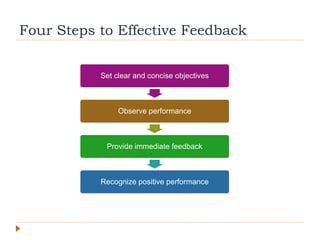
Four Steps to Effective Feedback
Set clear and concise objectives
Observe performance
Provide immediate feedback
Recognize positive performance
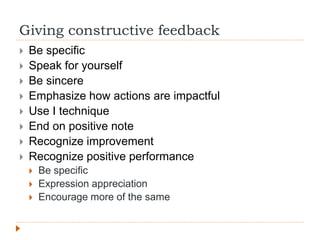
Giving constructive feedback
 Be specific
 Speak for yourself
 Be sincere
 Emphasize how actions are impactful
 Use I technique
 End on positive note
 Recognize improvement
 Recognize positive performance
 Be specific
 Expression appreciation
 Encourage more of the same
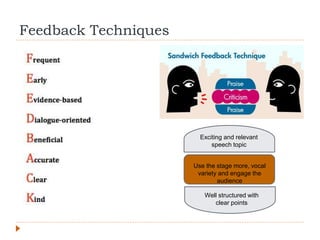
Feedback Techniques
Exciting and relevant
speech topic
Well structured with
clear points
Use the stage more, vocal
variety and engage the
audience
Conclusion
Providing meaningful feedback
reinforces outstanding
performance and encourages
improvement.

Giving effective feedback

Editor's Notes

  • #3 Feedback helps with ‘improvement’. At toastmaster, we give each other feedback help us be better communicators and leaders. In the workplace, our managers give us feedback to be better at our job. Customers give companies feedback to improve their products and services.
  • #4 Speech projects have objectives. Annual goals/objectives are set in workplace. Personally, you can set goals.
  • #6 1. Everyone Needs Feedback. Yes, including you. 2. Be Specific. If your feedback is general or unclear, it can be misinterpreted and that is the last thing that you want to happen. 3. Speak for yourself. PLEASE avoid speaking for others. Typically people hide behind this when they don’t have the courage to speak for themselves. 4. Don’t make it personal. Giving feedback is not an opportunity to share your personal feelings or to attack your teammates. 5. Be sincere Express how your team members’ actions affect the group and give specific examples. 6. Use the “I” technique Avoid saying “you”. This technique keeps the other person from becoming defensive and allows for more open and authentic communication. 7. Ask permission This will ensure that the person is ready and willing to receive feedback from you. 8. Keep it private Whatever you do, do not give feedback in a public setting! It’s embarrassing and unprofessional and your feedback will fall on deaf ears. 9. End on a positive note Express confidence in your team member and his or her ability to improve. 10. Think of giving feedback as giving a gift Feedback gives the recipient the opportunity to get positive insight about what they are doing well and gain understanding about what they are not doing well in order to improve.