feedback
helping people and organisations learn faster
Eric Brooke, version 11
“It is easy to be honest in your head. But you are not
actually honest if you do not express it.”
“The core of an organizations culture is how the
people interact with each other”
“The core of a relationship is how the people
interact with each other”
• Feedback is essential between two friends, in a
marriage, or with work colleagues
• It often does not happen because we want people to
like us
• Overtime if not given, can create a
relationship/culture of non-communication until
someone loses it
What is it?
– Bill Gates
“We all need people who will give us feedback.
That's how we improve.”
• Encourages open dialogue
• It is part of any relationship and it occurs every day
• It provides guidance and encouragement
• Everyone giving and receiving, hierarchy is
irrelevant
• It always has a real example
• It can be positive or a growth opportunity
• It is when you saw something, that you think could
be better
• When you want to praise that person for something
you saw
• It is objective
• It is constructive and useful
• It is without judgement
What is it NOT?
• Policy and procedure enforcement
• Disciplinary action
• An opportunity to vent emotions
• Telling someone they are wrong
• A list of everything this person has done wrong
• You telling everyone else’s opinion i.e. we feel
• You giving your opinion from across the room
Feedback Map Exercise
Write down the name of everyone you work
with and put a tick next to them if you have
given positive or growth feedback
When to use it?
– Assegid Habtewold
“The people who care about you may not tell you
your blind spots fearing to offend/hurt you.
Open up and ask their feedback and get
enlightened.”
• We can identify a behaviour that has an impact on
another human e.g. employee or customer
• The behaviour is something we can see or hear
• You have seen or heard the behaviour
• It is something a person can control
• It is one thing, not a list
Types of Feedback
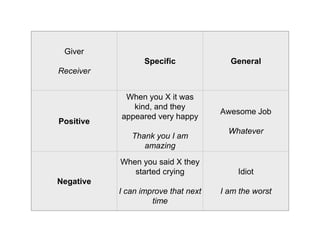
Giver
Receiver
Specific General
Positive
When you X it was
kind, and they
appeared very happy
Thank you I am
amazing
Awesome Job
Whatever
Negative
When you said X they
started crying
I can improve that next
time
Idiot
I am the worst
• Be specific NOT general with your feedback
• Providing specific examples helps the recipient
understand exactly what the issue is
• Specific is more likely to have a lasting impact
• You can then agree on the details and work on
targeted solutions
Timing
• Immediate rather than delayed
• It should be given as soon after the event as
feasible
• Ask permission before giving
• It is OK for them say not now and delay to another
time
• Don't save it up for the formal performance review.
Emotion
Take your emotion out of the equation
• Don't give feedback if you are angry or upset
• Wait until you have cooled off and can be calm and
objective about the issue
• Is this actually your issue not theirs?
How you process information is very important
• What is your learning style?
• How do you cope with stress?
• What is theirs?
• Feedback may take time to be processed by the
person receiving it
Be kind but not nice
Being kind is fundamentally about taking responsibility
for your impact on the people around you. It requires
you be mindful of their feelings and considerate of the
way your presence affects them.
http://boz.com/articles/be-kind.html
Receiving Feedback
– Wayne W. Dyer
“How people treat you is their karma; how you
react is yours.”
• Our culture, relationship with parents and teachers all
impact on how good we are at receiving feedback
• We all have baggage, we all have triggers
• We are all defensive internally
• It is how we manage the defences, that helps be cool
under fire
• We all need time to process it and take it onboard
• Understand your process for receiving feedback
Receiving Feedback Exercise
Write Down - How do you like to receive feedback?
Questions to consider
Consider the feedback before giving it
• What did you observe in your co-worker’s behaviour?
• What kind of positive or negative impact does the
behaviour have?
• How would you position the feedback?
• What specific feedback would you provide?
• How would you end the interaction?
• Is this about you? and not them?
William S. Burroughs
“There are no innocent bystanders”
What are the steps
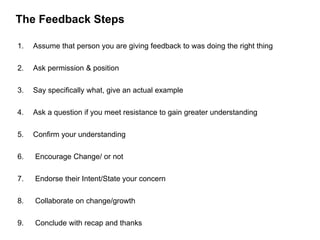
The Feedback Steps
1. Assume that person you are giving feedback to was doing the right thing
2. Ask permission & position
3. Say specifically what, give an actual example
4. Ask a question if you meet resistance to gain greater understanding
5. Confirm your understanding
6. Encourage Change/ or not
7. Endorse their Intent/State your concern
8. Collaborate on change/growth
9. Conclude with recap and thanks
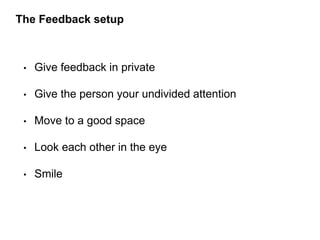
• Give feedback in private
• Give the person your undivided attention
• Move to a good space
• Look each other in the eye
• Smile
The Feedback setup
1. Assume that person you are giving feedback to was
doing the right thing
2. Position and Ask Permission
I overheard your conversation with your customer
and I have some feedback if you have a moment. Is
this a good time
Yes, this is a good time
3. Say specifically what, give an example
Describing what I observed (Objective)
I saw you help the customer with their issue. I was
surprised with how fast you spoke to the
customer. It seemed like you were rushing, and
the customer had more questions
I was trying to wrap up quickly so I could get back
from lunch on time
• Focus on behaviour not the person
Describe versus evaluate
Avoid expressing judgements
Avoid assumptions
Avoid conclusions about peoples’ motives
4. Ask a question if you meet resistance to gain
greater understanding
Resistance to growth opportunities
We all have defence mechanisms that come into play when hearing any
form of criticism e.g. Distraction/Deflection/Defensiveness
• No! you are wrong
• I like your hair today or you are looking sexy
• I don’t care
• Sorry I don’t remember
• Freezing
• Stuck in a loop
• You know X is a really not a good fit here
Write Down - How do you resist feedback?
If you meet resistance/defence mechanisms:
• Ask a question
• Finish giving the feedback
• Offer to discuss it again if they want to later
5.Confirm your understanding
I see. You were concerned about going to lunch
late, so you tried to move quickly to resolve the
customers issue
yes
6. Encourage Change/ or not
7.Endorse their Intent/State Your Concern
I can see that you wanted to respect your
colleagues time, by going on break as scheduled.
My concern is that the customer seemed confused
and unhappy. What else could you have done to
give the customer a great experience and ensure
colleagues went to lunch on time.
I could have communicated my situation with my
colleagues and warmly transferred the customer.
8.Collaborate on change/growth
You’re right - that’s a good idea I’ll make sure I’m
available for that kind of help.
Thanks
• Behaviour takes time to change
• It may take a number of interventions
9.Conclude with recap and thanks
Thanks for listening to the feedback. In the future,
please make sure to tell me if you need help rather
than work too quickly with a customer
Thanks for giving it!
Signs that you should
have already given
feedback
• If you are bitching/complaining about it to someone
else
• If you are avoiding talking to that person
• If you feel frustrated or angry
• If you cannot stop thinking about it
• When you know you are making assumptions about
why and start explaining it away, apologizing for it or
defining the behaviours involved
Bigger Picture
Feedback Strategy
or how to maintain a relationship
Eric Brooke
“Build a relationship before you have to test it”
• Maintain the relationship versus indulge in self-
serving behaviour e.g. being liked, promotion
• When was the last time you gave positive feedback?
• Telling people positive feedback now, makes it
easier when giving a growth opportunity later
• If you are only giving growth opportunities you will
lose credibility with that person
• Get to know them
• Understand how they like to receive feedback
• Learn how they process information
• Learn how they process emotion
• Learn how they handle stress
• Build trust
– Confucius
“When you see a good person, think of
becoming like her/him. When you see someone
not so good, reflect on your own weak points.”
Toxic archetypes
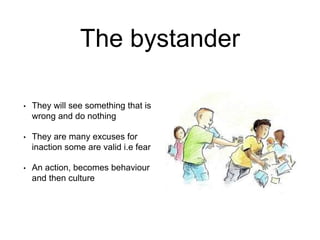
The bystander
• They will see something that is
wrong and do nothing
• They are many excuses for
inaction some are valid i.e fear
• An action, becomes behaviour
and then culture
– Albert Einstein
“The world is a dangerous place, not because of
those who do evil, but because of those who
look on and do nothing.”
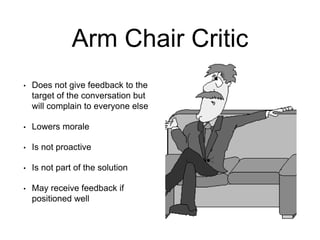
Arm Chair Critic
• Does not give feedback to the
target of the conversation but
will complain to everyone else
• Lowers morale
• Is not proactive
• Is not part of the solution
• May receive feedback if
positioned well
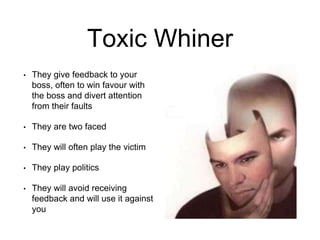
Toxic Whiner
• They give feedback to your
boss, often to win favour with
the boss and divert attention
from their faults
• They are two faced
• They will often play the victim
• They play politics
• They will avoid receiving
feedback and will use it against
you
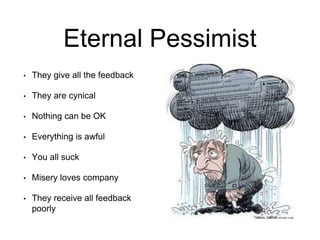
Eternal Pessimist
• They give all the feedback
• They are cynical
• Nothing can be OK
• Everything is awful
• You all suck
• Misery loves company
• They receive all feedback
poorly
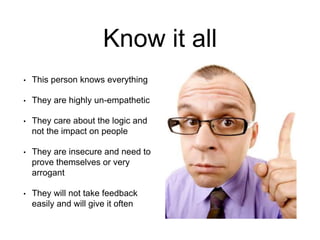
Know it all
• This person knows everything
• They are highly un-empathetic
• They care about the logic and
not the impact on people
• They are insecure and need to
prove themselves or very
arrogant
• They will not take feedback
easily and will give it often
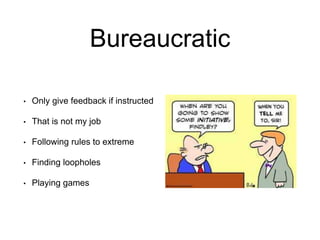
Bureaucratic
• Only give feedback if instructed
• That is not my job
• Following rules to extreme
• Finding loopholes
• Playing games
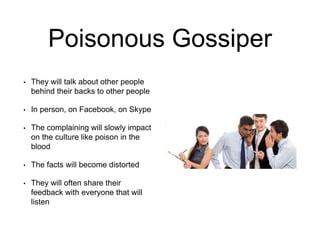
Poisonous Gossiper
• They will talk about other people
behind their backs to other people
• In person, on Facebook, on Skype
• The complaining will slowly impact
on the culture like poison in the
blood
• The facts will become distorted
• They will often share their
feedback with everyone that will
listen
Postitive archetypes
Open Book
• They are totally transparent
• You know what they are
thinking because they share
• They are vulnerable with you
• Helps other people make better
decisions
• Will give feedback and will
receive feedback
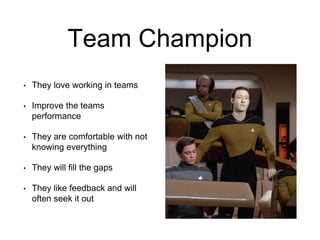
Team Champion
• They love working in teams
• Improve the teams
performance
• They are comfortable with not
knowing everything
• They will fill the gaps
• They like feedback and will
often seek it out
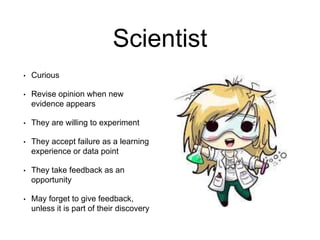
Scientist
• Curious
• Revise opinion when new
evidence appears
• They are willing to experiment
• They accept failure as a learning
experience or data point
• They take feedback as an
opportunity
• May forget to give feedback,
unless it is part of their discovery
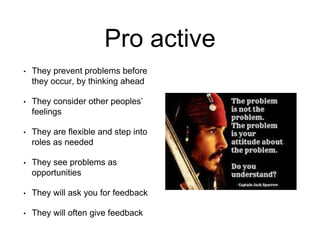
Pro active
• They prevent problems before
they occur, by thinking ahead
• They consider other peoples’
feelings
• They are flexible and step into
roles as needed
• They see problems as
opportunities
• They will ask you for feedback
• They will often give feedback
Exercises
• Everyone should know how they want receive
feedback
• Everyone should know how others want to receive
feedback
• Everyone should become aware of how they resist
feedback
Goals
• Write down how each person wants to receive
feedback
• Write down how others want to receive feedback
• Write down how they resist feedback
• Role play ongoing issues in the company - 2 per
person
Examples:
• When I am on the phone please can you reduce your volume so my
client can hear me?
• Why do I have to do feedback training and I often give to their face!
• Do you mind clearing the cups up after you have used them?
• Why do you have to bitch about B.O. behind my back, why not come
talk to me direct?
• Can you put the toilet seat down after peeing?
• When I come home from work, please can you not launch into a list
of everything I have not done?
Instructor Comments
• Note who gives feedback on a regularly basis both positive and growth
oriented
• The people most resistant to the training maybe scared of feedback
particularly the receiving of feedback, who may surprise you
• Some people will be very conflict adverse yet passive aggressive, manage
them i.e. call them out
• Some people are just shy, draw them out
• People who spend social time together are far much more likely to give
feedback
• Certain cultures can be adverse to giving feedback to other groups i.e.
leaders, male/female - research before
• Discover ongoing issues in team/company and use these as examples to
roleplay
• You need people comfortable in giving feedback to show others how to do it
in the roleplay sessions
FAQ
Giving feedback to my boss is hard
• Ask the boss how they like to receive feedback
• Support ideas growth to a point and explore the idea
• Choose your battles
• Balance positive with growth opportunities
• “Plans fail when there is no counsel, but with many advisers
they succeed.” Proverbs 15:22
• kill the messenger - if your boss kills the messenger get
another boss
Impact on personal life
• Share with your partner what you learned about
feedback
• Ask and understand how they like to receive
feedback
• Share how you like to receive feedback
• Start with the small things
Defense Mechanisms
• Denial - a person who is a functioning alcoholic will often simply deny they have a drinking problem, pointing to
how well they function in their job and relationships.
• Regression - An adult may regress when under a great deal of stress, refusing to leave their bed and engage in
normal, everyday activities.
• Acting Out - a child’s temper tantrum is a form of acting out when he or she doesn’t get his or her way with a
parent.
• Dissociation - People who use dissociation often have a disconnected view of themselves in their world. Time
and their own self-image may not flow continuously, as it does for most people.
• Compartmentalization - an honest person who cheats on their tax return and keeps their two value systems
distinct and un-integrated while remaining unconscious of the cognitive dissonance.
• Projection - a partner may be angry at their significant other for not listening, when in fact it is the angry partner
who does not listen.
• Reaction Formation - a woman who is very angry with her boss and would like to quit her job may instead be
overly kind and generous toward her boss and express a desire to keep working there forever.
• Repression - “Repressed memories” are memories that have been unconsciously blocked from access or view.
• Displacement - he man who gets angry at his boss, but can’t express his anger to his boss for fear of being fired.
He instead comes home and kicks the dog or starts an argument with his wife. The man is redirecting his anger
from his boss to his dog or wife.
• Assertiveness - People who are assertive strike a balance where they speak up for themselves, express their
opinions or needs in a respectful yet firm manner, and listen when they are being spoken to.
• Intellectualization - a person who has just been given a terminal medical
diagnosis, instead of expressing their sadness and grief, focuses instead on the
details of all possible fruitless medical procedures.
• Rationalization - a woman who starts dating a man she really, really likes and
thinks the world of is suddenly dumped by the man for no reason. She reframes
the situation in her mind with, “I suspected he was a loser all along.”
• Undoing - after realizing you just insulted your significant other unintentionally,
you might spend then next hour praising their beauty, charm and intellect.
• Sublimation - when a person has sexual impulses they would like not to act
upon, they may instead focus on rigorous exercise. Refocusing such
unacceptable or harmful impulses into productive use helps a person channel
energy that otherwise would be lost or used in a manner that might cause the
person more anxiety.
• Compensation - when a person says, “I may not know how to cook, but I can
sure do the dishes!,” they’re trying to compensate for their lack of cooking skills
by emphasizing their cleaning skills instead.
– Eric Brooke
“It is easy to be honest in your head. But you
are not actually honest if you do not express it.”
Feedback Summary
1. Humans need feedback to evolve
2. Ask for permission, in private and focused
3. State the facts
4. Ask questions to understand
5. Confirm what you understand
6. Be kind not nice
7. Consider future solutions together
8. Change can take time be patient
9. Remember to give both positive and growth feedback

Feedback

  • 1.
    feedback helping people andorganisations learn faster Eric Brooke, version 11 “It is easy to be honest in your head. But you are not actually honest if you do not express it.”
  • 2.
    “The core ofan organizations culture is how the people interact with each other”
  • 3.
    “The core ofa relationship is how the people interact with each other”
  • 4.
    • Feedback isessential between two friends, in a marriage, or with work colleagues • It often does not happen because we want people to like us • Overtime if not given, can create a relationship/culture of non-communication until someone loses it
  • 5.
  • 6.
    – Bill Gates “Weall need people who will give us feedback. That's how we improve.”
  • 7.
    • Encourages opendialogue • It is part of any relationship and it occurs every day • It provides guidance and encouragement • Everyone giving and receiving, hierarchy is irrelevant • It always has a real example
  • 8.
    • It canbe positive or a growth opportunity • It is when you saw something, that you think could be better • When you want to praise that person for something you saw • It is objective • It is constructive and useful • It is without judgement
  • 9.
  • 10.
    • Policy andprocedure enforcement • Disciplinary action • An opportunity to vent emotions • Telling someone they are wrong • A list of everything this person has done wrong • You telling everyone else’s opinion i.e. we feel • You giving your opinion from across the room
  • 11.
    Feedback Map Exercise Writedown the name of everyone you work with and put a tick next to them if you have given positive or growth feedback
  • 12.
  • 13.
    – Assegid Habtewold “Thepeople who care about you may not tell you your blind spots fearing to offend/hurt you. Open up and ask their feedback and get enlightened.”
  • 14.
    • We canidentify a behaviour that has an impact on another human e.g. employee or customer • The behaviour is something we can see or hear • You have seen or heard the behaviour • It is something a person can control • It is one thing, not a list
  • 15.
  • 16.
    Giver Receiver Specific General Positive When youX it was kind, and they appeared very happy Thank you I am amazing Awesome Job Whatever Negative When you said X they started crying I can improve that next time Idiot I am the worst
  • 17.
    • Be specificNOT general with your feedback • Providing specific examples helps the recipient understand exactly what the issue is • Specific is more likely to have a lasting impact • You can then agree on the details and work on targeted solutions
  • 18.
  • 19.
    • Immediate ratherthan delayed • It should be given as soon after the event as feasible • Ask permission before giving • It is OK for them say not now and delay to another time • Don't save it up for the formal performance review.
  • 20.
  • 21.
    Take your emotionout of the equation • Don't give feedback if you are angry or upset • Wait until you have cooled off and can be calm and objective about the issue • Is this actually your issue not theirs?
  • 22.
    How you processinformation is very important • What is your learning style? • How do you cope with stress? • What is theirs? • Feedback may take time to be processed by the person receiving it
  • 23.
    Be kind butnot nice Being kind is fundamentally about taking responsibility for your impact on the people around you. It requires you be mindful of their feelings and considerate of the way your presence affects them. http://boz.com/articles/be-kind.html
  • 24.
  • 25.
    – Wayne W.Dyer “How people treat you is their karma; how you react is yours.”
  • 26.
    • Our culture,relationship with parents and teachers all impact on how good we are at receiving feedback • We all have baggage, we all have triggers • We are all defensive internally • It is how we manage the defences, that helps be cool under fire • We all need time to process it and take it onboard • Understand your process for receiving feedback
  • 27.
    Receiving Feedback Exercise WriteDown - How do you like to receive feedback?
  • 28.
  • 29.
    Consider the feedbackbefore giving it • What did you observe in your co-worker’s behaviour? • What kind of positive or negative impact does the behaviour have? • How would you position the feedback? • What specific feedback would you provide? • How would you end the interaction? • Is this about you? and not them?
  • 30.
    William S. Burroughs “Thereare no innocent bystanders”
  • 31.
  • 32.
    The Feedback Steps 1.Assume that person you are giving feedback to was doing the right thing 2. Ask permission & position 3. Say specifically what, give an actual example 4. Ask a question if you meet resistance to gain greater understanding 5. Confirm your understanding 6. Encourage Change/ or not 7. Endorse their Intent/State your concern 8. Collaborate on change/growth 9. Conclude with recap and thanks
  • 33.
    • Give feedbackin private • Give the person your undivided attention • Move to a good space • Look each other in the eye • Smile The Feedback setup
  • 34.
    1. Assume thatperson you are giving feedback to was doing the right thing
  • 35.
    2. Position andAsk Permission I overheard your conversation with your customer and I have some feedback if you have a moment. Is this a good time Yes, this is a good time
  • 36.
    3. Say specificallywhat, give an example Describing what I observed (Objective) I saw you help the customer with their issue. I was surprised with how fast you spoke to the customer. It seemed like you were rushing, and the customer had more questions I was trying to wrap up quickly so I could get back from lunch on time
  • 37.
    • Focus onbehaviour not the person Describe versus evaluate Avoid expressing judgements Avoid assumptions Avoid conclusions about peoples’ motives
  • 38.
    4. Ask aquestion if you meet resistance to gain greater understanding
  • 39.
    Resistance to growthopportunities We all have defence mechanisms that come into play when hearing any form of criticism e.g. Distraction/Deflection/Defensiveness • No! you are wrong • I like your hair today or you are looking sexy • I don’t care • Sorry I don’t remember • Freezing • Stuck in a loop • You know X is a really not a good fit here
  • 40.
    Write Down -How do you resist feedback?
  • 41.
    If you meetresistance/defence mechanisms: • Ask a question • Finish giving the feedback • Offer to discuss it again if they want to later
  • 42.
    5.Confirm your understanding Isee. You were concerned about going to lunch late, so you tried to move quickly to resolve the customers issue yes
  • 43.
  • 44.
    7.Endorse their Intent/StateYour Concern I can see that you wanted to respect your colleagues time, by going on break as scheduled. My concern is that the customer seemed confused and unhappy. What else could you have done to give the customer a great experience and ensure colleagues went to lunch on time. I could have communicated my situation with my colleagues and warmly transferred the customer.
  • 45.
    8.Collaborate on change/growth You’reright - that’s a good idea I’ll make sure I’m available for that kind of help. Thanks
  • 46.
    • Behaviour takestime to change • It may take a number of interventions
  • 47.
    9.Conclude with recapand thanks Thanks for listening to the feedback. In the future, please make sure to tell me if you need help rather than work too quickly with a customer Thanks for giving it!
  • 48.
    Signs that youshould have already given feedback
  • 49.
    • If youare bitching/complaining about it to someone else • If you are avoiding talking to that person • If you feel frustrated or angry • If you cannot stop thinking about it • When you know you are making assumptions about why and start explaining it away, apologizing for it or defining the behaviours involved
  • 50.
    Bigger Picture Feedback Strategy orhow to maintain a relationship
  • 51.
    Eric Brooke “Build arelationship before you have to test it”
  • 52.
    • Maintain therelationship versus indulge in self- serving behaviour e.g. being liked, promotion • When was the last time you gave positive feedback? • Telling people positive feedback now, makes it easier when giving a growth opportunity later • If you are only giving growth opportunities you will lose credibility with that person
  • 53.
    • Get toknow them • Understand how they like to receive feedback • Learn how they process information • Learn how they process emotion • Learn how they handle stress • Build trust
  • 54.
    – Confucius “When yousee a good person, think of becoming like her/him. When you see someone not so good, reflect on your own weak points.”
  • 55.
  • 56.
    The bystander • Theywill see something that is wrong and do nothing • They are many excuses for inaction some are valid i.e fear • An action, becomes behaviour and then culture
  • 57.
    – Albert Einstein “Theworld is a dangerous place, not because of those who do evil, but because of those who look on and do nothing.”
  • 58.
    Arm Chair Critic •Does not give feedback to the target of the conversation but will complain to everyone else • Lowers morale • Is not proactive • Is not part of the solution • May receive feedback if positioned well
  • 59.
    Toxic Whiner • Theygive feedback to your boss, often to win favour with the boss and divert attention from their faults • They are two faced • They will often play the victim • They play politics • They will avoid receiving feedback and will use it against you
  • 60.
    Eternal Pessimist • Theygive all the feedback • They are cynical • Nothing can be OK • Everything is awful • You all suck • Misery loves company • They receive all feedback poorly
  • 61.
    Know it all •This person knows everything • They are highly un-empathetic • They care about the logic and not the impact on people • They are insecure and need to prove themselves or very arrogant • They will not take feedback easily and will give it often
  • 62.
    Bureaucratic • Only givefeedback if instructed • That is not my job • Following rules to extreme • Finding loopholes • Playing games
  • 63.
    Poisonous Gossiper • Theywill talk about other people behind their backs to other people • In person, on Facebook, on Skype • The complaining will slowly impact on the culture like poison in the blood • The facts will become distorted • They will often share their feedback with everyone that will listen
  • 64.
  • 65.
    Open Book • Theyare totally transparent • You know what they are thinking because they share • They are vulnerable with you • Helps other people make better decisions • Will give feedback and will receive feedback
  • 66.
    Team Champion • Theylove working in teams • Improve the teams performance • They are comfortable with not knowing everything • They will fill the gaps • They like feedback and will often seek it out
  • 67.
    Scientist • Curious • Reviseopinion when new evidence appears • They are willing to experiment • They accept failure as a learning experience or data point • They take feedback as an opportunity • May forget to give feedback, unless it is part of their discovery
  • 68.
    Pro active • Theyprevent problems before they occur, by thinking ahead • They consider other peoples’ feelings • They are flexible and step into roles as needed • They see problems as opportunities • They will ask you for feedback • They will often give feedback
  • 69.
  • 70.
    • Everyone shouldknow how they want receive feedback • Everyone should know how others want to receive feedback • Everyone should become aware of how they resist feedback Goals
  • 71.
    • Write downhow each person wants to receive feedback • Write down how others want to receive feedback • Write down how they resist feedback • Role play ongoing issues in the company - 2 per person
  • 72.
    Examples: • When Iam on the phone please can you reduce your volume so my client can hear me? • Why do I have to do feedback training and I often give to their face! • Do you mind clearing the cups up after you have used them? • Why do you have to bitch about B.O. behind my back, why not come talk to me direct? • Can you put the toilet seat down after peeing? • When I come home from work, please can you not launch into a list of everything I have not done?
  • 73.
  • 74.
    • Note whogives feedback on a regularly basis both positive and growth oriented • The people most resistant to the training maybe scared of feedback particularly the receiving of feedback, who may surprise you • Some people will be very conflict adverse yet passive aggressive, manage them i.e. call them out • Some people are just shy, draw them out • People who spend social time together are far much more likely to give feedback • Certain cultures can be adverse to giving feedback to other groups i.e. leaders, male/female - research before • Discover ongoing issues in team/company and use these as examples to roleplay • You need people comfortable in giving feedback to show others how to do it in the roleplay sessions
  • 75.
  • 76.
    Giving feedback tomy boss is hard • Ask the boss how they like to receive feedback • Support ideas growth to a point and explore the idea • Choose your battles • Balance positive with growth opportunities • “Plans fail when there is no counsel, but with many advisers they succeed.” Proverbs 15:22 • kill the messenger - if your boss kills the messenger get another boss
  • 77.
    Impact on personallife • Share with your partner what you learned about feedback • Ask and understand how they like to receive feedback • Share how you like to receive feedback • Start with the small things
  • 78.
    Defense Mechanisms • Denial- a person who is a functioning alcoholic will often simply deny they have a drinking problem, pointing to how well they function in their job and relationships. • Regression - An adult may regress when under a great deal of stress, refusing to leave their bed and engage in normal, everyday activities. • Acting Out - a child’s temper tantrum is a form of acting out when he or she doesn’t get his or her way with a parent. • Dissociation - People who use dissociation often have a disconnected view of themselves in their world. Time and their own self-image may not flow continuously, as it does for most people. • Compartmentalization - an honest person who cheats on their tax return and keeps their two value systems distinct and un-integrated while remaining unconscious of the cognitive dissonance. • Projection - a partner may be angry at their significant other for not listening, when in fact it is the angry partner who does not listen. • Reaction Formation - a woman who is very angry with her boss and would like to quit her job may instead be overly kind and generous toward her boss and express a desire to keep working there forever. • Repression - “Repressed memories” are memories that have been unconsciously blocked from access or view. • Displacement - he man who gets angry at his boss, but can’t express his anger to his boss for fear of being fired. He instead comes home and kicks the dog or starts an argument with his wife. The man is redirecting his anger from his boss to his dog or wife. • Assertiveness - People who are assertive strike a balance where they speak up for themselves, express their opinions or needs in a respectful yet firm manner, and listen when they are being spoken to.
  • 79.
    • Intellectualization -a person who has just been given a terminal medical diagnosis, instead of expressing their sadness and grief, focuses instead on the details of all possible fruitless medical procedures. • Rationalization - a woman who starts dating a man she really, really likes and thinks the world of is suddenly dumped by the man for no reason. She reframes the situation in her mind with, “I suspected he was a loser all along.” • Undoing - after realizing you just insulted your significant other unintentionally, you might spend then next hour praising their beauty, charm and intellect. • Sublimation - when a person has sexual impulses they would like not to act upon, they may instead focus on rigorous exercise. Refocusing such unacceptable or harmful impulses into productive use helps a person channel energy that otherwise would be lost or used in a manner that might cause the person more anxiety. • Compensation - when a person says, “I may not know how to cook, but I can sure do the dishes!,” they’re trying to compensate for their lack of cooking skills by emphasizing their cleaning skills instead.
  • 80.
    – Eric Brooke “Itis easy to be honest in your head. But you are not actually honest if you do not express it.”
  • 81.
    Feedback Summary 1. Humansneed feedback to evolve 2. Ask for permission, in private and focused 3. State the facts 4. Ask questions to understand 5. Confirm what you understand 6. Be kind not nice 7. Consider future solutions together 8. Change can take time be patient 9. Remember to give both positive and growth feedback