
Communication Best Practices
                     or…
   “Everything I know about communication I
            learned the hard way.”


                                  Evelyn Jenkinson
                 Director, Employee Communications
                 Western Connecticut Health Network
                                       February 2013
Communication Best Practices
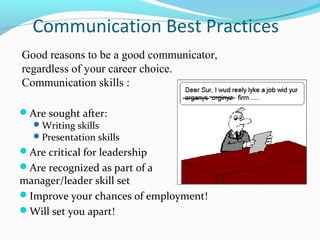
Good reasons to be a good communicator,
regardless of your career choice.
Communication skills :

Are sought after:
   Writing skills
   Presentation skills
Are critical for leadership
Are recognized as part of a
manager/leader skill set
Improve your chances of employment!
Will set you apart!
Communication Best Practices
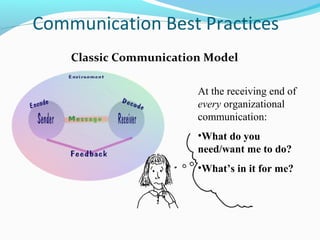
    Classic Communication Model

                        At the receiving end of
                        every organizational
                        communication:
                        •What do you
                        need/want me to do?
                        •What’s in it for me?
Communication Best Practices


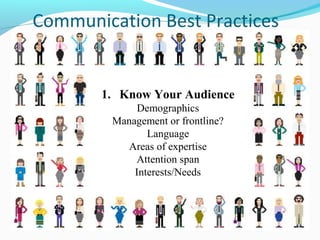
       1. Know Your Audience
              Demographics
         Management or frontline?
                Language
            Areas of expertise
             Attention span
             Interests/Needs
Communication Best Practices
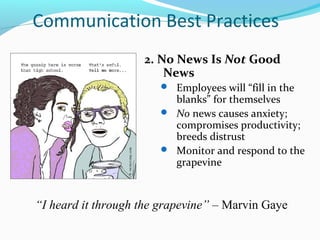
                    2. No News Is Not Good
                        News
                        Employees will “fill in the
                         blanks” for themselves
                        No news causes anxiety;
                         compromises productivity;
                         breeds distrust
                        Monitor and respond to the
                         grapevine


“I heard it through the grapevine” – Marvin Gaye
Communication Best Practices
            3. Keep the “Noise” Down
             “Noise”: all of the factors that
              prevent your message from being
              received and understood.
                  Jargon
                  Verbosity/length
                  Ambiguity (huh?)
                  Frequency/quantity
                  Competition of other messages
Communication Best Practices
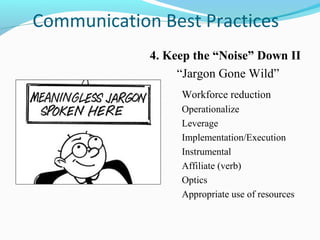
             4. Keep the “Noise” Down II
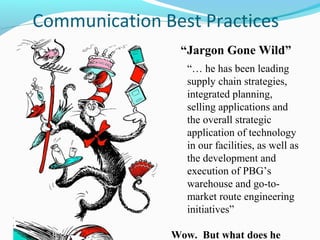
                  “Jargon Gone Wild”
                  Workforce reduction
                  Operationalize
                  Leverage
                  Implementation/Execution
                  Instrumental
                  Affiliate (verb)
                  Optics
                  Appropriate use of resources
Communication Best Practices
                “Jargon Gone Wild”
                  “… he has been leading
                  supply chain strategies,
                  integrated planning,
                  selling applications and
                  the overall strategic
                  application of technology
                  in our facilities, as well as
                  the development and
                  execution of PBG’s
                  warehouse and go-to-
                  market route engineering
                  initiatives”

               Wow. But what does he
Communication Best Practices

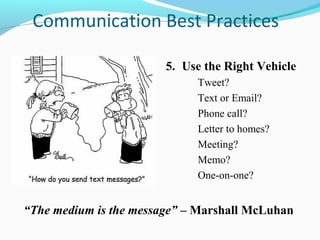
                        5. Use the Right Vehicle
                             Tweet?
                             Text or Email?
                             Phone call?
                             Letter to homes?
                             Meeting?
                             Memo?
                             One-on-one?


“The medium is the message” – Marshall McLuhan
Communication Best Practices
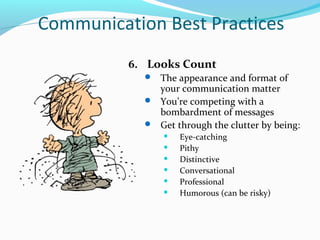
          6. Looks Count
             The appearance and format of
              your communication matter
             You’re competing with a
              bombardment of messages
             Get through the clutter by being:
                   Eye-catching
                   Pithy
                   Distinctive
                   Conversational
                   Professional
                   Humorous (can be risky)
Communication Best Practices
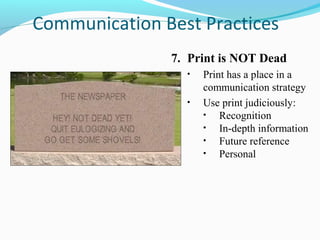
               7. Print is NOT Dead
                 •   Print has a place in a
                     communication strategy
                 •   Use print judiciously:
                     •   Recognition
                     •   In-depth information
                     •   Future reference
                     •   Personal
Communication Best Practices
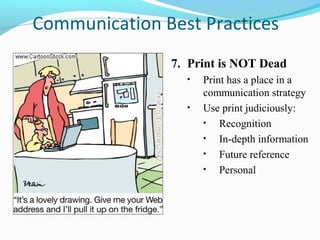
               7. Print is NOT Dead
                 •   Print has a place in a
                     communication strategy
                 •   Use print judiciously:
                     •   Recognition
                     •   In-depth information
                     •   Future reference
                     •   Personal
Communication Best Practices
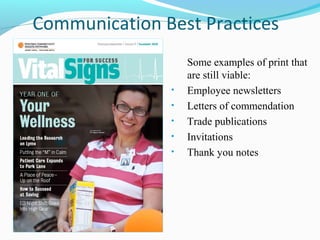
                   Some examples of print that
                   are still viable:
               •   Employee newsletters
               •   Letters of commendation
               •   Trade publications
               •   Invitations
               •   Thank you notes
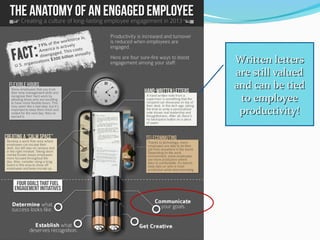
Written letters
are still valued
and can be tied
 to employee
 productivity!
Communication Best Practices
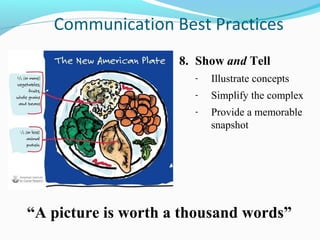
                     8. Show and Tell
                       -   Illustrate concepts
                       -   Simplify the complex
                       -   Provide a memorable
                           snapshot


“A picture is worth a thousand words”
Communication Best Practices


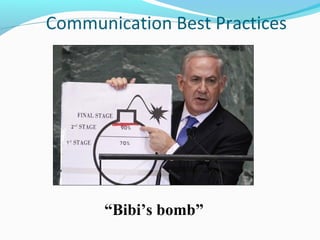
      “Bibi’s bomb”
Communication Best Practices
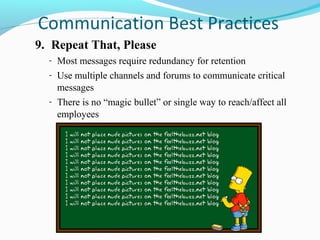
9. Repeat That, Please
  - Most messages require redundancy for retention
  - Use multiple channels and forums to communicate critical
    messages
  - There is no “magic bullet” or single way to reach/affect all
    employees
Communication Best Practices
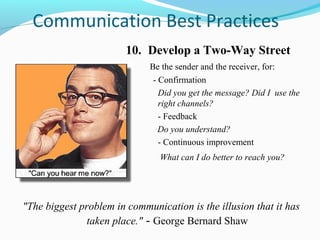
                        10. Develop a Two-Way Street
                             Be the sender and the receiver, for:
                              - Confirmation
                                Did you get the message? Did I use the
                                right channels?
                                - Feedback
                                Do you understand?
                                - Continuous improvement
                                What can I do better to reach you?


"The biggest problem in communication is the illusion that it has
               taken place." - George Bernard Shaw

Communication best practices: West Conn presentation

  • 1.
    Communication Best Practices or… “Everything I know about communication I learned the hard way.” Evelyn Jenkinson Director, Employee Communications Western Connecticut Health Network February 2013
  • 2.
    Communication Best Practices Goodreasons to be a good communicator, regardless of your career choice. Communication skills : Are sought after:  Writing skills  Presentation skills Are critical for leadership Are recognized as part of a manager/leader skill set Improve your chances of employment! Will set you apart!
  • 3.
    Communication Best Practices Classic Communication Model At the receiving end of every organizational communication: •What do you need/want me to do? •What’s in it for me?
  • 4.
    Communication Best Practices 1. Know Your Audience Demographics Management or frontline? Language Areas of expertise Attention span Interests/Needs
  • 5.
  • 6.
    Communication Best Practices 2. No News Is Not Good News  Employees will “fill in the blanks” for themselves  No news causes anxiety; compromises productivity; breeds distrust  Monitor and respond to the grapevine “I heard it through the grapevine” – Marvin Gaye
  • 8.
    Communication Best Practices 3. Keep the “Noise” Down “Noise”: all of the factors that prevent your message from being received and understood. Jargon Verbosity/length Ambiguity (huh?) Frequency/quantity Competition of other messages
  • 9.
    Communication Best Practices 4. Keep the “Noise” Down II “Jargon Gone Wild” Workforce reduction Operationalize Leverage Implementation/Execution Instrumental Affiliate (verb) Optics Appropriate use of resources
  • 10.
    Communication Best Practices “Jargon Gone Wild” “… he has been leading supply chain strategies, integrated planning, selling applications and the overall strategic application of technology in our facilities, as well as the development and execution of PBG’s warehouse and go-to- market route engineering initiatives” Wow. But what does he
  • 11.
    Communication Best Practices 5. Use the Right Vehicle Tweet? Text or Email? Phone call? Letter to homes? Meeting? Memo? One-on-one? “The medium is the message” – Marshall McLuhan
  • 12.
    Communication Best Practices 6. Looks Count  The appearance and format of your communication matter  You’re competing with a bombardment of messages  Get through the clutter by being:  Eye-catching  Pithy  Distinctive  Conversational  Professional  Humorous (can be risky)
  • 13.
  • 14.
  • 15.
  • 16.
  • 17.
  • 18.
    Communication Best Practices 7. Print is NOT Dead • Print has a place in a communication strategy • Use print judiciously: • Recognition • In-depth information • Future reference • Personal
  • 19.
    Communication Best Practices 7. Print is NOT Dead • Print has a place in a communication strategy • Use print judiciously: • Recognition • In-depth information • Future reference • Personal
  • 20.
    Communication Best Practices Some examples of print that are still viable: • Employee newsletters • Letters of commendation • Trade publications • Invitations • Thank you notes
  • 21.
    Written letters are stillvalued and can be tied to employee productivity!
  • 22.
    Communication Best Practices 8. Show and Tell - Illustrate concepts - Simplify the complex - Provide a memorable snapshot “A picture is worth a thousand words”
  • 23.
    Communication Best Practices “Bibi’s bomb”
  • 24.
    Communication Best Practices 9.Repeat That, Please - Most messages require redundancy for retention - Use multiple channels and forums to communicate critical messages - There is no “magic bullet” or single way to reach/affect all employees
  • 25.
    Communication Best Practices 10. Develop a Two-Way Street Be the sender and the receiver, for: - Confirmation Did you get the message? Did I use the right channels? - Feedback Do you understand? - Continuous improvement What can I do better to reach you? "The biggest problem in communication is the illusion that it has taken place." - George Bernard Shaw

Editor's Notes

  • #2 About me: a undergrad degree in English; Masters in Communication I’ve been the Director of Employee Communications for Western Connecticut Health Network for nearly 5 years. Does anyone know what that means? What I actually do? Don’t feel bad – my mother doesn’t know what I do, either. [explain] Before I joined the Health Network, I spent almost 14 years in the Pepsi system in Corporate communications. And before that, probably when many of you were just being born, I worked for an environmental engineering company, doing public relations and employee communications. I’ve always worked in communications, but it has not always been what it is today – particularly employee communications. When I started my career, employee communications was about, “look what we made.” We made newsletters and magazines and flyers and brochures. We planned special events and eventually worked with IT to build intranet sites. Today employee communications is no longer about producing stuff to push out. It’s more about driving the business. Everything we produce answers the question: What are we trying to achieve with this communication? What business result are we after? What measurable outcome? Money is tight; resources stretched – we have to be smart and effective with how we communicate. It’s forced us to be more clever, innovative and creative. That’s why I love it (on most days). I want to share with you today some of the lessons and best practices I’ve learned on this bumpy, evolutionary path. Please feel free to interrupt me at any time with questions.
  • #3 Before I dive into that, I want to digress for just a minute. Because I know most of you will likely not become professional communicators, you might be thinking why are good communication practices very important. There are some very good reasons! A survey of employers a few years ago found that firms consistently ranked communication skills – particularly writing – among the most important skills to possess Another study found that oral communication (public speaking, presentation skills) was one of the top 3 competences needed to succeed in a managerial position (when you think “managerial,” think “more money”). Scholars and practitioners have long known that professional effectiveness and communication competence are absolutely linked! Being a good communicator will be a point of difference for you, and can improve your chances at getting a job – a good job!
  • #4 Before I start in with the best practices in communication – all the do’s and don’ts, let’s have a look at a basic model of communication so we have some common terminology. You’ve probably seen something like this before. (walk through the model) At the receiving end of every organizational communication you have a receiver, in my case employees, asking (consciously or subconsciously): What do you want me to do with this information? And what’s in it for me? A basic human reaction. Truth be told, most of the time in organizational communications, the leadership issuing the communication does want something. We want : your awareness of what’s happening (no action, just “get it”) and why your compliance and cooperation (we’re implementing something, so go along with it, please) a change in your behavior or a process (actively make a change) your participation (show up; get involved; sign up; take the survey) your ambassadorship (promote us; spread the good word to fellow employees or our customers); your loyalty (don’t leave – we just trained you!) HELP US ACHIEVE RESULTS Today, employee communication focused more on business. It’s about rallying employees to help meet goals – and making them WANT TO contribute. So what follows now are 10 of the best ways I know to do that.
  • #5 How your messages are received and reacted to depends greatly on the qualities of your audience – whether that’s a single person in a face-to-face meeting, a group situation or a large audience. Think about the characteristics of your audience – it will help you determine the best way to get your message across. Don’t give employees who speak English as a second language a lot of written material to review. Also, get translated material reviewed by a native speaker. Don’t make employees who are used to moving about all day and interacting sit through a day of meetings and PowerPoint. They will get hostile. Don’t try to teach factory workers about the business by lecturing to them. (use example of board games at Pepsi, using poker chips) [transition to next slide] SO, KNOW YOUR AUDIENCE.
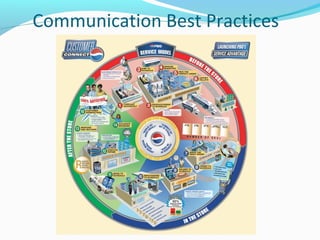
  • #6 Do you want to try to teach truck drivers about the business by lecturing to them? Of course not. (use example of board games at Pepsi, using poker chips) This is actually a board game we developed at Pepsi to teach all employees how all elements of the business affect customer service. It took about 90 minutes to play, and it involved poker chips and cards. And there were prizes – like gift cards. If we had forced these folks to sit through a 90-minute PowerPoint presentation, they would have gone nuts and it might have been scary. This was a much more effective way to teach a group of Teamsters about customer service than a lecture – and a lot safer! And, a questionnaire we issued after the fact told us they did absorb and retain the information. SO, KNOW YOUR AUDIENCE.
  • #7 Examples: Picture this: you’re a Pepsi bottling plant employee hearing rumors that your workplace is closing, and they will be moving some of you, but not all, to another site across the state border. You’ve heard nothing directly from management about this. Hush hush. It’s all rumors. Then, one day you come in and hear the buzz. It seems another employee was driving to work and saw a sign on a plot of land off the highway. It said, “Future site of Pepsi Bottling Group.” So much for still up in the air. The employees had not been told about the new facility , a potential consolidation and how it would affect them. Not good. Reason: BOD had not approved the money yet, but the deal was imminent, and the property owner got excited and posted the sign. I get the call on a Monday morning at 7:30 a.m., “We’ve got a problem.” Now we’re in damage control mode. What ends up happening when people feel distrustful and insecure. They’re not receptive to ways to be more productive, or selling more. They’re frightened and preoccupied. Worst, they lose trust that their management is truthful. Keep communications timely! Don’t let the press or social media deliver the news to your employees. Better to say something “is under consideration,” or “the deal is in the works but we are not permitted to say anything yet, but we’ll be getting back to you when more details are available.” Offer any comforting info that you can “we’re not looking to reduce the workforce”; our first consideration will be our employees, etc… There is always a rumor mill– keep tabs on it. You’ll get to know what’s on people’s minds if you do. Most of the time, people will deal better with uncertain or bad news if it’s honest, rather than no news. It’s easier to be preemptive than do damage control.
  • #8 Trying to fix a communications debacle after the fact is like walking behind the elephant.
  • #9 There is a part of the classic communication model called “noise.” That term is extremely broad. It refers to all the things that compete with you trying to get your message across. Any one of these could be a topic on its own, but I’ll just alert you to the most common forms of noise we all face – which I’m sure you know intuitively. We can’t completely eliminate many of these, but we can definitely reduce them in our own communication. Jargon – I’ll get back to that Verbosity/length – get to the point. Ambiguity: what do you want/need me to do? Don’t leave the message unclear Frequency/quantity: Too much communication diminishes significance. “Not again” syndrome. Reserve the communication for the important stuff. Competing messages: what’s the priority? Which do I entertain first? (example: Danbury Hospital lobby posters – looked like where posters went to die).
  • #10 Jargon can have a positive side: it has a part in creating a company culture – almost like a secret hand-shake. Inevitably, however, jargon becomes a form of noise. The words lose their meaning as they are overused, and they have no impact. Or else people just don’t know what you’re talking about. Or, they know what you’re saying, but you lose credibility because you don’t just come out and say what you mean. Example: transition ownership of, instead of “sell” of Danbury Pharmacy.
  • #11 Here’s one of my favorite examples of jargon gone wild. This is text that is taken from an actual organization notice announcing someone’s promotion. “… he has been leading supply chain strategies, integrated planning, selling applications and the overall strategic application of technology in our facilities, as well as the development and integration of PBG’s warehouse and go-to-market route engineering initiatives”
  • #12 The medium or vehicle you use to communicate carries a message of its own. What you use to communicate may have unintended consequences, creating a message of its own. (example: Phil Collins asking for a divorce via FAX; REALLY? secretary resigning via FAX) Tweet: how serious can this be if it’s 150 characters? Email: casual, less formal, speed more important than form Memo: something to file or save, or tack up on my board? Text: urgent? Directional? Meeting: must be important. We’re all gathering together and taking time out of the day. [What does it say about the values of the meeting leaders?] One-on- one – this must be very important, good or bad. Could be confidential. “See me.” Here’s a cautionary statement: be careful in picking a channel – because it can have unintended consequences. Examples: I had a summer intern once who wanted to sell extra concert tickets for Christina Aguilera’s concert. Without checking with anyone, she sent an email to “Everyone.” The Everyone list, by the way, included the CEO of the company. Who responded back to her, with a copy to me, “I prefer Britney Spears.” Which would you use to announce a policy change? (memo or email) The start of open enrollment and instructions? (mail or email) Alert staff about a big organizational change? Layoffs? BY THE WAY: YOU ARE A MEDIUM – AND I DON’T MEAN A PSYCHIC. HOW YOU DELIVER INFORMATION AND CARRY YOURSELF SAYS SOMETHING IMPORTANT.
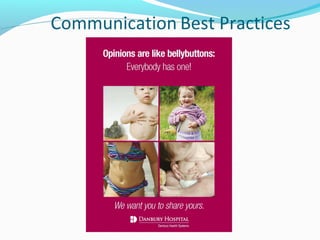
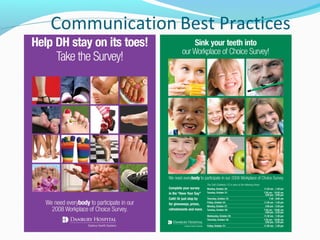
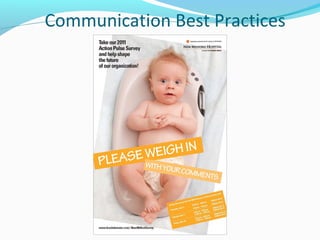
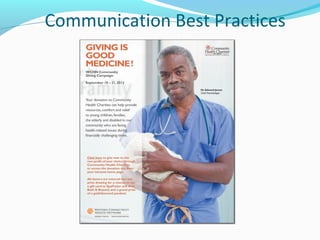
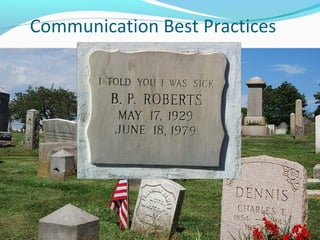
  • #13 Think about what you’re up against in terms of the quantity and kind of information that is communicated to you and your team daily – from both internal and external sources. The point is first to be noticed and ultimately understood. But if no one reads your email message or notices your flyer you’re communication is dead in the water. We’re a visual society – and appearance matters. Grab attention by being cute, funny, or different. Here’s some recent examples. Show examples on following slides
  • #16 Need to be attention-getting Make it harder to ignore of to throw away
  • #17 Need to be attention-getting Make it harder to ignore of to throw away
  • #18 Be different – stand out.
  • #19 Point Number 7: Print is not dead…yet. It still has a place in communication. For years and years I’ve been hearing print communications are going to go away. Pretty soon, we’ll be a paperless office. Has not happened yet. The mix of print and electronic has changed, true, but print has not disappeared. There are subjects and material simply more appropriate for print.
  • #20 How many of you still use or read real, paper books? How many of you read a paper newspaper? Magazines? Send email thank you notes? How many of you would prefer to receive an electronic diploma instead of a hard copy paper one? There is something about the permanence of print, the tangibility that gives it meaning for most people, and a significance that electronic media do not have. DON’T OVERLOOK PRINT.
  • #21 At Western Connecticut Health Network, I produce a quarterly, print newsletter that always features an employee on the cover. And it never fails – the employee ALWAYS wants extra copies – not a pdf file or a jpg. They invariably ask for extra print copies. There is something about the permanence of print, the tangibility that gives it meaning for most people, and a significance that electronic media do not have. DON’T OVERLOOK PRINT. IT’S STILL A RELEVANT PART OF THE MIX.
  • #22 This is an infographic I recently pulled off the internet, created by a big-name consultancy. It provides some ways employers can make their employees more engaged with their work – which means more satisfied, and contributing to the business. Lookey here – Hand-written notes to employees is one of the things referenced. Oh, and look here – communicate your goals is on here, too.
  • #23 People are generally visual by nature. When you have an important idea to convey, it’s always better to show a picture. It’s just more memorable. At the hospital, we’re trying to get our employees to eat healthier. Even though they work in healthcare, it helps if they see what a healthy plate actually looks like. So we started giving our employees a “rate your plate” form. The visual is much more effective than just telling them, hey 1/3 of your plate should be protein.
  • #24 Great example of the impact of visuals: “ The Red Line Speech” by Israeli Prime Minister Benjamin Netanyahu, telling the UN we needed to draw a red line on Iran before that country develops a nuclear weapons program. This very simple visual made more of an impact than the prime minister’s speech. It garnered its own media attention: “ It was a moment that riveted the attention of the world, and sent a firestorm raging across the Internet, even though “Bibi’s Bomb” was really just a simple visual aid for highlighting the importance of stopping Iran’s nuclear ambitions before they can complete the final stage of the uranium enrichment process.  Some thought it was a brilliant use of imagery to capture attention, while other observers criticized Netanyahu for using a cartoon to trivialize an important point… but everyone was talking about it.” - Reuters Powerful words about a cartoon of a bomb. .
  • #25 Examples: Email a NewsFlash; post it on the intranet; include it in TopLine Key messages from Eric: presented in his speeches, repeated in his letters to employees, echoed by his leadership team Some redundancy is necessary – and expected. When people hear key messages again and again, it builds credibility and retention.