The Impact of Feedback on Writing
   Motivation and Achievement


J H ugh es   Se pte mb er 2011
Feedback


What is ‘effective feedback’?
Which types of feedback do students
find the most motivating?
Why this research?

Shirley Clarke, Helen Timperley and
John Hattie, amongst others, have
discussed effective feedback as
having one of the greatest
impacts on student learning
and achievement (Clarke,
Timperley & Hattie, 2001).
So What is Effective
           Feedback?
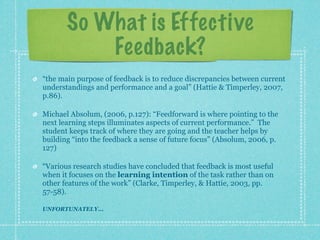
“the main purpose of feedback is to reduce discrepancies between current
understandings and performance and a goal” (Hattie & Timperley, 2007,
p.86).

Michael Absolum, (2006, p.127): “Feedforward is where pointing to the
next learning steps illuminates aspects of current performance.” The
student keeps track of where they are going and the teacher helps by
building “into the feedback a sense of future focus” (Absolum, 2006, p.
127)

“Various research studies have concluded that feedback is most useful
when it focuses on the learning intention of the task rather than on
other features of the work” (Clarke, Timperley, & Hattie, 2003, pp.
57-58).

UNFORTUNATELY...
What happens more often
         is...
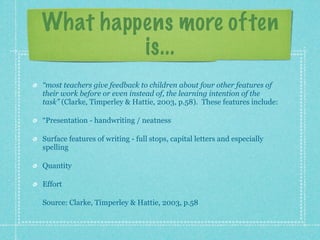
“most teachers give feedback to children about four other features of
their work before or even instead of, the learning intention of the
task” (Clarke, Timperley & Hattie, 2003, p.58). These features include:

“Presentation - handwriting / neatness

Surface features of writing - full stops, capital letters and especially
spelling

Quantity

Effort

Source: Clarke, Timperley & Hattie, 2003, p.58
The 3 Major Questions Effective Feedback
         is Designed to Answer


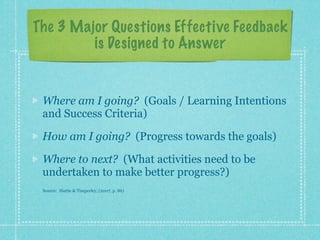
 Where am I going? (Goals / Learning Intentions
 and Success Criteria)

 How am I going? (Progress towards the goals)

 Where to next? (What activities need to be
 undertaken to make better progress?)
 Source: Hattie & Timperley, (2007, p. 86)
4 Types of Feedback


The following 4 types of feedback are those
which researchers such as John Hattie, Shirley
Clarke, Helen Timperley and Michael Absolum
have found are the most common in
classrooms.
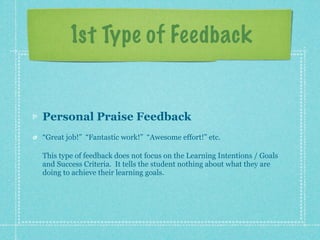
1st Type of Feedback


Personal Praise Feedback
“Great job!” “Fantastic work!” “Awesome effort!” etc.

This type of feedback does not focus on the Learning Intentions / Goals
and Success Criteria. It tells the student nothing about what they are
doing to achieve their learning goals.
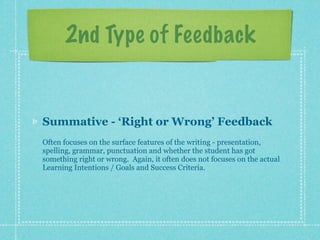
2nd Type of Feedback


Summative - ‘Right or Wrong’ Feedback
Often focuses on the surface features of the writing - presentation,
spelling, grammar, punctuation and whether the student has got
something right or wrong. Again, it often does not focuses on the actual
Learning Intentions / Goals and Success Criteria.
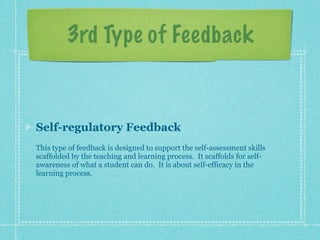
3rd Type of Feedback


Self-regulatory Feedback
This type of feedback is designed to support the self-assessment skills
scaffolded by the teaching and learning process. It scaffolds for self-
awareness of what a student can do. It is about self-efficacy in the
learning process.
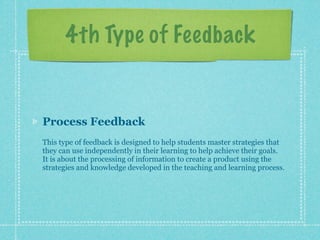
4th Type of Feedback


Process Feedback
This type of feedback is designed to help students master strategies that
they can use independently in their learning to help achieve their goals.
It is about the processing of information to create a product using the
strategies and knowledge developed in the teaching and learning process.
Which Types Are Most
   Effective in Learning?


The literature supports the use of the 3rd and
4th feedback types as the most effective. The
1st and 2nd are the least effective.
When feedback goes bad
So what are some of the traps we can fall into when giving feedback to
our students?

Providing too many areas to work on;

Not focusing on the Learning Intentions/Goals and Success Criteria;

Not being clear in our feedback;

Not providing time for students to reflect on the feedback and make changes in their
learning;

Not knowing enough about what we want the students to learn for us to be able to
provide specific feedback related to the LIs / SCs;

Talking too much - the learner loses track of what we are trying to help them with;
Rewarding performance instead of the learning - the praise factor - without being
specific about whether the LIs / SCs have been achieved;

Providing evaluative comments only - e.g. “That was an awesome piece of writing!”

Summative scores - “Don’t do it. It’s anti-learning. If it is school policy, change the
school policy” (Absolum, 2006, p. 137).

Repeating the same strategies - if they aren’t working, you need to help the student
find / learn a new one that does.

Providing prompts that don’t relate to what they are learning / wanting to achieve.

Asking questions that are not going to foster / support learning. Absolum (2006)
gives some great examples of these types of questions. Teachers often ask many
questions that are not designed to foster higher order thinking.

Source: Clarity in the Classroom: Building Learning-Focused Relationships - Michael Absolum (2006, pp.
135-139)
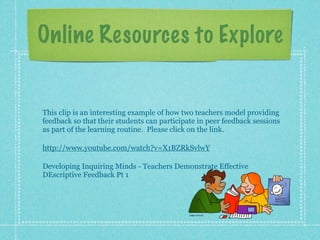
Online Resources to Explore


This clip is an interesting example of how two teachers model providing
feedback so that their students can participate in peer feedback sessions
as part of the learning routine. Please click on the link.

http://www.youtube.com/watch?v=X1BZRkSvlwY

Developing Inquiring Minds - Teachers Demonstrate Effective
DEscriptive Feedback Pt 1
TKI Resources


Principles of Assessment - on Te Kete Ipurangi
(TKI)

http://assessment.tki.org.nz/Assessment-in-the-
classroom/Assessment-for-learning/Principles-
of-assessment#3
Teacher Moderation
 Mentoring the Learning

This is another useful tool to help reflect on the
types of feedback we provide and how we provide
it.

http://www.youtube.com/watch?
v=llwSwHqZCNU&feature=results_video&playn
ext=1&list=PLCB718B345BE1E309

Effective Feedback

  • 1.
    The Impact ofFeedback on Writing Motivation and Achievement J H ugh es Se pte mb er 2011
  • 2.
    Feedback What is ‘effectivefeedback’? Which types of feedback do students find the most motivating?
  • 3.
    Why this research? ShirleyClarke, Helen Timperley and John Hattie, amongst others, have discussed effective feedback as having one of the greatest impacts on student learning and achievement (Clarke, Timperley & Hattie, 2001).
  • 4.
    So What isEffective Feedback? “the main purpose of feedback is to reduce discrepancies between current understandings and performance and a goal” (Hattie & Timperley, 2007, p.86). Michael Absolum, (2006, p.127): “Feedforward is where pointing to the next learning steps illuminates aspects of current performance.” The student keeps track of where they are going and the teacher helps by building “into the feedback a sense of future focus” (Absolum, 2006, p. 127) “Various research studies have concluded that feedback is most useful when it focuses on the learning intention of the task rather than on other features of the work” (Clarke, Timperley, & Hattie, 2003, pp. 57-58). UNFORTUNATELY...
  • 5.
    What happens moreoften is... “most teachers give feedback to children about four other features of their work before or even instead of, the learning intention of the task” (Clarke, Timperley & Hattie, 2003, p.58). These features include: “Presentation - handwriting / neatness Surface features of writing - full stops, capital letters and especially spelling Quantity Effort Source: Clarke, Timperley & Hattie, 2003, p.58
  • 6.
    The 3 MajorQuestions Effective Feedback is Designed to Answer Where am I going? (Goals / Learning Intentions and Success Criteria) How am I going? (Progress towards the goals) Where to next? (What activities need to be undertaken to make better progress?) Source: Hattie & Timperley, (2007, p. 86)
  • 7.
    4 Types ofFeedback The following 4 types of feedback are those which researchers such as John Hattie, Shirley Clarke, Helen Timperley and Michael Absolum have found are the most common in classrooms.
  • 8.
    1st Type ofFeedback Personal Praise Feedback “Great job!” “Fantastic work!” “Awesome effort!” etc. This type of feedback does not focus on the Learning Intentions / Goals and Success Criteria. It tells the student nothing about what they are doing to achieve their learning goals.
  • 9.
    2nd Type ofFeedback Summative - ‘Right or Wrong’ Feedback Often focuses on the surface features of the writing - presentation, spelling, grammar, punctuation and whether the student has got something right or wrong. Again, it often does not focuses on the actual Learning Intentions / Goals and Success Criteria.
  • 10.
    3rd Type ofFeedback Self-regulatory Feedback This type of feedback is designed to support the self-assessment skills scaffolded by the teaching and learning process. It scaffolds for self- awareness of what a student can do. It is about self-efficacy in the learning process.
  • 11.
    4th Type ofFeedback Process Feedback This type of feedback is designed to help students master strategies that they can use independently in their learning to help achieve their goals. It is about the processing of information to create a product using the strategies and knowledge developed in the teaching and learning process.
  • 12.
    Which Types AreMost Effective in Learning? The literature supports the use of the 3rd and 4th feedback types as the most effective. The 1st and 2nd are the least effective.
  • 13.
    When feedback goesbad So what are some of the traps we can fall into when giving feedback to our students? Providing too many areas to work on; Not focusing on the Learning Intentions/Goals and Success Criteria; Not being clear in our feedback; Not providing time for students to reflect on the feedback and make changes in their learning; Not knowing enough about what we want the students to learn for us to be able to provide specific feedback related to the LIs / SCs; Talking too much - the learner loses track of what we are trying to help them with;
  • 14.
    Rewarding performance insteadof the learning - the praise factor - without being specific about whether the LIs / SCs have been achieved; Providing evaluative comments only - e.g. “That was an awesome piece of writing!” Summative scores - “Don’t do it. It’s anti-learning. If it is school policy, change the school policy” (Absolum, 2006, p. 137). Repeating the same strategies - if they aren’t working, you need to help the student find / learn a new one that does. Providing prompts that don’t relate to what they are learning / wanting to achieve. Asking questions that are not going to foster / support learning. Absolum (2006) gives some great examples of these types of questions. Teachers often ask many questions that are not designed to foster higher order thinking. Source: Clarity in the Classroom: Building Learning-Focused Relationships - Michael Absolum (2006, pp. 135-139)
  • 15.
    Online Resources toExplore This clip is an interesting example of how two teachers model providing feedback so that their students can participate in peer feedback sessions as part of the learning routine. Please click on the link. http://www.youtube.com/watch?v=X1BZRkSvlwY Developing Inquiring Minds - Teachers Demonstrate Effective DEscriptive Feedback Pt 1
  • 16.
    TKI Resources Principles ofAssessment - on Te Kete Ipurangi (TKI) http://assessment.tki.org.nz/Assessment-in-the- classroom/Assessment-for-learning/Principles- of-assessment#3
  • 17.
    Teacher Moderation Mentoringthe Learning This is another useful tool to help reflect on the types of feedback we provide and how we provide it. http://www.youtube.com/watch? v=llwSwHqZCNU&feature=results_video&playn ext=1&list=PLCB718B345BE1E309